

What if the most stressful part of building your home wasn’t the weather or the council approvals, but the fear that your bank account might run dry before the roof goes on? For many families, the excitement of a new build is often overshadowed by the complex reality of construction loans nsw. You’ve likely heard stories of delayed progress payments or felt overwhelmed by the mountain of documentation lenders demand before a single brick is laid. It’s completely natural to feel protective of your investment and wary of the financial hurdles ahead.
We believe that financing your dream shouldn’t feel like a second job. This guide provides the clarity you need to manage your build with confidence, ensuring you understand exactly how progressive drawdowns work and how to handle the Building (Approvals and Practitioners) Act 2026. We’ll walk you through a structured plan for your finances, from securing a fixed-price contract to finding a lender that truly understands the local market. By the end of this article, you’ll have a steady hand guiding you toward your completion approval without the typical stress of the construction journey.
Key Takeaways
- Understand how construction loans nsw differ from standard mortgages by releasing funds in five distinct stages as your builder reaches specific milestones.
- Learn how to maintain steady cash flow during the build using interest-only repayments and strategic offset accounts to reduce your overall costs.
- Discover the essential documentation required for approval, including the necessity of a fixed-price building contract from a licensed NSW professional.
- Identify the 2026 NSW government assistance schemes and grant thresholds that can help lower the financial barrier to starting your build.
- Find out how an expert broker manages the heavy lifting of progress payments and gives you access to a panel of over 36 specialist lenders.
What is a Construction Loan and Why is it Different in NSW?
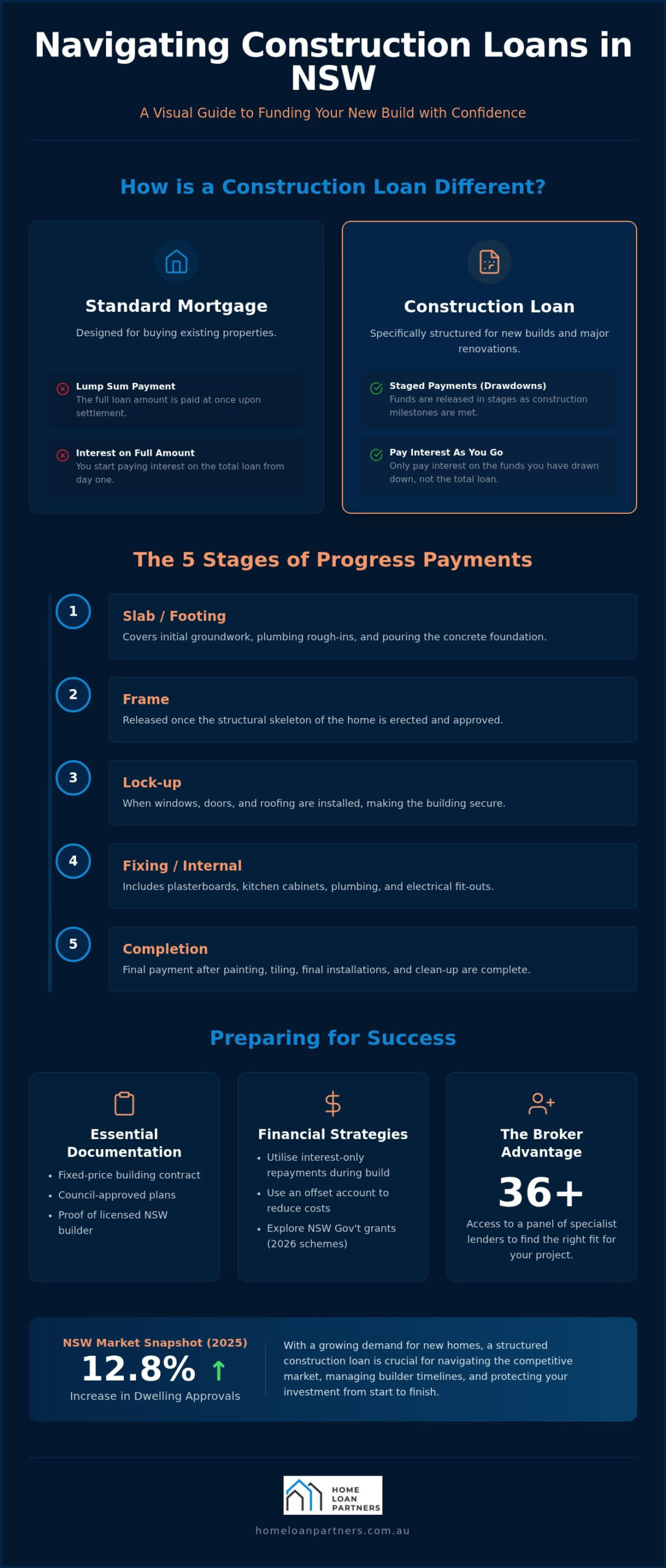
A construction loan is a flexible credit facility that aligns with a builder’s schedule. While it might look like a standard mortgage on the surface, its internal structure is specifically designed for the unique demands of building a new home or undertaking major structural renovations. Unlike a traditional loan where you receive the full sum of money at settlement, construction loans nsw release funds in increments. This ensures that your financial resources are protected and only disbursed once specific milestones are met during the real estate development process.
Managing the high land costs and strict builder contract requirements in the 2026 market requires a steady hand. With dwelling approvals increasing by 12.8% in 2025, the pressure on the local building industry has intensified. A staged payment structure gives you the leverage you need to ensure work is completed to a high standard before your capital is committed. It’s a supportive framework that keeps your project moving forward while protecting your future security.
Standard Mortgages vs. Construction Loans
You generally can’t use a standard mortgage for a new build because lenders won’t provide a lump sum for a property that doesn’t yet exist. Instead, they use an ‘as-if-complete’ valuation. This process estimates what the home will be worth once the final brick is laid, which determines your total borrowing power. The core advantage is the progressive drawdown. You don’t pay interest on the full loan amount from day one. You only pay for what you’ve actually spent at each stage of the build, which keeps your cash flow predictable and manageable during the construction phase.
When to Consider a Construction Loan in NSW
Determining if this is the right path for you depends on the scope of your project. Construction loans nsw are the industry standard for several common scenarios:
- New builds on vacant land: This includes house and land packages where the loan covers both the land purchase and the build.
- Knock-down-rebuild projects: If you love your current location but your house no longer fits your needs, this loan manages the demolition and the new construction.
- Major structural renovations: These are projects that require council approval and significant changes to the home’s footprint or integrity.
By choosing a specialized construction product, you’re partnering with a lender that understands the rhythm of building. It’s about more than just money; it’s about having a financial structure that respects the complexity of your journey.
The Progressive Drawdown: How Funding Works During Your Build
The progressive drawdown is the heartbeat of construction loans nsw. It’s a structured mechanism that ensures your money is spent wisely and only when the work is actually done. One of the most reassuring features of this arrangement is that you only pay interest on the amount actually drawn down, not the total loan limit. This keeps your monthly repayments significantly lower during the build phase, allowing you to manage your current living expenses while your new home takes shape. It’s a protective measure that provides peace of mind throughout the journey.
Lenders typically divide the process into five distinct stages to manage risk and maintain transparency. At each milestone, your builder will issue an invoice, and the lender will often conduct an independent inspection to verify the progress before releasing funds. This collaborative approach protects both you and the bank from paying for incomplete or substandard work. According to recent Australian Bureau of Statistics lending data, commitments for new dwelling construction continue to be a cornerstone of the property market, highlighting how essential these structured products are for local growth.
The Five Stages of Progress Payments
- Slab/Footing: This payment covers the initial groundwork, plumbing rough-ins, and the pouring of the concrete foundation.
- Frame: Once the structural skeleton of the home is erected and approved, the second payment is released to the builder.
- Lock-up: This stage is reached when the windows, doors, and roofing are installed, making the building weather-tight and secure.
- Fixing/Internal: This covers the internal “skin” of the house, including plastering, cabinetry, and essential plumbing fixtures.
- Completion: The final stage involves the last touches and the issuance of a completion approval under the 2026 regulations.
Transitioning to a Permanent Loan
Many borrowers worry about what happens once the keys are in hand. This is the transition phase, where your construction facility evolves into a permanent mortgage. Once the final drawdown is complete and the property is fully valued as a finished asset, your loan typically switches from interest-only to principal and interest repayments. It’s an ideal time to review your rate and ensure your loan features are fully optimized for your long-term goals. If you’re feeling unsure about how your specific timeline will unfold, talking to construction loan specialists can provide the steady hand you need.
Navigating the Application: Documentation and Eligibility Requirements
The application process for construction loans nsw is naturally more detailed than a standard mortgage. Lenders view these arrangements as higher risk because the primary security, your finished home, doesn’t exist yet. This extra scrutiny isn’t meant to be a hurdle. Instead, it’s a protective measure designed to ensure your project is financially viable and your builder is fully compliant with local regulations. By preparing your paperwork early, you can move through this phase with a sense of calm and control.
A non-negotiable requirement for most lenders is a fixed-price building contract. This document provides a safeguard against price hikes during the construction journey, ensuring your budget remains intact from the first day of work. Under the Building (Approvals and Practitioners) Act 2026, it’s also vital to ensure your documentation uses current terminology. For example, what were previously known as construction certificates are now referred to as building approvals. Aligning your application with these latest standards demonstrates a high level of preparation and professionalism to your chosen lender.
The Essential Documentation Checklist
To secure a formal approval, you’ll need to gather a specific set of documents that prove the project’s feasibility. Your lender will require a signed fixed-price building contract that includes a clear schedule of progress payments. You also need to provide council-approved plans and detailed specifications for the build. Beyond the project itself, you’ll need to demonstrate the builder’s credentials, including their NSW license and current insurance policies, such as Public Liability and Home Building Compensation Cover. Standard proof of income and financial statements remain a core part of the package.
LVR and Your Borrowing Power in 2026
Your borrowing power is determined by an ‘on-completion’ valuation. Lenders look at the current value of your land and add the total cost of the building contract to estimate the property’s future worth. Managing your Loan-to-Value Ratio (LVR) is crucial here. If you can provide a 20% deposit, you’ll likely avoid the additional cost of Lenders Mortgage Insurance (LMI). If you already own the land, the equity you’ve built up can often serve as your deposit for the construction phase. This strategy is a powerful way to leverage your existing assets to fund your new build without needing a large cash reserve. Our role as your expert collaborator is to help you package these complex details so lenders see the true value of your vision.
Financial Strategies: NSW Grants, Offsets, and ROI
Success in building your own home often depends on how well you leverage the financial tools available to you. In the 2026 market, construction loans nsw are more than just a way to pay the builder; they’re a strategic foundation for your long-term wealth. By aligning your borrowing with state-based incentives and smart account structures, you can protect your cash flow and maximize your return on investment. If you’re just starting out, our guide on How Do I Buy a House in Australia? provides the essential context for your property journey.
Strategic land tax considerations are also vital for those planning a knock-down-rebuild. In NSW, you may be eligible for exemptions while the property is uninhabitable during construction, provided it’s intended to be your primary residence. These small administrative wins add up, contributing to a smoother and more cost-effective build. We act as your steady hand, ensuring no stone is left unturned when it comes to your financial security.
NSW First Home Buyer Incentives for 2026
Eligible first home buyers in NSW can access a $10,000 grant when purchasing or building a new home. For those opting for a house and land package, the combined value of the land and building contract must not exceed $750,000 to qualify. These funds are incredibly valuable because they can often be used to bolster your construction deposit, potentially helping you stay below the 80% LVR threshold. You should also explore current stamp duty exemptions or concessions, which significantly lower your upfront costs. These savings act as a vital financial buffer, giving you more breathing room as you navigate the complexities of a new build.
Using Offset Accounts During the Construction Phase
An offset account is one of the most powerful tools you can pair with your construction finance. Because you only pay interest on the amount actually drawn down, keeping your savings in a linked offset account effectively reduces that balance even further. It’s almost always better to keep your cash in an offset rather than paying the builder ahead of schedule. This strategy ensures your money stays in your hands for as long as possible while simultaneously lowering your monthly interest costs. To see how these savings might impact your specific budget, you can use our Home Loan Calculator Guide to model different scenarios. If you want to ensure your financial strategy is fully optimized for the current market, reach out to our expert team for a personalized assessment.
Why Partnering with a Broker Simplifies Your Construction Journey
Building a home is a marathon that tests your patience as much as your budget. It’s a journey filled with significant milestones and, occasionally, unexpected hurdles that require a calm, expert perspective to navigate. Partnering with a broker means you’re not just getting a loan; you’re gaining a dedicated collaborator who manages the heavy lifting of the financial process. Because our service is lender-paid, you receive professional advice at no cost to you, ensuring your financial interests remain the priority from the first site visit to the final inspection.
Our role is to act as the steady hand that connects your aspirations with the right financial structure. We understand the emotional weight of these investments and work proactively to alleviate the stress of managing builder invoices and lender requirements. By translating complex industry jargon into practical steps, we ensure you feel supported and informed throughout the entire construction loans nsw process. This partnership allows you to focus on the design and progress of your new home while we handle the intricate details of the funding.
Accessing a Wider Panel of Lenders
Not every bank has an appetite for the complexities of a new build. Some lenders can be ‘construction-shy’, imposing overly strict conditions that can stall your project before it begins. We provide access to a panel of over 36 lenders, including niche providers who offer more flexible drawdown schedules and competitive interest rates. This variety is crucial for finding a lender that aligns with your specific builder’s contract and your long-term financial goals. We help you compare options that keep your repayments manageable, ensuring your rate doesn’t just look good on paper but performs well throughout the build.
A Steady Hand from Slab to Settlement
The administrative burden of coordinating progress payments is often the most stressful part of the build for many families. We simplify this by acting as the central point of contact between you, your builder, and the bank. When build timelines shift due to weather or material delays, we provide the expert perspective needed to keep your finance structure intact. If your journey involves selling your current residence while the new one is under construction, we can also guide you through the strategic benefits of Bridging Finance in Australia. Our commitment doesn’t end when the loan is approved; we stay by your side until the final completion approval is issued and you’re ready to move in.
Building Your Future with Confidence
You now have the roadmap for navigating the progressive drawdown process and the latest 2026 building regulations. By understanding how to leverage offset accounts and NSW-specific grants, you’ve taken the first step toward a more secure and cost-effective build. Managing construction loans nsw doesn’t have to be a solo effort that keeps you up at night. It’s a journey that deserves a steady hand and professional oversight.
We’re here to act as your expert collaborator throughout the entire process. Our team provides specialised NSW construction finance expertise and access to a panel of over 36 Australian lenders, ensuring you find a policy that fits your builder’s unique schedule. Because our service model is lender-paid, you receive expert mortgage guidance at no cost to you. Your dream home is closer than you think, and we’re ready to help you lay the first stone with precision and care.
Start your construction journey with a stress-free expert consultation
Frequently Asked Questions
Can I get a construction loan if I am an owner-builder in NSW?
Yes, but it is significantly more challenging than a standard build. Most major lenders require a fixed-price contract with a licensed builder to mitigate their risk. Owner-builders often face lower Loan-to-Value Ratios and stricter documentation requirements regarding their project management experience. We can help you identify specialist lenders who are comfortable with the owner-builder path and understand the unique risks involved in managing your own site.
How long does it typically take for a lender to approve a progress payment?
Most lenders typically approve progress payments within three to five business days after receiving a valid builder’s invoice and any required inspection reports. This timeline ensures your builder remains motivated and the project stays on schedule. We recommend submitting your paperwork as soon as a stage is completed to avoid any unnecessary delays. Our team often helps manage this communication to ensure a smooth transition between construction phases.
Do I need to pay a deposit to my builder before the loan is approved?
You usually pay a small preliminary deposit to your builder for plans and council approvals before the loan is fully approved. However, the main construction deposit is typically the first stage of your progressive drawdown. It’s important not to pay large sums out of pocket before your finance is secured. We can review your contract to ensure the payment schedule aligns with lender requirements and protects your initial capital investment.
What happens if the construction costs increase after the loan is settled?
If costs increase due to variations or unforeseen circumstances, you are generally responsible for covering the gap from your own funds. This is why a fixed-price building contract is so critical for construction loans nsw. If the increase is substantial, you might need to apply for a loan top-up, which involves a new valuation and credit assessment. We always suggest keeping a small contingency fund to handle these minor adjustments without stressing your project.
Is it possible to use a bridging loan alongside a construction loan?
Yes, it is entirely possible and often strategic to use a bridging loan alongside a construction loan. This arrangement allows you to stay in your current home while your new one is being built, avoiding the stress of double moves or expensive short-term rentals. This is a complex structure that requires a steady hand to manage correctly. We specialize in these arrangements, ensuring your debt is managed safely across both properties until the build is complete.
Can I link an offset account to my construction loan during the build?
Many lenders allow you to link an offset account to your construction loan, which is a powerful way to reduce interest costs. Because you only pay interest on the amount actually drawn down, any savings in your offset account further reduce that interest-bearing balance. This keeps your cash flow steady and ensures your money is working for you throughout the construction journey. We can help you find lenders that offer this specific feature for new builds.
What is the maximum LVR for a construction loan in NSW in 2026?
In 2026, the maximum Loan-to-Value Ratio (LVR) for construction loans nsw typically reaches 95% of the on-completion value, provided you pay Lenders Mortgage Insurance. If you want to avoid this extra cost, you generally need a 20% deposit to keep your LVR at 80%. These limits can vary based on the specific lender and the nature of your project. We work with you to determine the most cost-effective deposit level for your financial situation.
What happens if my builder goes into liquidation during the project?
If your builder goes into liquidation, your Home Building Compensation Cover is the primary safety net. This insurance is a mandatory requirement for residential work in NSW over $20,000 and protects you against incomplete or defective work. You would typically need to find a new licensed builder to take over the contract. We act as a steady guide during these rare but stressful events, helping you communicate with your lender to restructure the remaining progress payments.