

The lowest interest rate you’re offered might actually be the most expensive way to fund your build. While a quick personal loan seems simple, it often lacks the flexibility and lower cost structure needed for a major project. We understand that rising construction costs and the fear of overcapitalising in a shifting property market can make the journey feel daunting. Finding the right renovation loans nsw can mean the difference between a stressful build and a smooth, value-adding transformation of your home.
You deserve a financial structure that works as hard as you do. We’re here to help you discover the most cost-effective ways to finance your NSW home renovation, from unlocking existing equity to utilising specialised construction loans. By choosing a path that allows for progress payments, you keep your cash flow steady and your interest costs down. Our guide explores how to navigate the 2026 Building Approvals process and compare lenders to find a solution that offers long-term security. We’ll walk through the differences between top-ups and construction finance, providing you with a clear, expert-guided plan to fund your build with confidence.
Key Takeaways
- Learn how to differentiate between simple home loan top-ups and complex construction finance to ensure your project stays on budget.
- Discover how to secure the most cost-effective renovation loans nsw by matching your financing strategy to the specific scale of your build.
- Understand the impact of the 2026 Building Approvals process on your loan application and how to align your funding with NSW regulatory requirements.
- Identify the critical “decision matrix” that helps you choose between using existing equity or specialized progress payment structures.
- Find out how partnering with an expert broker provides access to over 36 lenders, helping you translate complex financial jargon into a clear path forward.
Understanding Renovation Loans in the NSW Property Market
Think of renovation loans nsw as a financial toolkit rather than a single product. It’s an umbrella term covering everything from simple home loan top-ups to complex construction finance. Choosing the right one depends on your project’s scope, your current equity, and your long-term goals. We see our role as your expert collaborator, helping you navigate these choices so you can build with confidence and clarity.
Why NSW Homeowners are Upgrading in 2026
The decision to renovate rather than relocate is a defining trend for NSW residents in 2026. The high costs associated with selling and buying, such as agent commissions and significant stamp duty, often outweigh the cost of a high-quality extension. By staying in your current home, you maintain your connection to local communities and school zones. You’re also investing directly into an asset you already own. Strategic structural improvements don’t just make life more comfortable; they proactively build wealth by increasing your property’s market appeal. With the recent passage of the Building (Approvals and Practitioners) Bill 2026, the process for modern construction methods is becoming more streamlined, making it an ideal time to upgrade.
Equity: The Engine of Your Renovation Finance
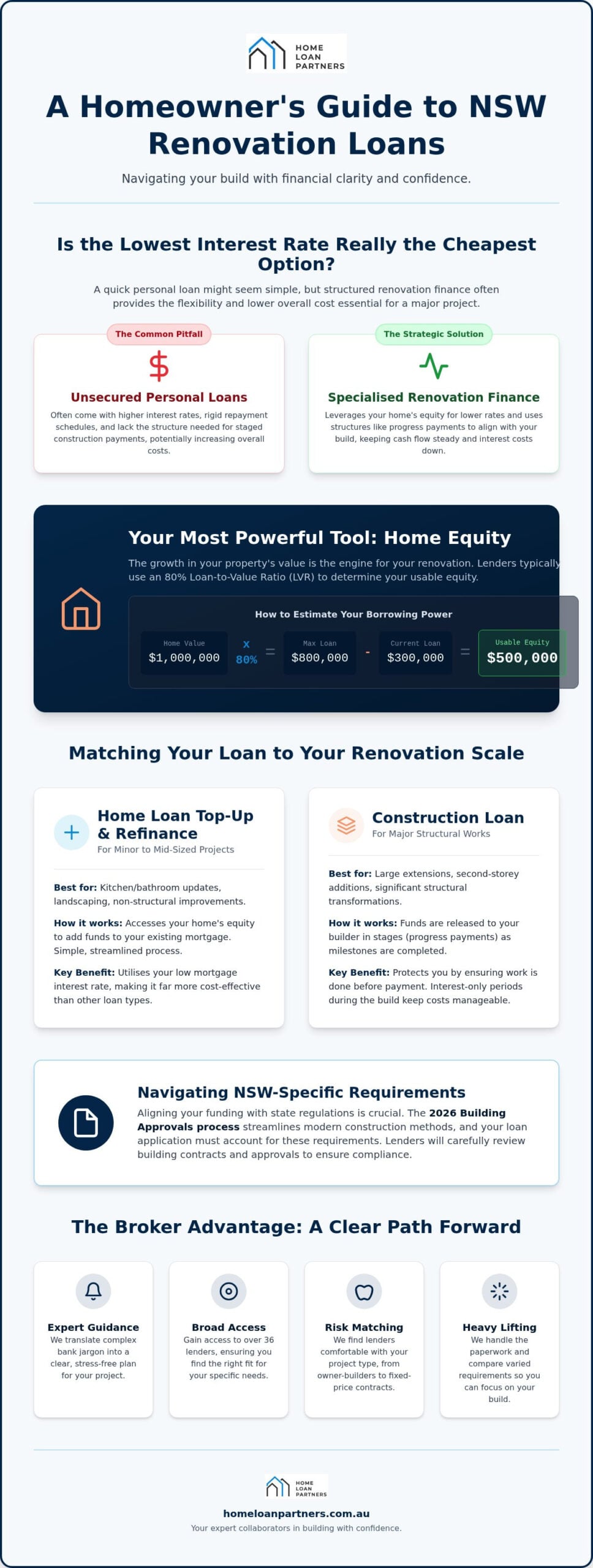
Your property’s growth is the most powerful tool in your renovation arsenal. Most lenders operate on an 80% Loan-to-Value Ratio (LVR) rule, which determines your usable equity. Essentially, this is the gap between 80% of your home’s current value and your remaining mortgage balance. Utilizing a home equity loan or a top-up often allows you to access much lower interest rates than a standard unsecured personal loan. It’s a steady way to fund significant changes without the high pressure of short-term debt. Before you start your build, you can estimate your borrowing power by following these steps:
- Research recent comparable sales in your specific street or suburb to find a realistic market value.
- Calculate 80% of that estimated property value to find your maximum lending limit.
- Subtract your current loan balance from that figure to see what’s available for your project.
Navigating the policies of 36+ lenders requires precision and patience. Every bank has a different appetite for risk. Some are comfortable with owner-builder projects, while others require a fixed-price contract with a licensed professional. We handle the heavy lifting by comparing these varied requirements for you. Our goal is to translate complex bank jargon into a clear, stress-free path forward, ensuring your loan structure supports your project from the first slab to the final completion approval.
Four Ways to Finance Your NSW Home Renovation
Selecting the right path for renovation loans nsw isn’t just about finding the lowest interest rate; it’s about matching the financial structure to the scale of your vision. Every project is unique. A minor kitchen update requires a different approach than a full structural extension. Our role is to act as your expert collaborator, identifying which of our 36+ lenders offers the specific flexibility your project demands. We focus on creating a stress-free experience by managing the heavy lifting, ensuring your funding is ready when your builder is.
1. Refinancing and Topping Up Your Mortgage
For many homeowners, their existing property is the most efficient tool for funding. A home loan refinance allows you to restructure your current debt to release cash for your build. This process can also help improve your monthly cash flow by consolidating other high-interest debts into a single, manageable payment. A mortgage top-up keeps your interest rate aligned with your main home loan, which is typically much more cost-effective than taking out a separate personal loan for a mid-sized project. It’s a steady, logical way to use the wealth you’ve already built in your home.
2. Construction Loans for Major Structural Works
If you’re planning a significant transformation, a construction loan is often the most secure choice. These loans use a progress payment system, where the bank pays your builder in stages as specific milestones are reached. This structure protects you by ensuring work is completed before funds are released. During the construction phase, most lenders offer interest-only periods, which helps keep your costs down while you might be paying for alternative accommodation. To secure this finance, lenders will carefully review your NSW home building contract requirements to ensure the project is fully costed and legally compliant.
3. Using Redraw or Offset Accounts
If you’ve been diligently saving, your redraw facility or offset account can provide immediate access to funds without the need for a new loan application. Redraw allows you to pull back extra repayments you’ve made, while an offset account lets you spend savings directly on materials or trades. You can use our home loan calculator to see how using these funds might change your long-term repayment schedule. While using your own money avoids additional interest, it does reduce your liquid safety net. We often help clients find a balance between using savings and modest borrowing to maintain financial security.
For smaller, cosmetic updates under $30,000, a simple personal loan can sometimes be the quickest route, though the interest costs are higher. Our collaborative approach ensures we look at the big picture of your financial health, not just the immediate transaction. If you’re ready to map out your journey, speaking with a specialist can help you decide which of these four paths aligns best with your 2026 renovation goals.
Matching Your Loan to Your Renovation Scale
Finding the right renovation loans nsw starts with an honest look at your project’s blueprint. A common mistake is using a one-size-fits-all approach to funding. If you’re simply painting and replacing cabinetry, a large-scale construction loan is likely overkill. Conversely, trying to fund a $200,000 extension through multiple personal loans can lead to high interest costs and a fragmented financial structure. We use a “Cosmetic vs. Structural” decision matrix to help you identify the most efficient path forward. This approach ensures your debt level remains sustainable while protecting you from the risk of overcapitalisation in your specific NSW suburb. We always recommend a professional valuation before and after the build to ensure your investment translates into real market value.
Cosmetic Refreshes (Budgets under $50,000)
These projects usually include kitchen facelifts, bathroom tiling, or new landscaping. For these smaller budgets, speed is often the priority. You might choose a high-feature credit card for the reward points or an unsecured personal loan for its rapid approval time. While these offer immediate access to funds, they carry higher interest rates than mortgage-based finance. We help you weigh the convenience of a fast approval against the long-term cost of interest to ensure the refresh doesn’t become a financial burden. Choosing between these paths is where expert guidance becomes vital; we compare the policies of over 36 lenders to find renovation loans nsw that provide the specific redraw or progress payment features your project scale requires.
Structural Overhauls (Budgets over $50,000)
When you’re adding a second storey or extending the footprint of your home, the complexity increases. These major works require council-approved plans and a formal construction loan structure. Lenders will typically require an “as-if-complete” valuation. An “as-if-complete” valuation is a lender’s estimation of your property’s total market value after all planned renovations are successfully finished. This valuation allows you to borrow against the future value of the property rather than just its current state. It’s a proactive way to secure the necessary funds while keeping your interest rates as low as possible. By using this forward-looking assessment, you can often unlock more borrowing power than you currently have in existing equity.
NSW-Specific Requirements for Renovation Lending
NSW has some of the most rigorous building standards in Australia. Getting renovation loans nsw approved means more than just having a healthy deposit; it requires a precise alignment between your financial structure and state-based planning laws. We act as your steady guide through this complex landscape. Our team ensures your paperwork meets the exact standards of our 36+ lenders, preventing the common delays that can stall a project before the first hammer is even swung.
DA vs. CDC: How Approvals Impact Your Finance
The path your project takes through the planning system directly dictates when your funds become available. A traditional Development Application (DA) through your local council is often necessary for bespoke or complex designs. Alternatively, a Complying Development Certificate (Certificate (CDC) can offer a faster route via a private certifier if your project meets specific state criteria. Lenders are incredibly strict about this stage. They won’t release the first progress payment to your builder without a stamped approval. With the passage of the Building (Approvals and Practitioners) Bill in August 2026, the terminology has shifted. Lenders now look for “Building Approvals” rather than the older “Construction Certificates.” We help you understand these changes so your funding stays on track with 2026 regulatory timelines.
NSW Builder Licensing and Insurance
Your builder’s credentials are just as vital as your own financial standing. We always recommend verifying a builder’s license through the Service NSW public register to ensure it’s current and appropriate for the work being done. For any residential project in NSW valued over $20,000, Home Building Compensation (HBC) cover is a legal necessity. This insurance is a non-negotiable requirement for lenders. It protects you if your builder is unable to complete the project due to insolvency or other specified reasons. We check that your builder’s certificates are in order before submitting your loan application, providing an extra layer of protection for your investment. A fixed-price contract that clearly outlines these insurance details is the gold standard for a stress-free approval.
Managing the specific documentation NSW lenders demand can feel like a full-time job. From stamped plans to HBC certificates and the new Completion Approvals, the list is extensive. We take care of the heavy lifting by coordinating with your builder and the bank to ensure every box is ticked. If you’re unsure if your documentation is ready for a bank’s review, our expert team can assess your plans and help you prepare a submission that stands out to the right lender.
The Broker Advantage: Finding the Right NSW Renovation Loan
When you walk into a local bank branch, their staff are restricted to a single menu of products. This constraint can be a major hurdle for something as nuanced as renovation loans nsw. We offer a different experience. As your expert collaborator, we look across a panel of over 36 lenders to find the one that fits your project’s unique footprint. This isn’t just about a transaction. It’s about a partnership that supports your financial security as your home and life milestones evolve. We prioritize your understanding above all else, distilling complex financial arrangements into manageable, punchy steps.
Navigating 36+ Lenders for One Result
Every lender has a different appetite for risk, and these preferences shift frequently. Some are comfortable with owner-builder projects, while others strictly require a registered builder with a fixed-price contract. We identify which lenders have the most generous equity release policies for the 2026 market. This unbiased perspective is vital. We translate technical bank jargon into practical, everyday language so you can make decisions with total clarity. By managing the heavy lifting, we ensure your loan structure doesn’t just fund the build, but protects your long-term wealth. Our panel includes:
- Major banks with competitive top-up features.
- Specialist lenders who understand the nuances of NSW structural extensions.
- Non-bank lenders offering flexible progress payment schedules.
A Stress-Free Path to Your Dream Home
The application process for construction finance is notoriously document-heavy. We handle the coordination between your builder, the valuer, and the bank credit team. You won’t have to spend your lunch breaks chasing insurance certificates or clarifying progress payment schedules. We take care of those details for you. This steady, professional guidance provides the calm you need to focus on your design and the exciting transformation of your living space. We act as a protective hand, navigating you through the various options with patience and precision.
Our involvement doesn’t end when the build is finished. We stay by your side throughout the duration of your loan, helping you navigate future property goals and ensuring your finance continues to work for you. We view every client relationship as a long-term journey. Ready to upgrade? Contact The Home Loan Partners for a personalised renovation finance strategy that puts your future security first.
Start Your NSW Home Transformation Today
Your home is more than an asset; it’s the foundation for your future. Successfully securing renovation loans nsw requires a careful balance of local market insight and precise financial structuring. We’ve explored how matching your loan to your project’s scale and navigating state-specific approvals can protect your investment from overcapitalisation. Our team takes pride in acting as your steady guide, translating complex jargon into a clear, stress-free plan that puts your needs first.
With access to over 36 Australian lenders, we manage the heavy lifting of document collection and negotiation on your behalf. This collaborative approach ensures you receive expert NSW property market knowledge tailored to your specific goals. We’re here to support your journey from the first slab to your long-term financial security. Ready to take the next step? Book a Stress-Free Renovation Finance Consultation and let’s build your dream home together. We look forward to helping you achieve this major life milestone with confidence and ease.
Frequently Asked Questions
How much can I borrow for a renovation in NSW?
Your borrowing capacity primarily depends on your current usable equity and your ability to service the loan repayments. Most lenders allow you to borrow up to 80% of the property’s value without paying Lenders Mortgage Insurance. For structural projects, we often look at the “as-if-complete” value, which can significantly increase your limit. We compare options across 36+ lenders to find a structure that supports your specific budget while maintaining your long-term financial security.
Do I need a deposit for a renovation loan if I already have equity?
You don’t necessarily need a cash deposit if you have sufficient usable equity in your property. Usable equity is the difference between 80% of your home’s current market value and your remaining mortgage balance. This equity serves as collateral, allowing you to secure renovation loans nsw without dipping into your savings. It’s a steady way to fund upgrades while keeping your liquid cash available for unexpected project variations or furniture once the build is finished.
What is the difference between a renovation loan and a construction loan?
The main difference lies in the project’s scale and how the funds are released to you. Renovation loans are often simple mortgage top-ups or personal loans used for cosmetic updates like new flooring or painting. Construction loans are designed for major structural changes where the bank releases funds in stages as the builder reaches milestones. This progress payment structure provides a protective layer, ensuring you only pay for work that has been completed and inspected.
Can I use a renovation loan for an owner-builder project in NSW?
Yes, but finding the right lender is more complex for owner-builder projects. Many major banks prefer projects managed by a registered builder with a fixed-price contract due to the lower risk involved. However, some specialist lenders on our panel of 36+ provide options for experienced owner-builders who meet specific criteria. You’ll typically need to provide detailed costings and relevant permits. We help manage the heavy lifting by identifying which lenders currently support these specific NSW arrangements.
Will a renovation loan increase my monthly mortgage repayments?
Increasing your total loan amount will result in higher monthly repayments unless you choose to restructure your debt. If you opt for an interest-only period during the construction phase, your initial costs might be lower, but repayments will increase once the project is finished. We use precision-oriented modeling to show you exactly how these changes impact your monthly cash flow. This collaborative approach helps you maintain financial security throughout the duration of your entire renovation journey.
How long does it take to get a renovation loan approved in 2026?
Approval timelines in 2026 generally range from two to four weeks, depending on the complexity of your project. Simple equity top-ups for cosmetic work are often faster than formal construction loans. Structural projects require extra time for “as-if-complete” valuations and a thorough review of your building contracts. We act as a steady hand, coordinating with valuers and lenders to keep the process moving efficiently so you can start your build on schedule without unnecessary delays.
Is it better to refinance or get a separate personal loan for home improvements?
Refinancing is often the more cost-effective choice because home loan interest rates are typically much lower than personal loan rates. It also allows you to spread the cost over a longer term, making the repayments more manageable for your household budget. However, a personal loan might suit smaller projects under $30,000 if you need funds immediately and want to avoid mortgage setup fees. We’ll help you compare these paths to find the most sustainable renovation loans nsw.
What documents do I need for a NSW renovation loan application?
You will need to provide standard income documents like recent payslips, along with specific project details. For structural work, lenders require a signed fixed-price building contract, council-approved plans or a Complying Development Certificate, and the builder’s Home Building Compensation insurance. We handle the heavy lifting by organizing these documents for you. Our goal is to ensure your application meets the specific standards required by our panel of 36+ lenders for a stress-free approval process.