

What if the most vital tool for your new build isn’t a spirit level or a blueprint, but a precise map of your future cash flow? Most Australians dreaming of a custom home feel a mix of thrill and deep-seated anxiety about the financial unknowns of building. Using a construction loan calculator australia is the first step toward replacing that stress with certainty. You’ve likely spent hours worrying about how your monthly repayments will fluctuate as your builder requests payments for each stage, from the initial slab to the final fit-out.
We understand that the transition from a vacant lot to a finished home involves a complex series of moving parts. It’s perfectly normal to feel overwhelmed by interest-only periods and the technicalities of progressive drawdowns. This guide promises to demystify the process, helping you manage your budget with the same precision your architect uses for your floor plans. We will walk through the 2026 lending environment, including how to leverage current RBA rates of 4.35% and navigate lender flexibility. By the end, you’ll have the confidence to choose a loan that supports your project’s unique timeline and eventually transitions smoothly into a standard mortgage.
Key Takeaways
- Understand how progressive drawdowns release funds in stages, ensuring your builder is paid only for completed work while keeping your debt manageable.
- Learn to use a construction loan calculator australia to forecast your interest-only repayments across the five standard build stages, protecting your cash flow during the journey.
- Discover how to identify the “Valuation Gap” and plan for out-of-contract expenses that standard calculators often overlook.
- Find out why accessing 36+ lenders provides a better policy fit for unique builds compared to the limited options of a single bank.
Understanding How Construction Loans Work in Australia
Building a home in 2026 requires a financial strategy as robust as the foundation of your future house. A construction loan is a specialized mortgage designed to fund your project in stages rather than providing a single lump sum. This structure is essential because it aligns your debt with the actual progress on-site. While a standard mortgage pays for a completed house on settlement, a construction loan grows alongside your home. Using a construction loan calculator australia helps you visualize how these payments scale over time, giving you a clear view of your monthly commitments as the walls go up.
Lenders generally require a Fixed Price Building Contract before they’ll approve your finance. This document acts as a safeguard. It ensures the builder is committed to a specific price and timeline, which is particularly important in a market where labor shortages can still impact the housing pipeline. By locking in these details, you provide the bank with the certainty they need to support your investment. With the RBA cash rate held at 4.35% as of June 2026, having this fixed-price certainty allows you to manage your cash flow with much more precision during the build.
Progressive Drawdowns Explained
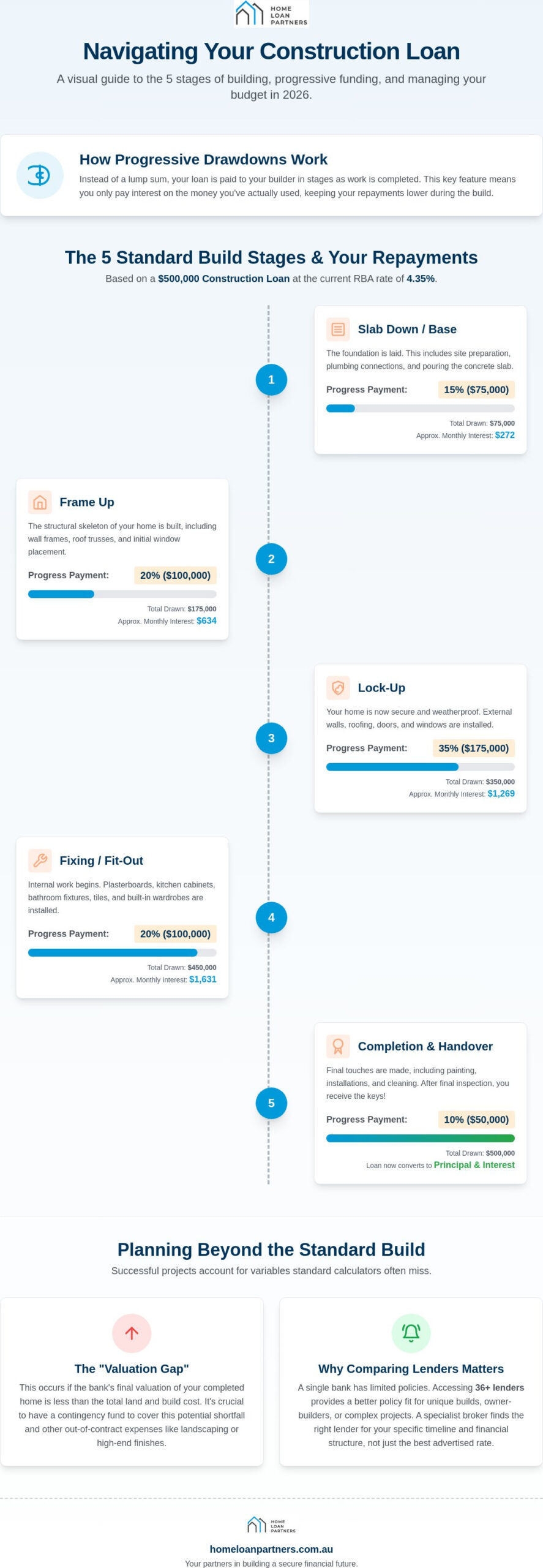
The defining feature of this finance is the progressive drawdown. Instead of receiving the full loan amount at once, your lender releases funds in increments called “progress payments.” These payments go directly to your builder after they complete specific milestones, such as the slab, frame, or lock-up stage. You can learn more about the mechanics of How Construction Loans Work through staged funding models that prioritize project milestones over lump-sum transfers.
Before each payment is made, you’ll typically sign an “Authority to Pay” form. In some cases, the bank might send a valuer to the site to confirm the work matches the builder’s invoice. The biggest advantage here is that you only pay interest on the portion of the loan that has been drawn down. If you’ve only used $100,000 of a $500,000 loan, your interest is calculated only on that smaller amount. This keeps your out-of-pocket costs lower while you’re still paying for your current accommodation.
Land Loans vs. Construction Loans
Many Australians choose to secure their perfect block of land before they’ve finalized their house plans. If you do this, you’ll initially take out a land loan. This functions like a standard mortgage. The real benefit happens when you’re ready to build; your land equity can often serve as the deposit for your construction loan. This potentially reduces the amount of fresh cash you need to provide upfront, especially if the land value has increased since you bought it.
You can also combine both into a single “construction pack” to simplify your management. The construction phase officially begins once the bank receives your council-approved plans and the signed building contract. At this point, your loan shifts from a standard mortgage into the staged drawdown phase. Planning this transition carefully with a construction loan calculator australia ensures you don’t face any surprises when the first builder’s invoice arrives on your doorstep.
The 5 Standard Build Stages and Your Repayment Schedule
Your building journey isn’t a single event. It’s a series of five distinct financial milestones. Each one marks progress on site and a shift in your loan balance. Understanding these stages is the secret to using a construction loan calculator australia effectively. It allows you to predict exactly when your monthly interest will tick upward. As each stage finishes, your builder issues an invoice, and your lender releases the next portion of funds. This ensures your money is only spent on work that’s actually been completed.
Lenders follow industry best practices to verify that each milestone meets specific quality and progress standards. Before funds move from the bank to the builder, you’ll need to confirm you’re happy with the work. This structured approach protects you from paying for incomplete stages. It also keeps your interest-only repayments lower in the early months, as you’re only paying for the foundations and frame rather than the full loan amount. If you’re feeling unsure about how these stages align with your specific builder’s contract, talking to an expert in construction loans can provide the clarity you need.
From Slab to Lock-up: The Early Milestones
The first three stages of your build move quickly. Stage 1 is the Deposit and Slab stage. This covers the initial foundation work and plumbing that happens underground. Once the slab is poured and cured, the bank releases the first major payment. Stage 2 is the Frame stage. This is when the skeleton of your home appears, giving you the first real sense of the house’s size and layout. Stage 3 is Lock-up. This is a significant moment because it means the windows, external doors, and roofing are installed. Your home is now weather-tight, and your loan balance will have grown significantly, which you should account for in your construction loan calculator australia projections.
The Final Touches: Fixing and Completion
The final two stages focus on the interior and the finishing details. Stage 4 is the Fixing stage. This includes internal fittings like cabinetry, plastering, and the installation of skirting boards and architraves. Finally, Stage 5 is Practical Completion. This covers painting, electrical work, and the final cleanup. It’s the most exciting part of the process, but it also carries a specific financial nuance. Many lenders hold back a “Retention Sum.” This final payment isn’t released until the builder provides a certificate of occupancy. This ensures all final council requirements are met and the home is legally habitable before the final funds change hands.
Calculating Interest-Only Repayments vs. Final Principal & Interest
Managing your finances during a build requires a dual perspective. You need to understand your costs today and your commitments tomorrow. Most construction loans in Australia are structured as interest-only during the building phase. This means you aren’t paying down the loan balance while the builders are on site. Instead, you only pay the interest on the amount of money actually drawn from your loan facility. Using a construction loan calculator australia allows you to model this progressive increase in cost, ensuring you aren’t caught off guard as the project nears completion.
This structure provides a vital buffer for your monthly budget. Many people building a new home are still paying rent or a mortgage on their current property. By keeping your construction repayments to interest-only, you reduce the immediate financial pressure on your household. Once the final payment is made to the builder and you receive your keys, the lender will typically switch your loan to a standard Principal and Interest (P&I) structure. This is the moment your long-term debt reduction begins, and your repayments will increase to cover both the interest and the original amount borrowed.
The Interest-Only Advantage During Construction
The math behind interest-only payments is straightforward but powerful for your cash flow. If you have a variable rate of 5.89% p.a., your monthly interest on a $100,000 slab stage drawdown would be approximately $491. By the time you reach the final completion stage and have drawn $500,000, that monthly interest payment rises to roughly $2,454. The Interest-Only period acts as a temporary cash-flow shield. To further optimize this, some lenders allow you to use an offset account. Any savings you keep in that account can reduce the interest you’re charged, even while the build is still in progress.
Transitioning to Your Long-Term Mortgage
The switch to a standard mortgage happens automatically after the final “practical completion” stage. You’ll need to decide on your loan term, which is commonly 30 years, and your preferred repayment frequency. With the RBA cash rate sitting at 4.35% as of mid-2026, it’s important to use a construction loan calculator australia to prepare for the “repayment shock” of moving to P&I. While your interest-only payments were manageable during the build, your final P&I repayments will be higher because you’re now paying back the principal over the remaining 28 or 29 years of your loan term. Planning for this transition early ensures your dream home remains affordable long after you’ve moved in.
Planning for Hidden Costs and Build Budget Variations
A construction loan calculator australia is an excellent tool for estimating your monthly repayments, but it typically only accounts for the figure on your building contract. It doesn’t see the full picture of what it takes to actually turn a house into a home. One of the most common hurdles we help clients navigate is the “Valuation Gap.” This occurs when a bank’s valuer assesses your plans and determines the finished property’s worth is lower than the combined cost of your land and construction. If this happens, you might need to provide a larger deposit to cover the difference, as the lender will only lend against their appraised value, not your total spend.
To protect your peace of mind, we always suggest maintaining a 10% contingency fund. Building projects are dynamic, and even the most experienced builders can encounter surprises once they break ground. Whether it’s an unexpected rock shelf during excavation or a last-minute change to your kitchen layout, having a cash buffer ensures these moments don’t stall your progress. If your builder asks for more money halfway through, it’s usually due to a formal variation. We act as your steady hand during these times, helping you understand the bank’s requirements for approving additional funds so the project stays on track.
Common Out-of-Contract Expenses
Many “turnkey” packages still leave out essential finishing touches. It’s vital to check your contract for exclusions that could impact your move-in date. Common items that often sit outside the standard loan include:
- Landscaping, retaining walls, and perimeter fencing.
- Driveways and letterboxes.
- Site costs like rock removal or extra piers required by council.
- Internal finishes such as window blinds, floor coverings, or flyscreens.
Utility connection fees and council rates during the build phase also add up. For a broader look at how to structure your total property budget, you can explore our Home Loan Calculator Guide. Understanding these “hidden” costs early allows you to use a construction loan calculator australia with much more realistic figures.
Managing Variations and Cost Blowouts
Your contract likely contains “Prime Cost” (PC) and “Provisional Sums” (PS). PC items are allowances for specific materials, like a $2,000 budget for a bathtub. If you choose a tub that costs $3,000, you’ll need to cover that $1,000 variation. PS items are estimates for work that cannot be fully priced until it begins, such as earthworks. If these costs blow out, you must follow a formal process to request extra funds from your lender. Because we specialize in construction loans, we can guide you through the paperwork required to ensure the bank supports these necessary adjustments without unnecessary stress.
Why Comparing 36+ Lenders Beats Going Direct to One Bank
A construction loan calculator australia is an excellent starting point for your research, but it cannot tell you which bank will actually approve your specific project. Every lender in the Australian market has a different appetite for risk, especially when it involves the complexities of a new build. While a single bank can only offer you their own products and rigid policies, we provide access to over 36 lenders. This diversity is crucial because the right “policy fit” is often more important than the interest rate alone. We act as your expert collaborator, looking beyond the numbers to find a lender that understands your vision and your builder’s track record.
Having a professional manage the ongoing communication between your builder and the bank is a significant advantage. Construction involves a constant flow of invoices, inspections, and “Authority to Pay” forms. If a single document is missing or a bank valuer is delayed, it can stall your build. We step in as the steady hand, managing the heavy lifting of the paperwork and ensuring the funds flow smoothly at every milestone. This partnership allows you to focus on the exciting parts of your project, like choosing your finishes, while we handle the technical financial details.
Policy Variations You Should Know
Lending policies for construction are rarely uniform across the industry. Some lenders are comfortable with higher Loan-to-Value Ratios (LVRs) for new builds, which is vital if your deposit is smaller. Others have much more flexible views on how they treat the revamped First Home Guarantee scheme or state-based builder incentives. For example, as of July 2026, the removal of income caps for certain guarantees has changed how some banks assess serviceability. While “Lender A” might reject a project because of a specific clause in your building contract, “Lender B” might happily fund it because their internal policy is more accommodating to that specific build type.
The Stress-Free Path to Completion
Our commitment to your journey doesn’t end when the first slab is poured. We remain by your side until the final key is turned and beyond. If you’re currently living in a home you need to sell while your new one is being built, you might also need to learn about Bridging Finance to manage the transition without two sets of repayments. We pride ourselves on being more than just a service provider; we are your long-term guides through every major life milestone. By using a construction loan calculator australia and then partnering with us, you’re choosing a path defined by precision, reassurance, and a deeply client-centric approach to building your dream home.
Your Path to a Seamless Home Build
Building your dream home is a monumental milestone, and having the right financial partner makes all the difference. We’ve explored how staged payments protect your interests and why planning for those often-overlooked expenses, like landscaping and fencing, is vital for your budget’s success. While a construction loan calculator australia provides the necessary baseline for your initial planning, the true security comes from matching your unique project with the right lender’s policy.
As specialists in complex construction and renovation finance, we offer you access to over 36 Australian lenders to find your perfect fit. We pride ourselves on providing personalised guidance that prioritises your long-term goals, acting as the steady hand that navigates the relationship between your bank and your builder. Don’t let the technicalities of progressive drawdowns or valuation gaps cloud your vision. We’re here to manage the heavy lifting so you can focus on the joy of watching your new home take shape, knowing that settling into a new area also means finding trusted local partners like the multi-award-winning Star Dental Care to care for your family’s future.
Book a Stress-Free Consultation with Our Construction Loan Experts and let’s start this journey together. Your future home is waiting, and we’re ready to help you reach it with confidence.
Frequently Asked Questions
How does a construction loan calculator differ from a standard mortgage calculator?
A construction loan calculator australia differs from a standard mortgage tool by modeling staged drawdowns rather than a single lump-sum payment. It calculates interest based on your projected building milestones, such as the slab or frame stage. This allows you to see how your repayments gradually increase as the build progresses. Standard calculators assume you owe the full amount from day one, which doesn’t reflect the financial reality of a building project.
Can I get a construction loan with a 5% or 10% deposit in 2026?
You can obtain a construction loan with a 5% or 10% deposit in 2026, particularly through the revamped First Home Guarantee scheme. This federal initiative no longer carries income caps, making it accessible for a wider range of buyers. While a 20% deposit is the traditional benchmark to avoid Lenders Mortgage Insurance (LMI), many lenders now offer competitive terms for those with smaller savings. We specialize in finding lenders who have a strong appetite for low-deposit construction finance.
What happens if my builder goes over budget or the build takes longer than expected?
If your builder goes over budget or the project is delayed, you must notify your lender immediately. Any costs above the original fixed-price contract are considered “variations” and typically require you to provide additional funds from your own savings. Delays can also extend your interest-only period, meaning you’ll pay more in total interest over the duration of the build. Maintaining a 10% contingency fund is a smart way to manage these unexpected hurdles without stalling your project.
Do I need to pay for a valuation before the bank approves my construction loan?
Lenders require an “as-if-complete” valuation before they officially approve your loan. A professional valuer reviews your land value and building plans to estimate what the property will be worth once the house is finished. This valuation determines your maximum borrowing capacity and helps identify any potential valuation gaps. If the bank’s appraisal is lower than your total project cost, you may need to provide a larger deposit to bridge the difference before the build begins.
Can I use a construction loan for a major renovation or only for a new build?
You can use a construction loan for major structural renovations just as easily as for a new build. If your project involves moving walls, adding an extension, or significant plumbing and electrical work, lenders prefer this staged payment structure. For smaller cosmetic updates, a standard top-up or personal loan might be more appropriate. A construction loan calculator australia can help you model the costs for any renovation project that requires council approval and a formal building contract.
What is a “Fixed Price Contract” and why is it mandatory for most Australian lenders?
A Fixed Price Contract is a legal agreement where your builder commits to completing the project for a specific total sum. This is mandatory for most Australian lenders because it provides financial certainty and reduces the risk of cost blowouts. While it protects you from price hikes, it also ensures the bank knows exactly how much to allocate for each progress payment. It’s essential to check for “prime cost” or “provisional sums” within the contract, as these can still fluctuate.
How do progress payments work if I am an owner-builder?
Managing progress payments as an owner-builder is more complex than a standard contract build. Lenders are often more cautious and will require detailed receipts, invoices, and site inspections before releasing funds for each stage. You’ll need to provide a comprehensive project budget and timeline upfront. Because fewer lenders cater to owner-builders, it’s essential to work with a broker who can find a specific policy fit for your DIY project and manage the bank’s expectations.
When do I start making principal repayments on my construction loan?
You typically start making principal repayments once your home reaches the final completion stage and you move in. During the building phase, your loan is structured as interest-only to keep your cash flow manageable while you might still be paying for other housing. Once the builder receives their final payment, the lender automatically switches the loan to a standard Principal and Interest (P&I) structure. This transition marks the beginning of your long-term debt reduction journey and your full mortgage commitment.