

What if your monthly mortgage repayment wasn’t a fixed burden, but a flexible lever you could pull to free up cash for other investments? We understand that high monthly costs can feel like they’re limiting your lifestyle, particularly with the RBA cash rate sitting at 4.35% as of late 2024. Many Australian property owners are looking for ways to breathe easier. Choosing an interest only home loan can be a strategic move to manage your cash flow more effectively while you focus on other financial goals.
You likely believe that debt should always be paid down as fast as possible, but for many successful investors, a different approach creates more wealth. We’ll show you how to use these loans to maximise tax deductions on your investment properties and keep your outgoings low. This guide provides a clear roadmap for managing the eventual transition back to principal repayments without the typical stress. We’re here to partner with you on this journey, ensuring you have a steady hand to guide you through every stage of your property ownership.
Key Takeaways
- Understand the fundamental mechanics of interest-only periods in Australia, typically ranging from 1 to 5 years for homeowners and up to 10 years for strategic investors.
- Learn how an interest only home loan can be used to maximise tax-deductible debt while preserving essential cash flow for other wealth-building opportunities.
- Identify the long-term cost differences between repayment types and how to navigate the “compounding” effect of paying interest on a larger balance.
- Discover practical steps to avoid “repayment shock” by planning for the transition when your deferred principal period eventually concludes.
- Explore how an expert mortgage broker can help you access over 36 lenders to find a tailored loan structure that aligns with your long-term property goals.
What is an Interest Only Home Loan and How Does It Work in 2026?
Choosing an interest only home loan is a strategic decision that prioritizes immediate cash flow over immediate equity building. In this arrangement, your monthly repayments only cover the interest charged by the lender, leaving the original amount you borrowed, known as the principal, completely untouched. This structure differs from a traditional mortgage where every payment reduces your debt. By working with a dedicated partner to set up this structure, you can redirect your funds toward other financial goals like property renovations or diverse investment portfolios.
In the Australian market of 2026, standard interest-only periods usually range from 1 to 5 years for owner-occupiers. Investors often have more flexibility, with some lenders offering terms up to 10 years to help maximize tax-deductible expenses. An Interest-only loan is often favored by those seeking to manage their budget during specific life stages, such as parental leave or career transitions. However, lending standards are stricter than in previous years. Banks currently apply rigorous serviceability tests, often requiring proof that you can afford the much higher principal and interest repayments that kick in once the interest-only term expires. This ensures the loan remains a sustainable part of your long-term journey toward homeownership.
The Mechanics of Monthly Repayments
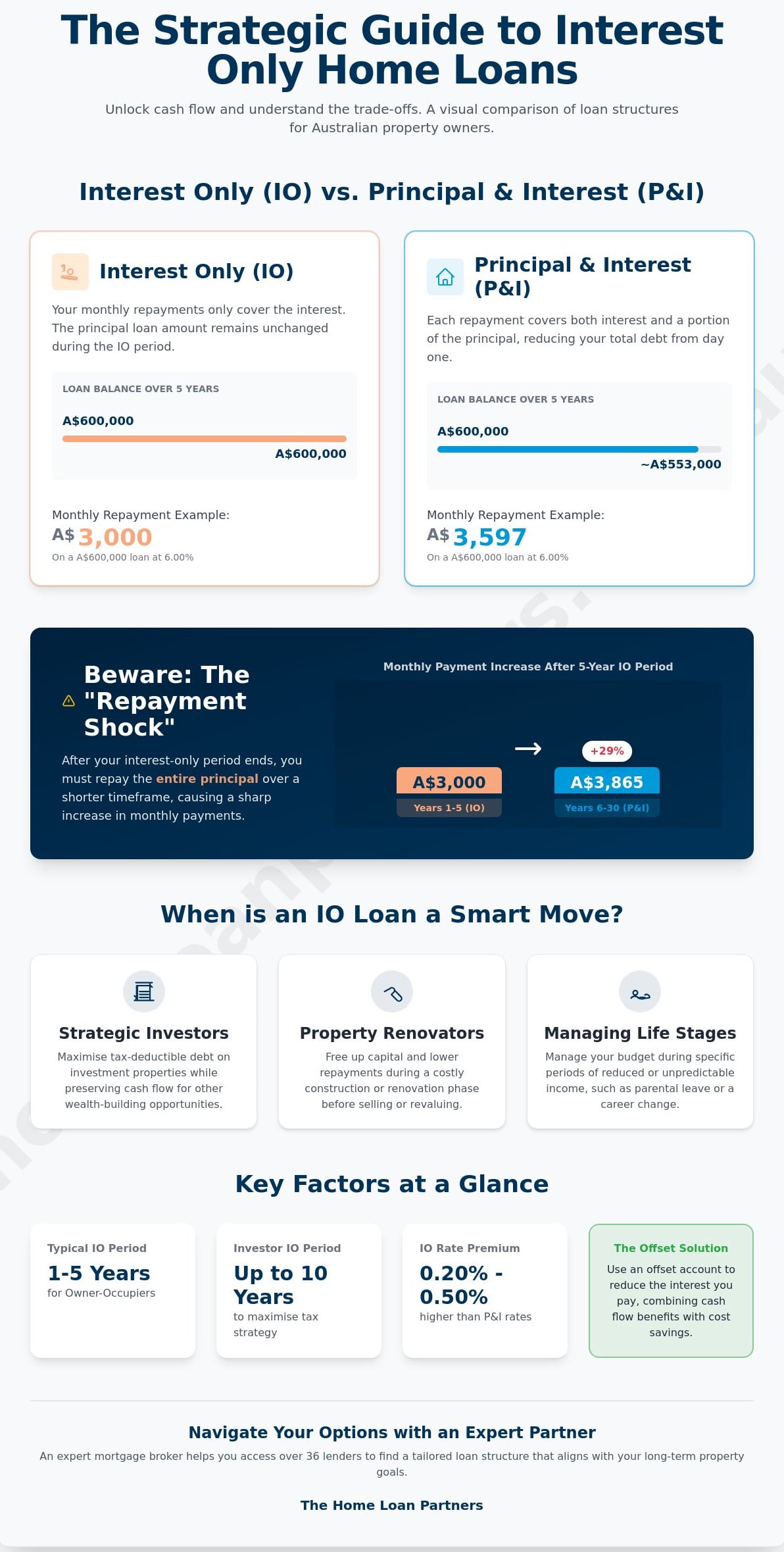
The calculation for these repayments is straightforward. Because you aren’t paying back any of the principal, the monthly cost is significantly lower than a standard loan. For example, on a A$600,000 loan at a 6% interest rate, your monthly interest-only payment would be approximately A$3,000. If you chose a variable rate, this amount would shift whenever the market fluctuates. Conversely, a fixed rate locks that payment in for a set time, providing a sense of calm and predictability. An interest-only period is a temporary contractual agreement to defer principal repayments for a specific timeframe.
Interest Only vs. Standard Mortgages
The most striking difference between these two paths is the debt curve. With a standard mortgage, your loan balance slowly trends downward from day one. With an interest only home loan, your debt balance stays flat. This creates a clear trade-off: you enjoy a lower current cost, but you face a higher future cost. It’s vital to remember that the total loan term, usually 30 years, remains fixed. If you spend five years on interest-only payments, you’ll eventually have to pay off the entire principal in just 25 years. This leads to a sharp increase in your monthly obligations once the initial term ends, so planning for that transition is a key part of our expert guidance.
Interest Only vs. Principal and Interest: A Comparison of Costs
Choosing an interest only home loan involves a trade-off between immediate flexibility and total cost. Lenders in the Australian market typically price these loans higher than standard principal and interest (P&I) products. You’ll often find interest rates for interest-only periods are 0.20% to 0.50% higher than their P&I counterparts. Banks apply this premium because they view non-amortising loans as a higher risk; the debt remains static while the property value fluctuates.
The compounding effect represents the most significant long-term cost. On a A$600,000 loan at a 6.00% interest rate, a five-year interest-only period means you don’t reduce the debt at all during those sixty months. While a P&I borrower would have reduced their balance to roughly A$553,000 in that same timeframe, your balance stays at A$600,000. This means you pay interest on a larger amount for a longer duration. Over a 30-year term, this five-year delay can add more than A$55,000 in total interest costs because you must eventually pack the full principal repayment into a shorter 25-year window.
You can mitigate these disadvantages by using an offset account. If you place your surplus cash flow into an offset linked to your interest only home loan, you reduce the balance used for interest calculations. For instance, keeping A$50,000 in an offset against that A$600,000 loan means you only pay interest on A$550,000. This strategy provides the cash flow benefits of an interest-only structure while keeping your interest costs closer to a P&I arrangement.
Short-term Cash Flow vs. Long-term Equity
The primary appeal of an interest-only period is the “monthly saving.” On a A$600,000 mortgage, the interest-only payment might be A$3,000, whereas the P&I payment would be closer to A$3,600. This A$600 monthly difference is a powerful tool for investors looking to fund other ventures or homeowners managing temporary income changes. However, this creates an equity gap. Without capital growth, your ownership stake doesn’t move. While the immediate relief is attractive, borrowers must understand the risks of interest-only loans, specifically the lack of equity growth and the eventual “repayment shock” when the interest-only term ends.
Impact on Your Borrowing Power
Lenders assess your “serviceability” differently for interest-only applications. Even if you only plan to pay interest for five years, the bank calculates your ability to repay the entire loan over the remaining 25-year term. Because the principal must be repaid in a shorter window, the required monthly payments will be higher later on. Consequently, a five-year interest-only period can actually reduce your maximum borrowing capacity compared to a 30-year P&I loan. In the 2026 lending environment, banks also apply a 3% interest rate buffer to these assessments. This means they check if you can afford the repayments if rates rise significantly. If you’re unsure how these calculations affect your plans, our team can provide a tailored comparison for your specific financial situation.
Strategic Use Cases: When is an Interest Only Loan the Right Move?
An interest only home loan serves as a powerful lever for Australians looking to optimize their wealth. While principal and interest repayments remain the standard for most, certain financial milestones make an IO period the smarter choice. For instance, investors often use this path to maximize tax-deductible interest. By not paying down the principal, they keep their deductible debt at its peak. This can be a key component of a negative gearing strategy, especially in a high-interest environment.
Managing a property transition also becomes easier with this structure. If you’ve bought a new home but haven’t sold your existing one, an IO period reduces your monthly outgoings during that stressful bridging window. It creates breathing room when you need it most. You might also consider this during a career break or a major renovation. Instead of feeling squeezed by high repayments, you maintain steady cash flow for your daily needs. We see many clients use this as a temporary safety net while they focus on family or professional growth.
Debt recycling is another advanced move we often discuss with our partners. This involves using the cash saved from lower repayments to pay down non-deductible debt, such as a personal car loan or the mortgage on your primary residence. You then redraw those funds for investment purposes. This effectively turns “bad debt” into “good debt” over time, improving your overall tax position without increasing your total liabilities. For investors looking to take this further, lending to SMSF through a Limited Recourse Borrowing Arrangement is another strategy worth exploring to leverage your superannuation for property investment.
Property Investment and Tax Effectiveness
Investors typically prefer to keep the principal balance high on their investment debt. This keeps interest payments higher, which are generally tax-deductible in Australia. It’s a strategy that aligns with long-term capital growth goals. When you work with us, we ensure your broker structures the loan to fit your accountant’s specific advice. Understanding different Consumer Financial Protection Bureau on loan options can help you grasp how these structures work globally, though our focus remains on the local Australian tax landscape and your personal wealth journey.
Owner-Occupiers and Strategic Flexibility
For those building their dream home, an interest only home loan is standard during the construction phase. You only pay interest on the funds drawn down as the builder hits specific milestones. This keeps your costs manageable while you might still be paying rent elsewhere. Outside of building, some families use IO periods to build a cash buffer during parental leave. However, we always guide our clients to avoid “lifestyle creep.” It’s tempting to spend the extra cash on luxury items, but the goal is always your long-term financial security. We act as your steady hand, ensuring the lower repayment period serves a specific purpose rather than becoming a permanent habit.
Navigating the Risks: Managing the “Repayment Shock” Transition
While an interest only home loan offers immediate cash flow benefits, the transition back to principal and interest (P&I) repayments requires a steady hand. Repayment shock occurs when your interest-only term expires and your monthly commitment suddenly spikes. This isn’t just because you’re now paying down the principal; it’s because you’re repaying that principal over a shorter timeframe. On a standard 30-year loan with a five-year interest-only period, you must clear the entire debt in just 25 years. This compressed schedule can increase monthly costs by 20% to 40% compared to a standard P&I loan started on day one.
There’s also the risk of negative equity. If property prices soften during your interest-only term, your loan balance remains static while the home’s value drops. Australian property data from late 2025 showed that even minor market corrections can leave interest-only borrowers with less than 10% equity if they didn’t provide a large initial deposit. We act as your partner to monitor these shifts, ensuring your long-term security isn’t compromised by short-term market fluctuations.
Your Options When the IO Period Ends
Lenders in 2026 are increasingly diligent. To apply for an extension, you’ll need to demonstrate a clear exit strategy and strong serviceability under current interest rates. Many homeowners choose to refinance to a new lender to reset the loan term back to 30 years, which effectively lowers the monthly burden. Alternatively, switching to P&I six months early helps you adjust your household budget without the sudden stress of an automated bank transition at the end of the term.
Creating a Financial Safety Net
The most successful IO borrowers are those who save the difference rather than spend it. Using an offset account is a brilliant way to simulate P&I repayments while maintaining the flexibility of an interest only home loan. By “paying” yourself the extra amount into an offset, you reduce interest costs and build a buffer for the future. We recommend starting a Step-Up plan 12 months before your term expires. This involves increasing your monthly savings target every quarter to match the projected P&I amount. This gradual approach builds the discipline needed for the next phase of your homeownership journey. For borrowers who want to go further, understanding the full potential of a debt recycling strategy to convert non-deductible mortgage debt into tax-effective wealth can make this transition period even more financially rewarding.
Ready to plan your next move? Chat with our expert team to review your interest-only strategy today.
How a Mortgage Broker Helps You Structure an Interest Only Strategy
Choosing an interest only home loan isn’t just about lowering your monthly commitments; it’s about strategic precision. We provide you with direct access to over 36 lenders across the Australian market. This network includes boutique providers and wholesale lenders that often offer competitive rates that major banks don’t promote to the general public. Our role is to act as your intermediary, translating complex bank jargon into a clear path forward for your portfolio.
The application process for these loans has become significantly more detailed since the Australian Prudential Regulation Authority (APRA) updated its serviceability guidelines. We manage the heavy lifting by preparing your application to meet these strict requirements. We focus on your long-term security by ensuring your loan is structured to align with your 5-year and 10-year property goals. This proactive management includes:
- Analyzing your current equity to maximize borrowing power for future acquisitions.
- Structuring offset accounts to preserve liquidity while reducing interest costs.
- Planning for the eventual transition to principal and interest payments to avoid “payment shock.”
- Providing ongoing reviews every 12 to 18 months to ensure your rate remains competitive as market conditions shift.
The Value of an Expert Partner
A trusted guide is essential when dealing with complex investment structures. We help you avoid the “Loyalty Tax,” which is the hidden cost of staying with a lender that no longer offers you their best pricing. By regularly benchmarking your IO rate against the market, we ensure you aren’t paying more than necessary. We handle the tough negotiations with lenders on your behalf, using our industry relationships to secure terms that reflect your value as a borrower. This collaborative approach turns a cold transaction into a long-term partnership focused on your wealth creation.
Your Next Steps Toward a Tailored Loan
Your journey begins with a holistic financial health check. We evaluate your current position and future aspirations to see if an interest only home loan is the right tool for your specific needs. To prepare for an application, you’ll generally need to organize your recent income statements, tax returns, and a clear outline of your investment strategy. Having these documents ready allows us to move quickly and secure your approval without unnecessary stress. We stay by your side from the first conversation through to settlement and throughout the life of your loan.
Ready to optimize your cash flow? Partner with us to find the right loan structure for your goals.
Secure Your Property Future with a Tailored Cash Flow Strategy
Choosing an interest only home loan in 2026 is a calculated move to maximize tax benefits for investors or manage cash flow during major life transitions. While the lower initial costs are attractive, navigating the eventual shift to principal and interest requires a clear roadmap to avoid repayment shock. You don’t have to manage these complexities alone. At Home Loan Partners, we act as your long-term guide, helping you access options from over 36 Australian lenders to find a fit for your unique goals. Our team specializes in complex investment structures, ensuring your mortgage works as hard as you do. We’re here to help you turn the Australian dream of homeownership into a sustainable reality through every stage of your property journey. Whether you’re a first-time investor or expanding a portfolio, the right structure today protects your wealth tomorrow. Let’s build a plan that prioritizes your security and peace of mind.
Book a free strategy session with our expert mortgage brokers
Frequently Asked Questions
Can I make extra repayments on an interest-only home loan?
Yes, you can usually make extra repayments on an interest-only home loan, though the specific rules depend on your rate type. Variable loans often allow unlimited additional payments into an offset account or redraw facility. If you choose a fixed rate, most Australian lenders cap extra payments at A$10,000 per year. This flexibility helps you reduce the total interest charged while maintaining your strategic cash flow.
Are interest-only home loans only for property investors?
No, interest-only home loans aren’t exclusively for property investors, even though they represent about 65 percent of this loan type in the Australian market. Owner-occupiers often use them for short-term needs like managing costs during a major home renovation or during a temporary career break. We guide you through these options to ensure the structure aligns with your immediate lifestyle goals and your long-term financial security.
What happens at the end of an interest-only period?
When the interest-only period ends, your loan automatically reverts to principal and interest repayments. This results in a noticeable jump in your monthly commitment because you’re now repaying the original debt over a shorter remaining timeframe. For example, on a 30-year loan with a 5-year interest-only period, you must clear the entire balance in the remaining 25 years. We recommend reviewing your position 6 months before this transition.
Is the interest rate higher on an interest-only loan?
Yes, interest rates for an interest only home loan are typically higher than standard principal and interest rates. Australian lenders generally apply a premium of 0.20 percent to 0.50 percent because these loans carry a higher risk profile for the bank. While the rate is higher, your monthly out-of-pocket cost remains lower during the interest-only term since you aren’t paying down the loan balance yet.
Can I switch from interest-only to principal and interest early?
You can certainly switch from interest-only to principal and interest repayments before your agreed term expires. Most lenders allow this transition without charging heavy fees, as it reduces the bank’s risk when you start paying down the debt principal. Making this move early can save you thousands in interest over the life of the loan. Our team handles the heavy lifting to make this switch seamless for you.
How long can an interest-only period last in Australia?
Interest-only periods in Australia typically last between 1 and 5 years for most borrowers. Some lenders may extend this to 10 years for seasoned property investors, provided the total loan term doesn’t exceed 30 years. It’s important to remember that a longer interest-only period means you’ll face much higher repayments later on. We help you calculate these future costs so you can plan your journey with total confidence.
Do I need a bigger deposit for an interest-only home loan?
You often need a larger deposit for an interest-only arrangement compared to a standard principal and interest loan. Most Australian banks cap the Loan-to-Value Ratio (LVR) at 80 percent for interest-only applications, meaning you’ll need a 20 percent deposit to secure approval. In contrast, some standard loans allow for a 5 percent deposit with Lenders Mortgage Insurance. This requirement ensures you have a solid equity cushion from the start.
Will an interest-only loan affect my ability to refinance later?
Yes, an interest only home loan can make refinancing more complex because your debt balance hasn’t decreased since you settled the loan. Lenders assess your future serviceability based on your ability to repay the full debt over the remaining principal and interest term. If property prices haven’t risen, a lack of principal reduction might limit your available equity and your choice of new lenders when you’re ready to move.