

What if your largest monthly bill was actually the most powerful tool in your investment toolkit? For the 37% of Australian households currently paying off a mortgage, the dream of owning a home outright often feels like a 30 year marathon. You likely feel the frustration of watching your income vanish into non-deductible interest while your investment goals sit on the back burner. This is where debt recycling changes the game by turning your biggest liability into your greatest asset.
You don’t have to choose between a home and an investment portfolio. We’re here to show you how to transform non-deductible debt into tax-effective wealth using a strategy that’s both professional and proactive. This guide provides a clear roadmap to convert your mortgage into a tax-deductible tool, allowing you to build an investment portfolio and pay off your home years ahead of schedule. We’ll walk you through the exact steps to safely unlock your equity and create a tailored path toward lasting financial security.
Key Takeaways
- Unlock the potential of your mortgage by learning how to replace non-deductible home debt with tax-effective investment debt.
- Master the mechanics of using your home equity to establish a tailored loan split designed for long-term wealth creation.
- See the clear financial advantage of debt recycling compared to traditional repayments, potentially saving you thousands in tax and years off your mortgage.
- Navigate the risks with confidence by understanding your net debt position and how to protect your portfolio against market fluctuations.
- Identify the specific loan features and expert guidance needed to ensure your strategy is implemented seamlessly and effectively.
What is Debt Recycling? Transforming Your Mortgage into an Asset
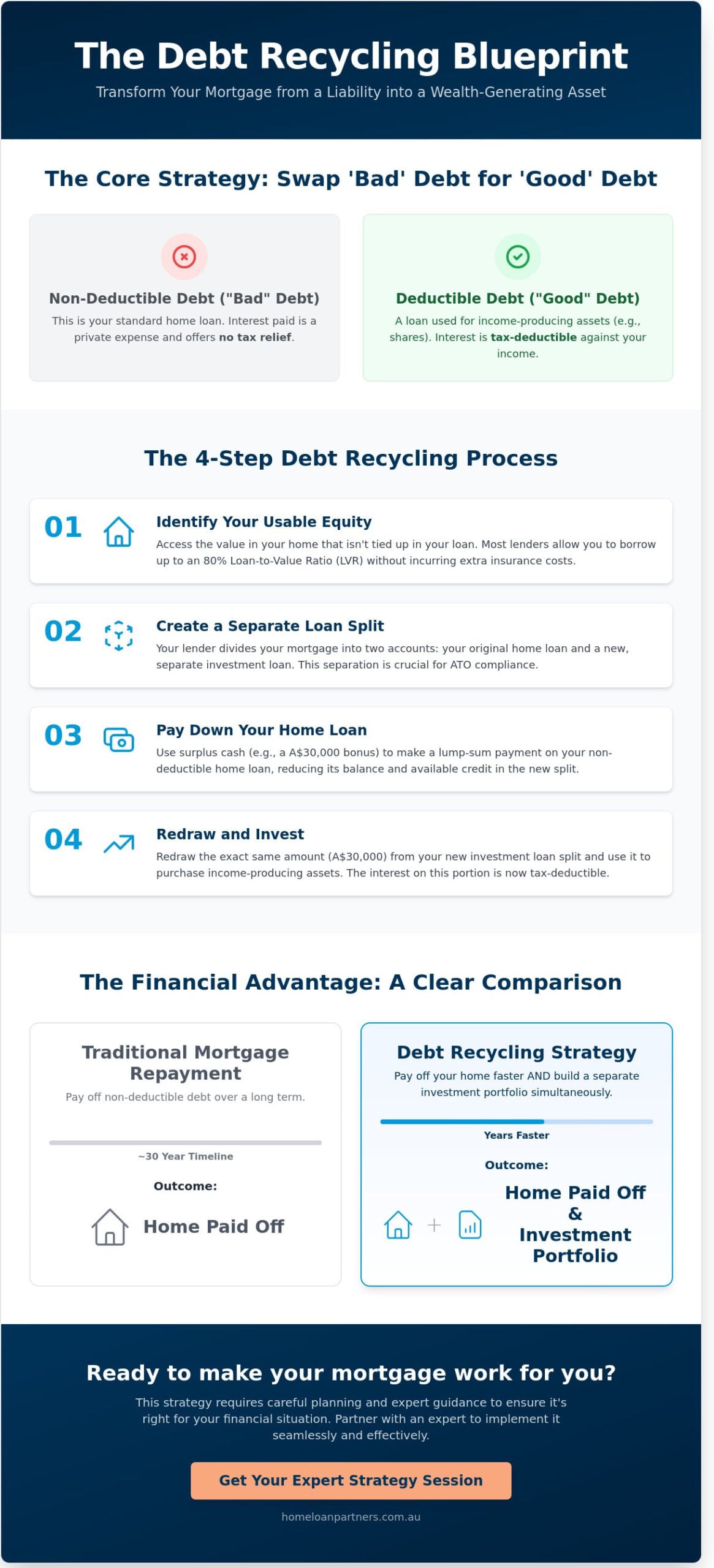
Debt recycling is a strategic financial process where you replace non-deductible home debt with deductible investment debt. It isn’t about increasing your total liabilities. Instead, it’s about changing the character of your debt to make it work for your long-term wealth. When you implement this strategy, your total debt level remains the same at the start, but the tax treatment of that debt undergoes a significant transformation. We act as your partner to help you understand how this shift can accelerate your journey toward financial freedom.
The primary goal of debt recycling is to pay off your non-deductible home loan as quickly as possible. By converting your mortgage into an investment loan, you unlock tax benefits that aren’t available to standard homeowners. This strategy relies on the fundamental distinction between two types of debt:
- Bad Debt: This is your standard home loan. It’s “bad” only in a tax sense because the interest you pay on your primary residence isn’t tax-deductible in Australia.
- Good Debt: This refers to loans used to purchase income-producing assets, such as shares or investment properties. The interest on this debt is generally tax-deductible.
By focusing on this distinction, you can use your cash flow more effectively. Every dollar of “bad debt” you convert into “good debt” brings you one step closer to owning your home outright while simultaneously building an investment portfolio.
The Core Philosophy: Deductible vs. Non-Deductible Debt
In Australia, the tax system is quite specific about what interest costs you can claim. Under current regulations, interest on a loan for your family home is considered a private expense, which offers no relief at tax time. However, when you use borrowed funds to invest in assets that generate assessable income, the interest becomes a powerful tool to reduce your taxable income. For the 2026 tax year, debt recycling creates a tailored tax-shield by converting non-deductible interest into a legitimate deduction that lowers your overall tax liability.
Why 2026 is the Right Time to Consider This Strategy
The Australian property market showed remarkable resilience throughout 2024 and 2025, with CoreLogic reporting a national home value increase of 8.1% in the 12 months leading into the current cycle. This growth has left many homeowners with a significant amount of “lazy equity” in their properties. As we move through 2026, interest rate cycles are expected to stabilize, making it a prime environment to restructure your finances. While the potential is high, it’s vital to seek expert advice to ensure your strategy is tailored to your unique goals. We’re here to guide you through every step of this transition, ensuring the process is seamless and secure.
The Step-by-Step Mechanics of a Debt Recycling Strategy
Implementing a successful debt recycling strategy requires a disciplined approach and a clear structure. It’s not about taking on more debt; it’s about changing the nature of your existing debt to work harder for your future. The process follows a logical sequence that transforms your non-deductible mortgage into a tax-effective investment tool.
- Step 1: Identify your equity. You’ll need to have a portion of your home’s value that isn’t tied up in your current loan. Most Australian lenders allow you to access equity as long as your total Loan to Value Ratio (LVR) remains below 80%. This ensures you avoid the added cost of Lenders Mortgage Insurance.
- Step 2: Create a separate loan split. Your lender can divide your mortgage into two or more sub-accounts. One remains your standard home loan, while the second split is a dedicated “recycling” account. This separation is vital for tracking purposes.
- Step 3: Reduce your non-deductible debt. Use surplus cash, such as an annual bonus or a tax refund, to pay down a portion of your primary home loan. For example, if you have A$30,000 in savings, you apply it directly to your non-deductible mortgage balance.
- Step 4: Redraw and invest. You then redraw that exact A$30,000 from your separate investment split. This money is used to purchase income-producing assets. Because the funds are now used for investment, the interest on that A$30,000 split becomes tax-deductible.
The Importance of Loan Splitting
You must never mix investment funds and personal funds in a single account. The Australian Taxation Office (ATO) requires a clear paper trail to prove that borrowed funds were used specifically for income-generating purposes. If you use one account for both your mortgage and your investments, the “nexus” between the loan and the investment becomes blurred. This can lead to the ATO disallowing your interest deductions during an audit. A separate split provides clean accounting, making it easy to identify exactly how much interest you can claim on your tax return each year. Our team can help you structure your loan splits to ensure your accounting remains transparent and compliant from day one.
Choosing Income-Producing Assets
To satisfy tax regulations, the assets you buy must have a reasonable expectation of generating taxable income. This typically includes Australian shares, managed funds, or exchange-traded funds (ETFs). While capital growth is a common goal, the asset must pay dividends or distributions to qualify. Many Australian investors prefer shares that offer franked dividends. These dividends come with tax credits because the company has already paid tax at the 30% corporate rate. This can be a powerful addition to your strategy, as the income helps pay down your remaining non-deductible home loan even faster, accelerating the “recycling” cycle. You might also consider a residential investment property, provided the rental income is documented and taxed appropriately.
Debt Recycling vs. Traditional Mortgage Repayment: A Comparison
Choosing between traditional mortgage repayment and debt recycling changes your financial trajectory over a 15 year period. A standard approach focuses solely on reducing the principal of your home loan. While this builds equity, it often leaves you asset rich but cash poor because your wealth is locked in your four walls. Debt recycling allows you to build an investment portfolio while simultaneously clearing your non-deductible home loan. It’s about making your money work harder in two places at once.
- Tax Efficiency: In a traditional setup, you pay your mortgage with after-tax dollars. With debt recycling, the interest on the investment portion of your loan becomes tax-deductible. This can significantly reduce your annual tax bill compared to a standard repayment plan.
- Net Debt Position: While your total debt might stay higher for longer, your net debt, which is your total debt minus your investment value, often reaches zero faster. This happens because your investments grow while your non-deductible debt shrinks.
- Opportunity Cost: By only paying off your home, you miss out on market growth. For context, the ASX 200 has delivered an average annual return of approximately 9% over the last 30 years. Waiting 20 years to start investing means losing decades of compounding.
The Power of Compounding and Tax Refunds
This strategy creates a powerful feedback loop that accelerates your progress. When you invest, your portfolio generates dividends and potential tax refunds through gearing benefits. Instead of spending these funds, you direct them straight back into your non-deductible home loan. This extra repayment reduces your principal faster, which allows you to redraw more funds for further investment. This cycle turns a linear debt reduction into an exponential wealth-building engine. Over time, the growth of your portfolio begins to outpace the remaining debt, creating a clear path to financial independence.
Who is Debt Recycling Best Suited For?
This strategy requires a specific financial profile to be successful. We find it works best for disciplined savers with a stable household income and at least 20% equity in their home. Because markets fluctuate, you need a long-term horizon of 10 years or more to ride out the cycles. It’s a strategy for those who have a buffer of cash or accessible equity to manage interest rate changes without stress. A steady hand and a clear plan are your best tools for this journey. We act as your partner to ensure the structure remains sound as your life evolves.
Navigating the Risks: Protecting Your Financial Future
The most frequent concern we hear from clients is that debt recycling feels like taking on more risk by increasing debt. It’s a valid worry, but it’s important to look at your net debt position. When you use this strategy, your total liabilities don’t actually increase. You’re simply converting a portion of your non-deductible home loan into a tax-deductible investment loan. Your total balance remains the same; only the tax treatment of the interest changes.
To keep the Australian Taxation Office (ATO) satisfied, you must maintain a clear “nexus” between the borrowed funds and the investment. This means the money should flow directly from the loan account into the investment without being mixed with personal cash. If you lose this trail, you risk losing your interest deductions. We always recommend keeping your investment loan split entirely separate from your daily spending accounts to ensure this link stays crystal clear.
Market Volatility and Margin Calls
One major advantage of this strategy is how it differs from margin lending. In a traditional margin loan, the lender can trigger a “margin call” if your portfolio value drops, forcing you to sell assets at a loss. Because debt recycling uses your home equity as security, your investments aren’t subject to these sudden calls. However, capital risk still exists. If the value of your shares or property falls below the loan amount, you’re in a position of negative equity on that specific portion. To manage this, we suggest focusing on diversified, lower-volatility investments like Exchange Traded Funds (ETFs) rather than speculative stocks. A diversified approach acts as a stabilizer for your long-term wealth.
Cash Flow Management and Interest Rate Stress
Successful investing requires a steady hand and a solid cash buffer. Investment income, such as dividends, can fluctuate. If your dividends drop, you still need to meet your interest payments. We advise our partners to stress test their finances by calculating whether they can still afford the loan if interest rates rise by 2% or 3%. This simple exercise ensures you aren’t caught off guard by shifts in the RBA cash rate. Using an offset account is a brilliant way to manage this liquidity. By keeping a reserve of cash in an offset linked to your home loan, you reduce interest costs while keeping funds available for emergencies or unexpected rate hikes.
Ready to see if your equity is working as hard as it could be? Speak with our expert team to build a tailored plan that prioritizes your security.
Partnering with an Expert: How to Implement Your Strategy
Implementing a debt recycling strategy requires more than just a standard home loan. Most basic bank products lack the flexibility to separate non-deductible debt from investment debt. Without clear boundaries between these funds, you risk creating a “mixed purpose” loan. This complication makes it nearly impossible to satisfy Australian Taxation Office (ATO) requirements for interest deductibility, potentially voiding your tax benefits.
A successful strategy relies on a dedicated partnership between your mortgage broker, accountant, and financial planner. While your accountant ensures the structure remains tax-compliant, your broker acts as the architect of your debt. We identify lenders that offer sophisticated split-loan features and seamless redraw facilities. This collaborative approach ensures your financial structure supports your long-term wealth goals rather than hindering them. Maintaining this strategy isn’t a one-time event. It requires annual reviews to ensure that as your home loan balance drops, your investment splits are adjusted to maximize your tax position.
Finding the Right Loan Structure
The foundation of debt recycling is a loan that allows for multiple, independent splits. You need the ability to isolate specific amounts of equity as they become available. Look for loans with low or no fees for creating new sub-accounts and easy redraw access. These features allow you to pay down your non-deductible debt and immediately redraw it for investment purposes without messy paperwork.
The choice between Interest Only and Principal and Interest splits is also vital for your cash flow. While you generally pay down your home loan as fast as possible using Principal and Interest repayments, keeping your investment splits on Interest Only can preserve cash flow. This extra liquidity can then be funneled back into your home loan to accelerate the cycle. Your broker guides you through these choices to ensure the rhythm of your repayments matches your income cycle.
Next Steps: Your Roadmap to Debt Recycling
Turning equity into an income-producing asset requires a methodical approach. Follow these steps to begin your journey:
- Assess your equity: Ensure you have sufficient usable equity. Lenders usually require you to leave a 20% buffer in your home to avoid Lenders Mortgage Insurance.
- Consult your tax professional: Confirm that your intended investment meets the ATO criteria for interest deductibility.
- Find a specialist broker: Secure a lender that supports complex split-loan structures and offers competitive rates.
- Review annually: Meet with your professional team every 12 months to monitor your progress and adjust your splits.
A tailored loan structure provides a sense of security as you build your portfolio. It transforms your mortgage from a monthly burden into a powerful tool for wealth creation. If you’re ready to explore how this strategy fits your specific situation, the team at The Home Loan Partners is here to help. Book a strategy session with The Home Loan Partners today to start your journey toward financial freedom.
Take Charge of Your Financial Future Today
Turning your home loan into a powerful wealth creation tool requires a shift in mindset and a structured approach. By implementing a debt recycling strategy, you’re not just paying off your mortgage; you’re actively building an investment portfolio. This method works by converting non-deductible home loan interest into tax-deductible investment debt according to Australian Taxation Office guidelines. It’s a proactive way to make your equity work harder while you focus on your long-term security.
Success depends on the right loan structure and a clear understanding of the risks involved. At The Home Loan Partners, we act as your steady guide through every step. We provide access to over 36 lenders to ensure your loan is tailored for maximum efficiency. Our team offers expert guidance on investment property loans and refinancing, ensuring your strategy is built on a solid foundation. We provide a personalised service that prioritises your specific wealth goals over simple transactions.
Partner with us to design your debt recycling strategy today
Building wealth is a long-term journey, and we’re here to help you navigate it with confidence and clarity.
Frequently Asked Questions
Is debt recycling legal in Australia?
Yes, debt recycling is a legitimate financial strategy that complies with Australian Taxation Office (ATO) guidelines, including Tax Ruling TR 95/25. It involves purposefully structuring your finances to transform non-deductible home loan interest into tax-deductible investment interest. Our team acts as your expert partner to ensure your loan structure remains compliant while you focus on building long-term wealth. This method is a proven way for homeowners to improve their tax position legally.
Do I need a large amount of equity to start debt recycling?
You don’t need a massive fortune to start, but most Australian lenders require you to have at least 20% equity in your property. For a home valued at A$800,000, this means having at least A$160,000 in equity to avoid Lenders Mortgage Insurance (LMI) when you restructure. We guide you through the valuation process to see if you’ve reached this threshold. Having a clear equity buffer ensures your investment journey remains stable and secure.
What happens if the value of my investments goes down?
If your investments decrease in value, you’re still responsible for repaying the full amount of the loan you borrowed against your equity. For instance, if a A$60,000 share portfolio drops by 12%, your debt to the bank remains exactly A$60,000. This is why we prioritize a calm, long-term approach to help you navigate market volatility. We act as a steady hand, helping you understand these risks before you begin your debt recycling journey.
Can I use debt recycling for my first home?
It’s difficult to use debt recycling for your first home immediately because the strategy relies on having usable equity. Most first-home buyers start with a high loan-to-value ratio, often 90% or 95%, which leaves no room to redraw funds for investment. As you pay down your mortgage and your property value grows, we’ll help you identify the right time to start. It’s a rewarding goal for patient homeowners who want to grow their future portfolio.
How does debt recycling help me pay off my mortgage faster?
Debt recycling helps you clear your mortgage sooner by using tax refunds and investment income to make extra repayments on your non-deductible debt. When you convert a portion of your home loan into an investment loan, the interest becomes tax-deductible, often resulting in a larger refund from the ATO. You then funnel that extra cash directly back into your home loan. This cycle creates a powerful snowball effect that can save you thousands in interest.
Do I need an accountant to manage debt recycling?
While you can manage the loan accounts yourself, we strongly recommend partnering with a qualified accountant to ensure your tax claims are accurate. The ATO requires strict “tracing” of funds to prove that borrowed money was used specifically for income-producing purposes. A simple mistake in your record-keeping could lead to your tax deductions being denied. We work alongside your tax professionals to ensure your accounts are structured perfectly from the very first day.
Is debt recycling the same as a home equity loan?
No, debt recycling isn’t just a standard home equity loan. A typical equity loan increases your total debt, while debt recycling focuses on replacing your existing “bad” debt with “good” investment debt. The goal is to keep your total debt level the same while changing its tax status to your advantage. It’s a more sophisticated way to use your home’s value to build wealth while simultaneously working toward the dream of a debt-free future.
What are the tax implications if I sell the investments later?
If you sell your investments for a profit, you’ll likely trigger a Capital Gains Tax (CGT) event. In Australia, if you’ve held the asset for more than 12 months, you’re generally entitled to a 50% CGT discount. This means only half of the profit is added to your taxable income for that financial year. We help you plan for these milestones so you’re never surprised by a tax bill as your investment portfolio matures over time.