

What if the figure you see on a standard borrowing power calculator is actually preventing you from securing your ideal property? With the Reserve Bank of Australia cash rate currently sitting at 4.35 percent, many local buyers feel stuck between conflicting online results and the fear of a potential loan rejection. It is completely normal to feel overwhelmed when different lenders offer wildly different estimates for the same household income.
We believe you deserve a steady hand and a clear perspective on your financial journey. You will learn how to accurately estimate your home loan capacity and discover the proven strategies we use to safely maximise what you can borrow in 2026. We will walk through the impact of APRA’s 3 percent serviceability buffer and provide a clear, stress free plan to move you closer to your homeownership goals as your trusted mortgage partner.
Key Takeaways
- Start your property journey by using a borrowing power calculator to accurately estimate the maximum loan amount Australian lenders may offer you.
- Learn how to correctly categorise your income and prepare financial documents to ensure your capacity assessment is precise and reliable.
- Understand why different banks provide varying results based on their unique credit policies regarding dependents and family tax benefits.
- Discover proactive steps to increase your lending limit, from closing unused credit cards to consolidating high-interest personal finance.
- Explore how a dedicated partner can navigate over 36 lenders to find a tailored solution that moves beyond the limitations of standard online tools.
What is a Borrowing Power Calculator and Why is it Essential?
Starting your property journey in Australia begins with a single question: how much can I actually afford? Your borrowing power is the maximum amount a bank or lender will provide for your home loan. Using a borrowing power calculator is your first step because it provides a realistic boundary for your property search. It transforms vague aspirations into a clear, actionable budget. At Home Loan Partners, we view this tool as the foundation of a stress-free experience, helping you narrow your focus to homes that fit your financial reality.
In the current 2026 market, interest rates have stabilized after the fluctuations of previous years, yet they remain a primary driver of your results. A small 0.25% shift in rates can change your capacity by tens of thousands of dollars. These tools help you see how today’s rates translate into monthly commitments. You’ll find it’s vital to distinguish between an online estimate and a formal pre-approval. A calculator provides a snapshot based on the data you provide. A pre-approval involves a lender verifying your documents and credit history. Think of the calculator as your compass and the pre-approval as your ticket to the auction.
The Role of Serviceability in Lending
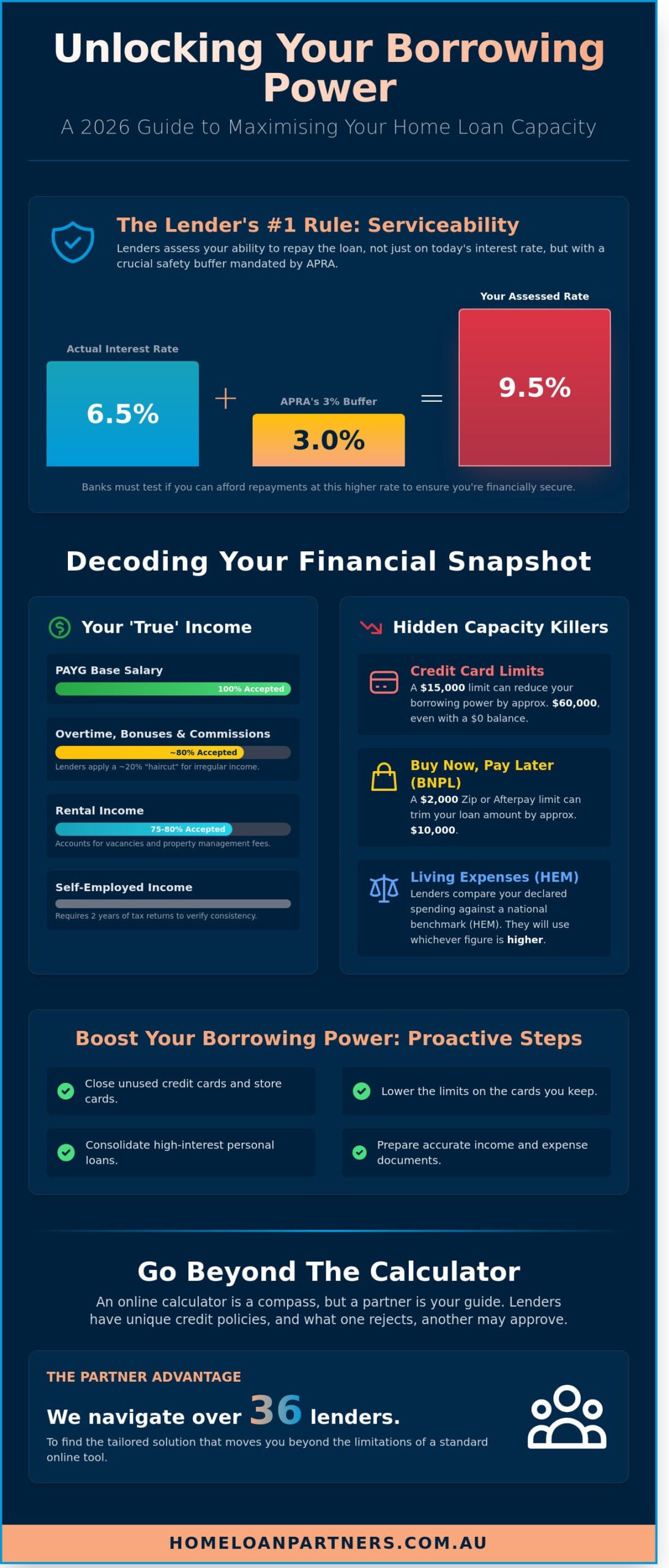
Lenders focus on “serviceability,” which is your ability to meet repayments without financial hardship. They don’t just look at your gross salary. Instead, they scrutinize your “net” position. This includes your take-home pay minus living expenses, existing debts, and tax. APRA (the Australian Prudential Regulation Authority) currently requires banks to apply a 3.0% serviceability buffer. This means if your actual rate is 6.5%, the bank tests if you can still pay at 9.5%. This protective measure ensures you remain secure even if market conditions change.
Calculator vs. Reality: Managing Expectations
While a borrowing power calculator is an expert tool for planning, it isn’t a guarantee. The reliability of the result depends entirely on the accuracy of your inputs. You need to account for mortgage calculation variables like loan terms and precise interest types to get a clear picture. Small details often have a big impact. For instance, “hidden” debts like Buy Now Pay Later (BNPL) accounts can reduce your capacity significantly. Even a A$2,000 limit on a Zip or Afterpay account is viewed as a potential debt by lenders. This might trim A$10,000 off your final loan amount because the bank assumes you could use that credit at any time.
We act as your partner in this process, helping you interpret these numbers so you can bid with confidence. By understanding the data behind the screen, you position yourself as a prepared and savvy buyer in the Australian market.
How to Use a Borrowing Power Calculator Accurately
To get a reliable result from a borrowing power calculator, you need to look beyond your gross annual salary. Start by gathering your two most recent payslips, your latest tax return, and bank statements covering the last 90 days. This preparation ensures the numbers you input reflect your actual financial position rather than a rough estimate. Once you have these documents, you can begin the process of fine-tuning your data to see what the banks see.
Step 1: Calculating Your True Income
Lenders view income through a lens of stability. While they usually accept 100% of a permanent PAYG base salary, they often apply a 20% haircut to irregular income like overtime, commissions, or bonuses. If you’re self-employed, most Australian banks require two years of tax returns to verify a consistent earning history. Rental income is treated similarly; banks typically only count 75% to 80% of the gross rent to account for property management fees and potential vacancies. Assessable income is the specific portion of your total earnings that a lender deems stable enough to contribute toward your monthly mortgage repayments.
Step 2: Scrutinising Your Expenses
Lenders don’t just look at what you earn; they look at how you spend. Living expenses include everything from your A$200 weekly grocery shop to your monthly streaming subscriptions and private school fees. Banks compare your declared spending against the Household Expenditure Measure (HEM). This is a benchmark based on the median spend for various family sizes in Australia. If your declared expenses are lower than the HEM for your demographic, the lender will likely use the higher benchmark figure to be conservative.
Your credit card limits also play a massive role in the final calculation. A A$15,000 credit limit can reduce your borrowing capacity by approximately A$60,000, regardless of whether you owe a cent on the card. This happens because lenders must assume you could max out the card at any time. Reducing these limits before you apply is one of the fastest ways to improve your results. While using Moneysmart’s mortgage calculator provides an excellent baseline, adjusting your inputs for different loan terms can reveal how much a 25-year versus a 30-year term impacts your monthly cash flow. Once you know your borrowing limit, pairing this knowledge with a mortgage repayment calculator to plan your home loan strategy helps you translate that figure into a realistic monthly budget and long-term repayment plan.
If you find these calculations complex, our team can help you find a tailored solution that fits your specific lifestyle goals and long-term security.
Why Different Lenders Give Different Results
You might notice that a borrowing power calculator on one bank’s website gives you a different figure than another. This happens because every Australian lender applies its own “secret sauce” to your financial data. While the Big 4 banks often rely on rigid benchmarks like the Household Expenditure Measure (HEM), second-tier lenders frequently offer more flexibility for unique situations. These benchmarks are updated annually to reflect rising costs of living, but how they’re applied varies wildly.
For example, banks treat family tax benefits and dependents with distinct sets of rules. One lender might accept 100% of your Family Tax Benefit Part A as usable income, while another might ignore it entirely if your children are over the age of 12. Similarly, the way banks view your job type can change your outcome. If you’re a nurse or an emergency responder, certain lenders will take 100% of your overtime and shift allowances into account. In contrast, more conservative banks might only “shade” this income, counting only 80% of it toward your total capacity.
The specific loan product you choose also plays a role. Lenders don’t just look at the current interest rate; they apply a serviceability buffer, which is typically 3% above the product rate. If you’re looking at a variable rate of 6.20%, the bank tests your ability to pay at 9.20%. Because fixed and variable rates differ, the “floor rate” used in their internal borrowing power calculator will shift your maximum loan amount.
The “Lender Appetite” Factor
Banks aren’t static institutions. Their “appetite” for new loans changes based on their current portfolio balance and quarterly targets. You’ll find that one bank might say “no” to a high-LVR (Loan to Value Ratio) application while another says “yes” with a competitive rate. Niche lenders often cater to specific financial situations, such as self-employed borrowers who have only one year of tax returns instead of the standard two. This variance is why a conservative policy at a major bank shouldn’t be the final word on your home ownership journey. We help you find the partner that values your specific financial profile.
The Impact of Debt-to-Income (DTI) Ratios
The Debt-to-Income ratio acts as a hard ceiling for many Australian lenders. This figure is calculated by dividing your total debt by your gross annual income. According to the Reserve Bank of Australia’s lending policies, a DTI ratio above 6.0 is often classified as high-risk. In the 2025-2026 regulatory environment, banks have become more sensitive to these ratios to ensure market stability. If your total debts, including credit card limits and personal loans, exceed six times your salary, many lenders will automatically cap your loan amount regardless of your surplus cash flow. It’s helpful to understand what is a good Debt to Income (DTI) ratio before you apply, as this single number can override other factors in a lender’s assessment.
Practical Steps to Increase Your Borrowing Capacity
Using a borrowing power calculator gives you a helpful starting point, but your final result isn’t set in stone. You can actively influence how lenders perceive your financial health by making a few strategic adjustments. Banks assess your ability to repay a loan based on your net income after all commitments are met. By trimming these commitments, you directly increase the surplus funds available for mortgage repayments.
- Cancel unused credit cards: Lenders don’t care if your balance is zero. They assess your “potential” debt based on the total credit limit. Closing a single A$10,000 credit card can potentially boost your borrowing capacity by approximately A$30,000 to A$40,000 depending on the lender’s specific formulas.
- Consolidate high-interest debt: Personal loans and car finance often carry higher interest rates than home loans. Rolling these into a single lower-interest facility or paying them down early reduces your monthly outgoings.
- The 90-day clean-up: Most Australian banks require three months of bank statements to verify your living expenses. Reducing discretionary spending on luxury items, recurring subscriptions, or excessive takeaway meals during this 90-day window presents a “cleaner” profile to credit assessors.
- Aim for a lower LVR: Increasing your deposit to reach a 20% Loan-to-Value Ratio (LVR) removes the need for Lenders Mortgage Insurance (LMI). This often unlocks lower interest rates, which improves your serviceability and overall capacity.
Optimising Your Financial Profile
Your financial habits tell a story. A bank statement free from overdrawn fees or constant “buy now, pay later” transactions builds confidence with your assessor. It’s often wise to wait 3 to 6 months before applying if you’ve recently changed jobs or had a period of high spending. This timeframe allows you to demonstrate a consistent savings pattern and a stable income. A higher credit score, typically above 700 on the Equifax scale, can also give you access to more competitive products that a standard borrowing power calculator might not initially show. Using a mortgage repayment calculator to model different rate and term scenarios at this stage helps you understand exactly how those competitive products translate into real monthly savings.
Leveraging Existing Equity
If you already own property, you don’t always need a cash deposit to move forward. You can use the equity built up in your current home to act as security for your next purchase. We recommend getting a professional valuation before you start; even a 5% increase in your property’s value can significantly expand your options. Understanding how to use this value is a core part of Home Loan Refinancing: A Complete 2026 Guide, which helps you restructure your debt for better long-term growth.
Ready to see how these steps change your numbers? Connect with our expert team today to receive a tailored assessment of your true lending potential.
Beyond the Calculator: Why a Partner Makes the Difference
A borrowing power calculator serves as an excellent starting point for your property journey. It provides a quick snapshot based on standard data. However, these digital tools operate on “one-size-fits-all” algorithms that often fail to capture the nuances of your financial life. They cannot see your career trajectory, your specific industry’s stability, or the subtle ways different Australian banks view your income.
The Home Loan Partners bridge the gap between a generic estimate and a formal approval. We access a panel of more than 36 lenders, ranging from the big four banks to specialized credit unions and non-bank lenders. This variety is vital because every lender applies different “shading” to income types. For instance, one bank might only recognize 80% of your overtime or bonuses, while another might accept 100%. This single discrepancy can change your borrowing capacity by tens of thousands of dollars.
Our role involves more than just finding the highest number. We focus on a tailored loan structure that protects your lifestyle. A generic calculator won’t tell you if an offset account or a split-rate loan is better for your five-year plan. We ensure your debt remains manageable so that a rate rise doesn’t compromise your quality of life. We turn a cold estimate into a clear, stress-free path toward settlement.
Personalised Guidance vs. Algorithms
Algorithms don’t have conversations, but we do. We interpret your unique story for the lender, explaining things like recent career changes or temporary fluctuations in expenses that a computer might flag as a risk. We proactively negotiate interest rates that aren’t advertised on public websites. Our team communicates directly with credit managers to advocate for your application. This human element focuses on your long-term financial security, ensuring you don’t just get a loan, but the right loan for your future.
Your Next Steps to Home Ownership
Moving from an online borrowing power calculator to a pre-approval requires a professional assessment. When you book a consultation with us, we perform a deep dive into your finances. We review your payslips, tax returns, and living expenses to provide a rock-solid figure you can take to auctions with confidence. During our first meeting, we’ll discuss your goals, explain the current market conditions in your specific Australian state, and map out a timeline for your purchase.
Ready to move beyond estimates? Let our experts find your true borrowing power today. We’ll handle the heavy lifting while you focus on finding the perfect home.
Take Control of Your Australian Property Future
A borrowing power calculator provides a vital baseline for your property search, yet it’s important to remember these figures are just the beginning. Every lender in the Australian market applies different benchmarks to your income and expenses, meaning your actual capacity can vary significantly between institutions. By refining your financial habits and understanding how banks view your debt, you can actively improve your position before submitting an application.
Navigating the 2026 lending landscape requires more than just a digital tool; it requires a dedicated partner. Home Loan Partners offers you direct access to a panel of 36+ Australian lenders, ensuring you find a solution that fits your specific needs. We don’t just find you a loan; we craft personalised loan structures tailored to your unique life goals. Our team handles the heavy lifting so you can focus on finding the right front door.
Start your journey with a personalised borrowing assessment
Your dream home is within reach, and we’re here to help you step into it with confidence and clarity.
Frequently Asked Questions
How accurate are online borrowing power calculators?
An online borrowing power calculator provides a reliable baseline estimate based on standard lending criteria, but it’s not a formal loan offer. Most tools apply a 3% serviceability buffer as mandated by the Australian Prudential Regulation Authority (APRA) to ensure you can handle future rate rises. Since every lender has different policies regarding overtime or bonus income, your actual capacity might vary by A$50,000 or more between different banks.
Does using a calculator affect my credit score?
Using our calculator won’t have any impact on your credit score. These tools perform a “soft” calculation that doesn’t involve a formal enquiry with credit reporting agencies like Equifax or Experian. You can test as many different scenarios as you like without leaving a footprint on your file. We only conduct a “hard” credit check when you’re ready to proceed with a formal pre-approval application through our team.
Why is my borrowing power lower than it was last year?
Your capacity has likely decreased because the Reserve Bank of Australia (RBA) raised the cash rate from 0.1% in April 2022 to 4.35% by November 2023. Higher interest rates mean larger monthly repayments, which reduces the total amount banks are willing to lend. Additionally, the 3% serviceability floor means banks assess your ability to pay at a rate much higher than the current market average to ensure long-term security.
Can I include my partner’s income in the calculation?
You can certainly include your partner’s income to boost your total limit. Combining two salaries often increases your capacity because your shared living expenses don’t typically double, leaving more surplus cash for loan repayments. It’s important to include all their regular earnings, such as base salary and any consistent commissions, to get the most accurate result from the borrowing power calculator.
What is the maximum Debt-to-Income (DTI) ratio most Australian banks allow?
Most Australian lenders prefer a Debt-to-Income (DTI) ratio of 6 or lower. If your total debt, including your new home loan and any credit card limits, exceeds 6 times your gross annual income, your application is considered higher risk. While some banks might consider a DTI up to 7 or 8 in specific circumstances, staying below the 6 mark makes the approval process much smoother and opens up more competitive interest rates.
How much deposit do I really need to maximise my borrowing power?
Aiming for a 20% deposit is the most effective way to maximise your options and avoid Lenders Mortgage Insurance (LMI). While you can enter the market with as little as 5%, having a 20% deposit proves to lenders that you’re a disciplined saver. This lower Loan-to-Value Ratio (LVR) often unlocks “tier one” interest rates, which are typically 0.2% to 0.5% lower than high-LVR products, directly improving your long-term affordability.
Does having a HECS/HELP debt reduce how much I can borrow?
Yes, your HECS/HELP debt reduces your borrowing capacity because it lowers your net take-home pay. Banks look at your after-tax income to determine your ability to meet repayments. For someone earning A$90,000, a HECS debt can reduce their annual take-home pay by approximately A$5,400 based on 2023/24 repayment thresholds. This reduction in disposable income means the bank will offer a smaller loan amount to ensure you aren’t overstretched.
What happens if the bank’s valuation is lower than the calculator’s estimate?
If a bank’s professional valuation comes in lower than expected, you’ll need to cover the “shortfall” with extra cash. For example, if you buy a home for A$800,000 but the bank values it at A$750,000, they’ll only lend based on the lower figure. This might mean you need a larger deposit or a family guarantor to bridge the gap. It’s a common hurdle that we can help you navigate by finding a different lender with a more favourable valuation policy.