

What if the most important tool for your 2026 property portfolio isn’t a “hot tip” on a suburb, but a clear set of numbers you can actually control? With the RBA cash rate sitting at 4.35% and lenders applying a strict 3% serviceability buffer, guessing your way into an acquisition is no longer an option. Utilizing a precise investment property loan calculator allows you to strip away the noise of shifting interest rates and see exactly how a new purchase fits into your current financial landscape. It’s about moving from “I hope this works” to “I know this works.”
We understand that the fear of hidden costs or the confusion surrounding interest-only structures can feel like a barrier to your next milestone. You’re likely looking for more than just a monthly repayment figure; you want to know how your hard-earned equity translates into real borrowing power under the 2026 debt-to-income caps. This guide will help you master the math behind your next acquisition. We’ll show you how to stress-test your strategy and provide a steady roadmap that takes you from your first calculation all the way to loan approval. Together, we can turn these complex variables into a predictable path for building long-term wealth.
Key Takeaways
- Learn how to use an investment property loan calculator to move beyond guesswork and validate your property choices with hard data.
- Identify the most critical variables for your 2026 strategy, including why your Loan-to-Value Ratio (LVR) is the foundation of your borrowing power.
- Understand the difference between gross and net yields to ensure hidden costs like maintenance and management fees don’t erode your rental returns.
- Discover how to “stress-test” your portfolio against future interest rate fluctuations by applying the same 3% serviceability buffer used by major lenders.
- See how a dedicated partner can translate your raw data into a compelling case for credit assessors across a panel of over 36 lenders.
Why Every Investor Needs an Investment Property Loan Calculator in 2026
In the current 2026 economic environment, property success isn’t about luck; it’s about precision. With the RBA cash rate at 4.35%, every percentage point matters for your bottom line. An investment property loan calculator acts as your primary diagnostic tool, allowing you to stress-test your assumptions before you commit your capital. It transforms a complex web of interest rates and fees into a clear, manageable set of figures that you can use to compare different opportunities across the country.
Analysis paralysis is a common hurdle for those looking to expand their portfolio. When you have access to clear data, you can validate property choices based on factual yields rather than emotional impulses. This precision is why an investment property loan calculator is the most valuable asset in your digital toolkit, especially when building a national portfolio where you can’t physically visit every site. It bridges the gap between seeing a potential property and knowing it’s a viable addition to your wealth-building journey.
Modeling Your Financial Future
Modeling your financial future requires a long-term perspective that goes beyond next month’s repayment. You can visualize how extra repayments accelerate your equity growth, which is vital for understanding real estate investment as a long-term vehicle for security. For those pursuing a multi-property strategy, these digital tools determine if your current cash flow can support a second or third acquisition without overextending your position. In 2026, a strategic calculator serves as the bridge between a speculative purchase and a resilient, income-producing asset.
The Psychology of Certainty
There’s a specific kind of anxiety that comes with large financial commitments in a shifting market. We find that breaking down costs into transparent figures significantly reduces this stress, allowing you to focus on your goals rather than your fears. Using a professional home loan calculator sets a foundation of confidence for your journey. It moves you from the “what if” phase into a concrete “how much” reality. By the time you reach out to an expert collaborator, you aren’t just bringing questions; you’re bringing a data-backed vision for your future security.
Essential Inputs: How to Get Accurate Results from Your Calculator
To get the most out of an investment property loan calculator, you need to look beyond the surface. While basic tools focus on simple salary inputs, a strategic investor knows that variables like the Loan-to-Value Ratio (LVR) and Debt-to-Income (DTI) ratio are the real gatekeepers. In 2026, lenders are under stricter scrutiny; APRA has limited most banks to a maximum of 20% of new lending for borrowers with a DTI ratio of six or more. This means your existing debt, from car loans to credit cards, plays a massive role in your total borrowing capacity. For a more comprehensive look at how these factors interact with your potential ROI, using a detailed investment property calculator can help you see the bigger picture before you commit.
Accurate rental income estimates are equally vital. Don’t rely on optimistic figures from a sales agent. Lenders often “shade” rental income, typically only counting around 70% to 80% of the gross rent to account for vacancies and management costs. When you input these more conservative figures into your model, you’re building a plan that can withstand real-world fluctuations. If you’re feeling overwhelmed by these variables, our team can help you review your investment loan structure to ensure it aligns with your long-term security.
Navigating Interest Rates and Loan Terms
Choosing between a 25-year and 30-year loan term is a strategic balancing act. A shorter term builds equity faster, but it puts more pressure on your monthly cash flow. In 2026, with competitive investment variable rates starting around 5.94% and 2-year fixed rates near 5.99%, you have choices to make regarding stability versus flexibility. Many investors opt for interest-only periods to maximize tax deductibility and keep initial outgoings low. However, you should be wary of “headline rates” found on basic bank tools. These often ignore the ongoing fees and charges that a true comparison rate captures, potentially skewing your results.
Leveraging Equity as a Deposit
Your current home is often the engine for your next purchase. You can use a calculator to estimate your “usable equity,” which is generally the difference between 80% of your home’s current value and your remaining mortgage balance. If you’re looking to upgrade while keeping your current home as an investment, integrating these findings into a bridging finance strategy can provide the necessary liquidity. Just remember that borrowing over 80% LVR typically triggers Lenders Mortgage Insurance (LMI). This is a significant cost that must be factored into your acquisition budget to ensure your calculations remain grounded in reality.
Calculating the Real Cost: Repayments vs. Net Investment Yield
Focusing solely on a monthly mortgage figure is a common trap that can lead to unexpected cash flow pressure. While a basic tool might show you a manageable repayment, a sophisticated investment property loan calculator helps you account for the “hidden” outgoings that define your actual profit. In 2026, successful investors treat property management fees, council rates, and strata levies as non-negotiable line items in their financial models. We recommend setting aside a maintenance fund of at least 1% of the property’s value annually to ensure you aren’t caught off guard by urgent repairs. This level of detail transforms your calculation from a simple estimate into a professional business plan.
Your bank views your potential acquisition through a different lens than a typical sales brochure. While a real estate agent might highlight a high gross yield, lenders are focused on the net yield after expenses. To ensure your strategy is resilient, factor in a vacancy buffer by calculating your annual rent over 48 weeks instead of 52. This conservative approach provides a safety net for tenant turnover or minor refurbishments between leases. Additionally, don’t overlook tax depreciation schedules; these non-cash deductions can significantly offset your calculated loan costs, potentially turning a property that looks “tight” on paper into a tax-effective wealth builder.
Understanding Cash Flow Positivity
Achieving a cash-flow-positive position means your total rental income exceeds all ownership costs, including interest, insurance, and maintenance. In the 2026 market, negative gearing remains a viable strategy for high-income earners looking to build long-term equity, but the focus has shifted toward properties with higher organic yields to combat sustained interest rates. To calculate your net rental yield, you must subtract all annual operating expenses from your total annual rent and then divide that remainder by the property’s total purchase price. This single number is the most accurate indicator of your investment’s performance relative to your debt.
The Impact of Offset Accounts
An offset account is one of the most powerful tools for managing the “true” cost of your debt over time. By keeping your surplus cash or emergency funds in a linked offset account, you reduce the principal balance used to calculate interest, effectively “saving” you money at the same rate as your loan. Modeling the difference between a standard savings account and an offset account often reveals thousands of dollars in potential interest savings over a 30-year term. If your current loan structure doesn’t offer this flexibility, it might be time to explore the refinance home loan benefits that could better align with your wealth-building goals. We can help you compare these structures to ensure every dollar is working as hard as possible for your future security.
Stress-Testing Your Loan: Preparing for 2026 Market Fluctuations
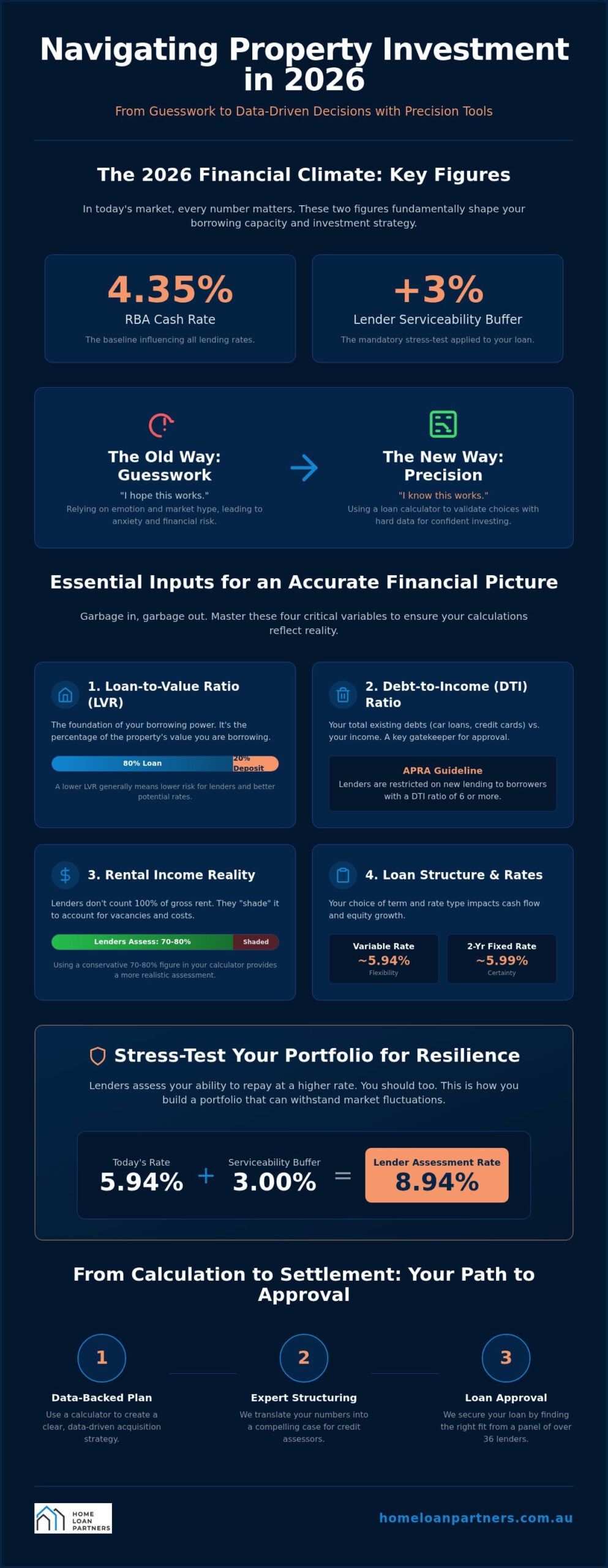
A calculation that looks comfortable today might feel very different if the market shifts. While your investment property loan calculator provides a vital snapshot of current costs, the most resilient investors use it to simulate “worst-case” scenarios before they commit. Banks already do this behind the scenes by applying a mandatory 3% serviceability buffer. This means if you’re looking at a variable rate of 5.94%, your lender is actually testing your ability to meet repayments at 8.94%. We recommend adopting this same level of discipline in your personal planning to ensure your portfolio remains a source of security.
Effective scenario planning involves asking difficult questions. What happens if interest rates rise another 1.5%? Or if you face a 10% drop in rental income due to localized oversupply? By modeling these possibilities, you can determine the exact size of the “rainy day” buffer you need to maintain. This proactive approach allows you to build a cash reserve that covers prolonged vacancy periods or unexpected maintenance, ensuring you don’t have to rely on high-interest credit if the market becomes volatile.
The ‘What-If’ Framework for 2026
Testing your portfolio against persistent inflationary pressures is essential for long-term health. As cost-of-living increases impact tenant budgets, your modeling should reflect potential delays in rent increases or higher property management expenses. It’s also vital to monitor your debt-to-income (DTI) ratio. With 2026 regulations capping high-DTI lending, maintaining a ratio below six is often the key to preserving your future borrowing power. Partnering with a professional finance broker can help you validate these assumptions and ensure your stress-tests align with current credit policies.
Risk Mitigation Strategies
If your calculations show that your cash flow is sensitive to minor rate changes, fixing a portion of your loan could provide the stability you need. This “split loan” strategy allows you to hedge against future hikes while keeping the flexibility of a variable component for extra repayments. Diversifying your income streams also acts as a protective layer. If the primary breadwinner’s income changes, having a well-structured portfolio with adequate insurance and liquid buffers ensures your assets remain protected. We can help you review your portfolio’s resilience to ensure you’re prepared for whatever the 2026 market brings.
From Calculation to Settlement: How a Mortgage Broker Secures Your Loan
Using an investment property loan calculator is an empowering first step; it provides the clarity needed to start your journey with confidence. However, a digital tool can’t replicate the nuanced decision-making of an expert collaborator. While a bank’s online tool only shows you what that specific institution is willing to offer, we look at the broader picture. With access to over 36 lenders, we can find the specific policy that fits your unique financial profile, rather than trying to fit your goals into a single bank’s rigid criteria.
Our role involves translating your investment property loan calculator results into a compelling case for credit assessors. We don’t just submit an application; we manage the narrative. This is particularly important in 2026, where credit policies are more complex and scrutiny on debt-to-income ratios is high. We ensure that your loan is structured for longevity, allowing you to move from your first acquisition toward a multi-property portfolio without hitting unnecessary roadblocks. We’re committed to your long-term journey, providing a steady hand through every transaction.
The Power of Choice
The true value of a broker lies in the ability to compare niche products that big bank calculators often ignore. Whether you’re exploring SMSF loans or specialized bridging finance, different lender policies can change your borrowing power by six figures. These variations are often found in how lenders treat rental income or existing debt. Because our professional support is supported by lender-paid commissions, you receive unbiased guidance focused entirely on your future security. We prioritize your understanding, ensuring you feel confident in every choice you make.
Your Next Steps to Property Success
Moving from a digital estimate to a formal pre-approval requires gathering the right documentation, from income statements to property appraisals. We manage the heavy lifting of the application process, coordinating with lenders to ensure a stress-free experience for you. This collaborative journey doesn’t end at settlement; we remain your steady guides throughout the life of your loan. If you’re ready to turn your calculations into a reality, connect with a professional broker at The Home Loan Partners today. We’re here to help you navigate the complexities of the 2026 market with precision and care.
Your Strategic Roadmap to Property Success
Building a resilient property portfolio in 2026 requires a balance of sophisticated data and expert human guidance. By mastering the inputs of an investment property loan calculator, you’ve already taken the first step toward replacing uncertainty with a clear, stress-tested financial model. You now understand that your success isn’t just about the lowest headline rate; it’s about structuring your debt for long-term growth and protecting your cash flow against future market fluctuations. This proactive approach ensures that your investments remain a source of security rather than stress.
The journey from a digital calculation to a successful settlement is one we take together. With access to over 36 Australian lenders and deep expertise in complex investment structures, our team at The Home Loan Partners is ready to act as your expert collaborator. We’ll manage the heavy lifting of the application process while ensuring your loan aligns perfectly with your personal milestones. Our national service is built on a client-first philosophy that values your long-term journey above a single transaction.
Ready to turn your numbers into a reality? Book a Strategy Session with The Home Loan Partners today. We look forward to helping you build a legacy of security and wealth with precision and care.
Frequently Asked Questions
How accurate are investment property loan calculators?
These tools are excellent for initial estimates but aren’t definitive approval documents. They provide a reliable baseline for repayments and yields based on the data you provide. However, they usually don’t account for specific lender policies or your individual credit score. Use them to narrow down your options, then consult with us to confirm the figures across our panel of over 36 lenders.
Can I use equity from my home to buy an investment property?
You can leverage the usable equity in your current home to act as a deposit for your next purchase. This is generally the difference between 80% of your home’s value and your remaining mortgage balance. This strategy removes the need for a cash deposit, though it increases your total debt. We’ll help you structure this so your primary residence remains protected while you grow your portfolio.
What is a good LVR for an investment property loan in 2026?
An 80% Loan-to-Value Ratio (LVR) is typically considered the ideal target for investors in 2026. This level allows you to avoid Lenders Mortgage Insurance (LMI), which is a significant upfront cost that doesn’t add value to your asset. While some lenders allow for higher LVRs, maintaining a 20% equity stake provides a safety buffer against market fluctuations and often secures more competitive interest rates.
Do calculators factor in stamp duty and legal fees?
Most basic tools focus only on loan repayments and don’t automatically include acquisition costs. When using an investment property loan calculator, you must manually add stamp duty, legal fees, and building inspections to your total cash requirement. These costs vary significantly by state, so it’s vital to research the specific charges for the property’s location to ensure your acquisition budget remains accurate and grounded in reality.
How much rental income do banks count toward my borrowing power?
Banks typically don’t count 100% of your rental income toward your serviceability assessment. Most lenders apply a shading factor, usually counting only 70% to 80% of the gross rent to account for potential vacancies and maintenance. Our role is to find lenders who apply more generous shading policies, which can significantly increase your borrowing power compared to a standard bank assessment that uses more conservative estimates.
What happens to my repayments if interest rates change after I buy?
If you choose a variable rate loan, your monthly repayments will fluctuate in line with market changes. With the RBA cash rate currently at 4.35%, many investors choose to fix a portion of their debt for peace of mind. If rates rise, your cash flow might tighten, which is why we emphasize the 3% serviceability buffer during the planning stage to ensure your portfolio remains resilient.
Is it better to choose an interest-only or principal and interest loan?
The choice depends on your specific cash flow goals and tax strategy. Interest-only loans keep your monthly outgoings lower and maximize tax-deductible interest, which is a common strategy for building a portfolio. Principal and interest loans allow you to build equity by paying down the debt over time. We’ll help you evaluate which structure aligns best with your 2026 wealth-building roadmap and your long-term financial security.
Should I use a calculator from a bank or an independent broker?
A bank’s investment property loan calculator only reflects their specific, rigid criteria. An independent broker’s tool is often more comprehensive because it’s designed to prepare you for a multi-lender environment. We provide unbiased guidance and access to 36+ lenders, ensuring you aren’t limited by one institution’s policy. This choice gives you a broader perspective on what’s truly possible for your property journey and future wealth.