

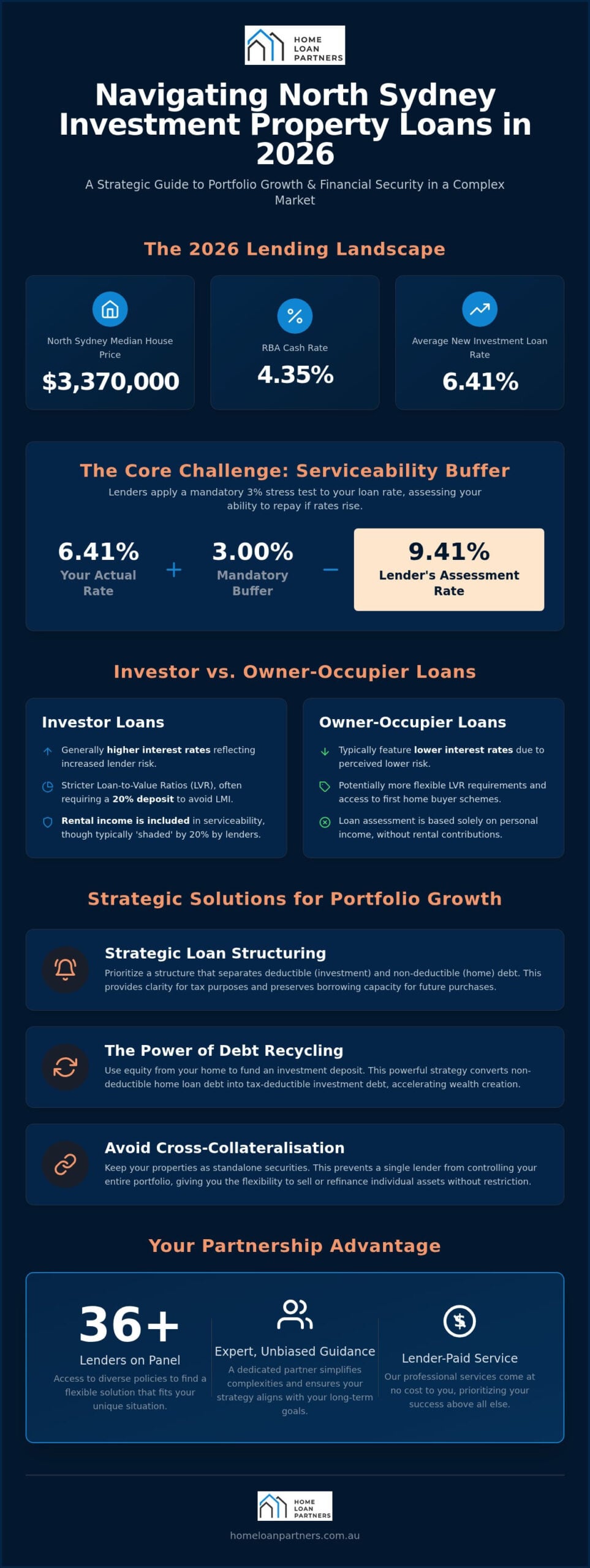
In 2026, the success of your property portfolio depends less on chasing the lowest headline rate and more on how you navigate the strict 3% serviceability buffer. With North Sydney median house prices reaching $3,370,000, securing the right investment property loans north sydney requires a sophisticated approach that balances ambition with protection. You likely feel the pressure of the 4.35% cash rate and the intricate web of lender policies that can make equity use feel like a minefield. It’s completely normal to feel a sense of hesitation when the stakes are this high and the rules of debt recycling seem to shift constantly.
We believe your investment journey should be defined by steady growth rather than financial stress. This guide offers a strategic framework designed to help you master investment lending complexities while protecting your future borrowing capacity. You’ll gain a clear path to portfolio expansion, learn how to optimize tax deductions, and see how a dedicated mortgage broker partnership simplifies the path forward. From analyzing current rental yields to selecting the right loan structure from our panel of over 36 lenders, we’re here to ensure your next move is both calculated and confident.
Key Takeaways
- Learn why strategic loan structuring and debt recycling are more critical for long-term wealth than simply finding the lowest interest rate.
- Discover how to accurately calculate your usable equity to fuel portfolio expansion without overextending your financial position.
- Compare the immediate cash flow advantages of interest-only periods against the long-term security of principal and interest repayments.
- Understand how navigating investment property loans north sydney with a panel of 36+ lenders provides the flexibility needed to bypass restrictive bank policies.
- Explore the benefits of a lender-paid service model that prioritizes your success through expert, unbiased guidance at no cost to you.
Understanding Investment Property Loans North Sydney in 2026
Investment property loans are sophisticated financial tools designed specifically to help you build wealth through real estate. Unlike a standard home loan, these products are structured to maximize tax efficiency and capital growth potential. Securing investment property loans north sydney in 2026 requires more than just a high income; it demands a deep understanding of how lenders view risk and reward. We help you move beyond the simple goal of a loan approval toward a comprehensive lending strategy. This strategy ensures your first investment doesn’t accidentally become your last by preserving your future borrowing capacity.
Investor vs. Owner-Occupier: Key Differences
Lenders categorize investment debt differently than owner-occupied debt because the risk profiles vary. You’ll generally find that interest rates for investors are higher. This reflects the increased statistical risk of default compared to someone’s primary residence. Most lenders also enforce stricter Loan-to-Value Ratio (LVR) requirements, often requiring a 20% deposit to avoid Lenders Mortgage Insurance. These rules help protect both the lender and your long-term equity.
A significant advantage for investors is the inclusion of rental income in the application. Lenders typically “shade” this income, counting only about 80% of the expected rent to account for vacancies and maintenance costs. This calculation is a fundamental part of the Australian property market overview, as it directly influences how much you can borrow. Understanding these nuances helps us tailor a structure that supports your specific financial goals without causing unnecessary stress.
The 2026 Lending Landscape
The current regulatory environment is shaped by APRA’s focus on financial stability. With the RBA cash rate sitting at 4.35% as of August 2026, lenders are under intense pressure to ensure borrowers can handle potential future increases. This is where professional guidance becomes invaluable. We act as your expert collaborator, helping you navigate a market where the average new investment loan rate is 6.41% p.a. and lender policies vary wildly.
The serviceability buffer is a mandatory 3% interest rate stress test that lenders apply to your actual rate to ensure you can afford repayments if rates rise significantly.
By working with a partner who understands these benchmarks, you can find lenders whose internal policies are more favorable to your specific situation. Our panel of over 36 lenders allows us to compare different serviceability models. This ensures you don’t get stuck with a rejection from a single bank when a more flexible option exists elsewhere.
Strategic Loan Structuring for Portfolio Growth
Securing a low interest rate is a great start, but the way you structure your investment property loans north sydney often has a bigger impact on your long-term wealth. A well-designed loan split allows you to segregate deductible and non-deductible debt with precision. This clarity is essential for tax purposes and future expansion. If your current setup feels rigid or outdated, you might want to explore what does refinancing a home loan mean to see how a reset can unlock new opportunities. We see many investors struggle because they prioritize the headline rate over a structure that supports their next three purchases.
The Power of Debt Recycling
Debt recycling is a proactive strategy where you use the equity in your primary residence to fund your next purchase. Instead of using cash savings, you draw down a separate loan account against your home to cover the deposit and costs. This effectively converts non-deductible debt into tax-deductible debt. Understanding the tax implications for investment properties is vital here; the interest on the investment portion of the loan can typically be claimed as a deduction. This process helps you pay off your non-deductible home mortgage much faster while simultaneously building your portfolio. By directing the rental income and tax savings back into your non-deductible home loan, you accelerate your path to being debt-free on your own home.
Avoiding Cross-Collateralisation
Many lenders prefer to cross-collateralise your properties, which means they use both your home and your investment property as security for the same loan. While this might seem convenient, it gives the bank significant control over your assets. If you decide to sell one property, the bank can demand that the proceeds be used to pay down the other loan rather than letting you keep the cash for your next move. This can trap your equity and stall your growth for years. We focus on keeping your properties standalone. By using separate lenders or distinct loan structures, you maintain total flexibility. This independence is a cornerstone of professional management for investment property loans north sydney, ensuring you remain in the driver’s seat of your financial future. We act as your expert collaborator to ensure your portfolio remains agile and responsive to market changes.
Equity, Deposits, and Borrowing Capacity
Moving from a single property to a growing portfolio requires a clear understanding of your current financial strength. When assessing investment property loans north sydney, lenders look beyond your income to see how much “usable” equity you’ve built. Equity is the difference between market value and the remaining loan balance. While your total equity might look substantial on paper, banks typically restrict access to 80% of the property’s value to maintain a safety margin. This ensures you aren’t overexposed if market conditions shift, which is a vital consideration given North Sydney median house prices sit at $3,370,000 as of mid-2026.
Your borrowing capacity isn’t just about what you own; it’s also about what you owe. Personal debts like car loans or HECS balances can significantly reduce the amount a lender will offer for your next investment. Using a home loan calculator is a great first step to estimate your capacity, but it won’t account for the 3% serviceability buffer lenders apply. We act as your expert collaborator to help you understand how these small details impact your final approval.
Calculating Your Usable Equity
To calculate your usable equity, take 80% of your property’s current market value and subtract your existing mortgage balance. For a North Sydney unit with a median price of $1,180,000, 80% equals $944,000. If your current debt is $600,000, you have $344,000 in usable equity to fund a deposit and costs for a new investment. In 2026, bank valuations have become more conservative, so we recommend getting a professional appraisal early in the process. If you want to push beyond the 80% threshold, you might consider Lenders Mortgage Insurance (LMI). While many investors avoid LMI, it can be a strategic tool to enter the market sooner and preserve your cash reserves for future renovations or acquisitions.
Deposit Structures for Investors
Choosing between a cash deposit and using equity is a pivotal decision. Cash offers a clean transaction, but using equity through a deposit bond or bank guarantee keeps your liquidity intact for emergencies. If you’re currently in the middle of a transition, such as selling a primary residence to upgrade while also looking for an investment, bridging finance can provide the necessary breathing room. This allows you to secure the right investment property loans north sydney without the pressure of perfectly timed settlements. We manage the heavy lifting of these complex arrangements, ensuring you have a steady hand guiding you through every valuation and contract exchange.
Interest-Only vs. Principal and Interest: Choosing Your Strategy
Choosing the right repayment structure is a pivotal decision that defines your monthly lifestyle and your long-term wealth. When comparing options for investment property loans north sydney, you’ll find that the choice between interest-only (IO) and principal and interest (P&I) isn’t just about the numbers; it’s about your specific strategy for the next decade. While one path prioritizes immediate cash flow to fund your next acquisition, the other focuses on the steady security of debt reduction. We help you weigh these options through a lens of risk management and future growth.
The Case for Interest-Only Repayments
Interest-only loans allow you to pay only the interest on the borrowed amount for a set period, typically between one and five years. This approach is popular because it keeps your monthly outgoings lower, which is helpful when managing high-value assets in the current market. By minimizing your non-deductible expenses, you can redirect that surplus cash toward your primary mortgage or the deposit for your next property. You also maximize your tax-deductible interest payments in these early years. However, you must be aware that your principal debt remains unchanged, and lenders often charge a premium on the interest rate for this flexibility. In 2026, the average interest rate for new investment loans is 6.41% p.a., but IO rates can often sit slightly higher.
The Case for Principal and Interest
P&I repayments are the traditional choice for building long-term equity. Because you’re paying down the loan balance from day one, lenders view these loans as lower risk and often offer more competitive interest rates. This structure also strengthens your serviceability standing for future lending. Banks prefer to see a track record of debt reduction, which can make it easier to secure additional investment property loans north sydney down the track. It acts as a forced savings plan, ensuring you’re progressively owning more of your asset regardless of market fluctuations. This steady build-up of equity provides a buffer that can be invaluable during periods of cooling property prices.
Offset accounts play a crucial role in both strategies, but they offer distinct advantages for investors. With an IO loan, keeping funds in an offset account preserves your tax-deductible debt while effectively lowering your interest payments. As you approach the end of an IO term, you face what’s known as the “interest-only cliff,” where repayments jump significantly as the loan reverts to P&I. We act as your steady hand during this transition, helping you plan years in advance to ensure the shift doesn’t disrupt your financial security. If you’re ready to model these scenarios for your portfolio, contact our expert team today to explore a tailored lending structure.
Partnering with The Home Loan Partners for Investment Success
Choosing the right support system is just as important as choosing the right property. At The Home Loan Partners, we don’t just process applications; we act as your dedicated collaborator throughout your entire property journey. Securing investment property loans north sydney can be a complex undertaking, but our goal is to make the experience entirely stress-free. By providing a steady hand and clear expertise, we ensure you feel confident in every decision you make for your portfolio’s future. We believe that a successful investment is built on a foundation of trust and long-term partnership.
Why a Broker Beats a Bank for Investors
Walking into a single bank branch limits you to a handful of products that might not fit your long-term goals. We provide access to a panel of over 36 lenders, ranging from major institutions to boutique specialists. This diversity is particularly valuable when structuring investment property loans north sydney, where specific lender niches can make the difference between a rejection and an approval. For investors with complex profiles, such as the self-employed or those with multiple properties, we find the lenders whose policies actually reward your ambition.
Our lender-paid model means we receive a commission from the bank once your loan settles, allowing us to offer you expert guidance at no cost to you. This structure aligns our interests with yours perfectly. Our priority is finding the loan that best supports your wealth-building strategy, not the one that benefits a single bank’s bottom line. We handle the negotiations and the paperwork, managing the heavy lifting so you can stay focused on your investment targets. Our involvement continues long after settlement; we review your loan regularly to ensure it remains competitive as the market evolves.
Starting Your Investment Journey
Success in 2026 starts with a clear understanding of your current borrowing power. A strategy call with our team helps you see the path forward without the pressure of a formal application. To secure an approval in the current environment, you’ll need to prepare documentation that demonstrates your financial stability. This typically includes up-to-date tax returns, proof of rental income, and a clear overview of your existing equity. We guide you through this preparation with patience and precision, ensuring your application is positioned for success from the very beginning.
We pride ourselves on being more than just a service provider; we’re your partner in achieving major life milestones. Whether you’re looking to purchase your first investment or you’re ready to expand an existing portfolio, we’re here to provide the steady expertise you need. Book your strategy session with The Home Loan Partners today to begin building your future with a partner who values your success as much as you do.
Build Your Legacy with Strategic Lending
Building a successful property portfolio in the current 2026 climate requires moving beyond simple loan approvals. It’s about mastering the serviceability buffer and choosing between interest-only and principal and interest repayments based on your long-term vision. By prioritizing standalone loan structures over cross-collateralisation, you maintain the flexibility needed to respond to market shifts. Securing investment property loans north sydney doesn’t have to be a source of stress when you have a dedicated partner managing the heavy lifting for you.
We provide access to over 36 leading Australian lenders and offer expert guidance on complex loan structures to ensure your portfolio remains agile. Our lender-paid service ensures you receive premium, unbiased advice without adding to your investment costs. We act as your steady hand, navigating the technical jargon to focus on what matters most: your future security and major life milestones.
Secure your property future with a tailored investment strategy from The Home Loan Partners. Your journey toward financial freedom is a marathon, not a sprint, and we’re ready to help you take that next confident step today.
Frequently Asked Questions
How much deposit do I need for an investment property in 2026?
You typically need a 20% deposit plus transaction costs to secure an investment property in 2026 without paying Lenders Mortgage Insurance. While some specialized lenders allow for a 10% deposit, you’ll generally need 20% to unlock the most competitive rates. This buffer protects your position in a shifting market and ensures you meet the strict serviceability requirements currently enforced by major Australian lenders.
Can I use the equity in my current home to buy an investment property?
You can certainly use the usable equity in your current home to fund the deposit and costs for a new investment. This process involves a new loan application where the lender assesses 80% of your home’s current market value minus your remaining mortgage. Using equity is a powerful way to grow your portfolio without depleting your cash reserves, provided you have a clear strategy for managing the increased debt.
Is interest on an investment property loan tax-deductible in Australia?
The interest charged on a loan used to acquire an income-producing asset is generally tax-deductible in Australia. This remains a fundamental component of investment property loans north sydney and a key driver for wealth creation. You can typically claim deductions for interest and other property-related expenses against your rental income. We recommend partnering with a specialist accountant to ensure you’re maximizing these benefits while staying compliant with current taxation laws.
What is the difference between an offset account and a redraw facility for investors?
An offset account is a separate transaction account that reduces the interest you pay, while a redraw facility allows you to pull back extra repayments made directly into the loan. Investors often prefer offset accounts because they maintain the integrity of the original loan balance for tax purposes. Redrawing funds can sometimes mix personal and investment debt, which complicates your tax deductions. We help you choose the structure that best preserves your future flexibility.
How many lenders can a mortgage broker access for investment loans?
A specialized mortgage broker provides you with access to a panel of over 36 lenders, including major banks and non-bank specialists. This variety is crucial because every lender has different policies regarding serviceability and complex income types. By working with us, you aren’t stuck with the limited products of a single bank. We compare dozens of options to find the specific loan structure that aligns with your long-term property goals.
What happens when my interest-only period ends?
Your loan will typically revert to principal and interest repayments once the interest-only period concludes. This transition often leads to a sharp increase in your monthly commitment, sometimes referred to as the interest-only cliff. It’s vital to plan for this change well in advance. We act as your expert collaborator to review your options, which may include extending the interest-only period or refinancing to a lender with more favorable terms for your situation.
How does rental income affect my ability to borrow for an investment property?
Lenders count a portion of your projected rental income to help meet their serviceability stress tests. Most institutions will “shade” this income by 20% to account for management fees and potential vacancy periods. This additional cash flow can significantly increase your borrowing capacity, allowing you to secure larger investment property loans north sydney. We help you present this income accurately to lenders to ensure your application reflects your true financial strength.
Is it better to have a fixed or variable rate on an investment loan right now?
Deciding between fixed and variable rates depends on your individual risk tolerance and your need for loan features like offset accounts. Fixed rates provide certainty in a fluctuating market but often limit your ability to make extra repayments. Variable rates generally offer more flexibility and access to full offset facilities, which can be invaluable for managing cash flow. We analyze your portfolio to help you decide which path best supports your 2026 investment strategy.