

Last Tuesday, a family we worked with found their perfect forever home, but they hadn’t even put a “For Sale” sign on their current property yet. It’s a common situation that brings a mix of excitement and the sudden fear of being stuck with two mortgages indefinitely. Understanding the current bridging finance interest rates australia is offering in 2026 is the first step toward turning that stress into a structured, manageable plan. You aren’t alone in worrying that interest costs might eat into your hard-earned equity, but with the right guidance, this transition can be a steady path to your next milestone.
We understand that “peak debt” calculations and lender terms can feel overwhelming. This guide provides a clear look at the true cost of bridging loans in today’s market, helping you secure a competitive rate while you transition between homes. We’ll explore how different lenders structure their products, comparing the major banks against more flexible alternatives, and share strategies to minimize your total interest bill. You’ll also learn about interest capitalization, a vital feature that can protect your monthly cash flow while you focus on selling your original property.
Key Takeaways
- Discover how bridging loans provide a short-term financial bridge, typically lasting 6 to 12 months, to help you secure a new home before selling your current one.
- Learn the critical difference between peak debt and end debt, which is essential for accurately calculating the total cost of your loan.
- Compare current bridging finance interest rates australia provides across major banks and flexible non-bank lenders to find a structure that aligns with your financial goals.
- Gain practical strategies to minimize interest costs, such as negotiating settlement periods and setting realistic sale prices for a faster transition.
- Understand how a personalized brokerage approach can simplify complex peak debt calculations and give you access to over 36 different lending options.
What Are Bridging Finance Interest Rates in Australia?
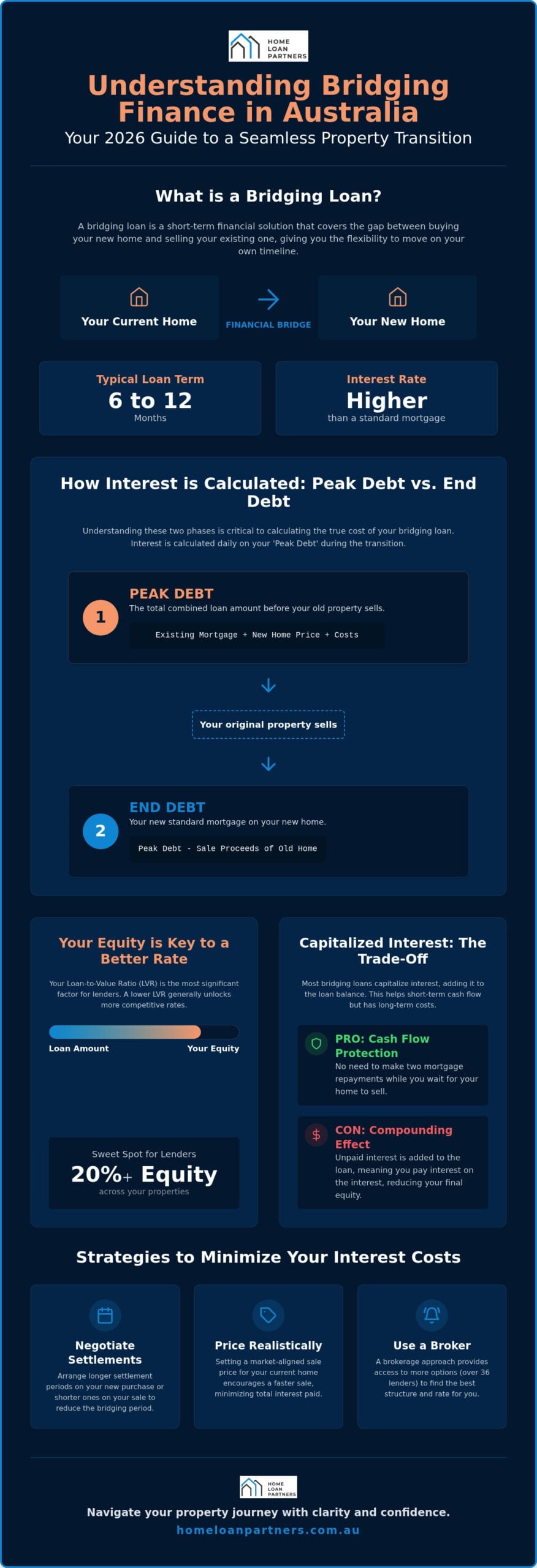
A common question we hear is: What is a bridging loan? Simply put, it’s a short term financial bridge designed to cover the gap between buying a new property and selling your current one. Most of these loans have a term of 6 to 12 months. While they offer incredible flexibility, bridging finance interest rates australia lenders set are typically higher than your standard variable mortgage. This “convenience premium” exists because the lender is providing you the freedom to move when the right home appears, rather than waiting for a settlement date that might not align perfectly with your plans.
In 2026, the Australian property market has seen varied movements, with national home prices falling by 0.3% in July 2026. This slight cooling, combined with KPMG’s forecast of a 1.1% fall in house values over the 2026 calendar year, means lenders are paying closer attention to the “peak debt” you carry during the transition. When you’re comparing options, it’s vital to look past the headline rate. The comparison rate is often more telling, as it includes the setup fees and government charges that can add up quickly on a short term facility.
How Bridging Rates Differ from Standard Mortgages
Lenders view the transition period between homes as a higher risk scenario because you’re temporarily responsible for two debts. Because of this, the interest margin added to the RBA cash rate is usually wider than what you’d see on a traditional 30 year home loan. Some lenders try to help with initial cash flow by offering “honeymoon” periods. For instance, some major banks offer a specific rate for the first three months, which then increases by 1.00% for the remainder of the term. We help you look at these structures to ensure the “honeymoon” doesn’t lead to an expensive surprise later on.
The Role of Equity in Securing Lower Rates
Your Loan to Value Ratio (LVR) is the most significant factor in determining the rate you’ll be offered. Most lenders in the 2026 market allow borrowing up to 80% of the new home’s value. Having 20% or more equity across your properties is the “sweet spot” that often unlocks more competitive pricing and a smoother approval process. If you’re trying to figure out your current standing, using a home loan calculator can help you estimate your equity position. A solid equity buffer gives lenders the security they need to offer their most favorable terms, keeping your transition costs as low as possible.
How Interest is Calculated: Peak Debt vs. End Debt
Understanding how your lender calculates interest is the best way to avoid “sticker shock” during your property transition. Unlike a standard mortgage where interest applies to a single balance, bridging finance in Australia involves two distinct phases: peak debt and end debt. It’s a lot to manage. When you buy your next home before selling your current one, your lender looks at the total exposure they have across both properties. This total amount is your peak debt.
Peak Debt is the combined total of your existing mortgage and the purchase price of your new home, plus any associated costs like stamp duty or legal fees. During the bridging period, bridging finance interest rates australia lenders apply are typically calculated daily on this entire peak balance. This means you’re paying interest on a much larger sum than you likely ever have before. End Debt is the remaining balance once your original property sells and the proceeds are used to pay down the peak debt. This becomes your new standard mortgage moving forward.
If you’re feeling unsure about how these numbers apply to your situation, we can help you model your specific scenario to ensure there are no surprises.
Capitalized Interest: The Pros and Cons
Most borrowers choose to capitalize their interest during the bridge. Interest capitalization is a method where unpaid interest is added to the principal loan balance. This offers a significant cashflow benefit because you don’t have to make two sets of mortgage repayments while waiting for your house to sell. However, you should be aware of the compounding effect. Because the interest is added to the loan each month, you’ll eventually pay interest on that interest. This reduces the final equity you’ll have in your new home, so it’s a trade-off between current lifestyle comfort and long-term debt levels.
Interest-Only Repayments vs. Compounding
If your budget allows, making interest-only repayments on the peak debt can save you money in the long run. By paying the interest as it accrues, you prevent the loan balance from growing. It keeps your end debt as low as possible. Not every lender allows this, as they must ensure you can comfortably service the total debt. We often see clients choose a hybrid approach, paying what they can to protect their equity. For a hypothetical example, a $1,200,000 peak debt held for six months could accrue significant interest. If capitalized, that total is added to your final mortgage; if paid monthly, your final mortgage starts exactly where you planned.
Comparing Bridging Rates: Banks vs. Non-Bank Lenders
When you’re searching for the best bridging finance interest rates australia has to offer, the source of your loan matters just as much as the percentage on the page. In 2026, the market is broadly split between traditional institutions and agile non-bank lenders. Major banks provide a sense of security and often link their bridging rates to their standard variable products. However, they typically have rigid servicing criteria that can be difficult for some families to meet. Non-bank lenders are gaining significant ground this year because they offer speed and a willingness to look at complex income profiles, even if their headline rates occasionally exceed 10% p.a.
It’s essential to look at the “Total Cost of Credit” rather than just the interest rate alone. This figure includes establishment fees, which can start from 0.60%, along with government charges and settlement fees. Tier 2 and Tier 3 lenders are becoming a go-to for many Australians because they often allow for more flexible repayment structures that the big banks might shy away from. We help you weigh these costs against the benefits of a faster approval, ensuring you don’t miss out on your dream home while waiting for an institutional credit committee to meet.
The Big 4 Bank Approach to Bridging
The major banks usually offer 12 month terms and almost always require you to hold both your existing mortgage and your new permanent loan with them. You should watch out for the “Rate Jump” trap. For example, a typical major bank bridging product in 2026 might offer an initial rate for the first 90 days, only to automatically increase that rate by 1.00% for the remainder of the term. This structure puts immense pressure on you to sell your home quickly. Understanding these nuances is a key part of our bridging finance strategic advice, ensuring you don’t get caught by a sudden spike in costs if your sale takes longer than expected.
Niche Lenders and Specialist Bridging Products
Specialist lenders often provide relocation loans tailored for those with non-standard needs, such as self-employed borrowers or those with multi-step financing requirements. These products might not be advertised on billboards, but they often offer the “no-repayment” periods that make a transition truly stress-free. Finding these “off-market” rates is where a finance broker becomes an invaluable partner. We compare your options across 36+ lenders to find the one that fits your specific timeline and equity goals, rather than trying to fit you into a generic bank product.
Strategies to Minimize Your Bridging Interest Costs
Managing your property transition effectively can save you tens of thousands of dollars in interest. While the headline bridging finance interest rates australia lenders promote are important, your strategy as a seller is the biggest variable in the total cost equation. Setting a realistic sale price for your current home isn’t just about finding a buyer; it’s about stopping the interest clock as soon as possible. Every week your property sits on the market, you’re paying interest on your peak debt. We often suggest that a slightly lower sale price can actually result in a higher net gain if it shortens your bridging period by a month or two.
Beyond the sale price, you should look closely at the discharge costs and exit fees associated with the loan. Some products have low entry rates but high fees when you finally settle and move to a permanent loan. If your lender allows an offset account during the bridging phase, use it. Parking your savings there can significantly reduce the interest calculated on your peak debt balance. If you want to see how these savings look for your specific situation, you can request a tailored bridging strategy from our team today.
Timing Your Sale and Purchase
The ultimate goal for any homeowner is a simultaneous settlement. If your sale and purchase settle on the same day, you might avoid a bridging loan entirely. Even a 14 day difference in settlement dates can be costly. On a $1,200,000 peak debt, those two weeks of interest add up quickly. Negotiating a longer settlement on your new purchase, such as 90 or 120 days, gives you a wider window to find the right buyer and align those dates. We work closely with your real estate agent and legal team to ensure these timelines are synchronized, protecting your equity from unnecessary erosion.
Avoid the “Default Rate” Pitfall
You need to be aware of the “rate cliffs” that some lenders build into their contracts. As we discussed earlier, some banks increase your rate after the first few months, but there is a second cliff at the end of the term. Most Australian bridging loans expire after 12 months, after which penalty rates may apply. If your property hasn’t sold by this point, your lender might shift you to a significantly higher default rate or even require immediate repayment of the peak debt. We help you identify these “step-up” clauses early on so you can plan your marketing strategy with full transparency of the risks involved.
Securing Your 2026 Bridging Loan with The Home Loan Partners
Moving house is one of life’s most significant milestones. It’s often accompanied by a mountain of paperwork and the looming pressure of financial deadlines. While we’ve explored how bridging finance interest rates australia lenders charge can impact your equity, the right loan structure is what truly protects your future. A bank might offer you a one size fits all bridging feature, but we believe your situation is unique. Our team acts as a steady hand, navigating the complexities of the 2026 market so you don’t have to.
We manage the heavy lifting by calculating your borrowing power across 36+ Australian lenders. This broad access allows us to find flexible terms that a single bank simply cannot match. We focus on reducing your financial stress by handling the documentation and lender negotiations with precision. Our commitment is to find a path that preserves your home equity, allowing you to move into your new space with peace of mind. We view this as a partnership, supporting you from the moment you start looking at properties until you are settled in your new home.
Beyond the Interest Rate: Expert Loan Structuring
Expert loan structuring is about more than just the lowest percentage. It’s about matching the right lender to your property type and your specific sale timeline. We also look ahead, integrating your bridging loan into a broader refinancing strategy. This ensures that once your original home sells, you’re positioned with a permanent mortgage that remains competitive for the long term. Our roadmap takes you from peak debt back to a manageable end debt with total clarity. We ensure your transition is logical and predictable, avoiding the jarring surprises that often come with generic bank products.
Start Your Property Transition Today
Early planning is the secret to a stress free bridge. Before you make an offer on that perfect property, it’s vital to know exactly where you stand. We provide clear, obligation free insights that won’t affect your credit score in the initial stages. By preparing now, you can walk into your next open home with the confidence that your financing is already mapped out. Our expert collaborators are ready to guide you through every hurdle and ensure your property journey is a success. Speak to a Home Loan Partner about your bridging options today.
Take the Next Step Toward Your New Home with Confidence
Navigating the transition between properties doesn’t have to be a source of financial strain. By understanding how peak debt works and selecting a structure that avoids unnecessary rate hikes, you can protect your equity while moving into your next chapter. We’ve explored the differences between major banks and flexible non-bank options, showing that the right choice depends entirely on your unique timeline and goals. Staying informed about bridging finance interest rates australia is offering in 2026 ensures you remain in control of your financial journey.
Our team provides expert national mortgage advice and manages the complex paperwork to ensure a stress free transition management experience. With access to 36+ lenders, we specialize in finding tailored solutions that prioritize your long term security. Your perfect home is within reach. We’re here to help you bridge the gap with precision and care. Get a Tailored Bridging Loan Quote from Our Experts.
Frequently Asked Questions
How much higher are bridging loan rates compared to standard home loans?
Bridging loan rates are typically 1.00% to 2.00% higher than standard variable rates because they carry a higher risk profile for lenders. This margin accounts for the fact that you are temporarily managing two properties at once. While standard mortgages might offer lower introductory rates, bridging finance interest rates australia lenders offer reflect the short term nature of the facility. We compare these margins across our panel to ensure you aren’t paying more than necessary.
Can I get a fixed interest rate on a bridging loan in Australia?
It’s very rare to find a fixed interest rate for bridging finance in the 2026 Australian market. Most lenders require these loans to remain on a variable rate because the term is short and unpredictable. Since you’ll likely pay the loan back in full as soon as your property sells, a variable structure avoids the heavy break costs associated with fixed loans. This flexibility allows you to settle early without financial penalties.
Do I need to make monthly repayments on a bridging loan?
You don’t always need to make monthly repayments if your lender allows for interest capitalization. This process adds the monthly interest cost to your total loan balance, which you then pay off once your original home sells. This structure is a popular choice for families who want to avoid the cash flow pressure of managing two mortgages simultaneously. However, some borrowers choose to pay interest monthly to protect their home equity and reduce the end debt.
What fees are associated with bridging finance besides interest?
Beyond interest, you should budget for various setup costs. These typically include:
- Establishment fees, often starting around 0.60% of the loan amount.
- Valuation fees for both your current and new properties.
- Government mortgage registration charges and legal settlement fees.
- Discharge fees as you transition to your permanent mortgage.
We provide a full breakdown of these costs early in the process so there are no hidden surprises for your budget.
What happens to my interest rate if my house doesn’t sell within 12 months?
Most bridging loans in Australia have a strict 12 month expiry date. If your property remains on the market past this point, your lender may transition the debt to a much higher default or penalty rate. In some cases, they might even require immediate repayment of the peak debt. Planning a realistic sale strategy is vital to avoid this rate cliff and ensure your transition remains within the agreed timeframe.
Is interest on a bridging loan tax-deductible for investment properties?
Interest on a bridging loan is generally tax deductible if the funds are used to purchase an income producing investment property. However, if you’re bridging between two primary places of residence, the interest is usually not deductible. Tax laws can be complex, especially when dealing with peak debt structures. We always recommend consulting with a qualified accountant to confirm how these deductions apply to your specific investment portfolio and financial goals.
Can I use an offset account to reduce bridging loan interest?
Some lenders allow you to link an offset account to your bridging facility, which can significantly reduce your interest costs. By keeping your savings in this account, the interest is only calculated on the difference between your peak debt and your offset balance. Not every bridging product offers this feature, so it’s a key detail we look for when comparing options. It’s an excellent way to maintain liquidity while controlling your total debt.
How does the LVR affect the interest rate I am offered for bridging?
Your Loan to Value Ratio (LVR) is a primary factor in determining your offered rate and your overall borrowing power. Lenders typically prefer an LVR of 80% or less across your combined property holdings. If you have more than 20% equity, you’ll often secure more competitive bridging finance interest rates australia wide. A lower LVR reduces the lender’s risk, which often leads to faster approvals and more flexible repayment terms for your transition.