

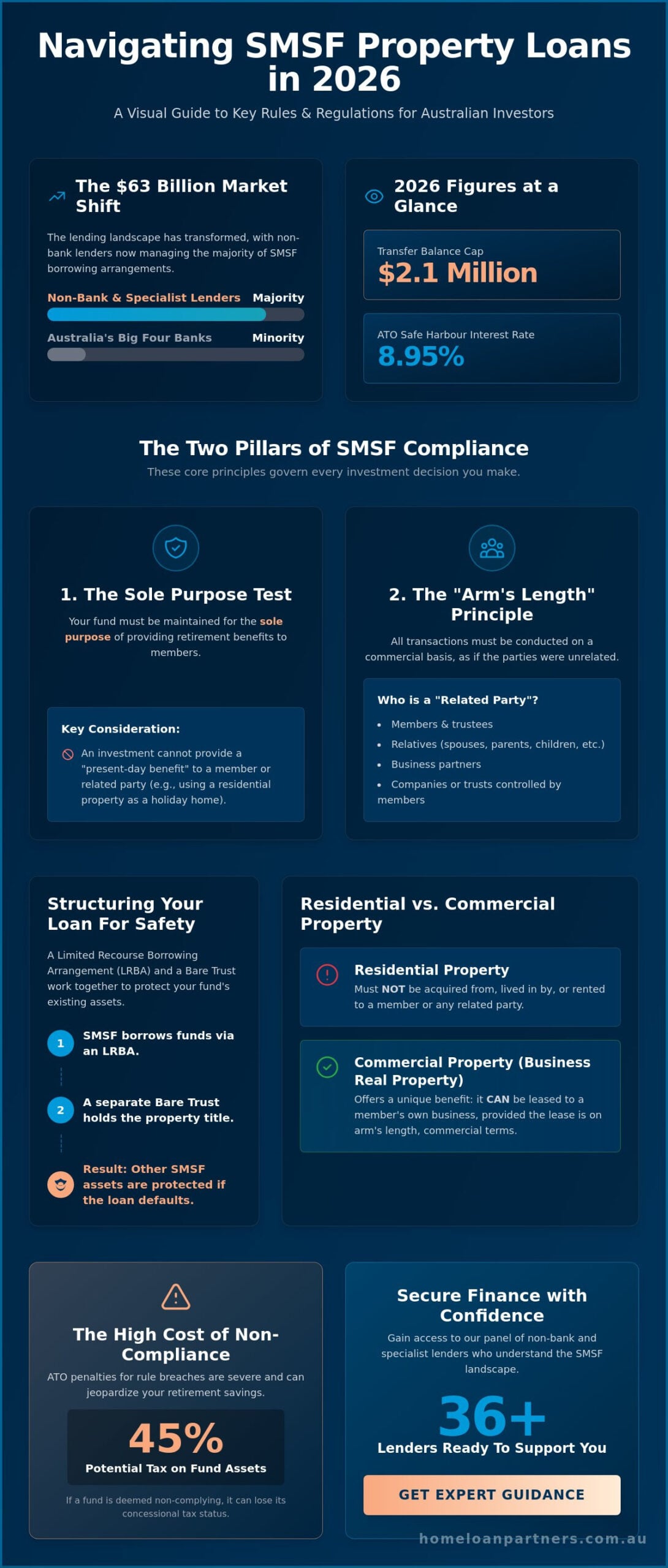
Did you know that while the big four banks have largely stepped back from the market, non-bank lenders now manage the majority of the $63 billion held in Australian borrowing arrangements? Staying on top of the SMSF loan property rules in 2026 requires more than just a passing interest. It demands a precise understanding of how the latest $2.1 million transfer balance cap and the 8.95% safe harbour interest rate impact your wealth-building strategy.
It’s completely natural to feel a bit overwhelmed by the technicalities of “Arm’s Length” requirements or the fear of a sudden ATO audit. You’ve worked hard for your super, and the last thing you want is a compliance slip-up to jeopardize your retirement security. We understand that finding a steady hand to guide you through these complexities is essential for your peace of mind and long-term success.
This guide provides the clarity you need to master the current regulatory landscape, ensuring your property acquisition remains both compliant and profitable. We’ll explore the critical differences between residential and commercial investments, break down the 2026 contribution limits, and show you how to access a panel of over 36 lenders who are ready to support your investment journey.
Key Takeaways
- Understand why every investment must strictly satisfy the Sole Purpose Test to ensure your retirement savings remain fully compliant with ATO regulations.
- Learn how to navigate the 2026 SMSF loan property rules regarding the “Arm’s Length” principle to avoid prohibited transactions with related parties.
- Discover the unique benefits of Business Real Property and how your own business can legally lease its premises from your super fund.
- Identify how Limited Recourse Borrowing Arrangements (LRBAs) and Bare Trusts work together to protect your fund’s existing assets during a property acquisition.
- Gain a clear roadmap for securing finance by understanding why non-bank and specialist lenders have become the primary choice for SMSF investors in the current market.
The Foundation: The Sole Purpose Test and SMSF Property Rules
Every successful investment journey within Superannuation in Australia starts with a clear understanding of the ground rules. The Sole Purpose Test serves as the ultimate benchmark for every decision you make as a trustee. It’s a simple concept with profound implications: your fund must be maintained for the single purpose of providing retirement benefits to its members. When you’re exploring SMSF loan property rules, this test dictates what you can buy and exactly how that asset must be managed.
You can’t buy a residential property and let your children live there, even if they pay full market rent. That would provide a “present day benefit” to a related party, which violates the core intent of the legislation. In 2026, the ATO uses sophisticated data-matching technology to monitor property valuations and rental yields across the country. They’re looking for outliers that suggest a property isn’t being managed on a strictly commercial basis. Understanding the strategic “why” behind these rules helps you build a more robust borrowing case. Lenders are often more comfortable approving your application when they see a documented strategy that prioritizes compliance over lifestyle perks.
What is the Sole Purpose Test?
The Sole Purpose Test is the legal requirement that an SMSF is maintained only for the purpose of providing retirement benefits to members or their dependents upon death. While the law distinguishes between primary and incidental benefits, the line is incredibly thin. If an investment choice is influenced by a desire to provide a benefit to a member today, it’s likely to fail. This is why your investment strategy must be documented and signed off before you even step foot in an auction. It proves the acquisition is a calculated move for your future security rather than a convenient solution for your current needs.
Consequences of Non-Compliance
The ATO doesn’t take breaches lightly. If your fund is deemed non-complying because it failed to follow SMSF loan property rules, the financial impact is immediate and severe. Your fund could lose its concessional tax status, meaning the entire value of your assets could be taxed at the highest marginal rate, which is currently 45%. This can wipe out years of hard-earned growth in a single stroke.
Independent auditors act as your first line of defense during the annual SMSF review. They’re required to report significant contraventions, but they also offer a chance to catch “honest mistakes” early. If you identify a compliance slip-up, such as an accidental related-party transaction, it’s vital to act quickly. Rectifying the issue through a voluntary disclosure before an audit begins can often prevent the most heavy-handed penalties. We’re here to help you stay on the right side of these regulations so you can focus on the growth of your portfolio with total confidence.
The “Arm’s Length” Principle: Who Can Use the Property?
The “Arm’s Length” principle is the practical safeguard that ensures your fund stays on the right side of the law. While the Sole Purpose Test defines your motivation, this rule governs your actions. It requires every transaction to be conducted as if there were no prior relationship between the parties. This means the terms of a lease or sale must reflect exactly what would happen in the open market. Understanding these SMSF loan property rules is vital because even a small oversight can lead to significant penalties.
A common question we hear is, “Can I stay in my SMSF-owned holiday home for just one weekend if I pay full market rent?” The answer is a firm no. The ATO views any personal use as a breach, regardless of whether you pay rent. This isn’t just about money; it’s about the fundamental requirement that the asset exists solely for your future retirement. As noted in this Moneysmart guide to SMSFs, the responsibilities of a trustee are significant, and maintaining this separation is a non-negotiable part of the role.
Defining “Related Parties” in 2026
The definition of a related party is broader than many investors realize. In 2026, the ATO considers the following groups as related parties:
- All members and trustees of the SMSF.
- Relatives of members, including spouses, parents, siblings, and children.
- Business partners of any member or trustee.
- Companies or trusts that are controlled or significantly influenced by a member or their associates.
While distant cousins or in-laws might seem far enough removed, they often require careful legal scrutiny. The 2026 family trust regulations have increased the ATO’s focus on any “associate” who might indirectly benefit from fund assets. If there’s any doubt about a connection, it’s best to seek professional guidance before proceeding with a transaction.
The “No Personal Use” Rule for Residential Assets
The 2026 SMSF loan property rules regarding residential assets are absolute. These properties must be strictly for external, unrelated tenants. You cannot buy a house from a family member, nor can you sell a fund asset to a relative. In 2026, the ATO’s oversight has become even more precise. They often cross-reference social media check-ins and utility usage patterns to identify if a property is being used by the owner rather than a tenant.
Rent-free arrangements or “mates’ rates” for family members are also prohibited. Every dollar of income must reflect current market conditions to protect the fund’s integrity and your future wealth. If you’re feeling unsure about how to structure your next acquisition, reaching out to an expert SMSF loan specialist can provide the clarity you need to move forward safely.
Residential vs. Commercial SMSF Property: Key Differences
While residential property rules are strict about personal use, commercial property offers a powerful strategic advantage known as the Business Real Property (BRP) exception. This exception is a game-changer for business owners. It allows your super fund to purchase the very building where you operate your business. Under the 2026 SMSF loan property rules, this is one of the few instances where a related party can legally occupy an asset owned by the fund. It’s a unique opportunity to align your current professional needs with your long-term retirement goals.
Choosing between residential and commercial isn’t just about the type of building; it’s about how that asset serves your fund’s liquidity. Residential property offers familiarity and often lower entry costs. Commercial property, however, provides a path to consolidate your business expenses into your retirement savings. Lenders in 2026 have distinct appetites for these two categories. While residential loans are seen as stable, commercial loans are often valued for their higher yield potential, provided the lease terms are rock-solid. We’ve seen many clients find great peace of mind by securing their business’s future through this structure.
Leasing to Your Own Business
Buying your own office, warehouse, or retail space through your SMSF is a sophisticated way to manage cash flow. You’ll need to establish a formal commercial lease that strictly adheres to market rates. This ensures the transaction remains at “arm’s length,” as we discussed earlier. Partnering with a business advisory like Business Wise can help you structure these leases to meet all regulatory standards. The primary benefit is that the rent your business pays becomes a tax-effective contribution to your own retirement fund rather than an expense paid to a third-party landlord. It’s a proactive way to build your future security while supporting your current business operations. It turns a standard business cost into a wealth-building tool.
Lending Criteria and LVR Limits
Securing finance for these assets requires a clear understanding of current lender thresholds. In 2026, you’ll typically find that residential SMSF loans offer a Loan-to-Value Ratio (LVR) of up to 80%. Commercial assets are generally viewed as higher risk by second-tier lenders, meaning they often cap their LVRs between 65% and 70%. This higher deposit requirement means your fund must maintain a healthy cash position before and after settlement.
Lenders also look closely at several specific factors during the approval process:
- Liquidity Buffers: Most non-bank lenders now require your fund to hold a cash buffer post-settlement to cover unexpected vacancies.
- Property Location: Regional commercial assets may face stricter scrutiny compared to those in major metropolitan hubs like Sydney or Melbourne.
- Lease Strength: For commercial property, the quality of the tenant and the length of the lease are just as important as the building itself.
We’re here to help you navigate these differing requirements with precision. Whether you’re looking at a suburban house or an industrial unit, our team can help you identify which path aligns best with your fund’s liquidity and your personal milestones.
LRBA and Bare Trusts: Structuring Your Loan for Compliance
Once you’ve identified the right asset, the next step is building the legal framework to hold it. A Limited Recourse Borrowing Arrangement (LRBA) is the only way an SMSF can legally borrow money to purchase property. This structure is designed with your protection in mind. The “limited recourse” part means the lender’s rights are confined strictly to the property being purchased. If the fund defaults, the lender can’t touch your other superannuation assets, such as your shares or cash reserves. It’s a vital safety net that keeps your broader retirement strategy secure while you grow your property portfolio.
Navigating the SMSF loan property rules requires a specific sequence of events. You can’t simply sign a contract in your own name and “fix it later.” Every entity must be in place before the ink dries on the purchase agreement. This precision ensures that the ATO views the transaction as a legitimate investment for the sole purpose of your retirement. We pride ourselves on acting as your steady hand through this process, managing the technical heavy lifting so you can focus on your long-term goals.
The Anatomy of an SMSF Property Purchase
The structure relies on a partnership between three key entities: your SMSF Trustee, a Bare Trustee, and the Lender. The Bare Trustee is a separate company that holds the legal title to the property “in trust” for your SMSF. It’s essential that this Bare Trust is established before you sign the Contract of Sale. A common mistake is using the wrong naming convention on the contract, which can trigger a “double stamp duty” event. This happens when the government treats the transfer of the property as two separate sales. Getting this right from the start is the best way to protect your fund’s capital. If you’re ready to set up your structure, our team can help you secure the right SMSF loans for your specific needs.
Restrictions on Property Improvements
Compliance doesn’t end once you’ve settled on the property. Under the “Single Acquirable Asset” rule, your loan must only cover one specific asset. This rule has big implications for how you manage the property. You’re allowed to use fund money for repairs and maintenance to keep the asset in good working order. However, you cannot use borrowed funds to “improve” the property in a way that changes its essential character. For instance, replacing a worn-out kitchen is usually acceptable maintenance. Adding an extra bedroom or a granny flat might be seen as creating a “new asset.” This could break your loan compliance and lead to heavy penalties. If you plan to renovate, it’s safer to use the fund’s existing cash rather than increasing the loan.
Navigating the 2026 SMSF Lender Panel: How to Secure Approval
The lending environment for self-managed super funds has transformed significantly over the last few years. While the “big four” banks were once the primary source of finance, they’ve largely stepped back from this space. This shift has opened the door for a diverse range of non-bank and second-tier lenders who now dominate the 2026 market. These specialist lenders often have a much higher appetite for the specific nuances of SMSF loan property rules, providing the flexibility that traditional institutions might lack. We’ve seen this transition first-hand, and it’s actually created more opportunities for investors who know where to look.
Today, there are approximately 653,000 SMSFs in Australia, and around 10% of them utilize borrowing arrangements to build their portfolios. This scale has encouraged lenders to refine their products, focusing more on serviceability and the long-term security of the fund. Understanding how these lenders view your application is the first step toward a successful acquisition. It’s not just about meeting a checklist; it’s about demonstrating that your fund is a stable, well-managed vehicle for wealth creation.
The Advantage of a 36+ Lender Panel
Having access to a panel of over 36 lenders is about more than just finding a competitive interest rate. It’s about finding the right home for your specific investment. Different lenders have different “sweet spots” for property types. Some may specialize in high-density apartments in city centers, while others are more comfortable with NDIS-approved housing or regional commercial assets. If a major bank says no, it doesn’t mean your strategy is over. It usually just means you haven’t found the lender whose criteria match your fund’s unique profile and liquidity position.
The Home Loan Partners’ Collaborative Approach
Securing a stress-free approval depends heavily on how you present your case. We help you prepare a comprehensive “Investor Pack” that anticipates the lender’s questions before they’re even asked. This pack typically includes your certified trust deeds, a signed investment strategy, and a clear history of member contributions. Lenders in 2026 place a heavy emphasis on post-settlement liquidity, so showing a healthy cash buffer is often the key to a smooth process.
Our role is to act as your expert collaborator. We don’t just find a loan; we work alongside your accountant and financial adviser to ensure every detail aligns with the complex SMSF loan property rules we’ve explored in this guide. This partnership ensures that your borrowing structure is built for longevity and total compliance. We manage the heavy lifting of the application, from the initial assessment to the final settlement, providing a steady hand at every turn. If you’re ready to take the next step in your investment journey, Speak with our SMSF lending experts to assess your borrowing power today.
Your Path to a Secure Retirement Property Portfolio
Building a property portfolio within your super is a powerful way to secure your future, provided you respect the compliance framework. We’ve explored how the Sole Purpose Test and the “Arm’s Length” principle act as the vital guardrails for your strategy. By establishing the correct LRBA and Bare Trust structure from the very beginning, you protect your fund’s existing assets while opening up new growth opportunities.
The 2026 landscape is more diverse than ever, and staying on top of the SMSF loan property rules is much easier with a dedicated expert by your side. Our team provides personalised service and expert guidance on complex LRBA structures to ensure your investment journey is smooth and compliant. With direct access to over 36 specialist lenders, we manage the heavy lifting of the application process so you can focus on your major life milestones.
Ready to map out your path? Book a strategy session with The Home Loan Partners today to explore your borrowing power and take the next step toward your goals with total confidence. We look forward to helping you navigate this journey with precision and care.
Frequently Asked Questions
Can I live in a property owned by my SMSF?
No, you cannot live in a residential property owned by your fund. This prohibition extends to your family members and any business associates. The ATO is incredibly strict about this to ensure the asset is used solely for generating retirement benefits. While you can lease a commercial property to your own business, residential use is a complete breach of the rules.
How much deposit do I need for an SMSF property loan in 2026?
Most lenders in 2026 require a 20% deposit for residential properties, which reflects an 80% Loan-to-Value Ratio. For commercial assets, you’ll generally need a larger deposit of 30% to 35%. You must also factor in a cash buffer, as many non-bank lenders require the fund to hold several months of liquidity after settlement to cover unexpected expenses or vacancies.
What is a Limited Recourse Borrowing Arrangement (LRBA)?
An LRBA is a specific loan structure where the lender’s rights are limited to the property being purchased. If the fund cannot meet its obligations, the lender cannot claim other fund assets like your shares or cash reserves. It’s a protective measure required by SMSF loan property rules to keep your broader retirement savings safe from potential investment risks.
Can my SMSF buy a property from me or my business?
Your fund cannot purchase residential property from a related party, even if you pay full market value. However, you can sell commercial “Business Real Property” to your SMSF. This exception allows business owners to move their premises into their super fund, provided the transaction is conducted at a verified market price and documented correctly to satisfy the ATO’s requirements.
Can I use my SMSF to renovate a property I just bought?
You can use the fund’s existing cash for repairs and maintenance, but you cannot use borrowed money to improve or transform a property under an LRBA. Adding a bedroom or a pool is often considered an “improvement” that creates a new asset. This would violate borrowing restrictions, so it’s vital to plan any works carefully with your adviser before you begin.
What are the ongoing costs of holding property in an SMSF?
Holding property in your fund involves several standard costs, including annual independent audits and specialised accounting fees. You’re also responsible for council rates, insurance, and land tax, all of which must be paid directly from the fund’s bank account. If you use a property manager, their fees are also a fund expense, ensuring the asset is managed professionally and at arm’s length.
For trustees managing more complex financial structures or international interests, Samios Partners offers specialized advisory services to ensure your fund’s reporting, including ATO foreign exchange calculations, is precise and compliant.
Can I use an offset account with an SMSF loan?
Yes, many specialist and non-bank lenders on our panel offer offset accounts with their SMSF products. An offset account allows you to use the fund’s surplus cash to reduce the interest charged on your loan. This can be a highly effective way to manage your fund’s liquidity while accelerating the growth of your net equity over the long term.
What happens to the property when I retire?
When you reach retirement and move into the pension phase, you can choose to keep the property and use the rental income to fund your pension payments. Alternatively, you might decide to sell the asset. One of the major benefits of this strategy is that if the property is sold while the fund is in the pension phase, the capital gains tax is often significantly reduced or even eliminated.