

Securing a land loan in 2026 is often less about your salary and more about the bankability of the specific block you’ve fallen in love with. While you might be ready to start your build, many lenders view vacant land as a higher risk, which is why understanding the specific land loan requirements in Australia is the most critical step in your journey. You might have already discovered that deposit expectations are often higher than standard home loans, or perhaps you’re feeling overwhelmed by complex zoning restrictions and land size caps that vary significantly by council.
It’s completely natural to feel a bit of pressure when the rules seem to change depending on whether you’re looking at a suburban lot or an off-grid rural retreat. We believe this process should be a steady, predictable path toward your future home, not a source of constant stress. This guide will help you master the financial and property criteria needed to secure your piece of land with confidence. We’ll walk through current LVR limits for different land types, the exact documentation you’ll need to prepare, and how to find a lender that understands the unique value of your chosen block.
Key Takeaways
- Understand the core differences between land-only loans and construction packages to ensure your finance matches your long-term building goals.
- Master the specific land loan requirements australia lenders look for, including deposit sizes and LVR limits for various property types.
- Identify how zoning and land size act as the primary filters for loan approval and how to navigate these local council restrictions.
- Prepare a comprehensive application checklist and learn the importance of ordering specialized valuations for vacant land.
- Discover how a collaborative approach across a wide lender panel can help you secure a “yes” for even the most unique blocks of land.
What is a Land Loan and How Does it Differ from a Standard Mortgage?
A land loan, often referred to as vacant land finance, is a specialized mortgage designed specifically for the purchase of a block of land where no dwelling currently exists. Unlike a standard mortgage where a finished house serves as the primary security, a land loan relies solely on the value of the dirt itself. This fundamental difference is why the land loan requirements australia lenders enforce are often stricter than those for an established home. When you buy a house, the bank knows exactly what the asset is worth and how easily it can be resold. With land, there are more variables to consider, from soil quality to future infrastructure.
Lenders view vacant land as a higher-risk asset for a simple reason: liquidity. If a borrower defaults on a home, the bank can usually sell a finished house to a wide pool of buyers relatively quickly. Selling a vacant block can be a slower process and is more susceptible to shifts in the local market. This increased risk is managed through higher deposit requirements and more rigorous checks on the property’s location and zoning. The legalities of these transactions are governed by Australian property law, which provides the framework for how titles are transferred and how mortgages are registered against the land.
Your “future intent” for the site is a major factor in the approval process. Lenders want to know if you plan to build your dream home immediately or if you’re holding the land as a long-term investment. This distinction dictates whether they offer a standalone land loan or a combined package. Having a clear plan helps alleviate lender concerns and positions you as a prepared, low-risk borrower.
Land Only vs. Construction Loans
If you aren’t ready to hire a builder or finalize blueprints, a land-only loan provides the flexibility you need to secure a location before prices rise. It allows you to own the property while you take the time to design your perfect home. However, you should be aware that many lenders impose building deadlines. It’s common for a bank to require that construction begins within two to five years of the loan settlement. Once you’re ready to break ground, you’ll typically transition from your land finance into one of our Construction Loans, where funds are released in stages as your builder hits specific milestones.
The 2026 Land Lending Landscape in Australia
As of June 2026, the RBA cash rate sits at 4.35%. This has influenced the broader market, with interest rates for vacant land typically land between 8% and 10%. While these rates are higher than standard residential mortgages, they reflect the unique nature of land finance in the current environment. We’re also seeing a trend toward planning reforms that favor increased housing density, which can make certain blocks more attractive to lenders. Finding the right fit doesn’t have to be a solo effort. By working with a broker, you gain access to over 36 lenders, allowing us to find the specific institution whose land loan requirements australia policies align with your chosen block and financial situation.
Financial Requirements: Deposits, LVRs, and Serviceability
Preparing your finances for a land purchase requires a different mindset than buying an existing home. Because there’s no potential rental income to offset your mortgage, lenders scrutinize your personal income and existing debts with extra care. This is a core part of land loan requirements australia; you must prove total serviceability on your own merits. Lenders also look for genuine savings, which typically means having your deposit held in a bank account for at least three months. This demonstrates the financial discipline needed to manage a loan where the interest rates currently range between 8% and 10% in the 2026 market.
Your credit score also carries significant weight in this specialized lending space. A high score doesn’t just help with approval; it’s often the key to unlocking better terms and lower fees. Lenders use your credit history as a primary indicator of how you’ll handle the unique risks associated with vacant land. If you’re concerned about how your current financial standing might impact your application, our team can help you explore your borrowing power across our extensive panel of lenders to find a supportive path forward.
LVR Limits by Land Category
The Loan-to-Value Ratio (LVR) is the bank’s safety net, and it varies significantly based on where your land is located. Urban residential blocks in established suburbs are the most “bankable” and often allow for an LVR of up to 90%. In some cases, you might even reach 95% if you qualify for government support. You can find more details on current assistance programs through Housing Australia, which manages national schemes designed to help buyers enter the market with smaller deposits. However, rural-residential blocks or hobby farms are typically capped at an 80% LVR. If you’re venturing into remote areas or looking at large parcels exceeding 50 hectares, be prepared for much stricter terms, as some lenders may require a 50% deposit.
Hidden Costs of Land Acquisition
It’s vital to look beyond the purchase price when calculating your required funds. While stamp duty is often lower on vacant land because it’s calculated only on the land value, other costs can surprise you. Specialized land valuations for remote or non-standard allotments are often more expensive than a standard suburban appraisal. You also need to factor in Lenders Mortgage Insurance (LMI) if your deposit is less than 20%. Since land is viewed as higher risk, LMI providers may have even stricter land loan requirements australia than the banks themselves, sometimes refusing to cover certain postcodes or large land sizes altogether.
Property Requirements: Zoning, Size, and Access
While your financial health is the engine of your application, the physical and legal traits of the land itself often determine if a lender will come along for the ride. Many applicants are surprised to find that the land loan requirements australia lenders enforce are heavily weighted toward the property’s “bankability.” If a bank feels a block is too niche or difficult to resell, they may decline the loan regardless of your income. Zoning is the primary reason these applications hit a wall. Lenders want to ensure that the land is designated for a purpose that aligns with their risk appetite, typically favoring residential use over speculative or agricultural ventures.
Size is another critical factor, often referred to as the “hectare hurdle.” In the Australian lending market, blocks under two hectares (about five acres) are generally treated with the same ease as a standard suburban lot. Once you exceed this size, the pool of available lenders begins to shrink. Large parcels, particularly those over 50 hectares, often trigger a shift into specialized or commercial lending categories. Banks worry that larger blocks are harder to value accurately and take longer to sell in a downturn. They also want to ensure the land isn’t being used for primary production, which changes the loan’s risk profile entirely.
Physical access is a non-negotiable requirement for most mainstream institutions. Your block must have all-weather road access, meaning a standard two-wheel-drive vehicle can reach the property year-round. If the only way to reach your dream site is via a dirt track that washes away in the rain, you’ll likely face a rejection. Environmental factors like Bushfire Attack Level (BAL) ratings and flood overlays also play a significant role. High-risk ratings can lead to higher insurance premiums or, in extreme cases, a lender’s refusal to secure the property at all.
Understanding Zoning Codes (RU, R, C)
Residential zoning, such as R1 or R2, is the gold standard for lenders because it guarantees the land is intended for housing. Rural zoning (RU1 or RU2) is more complex. Banks often worry about the “primary production” trap, where they suspect you might be running a commercial farm rather than a lifestyle property. If the land is zoned as commercial or mixed-use, you’ll likely need to explore Commercial & Business Loans instead of a standard residential land loan, as these require different deposit structures and interest rates.
Essential Services and Infrastructure
Lenders prefer land that is “build-ready,” which usually means having connections to power, water, and sewage already at the boundary. Financing off-grid land is significantly more challenging. While solar power and water tanks are common in rural Australia, some banks view “tank-only” properties as a risk to the property’s future resale value. Serviceability of property refers to the physical and legal readiness of a land parcel to be built upon, including its zoning status and the availability of essential infrastructure. If you’re looking at a remote block, it’s vital to confirm which lenders are comfortable with off-grid setups before you commit to the purchase.
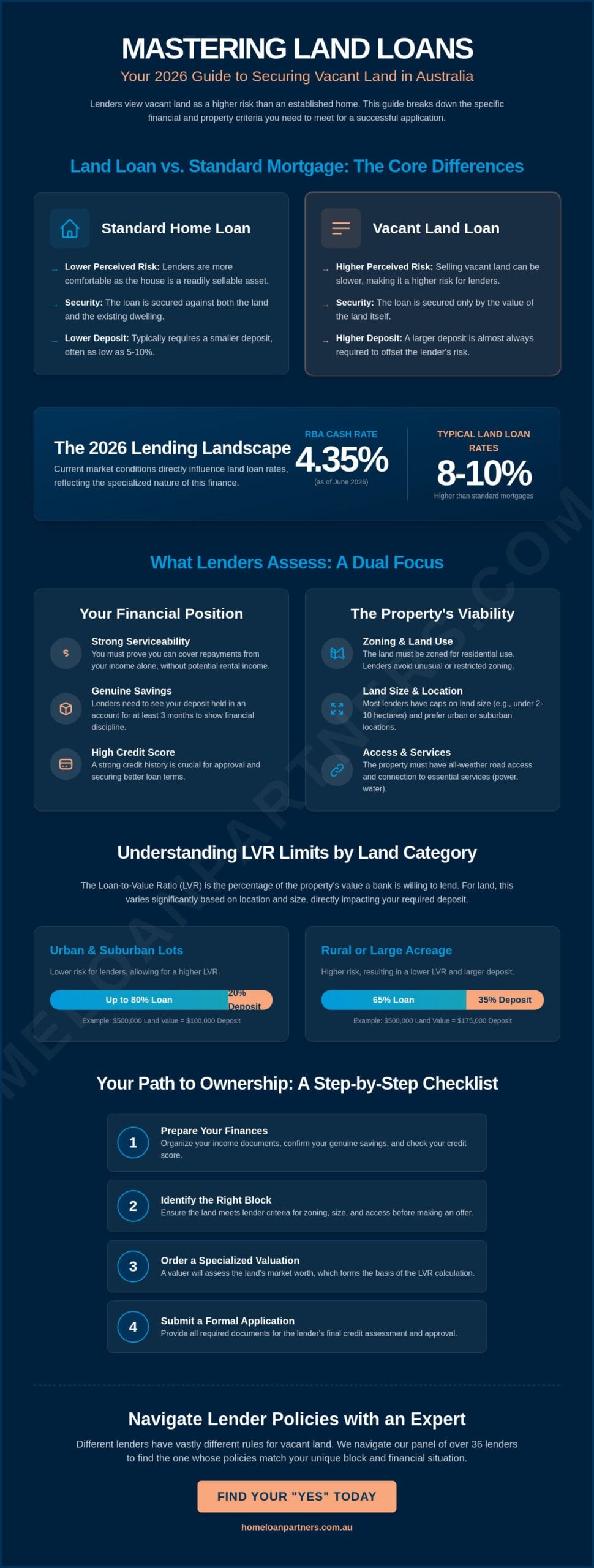
The Land Loan Application Process: A Step-by-Step Checklist
Applying for a land loan is a more deliberate process than a standard home purchase. In 2026, lenders have refined their assessment criteria, making your financial paper trail more important than ever. We start by ensuring your income documentation is airtight. For PAYG employees, this means your two most recent payslips and your latest group certificate. If you’re self-employed, we’ll need two years of tax returns and the accompanying notice of assessments. This level of preparation helps us meet the strict land loan requirements australia lenders now expect from every applicant.
A pivotal step often missed by generic advice is the specialized land valuation. Unlike a house valuation, a land valuer investigates local council planning schemes, easements, and infrastructure access in depth. This happens after you’ve signed a contract but before final approval. We also strongly recommend a thorough review of the Section 32 Vendor Statement, or the equivalent disclosure document in your state. This document reveals any legal encumbrances or heritage overlays that could derail your building plans. Once these checks are clear and your lender is satisfied, the path to settlement usually takes between 30 and 42 days.
Documentation You Will Need
Your application’s success hinges on the quality of your paperwork. Beyond income proof, you’ll need a fully executed Contract of Sale and the Vendor Statement. If you’re planning to build immediately, providing proposed building plans or a fixed-price building contract can often help secure one of our Construction Loans instead of a standalone land loan. This integrated approach can sometimes offer more competitive interest rates and a smoother transition from buying the dirt to laying the slab.
Avoiding Common Pitfalls
Buying land at auction can be risky because “subject to finance” clauses rarely apply in that environment. You must have your pre-approval firmly in place before the hammer falls to avoid losing your deposit. Off-the-plan land also carries a unique valuation risk; if the market shifts before the title is issued, the bank’s valuation might come in lower than your purchase price. Finally, be cautious of land with existing “shacks” or old structures. Lenders may require these to be demolished before they’ll treat the security as vacant land, or they might insist on a different loan product altogether. If you’re ready to start your journey with a team that handles the heavy lifting, you can apply for a land loan assessment today.
How The Home Loan Partners Navigate 36+ Lenders for You
The Australian lending market is vast, and when it comes to vacant land, every bank has its own unique playbook. While one major lender might have rigid land loan requirements australia that exclude your specific postcode or zoning type, another might see the potential in that exact same block. We believe that a single “no” shouldn’t end your dream. By working with over 36 lenders, we act as your expert collaborator, searching for the specific credit policy that aligns with your property’s unique characteristics. This breadth of choice provides the security you need to move forward with confidence, knowing you aren’t limited by the narrow criteria of a single institution.
Our relationship doesn’t end when the land settles. We view this as a partnership that spans from the moment you find the perfect dirt to the day you turn the key in your new front door. Many of our clients start with a land loan and eventually transition into our Construction Loans as their plans take shape. This long-term perspective allows us to structure your initial finance with the future build in mind, ensuring your total debt remains manageable and your investment is secure throughout the entire journey. We also maintain strong ties with niche lenders who specialize in rural or large-acreage blocks, which are often underserved by the big banks.
Expert Guidance for Complex Land Deals
Analyzing the legal and physical traits of a property before you sign a contract is where we add the most value. We look closely at the zoning codes and utility access to ensure the block meets the land loan requirements australia of our lender panel. Our team focuses on tailoring loan structures that aim to minimize your upfront deposit, keeping more of your capital available for the actual building costs. You can learn about our construction loan services to see how we bridge the gap between land acquisition and your completed home with precision and care.
Start Your Property Journey Today
We understand that buying land feels like a high-stakes investment. Our goal is to provide a stress-free experience by managing the heavy lifting of lender negotiations and paperwork for you. We offer unbiased, professional advice that prioritizes your goals over bank profits. Whether you’re looking at a standard suburban lot or a complex rural acreage, we have the steady hand needed to guide you through your options. If you’re ready to take the next step toward your dream home, book a consultation with our experts and let’s map out your path together.
Turning Your Vision into a Registered Address
Securing your ideal piece of land is the foundational step in building your future home. Success in this specialized market depends on more than just your income; it requires a strategic alignment with the land loan requirements australia lenders enforce regarding zoning, property size, and infrastructure. By understanding how these factors influence your borrowing power, you can approach the application process with clarity and confidence. The right preparation ensures that your chosen block is viewed as a bankable asset rather than a lending risk.
We believe that every unique property deserves a tailored financial solution. As your expert collaborator, we provide national mortgage advisory and specialized knowledge in complex property structures. With access to over 36 Australian lenders, our team works to find the specific institution that says “yes” to your aspirations. We’re committed to managing the heavy lifting, allowing you to focus on the exciting design and construction phases ahead. You don’t have to navigate these complexities alone. Secure your land with expert guidance from The Home Loan Partners today. We look forward to supporting you throughout this journey and helping you move one step closer to your dream home.
Frequently Asked Questions
Can I get a land loan with a 5% deposit in Australia?
Yes, you can secure a land loan with a 5% deposit if you qualify for the First Home Guarantee or find a lender willing to accept a high LVR with Lenders Mortgage Insurance. While the standard land loan requirements australia lenders set typically ask for 10% to 20%, government-backed schemes have removed income caps as of 2026, making it easier for eligible buyers to enter the market with a smaller upfront contribution.
Is there a time limit on how long I can hold land before building?
Most lenders impose a construction deadline, typically requiring you to begin building within two to five years of the loan settlement. This ensures the property eventually becomes a completed dwelling, which reduces the bank’s risk. If you don’t intend to build within this timeframe, we can help you find specialized lenders who offer longer holding periods for investment purposes or land banking.
Do land loans have higher interest rates than home loans?
Interest rates for vacant land are generally 1% to 3% higher than standard residential home loans. In the 2026 market, with standard rates around 6-7%, you should expect land loan rates to sit between 8% and 10%. This premium reflects the higher risk banks associate with undeveloped property and the absence of an existing structure that could be quickly resold or tenanted.
What is the maximum land size for a standard residential land loan?
Standard residential land loans usually cap the property size at two hectares, or approximately five acres. Once a block exceeds this size, lenders often reclassify the loan as rural or commercial, which may require a larger deposit of 20% to 50%. We work with niche lenders who are more flexible with larger lifestyle blocks, provided the land isn’t being used for primary production or commercial farming.
Can I use a guarantor for a land loan?
You can use a family guarantor to secure a land loan, which can help you avoid the need for a large cash deposit. The guarantor uses the equity in their own home as additional security for your loan. This is an excellent strategy for buyers who meet the income land loan requirements australia but haven’t yet saved the full deposit required for certain types of specialized land.
What happens if the land valuation comes in lower than the purchase price?
If the bank’s valuation is lower than your purchase price, you’ll need to cover the financial gap with your own cash. Lenders base their LVR on the lower of the two figures, which can leave you with a funding shortfall. This is a common risk with off-the-plan land or unique rural blocks, so we always recommend a pre-valuation where possible before you commit to an unconditional contract.
Can I get a land loan for an off-grid property?
Securing finance for off-grid land is possible, but it’s significantly more challenging than buying land with town services. Most mainstream lenders require connections to electricity, water, and sewage at the boundary. For blocks relying solely on solar and tank water, you’ll likely need to work with specialized lenders who understand the value of sustainable, self-sufficient properties in the current market.
Are first home buyer grants available for land-only purchases?
First home buyer grants are generally not paid out for land-only transactions. Most state governments release these funds only when construction starts or when you settle on a combined house and land package. However, you may still be eligible for stamp duty concessions on the land purchase itself, which can save you significant upfront costs depending on your state’s current property price caps.