

What if the safest way to fund your renovation isn’t by using the equity you have today, but by leveraging the value your home hasn’t even achieved yet? Many homeowners assume a simple loan top-up is the easiest path, but for structural changes, that choice often leads to funding gaps and valuation headaches. When you’re planning a project of this scale, the traditional approach can actually put your financial security at risk.
We understand that the fear of over-capitalising is real, especially with research suggesting that major renovations like adding a primary suite might see a return of only 24 to 36 percent. It’s natural to feel anxious when bank valuations come in low or when you’re caught between complex loan structures and builder deadlines. You want a steady hand to help you use your equity wisely without the stress of unexpected costs.
This guide provides a clear strategy for financing a major home extension in 2026, focusing on cost-effective methods that protect your future. You’ll discover how to navigate Australian construction finance, understand the “30 percent rule” for investment safety, and learn the steps to ensure a smooth approval process that keeps your project moving forward with confidence.
Key Takeaways
- Learn how structural changes like roofline alterations shift your funding requirements from simple equity top-ups to specialized construction finance.
- Compare four primary methods for financing a major home extension to find the most cost-effective balance between interest rates and borrowing power.
- Master the “As-Completed” valuation process to unlock funding based on what your home will be worth once your dream space is finished.
- Gain a step-by-step roadmap for the approval process, including the specific documentation required to secure a smooth, stress-free settlement.
- Discover how partnering with an expert broker provides access to a wide panel of lenders, helping you find a policy fit that the big banks might overlook.
Understanding the Financial Threshold: Major Extension vs. Minor Renovation
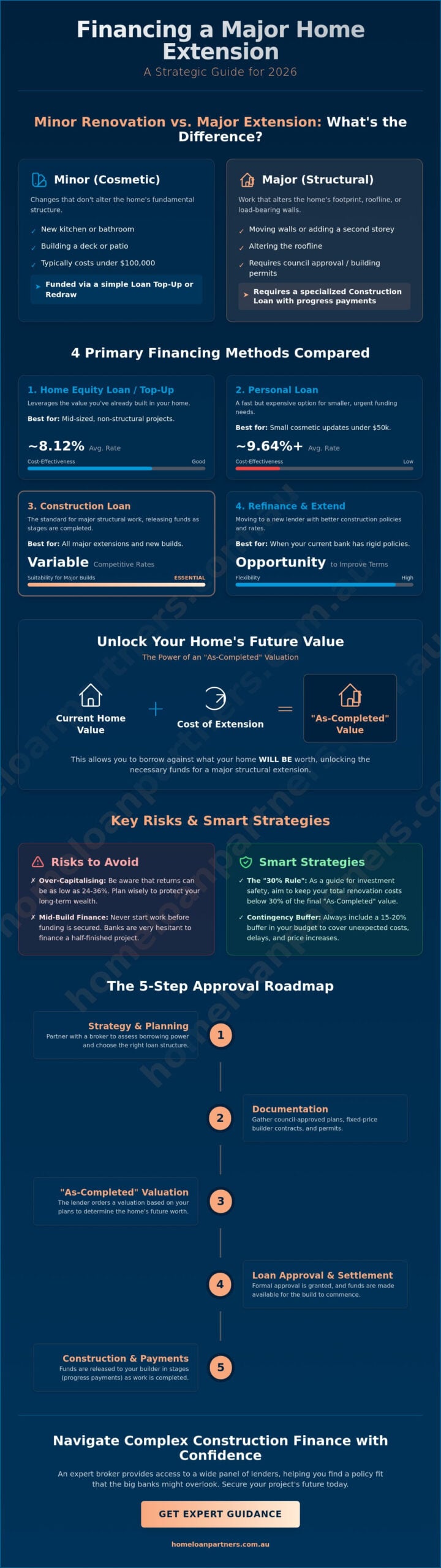
Many homeowners start their journey thinking a simple mortgage top-up will cover the costs. While that works for a new kitchen or a deck, structural changes trigger a completely different set of lending rules. Australian lenders use a strict “Cosmetic vs. Structural” rule to decide how they’ll fund your project. If you’re moving walls, altering the roofline, or adding a new footprint to the land, you’ve crossed the threshold into a major extension. This distinction is vital. It determines whether you can access equity easily or if you need a specialized construction loan. Banks view structural work as higher risk because the property is technically incomplete during the build, which affects their security.
The type of work you choose dictates your choice of mortgage product. For instance, Understanding Home Equity Loans is helpful for smaller projects, but structural extensions usually require a progress-payment structure. In 2026, building costs remain volatile, and renovation spending is predicted to reach a record $524 billion. This high demand for materials and labor means your financial strategy needs to be more robust than it might have been a few years ago. We focus on ensuring your loan product matches the physical reality of your build site to avoid funding delays.
When is an extension considered “Major”?
Generally, if your project requires council approval or a building permit, lenders will classify it as major. Most Australian banks use a $100,000 cost threshold as a rule of thumb. Once you pass this amount, or if the work is structural, they’ll likely insist on a formal construction loan. This is especially true for projects that involve “breaking the seal” of the home, such as adding a second storey or extending the roofline. Keep in mind that owner-builder projects face significantly stricter financing hurdles. Most lenders view these as high-risk and may require higher deposits or offer less competitive interest rates because they lack the guarantee of a licensed contractor’s fixed-price contract.
The financial risks of under-planning your extension
One of the biggest mistakes you can make is starting work before your full funding is settled. Attempting a “mid-build” finance application is incredibly difficult; banks are often reluctant to take on a half-finished project because they can’t easily value the security. This creates a massive risk to your family’s financial stability. When financing a major home extension, you must also consider the long-term wealth impact. Over-capitalising, or spending more than the eventual market value of the home, can stall your financial progress for years. We recommend a contingency buffer of at least 15 to 20 percent to account for inflation and material price shifts. This ensures you aren’t left stranded if the builder encounters unforeseen site issues, providing a steady hand through the complexities of the build.
The 4 Primary Methods for Financing a Home Extension
Choosing the right vehicle for financing a major home extension is about balancing speed, cost, and control. In June 2026, the financial landscape offers several paths, but the right choice depends entirely on the scale of your project. For minor works, a personal loan might be tempting for its speed, yet with average APRs for excellent credit starting at 9.64 percent, the cost adds up quickly. Conversely, home equity loans currently average 8.12 percent, making them a more stable choice for mid-sized projects that don’t require structural oversight.
Your current lender might seem like the logical first stop, but they aren’t always the best fit. Many major banks have rigid policies that don’t account for the nuances of a structural build. We often find that moving to a lender with a more sophisticated appetite for construction allows for better interest-only periods and more flexible drawdown schedules. This ensures your cash flow remains healthy while your dream space takes shape. If you’re ready to explore how your current mortgage can be optimized, our team can help you find a renovation loan that aligns with your builder’s timeline and your long-term goals.
Accessing Home Equity and Redraw Facilities
To find your “usable equity,” calculate 80 percent of your home’s current market value and subtract your existing mortgage balance. This is the amount lenders generally allow you to borrow without incurring extra costs. While using a redraw facility or a “top-up” is the fastest way to access funds, it’s not always the most efficient. Instead of spending your cash reserves directly, keeping them in an offset account provides better liquidity and tax advantages. This strategy protects your family’s safety net while still reducing the interest you pay on the debt.
Construction Loans: Structured Funding for Big Builds
For projects that involve significant structural changes, a construction loan is often the only viable path. This product uses a progressive drawdown mechanism, meaning the bank pays the builder directly as they complete specific stages of the work. During this time, you typically only pay interest on the amount actually drawn down, which significantly helps with cash flow. Lenders will require a fixed-price building contract to ensure the project stays within budget. While international programs like FHA 203k Renovation Loans highlight the global importance of structured oversight, our local market relies on these progress payments to manage risk. When financing a major home extension, this structure provides the security that your funds are being used exactly as intended, protecting both you and the bank.
The Construction Loan Deep Dive: Why Major Extensions Need Structure
When you cross the structural threshold mentioned earlier, your funding needs to become as precise as your architectural drawings. A standard home loan top-up lacks the oversight required for a project that involves pulling apart a house. This is why Construction Loans are the industry standard for significant works. They provide a protective framework that ensures your builder is paid for work completed, not just work promised. This structure gives you a steady hand throughout the process, ensuring that the bank’s interests and your dream home stay perfectly aligned.
The core benefit of this approach is the “As-Completed” valuation. Unlike a standard equity release that looks at what your house is worth today, this method looks at what it will be worth once the final nail is driven. When financing a major home extension, this forward-looking perspective often unlocks significantly more borrowing power, as the value of a four-bedroom home with a second storey is far higher than the two-bedroom cottage you currently inhabit.
The “As-Completed” Valuation Explained
During the application, a valuer reviews your fixed-price contract, detailed specifications, and council-approved plans. They use this data to estimate the future market value of the property. This is a critical step because it allows you to borrow against that future equity. If the valuation comes in lower than the combined cost of the land and the build, don’t panic. This is often a sign that the project might be “over-capitalising,” and it’s a prompt to review your specs with your builder. We help you navigate these valuation results to ensure your investment remains sound and your wealth strategy stays on track.
Managing Progressive Drawdowns
One of the most reassuring aspects of a construction loan is the progressive drawdown schedule. Instead of receiving a lump sum, the bank releases funds in five distinct stages:
- Foundations: Covering the slab or footings.
- Frame: Once the skeleton of the extension is standing.
- Lock-up: When windows, doors, and the roof are secure.
- Fixing: Internal linings, cabinetry, and plumbing are installed.
- Completion: The final finishing touches and site cleanup.
You only pay interest on the money that has actually been spent at each stage. This keeps your monthly costs manageable while the house is a construction site. To keep the process moving, your builder will issue an invoice at the end of each stage. Your lender may send a valuer to inspect the site before releasing the next payment. Keeping your builder and lender in sync is vital; delays in paperwork can lead to work stoppages. We act as the intermediary here, managing the heavy lifting of the paperwork so you can focus on choosing your finishes.
Once the final stage is reached, the lender typically holds the last payment until you provide the Occupation Certificate. This document proves the home is safe and meets all legal requirements. After the build is finished, your construction loan will naturally transition into a standard principal and interest mortgage. This is a perfect time to review your rate and ensure your new, more valuable asset is protected by the most competitive loan structure available.
Step-by-Step: Navigating the Approval Process in 2026
Securing the right path for financing a major home extension requires a synchronized timeline between your architect, your builder, and your lender. It’s not a simple one-step application. Instead, it’s a journey that begins with a clear financial health check to determine your maximum borrowing power before you even engage a designer. By understanding your limits early, you avoid the heartbreak of falling in love with a set of plans that the bank won’t support.
The approval process hinges on the “As-Completed” valuation we discussed earlier. Unlike a standard mortgage, the bank can’t give you a final “Yes” until they see exactly what you intend to build. This means your full approval is often the last piece of the puzzle, falling into place only after your council approvals are in hand and your builder has provided a final, signed contract. We manage this sequence for you, ensuring that each milestone aligns with your builder’s expected start date to prevent unnecessary delays.
The Documentation Checklist
Lenders are precision-oriented when it comes to structural builds. They require specific documents to mitigate their risk. A fixed-price building contract is essential; lenders almost universally reject cost-plus contracts because they provide no certainty regarding the final debt. Your broker will also need your council-approved plans and a full list of specifications, from the type of flooring to the structural steel requirements. Additionally, you must provide proof of the Builder’s Insurance and Home Warranty Insurance. These documents protect your investment if the builder is unable to complete the work, and no lender will settle the loan without them.
Timing Your Application
Timing is everything in the 2026 construction market. While a pre-approval gives you a baseline for your budget, it’s not a guarantee of funding for a specific extension. You should never sign a building contract without a finance clause that allows you to withdraw if the valuation comes in low. Research indicates that complex construction loans can take 60 days or more to reach full approval due to the detailed paperwork and contractor coordination involved. If your builder has a price-increase deadline, we need to move quickly. We recommend starting your formal application the moment your Development Application (DA) is submitted to the council. If you’re ready to start this journey, our team can help you apply for a construction loan and manage the complexities of the 2026 lending environment.
Partnering for Success: How a Mortgage Broker Simplifies Extension Finance
While the “Big Four” banks offer a sense of familiarity, their rigid lending criteria often clash with the complexities of financing a major home extension. These large institutions frequently have strict limits on how much they’ll lend against an incomplete property or may impose aggressive valuation “haircuts” that stall your project before it begins. A specialized mortgage broker acts as your expert collaborator, looking beyond the household names to find a lender whose appetite for construction matches your specific goals. We understand that your project isn’t just a loan application; it’s the creation of your dream space.
By accessing a panel of 36+ lenders, we can identify institutions that specialize in “future-value” lending. This breadth of choice is essential because every project is unique. A lender that is perfect for a simple bedroom addition might be entirely unsuitable for a complex second-storey extension involving significant structural alterations. We manage the heavy lifting between you, the bank, and your builder, ensuring that the financial gears keep turning while you focus on the physical transformation of your home. If your plans involve improving accessibility for ageing family members, you can learn more about mobility products that fit your new layout. Our role is to provide a steady hand, navigating the technical requirements so you don’t have to.
Beyond Interest Rates: Finding the Right Policy
It’s easy to get fixated on a headline interest rate, but for a major extension, policy fit is often more important for your success. Some lenders are “renovation friendly,” allowing for higher Loan-to-Value Ratios (LVR) based on the “as-completed” valuation, while others might restrict you to 80 percent of the current value. A broker also plays a vital role in identifying hidden fees within construction loan contracts, such as inspection fees for every progress payment or specialized valuation costs. We translate this technical jargon into practical language, ensuring you understand every aspect of your commitment before you sign.
A Long-Term Financial Relationship
At The Home Loan Partners, we view your project as a significant life milestone rather than a one-off transaction. Our involvement doesn’t end when the final brick is laid and the occupation certificate is issued. We provide steady, reassuring guidance throughout the often stressful building environment, acting as a buffer between you and the lender’s administrative demands. Once your extension is complete and your home’s value has increased, we check in to ensure your loan structure still serves your long-term wealth strategy. Whether it’s shifting from an interest-only construction period to a more competitive principal and interest rate, we’re with you for the duration of the journey. Ready to expand your home? Let’s structure your extension finance for success.
Building Your Future on Solid Financial Ground
Your home is the foundation of your family’s security and future aspirations. By understanding the structural threshold and leveraging the power of “As-Completed” valuations, you’ve already taken the most important step toward a successful build. Navigating the complexities of financing a major home extension shouldn’t be a solo journey that causes unnecessary stress. We’ve seen how structured progress payments and a robust contingency buffer can protect your wealth while your new space takes shape.
As specialists in construction and renovation finance, we offer unbiased expert advice for NSW homeowners. Our team manages the heavy lifting by comparing options from a panel of 36+ Australian lenders to find the exact policy fit for your project. We act as your steady guide, ensuring your funding strategy is as precise as your architectural plans. Our relationship with you continues long after the final brick is laid, supporting your long-term financial health.
Are you ready to move forward with confidence and clarity? Book a Stress-Free Finance Strategy Session today. We’re here to help you turn your vision into a reality with a plan that truly serves your family’s needs.
Frequently Asked Questions
Can I use a standard home loan for a major extension?
You generally cannot use a standard home loan for structural work like adding levels or moving walls. Lenders usually require a construction loan for projects involving structural changes because the property value is in flux. While a simple equity top-up might cover a kitchen refresh, financing a major home extension requires a product that handles progress payments. This structure protects your investment and ensures the bank’s security remains intact throughout the build.
How much equity do I need to finance a $200,000 extension?
To fund a $200,000 project, you typically need enough equity to ensure your total debt stays below 80 percent of the home’s “as-completed” value. Lenders calculate your usable equity by taking 80 percent of the property’s estimated future value and subtracting your current mortgage balance. If your home will be worth $1,000,000 after work, you could potentially borrow up to $800,000 in total. This structure avoids the extra cost of Lenders Mortgage Insurance.
What is an “As-Completed” valuation and why is it important?
An as-completed valuation is an assessment of what your property will be worth once all planned construction is finished. The valuer reviews your fixed-price contract and council-approved plans to determine this future market value. This is a critical tool for financing a major home extension because it often unlocks significantly more borrowing power than your home’s current value. It ensures your loan reflects the true scale and worth of your improved asset after the build.
Will my bank pay the builder directly during construction?
Yes, your bank will typically pay the builder directly through a series of progress payments at specified construction stages. After the builder issues an invoice for a completed stage, such as the frame or lock-up, you’ll sign a drawdown request form. The lender may then conduct an inspection before releasing the funds. This process ensures the builder is only paid for work actually performed, providing a vital layer of financial security for your family.
Can I stay in my home while the extension is being built?
Whether you can stay in your home depends on the project’s scope and safety requirements. If the extension involves significant roof removal or utility shut-offs, your builder may require you to vacate for a period. From a finance perspective, if you need to rent elsewhere, we’ll factor those living expenses into your borrowing capacity. This ensures you have a sufficient financial buffer to cover both your mortgage and temporary accommodation costs during the build. If you decide to take a break from the construction by heading away, Get U There Shuttles offers specialized private transport for airport and cruise transfers across NSW.
What happens if my extension costs more than the original quote?
If costs exceed the quote, you’ll generally need to cover the difference using your own savings or a pre-arranged contingency buffer. This is why we strongly recommend a 15 to 20 percent cash reserve before starting. Most construction loans are based on a fixed-price contract, which protects you from many price hikes. However, if you request variations or changes during the build, those additional costs usually must be paid upfront by the homeowner.
How long does it take to get a construction loan approved in Australia?
Construction loan approvals in Australia typically take 60 days or more due to the extra layers of documentation required. Unlike a standard refinance, the lender must review council-approved plans, builder insurance, and the fixed-price contract. We help manage this process by ensuring your paperwork is decision-ready before submission. Starting the process as soon as your DA is lodged with the council is the best way to align your finance with the builder’s expected start date.
Is it better to refinance with a new lender for an extension?
Refinancing with a new lender is often a smart move if your current bank has restrictive construction policies. While staying put might seem easier, other lenders on our panel of 36+ may offer better interest-only periods or more generous valuations for structural work. We compare the market to find a policy fit that prioritizes your project’s success. This ensures your loan structure remains a helpful tool rather than a hurdle during your renovation journey.