

Paying off your investment debt as quickly as possible might actually be the slowest way to grow your wealth in the current Australian market. While traditional wisdom suggests clearing debt is always better, a sophisticated interest only loan for investment property strategy can be the key to unlocking capital you didn’t know you had. With national home value growth stalling and Sydney prices dipping by 0.9% as of May 2026, every dollar of cash flow counts more than ever.
We understand that the current lending environment feels restrictive, especially with the APRA debt-to-income limits introduced in February 2026. It’s natural to feel concerned about high interest rates or the eventual shift back to principal repayments. However, when managed with a steady hand, interest-only structures allow you to redirect funds toward non-deductible home debt or new acquisitions. This guide will show you how to maximize your tax deductions, protect your yields against rising costs, and build a clear exit strategy that avoids repayment shock. We’ll explore the latest 2026 regulations and provide a logical path to scaling your portfolio with confidence.
Key Takeaways
- Learn how to navigate the 2026 lending landscape to identify when an interest-only structure aligns with your long-term wealth goals.
- Discover how a tailored interest only loan for investment property strategy can maximize your tax deductions while providing a vital cash flow buffer for your portfolio.
- Master the art of debt recycling to systematically convert your non-deductible home debt into tax-effective investment debt.
- Gain clarity on the financial trade-offs between different repayment types to ensure you’re fully prepared for the end of your interest-only period.
- Understand the importance of strategic loan structuring over simple rate-hunting to secure a resilient and scalable investment future.
What is an Interest Only Loan Strategy for Investment Properties?
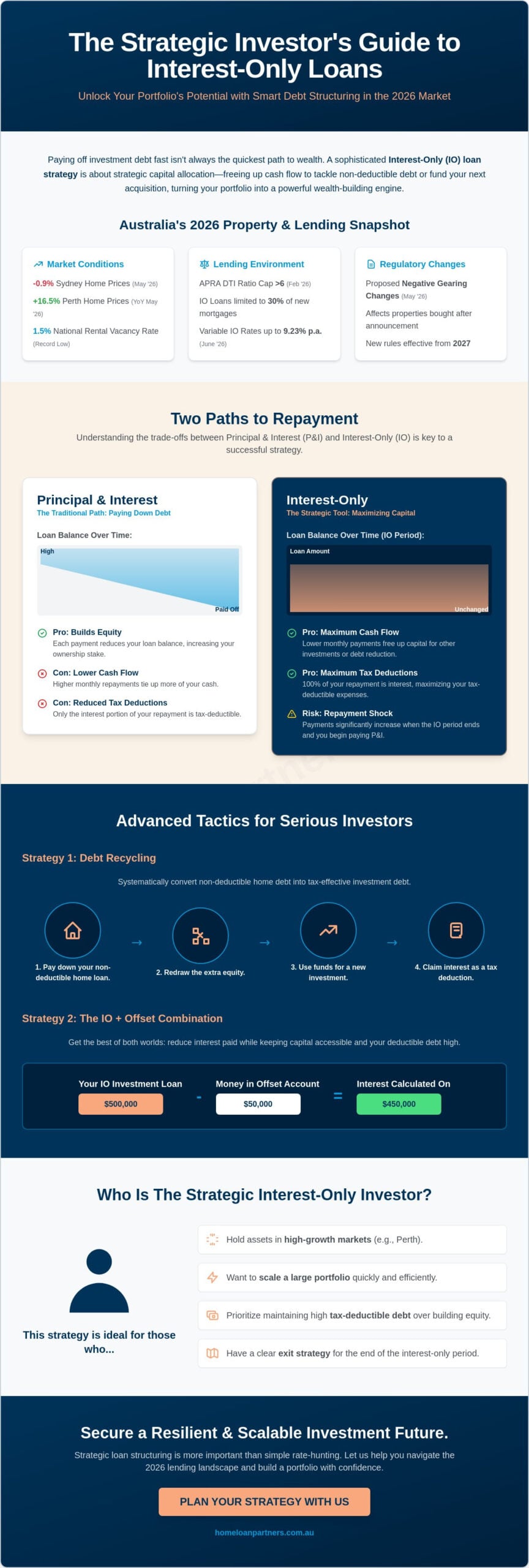
An Interest-only loan is a mortgage structure where you pay only the interest charges for a set period, typically between one and five years. Unlike a standard principal and interest loan, your debt balance doesn’t decrease because you aren’t paying down the loan itself. In the Australian market, this isn’t usually about avoiding debt. Instead, a well-executed interest only loan for investment property strategy is about sophisticated capital allocation. It allows you to keep your monthly commitments lower, freeing up cash to tackle non-deductible personal debt or to fund your next acquisition.
The 2026 lending environment has transformed these loans into a specialized tool for the serious investor. APRA has requested that banks limit interest-only lending to 30% of new residential mortgages. This means lenders are increasingly selective, often reserving these structures for clients with clear, long-term financial goals. While some investors see it as temporary relief from high rates, we view it as strategic portfolio management. It’s a method to maintain liquidity and flexibility while waiting for the next phase of the property cycle.
How Interest-Only Repayments Work
When you choose this path, your monthly payment covers the cost of borrowing the money but doesn’t touch the principal amount. Lenders generally charge a premium for this flexibility. For instance, as of June 2026, major banks like NAB have variable interest-only rates reaching as high as 9.23% p.a. This is significantly higher than their standard principal and interest counterparts.
Beyond the rate, you must consider your borrowing capacity. Under the APRA guidelines effective from February 1, 2026, banks are restricted on how much they can lend to borrowers with a debt-to-income (DTI) ratio higher than six. Because interest-only loans eventually revert to higher principal and interest payments, banks assess your ability to pay based on that future, more expensive period. We work closely with you to navigate these calculations so you don’t face unexpected hurdles during the application process.
Who is the Strategic Interest-Only Investor?
This approach is often the “sweet spot” for those holding high-growth assets in markets like Perth, where median prices rose 16.5% year-on-year by May 2026. These investors prioritize tax-deductible debt over equity growth. By only paying the interest, they maximize their tax deductions. This is particularly relevant given the proposed changes to negative gearing announced on May 12, 2026. Investors who already hold property are looking to solidify their cash flow positions before new rules take effect in 2027. If your goal is to scale a large portfolio quickly, keeping your deductible debt high while using surplus cash to clear your own home loan is a powerful move.
The Strategic Advantages: Cash Flow and Tax Deductibility
A successful interest only loan for investment property strategy hinges on the relationship between your monthly expenses and your annual tax return. By choosing to pay only the interest, you keep your immediate outgoings as low as possible. In a market where the national rental vacancy rate is at a record low of 1.5% as of May 2026, many investors are seeing strong rental income. However, high interest rates can still squeeze those margins. Minimizing your required repayments provides a vital buffer. This extra liquidity ensures you can handle unexpected repairs or short-term vacancies without stressing your personal finances.
The tax benefits are equally compelling. In Australia, the interest paid on an investment loan is generally tax-deductible, whereas the principal component is not. By maintaining a higher loan balance through interest-only payments, you maximize your deductible expenses. This is particularly significant following the Federal Government’s May 12, 2026, proposal regarding negative gearing. For properties purchased after this date, losses will eventually only be deductible against other residential property income. Keeping your deductible interest high helps you manage your tax position more effectively within these new boundaries.
The Power of the IO + Offset Combination
One of the most effective ways to manage this debt is by pairing your loan with an offset account. This gives you the best of both worlds. Money sitting in your offset account reduces the interest you’re charged, effectively “paying down” the loan without actually making a permanent principal reduction. This keeps your capital accessible. If you need funds for a deposit on a future property, you can simply withdraw them from the offset. If you had paid that money directly into the loan principal, getting it back would be far more difficult. If you’re looking to optimize your current debt, refinancing your investment property into this structure could unlock significant flexibility.
Tax Efficiency and the ATO Framework
Paying down the principal on an investment loan is often considered tax-inefficient for many Australian investors. Every dollar of principal you pay off reduces the amount of debt you can claim as a tax deduction. This “traps” your equity in the investment property, where it does nothing to reduce your non-deductible debt, such as your primary home loan. While it’s vital to understand the risks of interest-only mortgages, such as the lack of equity build-up from repayments, the tax-deductible nature of the debt makes it a preferred choice for portfolio scaling. We always recommend consulting with a qualified tax professional to ensure your loan structure aligns perfectly with your specific tax bracket and long-term wealth goals.
Advanced Tactics: Debt Recycling and Portfolio Scaling
A sophisticated interest only loan for investment property strategy isn’t just about surviving high-interest periods; it’s about weaponizing your cash flow to build wealth faster. While most investors focus on the lower monthly commitment, the true power lies in debt recycling. This involves using the surplus cash you aren’t sending to the bank as principal to aggressively target your non-deductible debts. By keeping your investment debt high and your personal debt low, you effectively transform “bad” debt into “good” tax-deductible debt over time.
This approach allows you to maintain a substantial “war chest” of liquidity. In a cooling market like Sydney or Melbourne, where sales volumes fell significantly by mid-2026, having accessible cash is vital. It gives you the agility to jump on opportunities when other buyers are sidelined by tight credit. Understanding How Interest-Only Mortgages Work at a structural level is the first step in realizing that equity growth, rather than principal reduction, is often the primary driver for successful portfolio expansion.
Strategic Debt Redirection
The hierarchy of debt is simple: always pay down the debt that doesn’t provide a tax benefit first. Your home loan is the most expensive money you’ll ever borrow because you pay for it with after-tax dollars. Imagine you have an investment loan at 6.8% and a home loan at 6.2%. While the investment rate is higher, the net cost after a 37% tax deduction is actually around 4.28%. Every $1,000 you redirect from your investment principal into your home loan principal saves you a full 6.2% in non-deductible interest. Mathematically, that $1,000 is working nearly 45% harder for you when applied to your personal residence than it would be if used to pay down the investment property.
Scaling to Property Number Two and Beyond
Scaling a portfolio requires a delicate balance of serviceability and deposit capital. An interest-only structure preserves your serviceability in the eyes of many lenders because your actual monthly outgoings are lower, which helps when banks calculate your surplus income. Under the APRA Debt-to-Income (DTI) rules effective since February 2026, staying below the six-times-income threshold is critical. By keeping your repayments low, you can save for your next deposit much faster than an investor tied to heavy principal and interest payments.
Interest-Only vs. Principal & Interest: Navigating the Trade-offs
Choosing between repayment types is one of the most significant decisions you’ll make in your interest only loan for investment property strategy. While the allure of lower monthly payments is strong, it’s essential to look at the full 30-year horizon. For conservative investors or those with a “set and forget” mentality, a standard Principal and Interest (P&I) structure might offer more peace of mind. It ensures you’re building equity from day one. However, the premium you pay for an IO term can be a price worth paying if the freed-up cash is working harder elsewhere.
The Mathematical Reality of Total Interest
When you defer principal repayments for the first five years, you’re essentially compressing your 30-year debt repayment into 25 years. This leads to higher total interest costs over the life of the loan. With major bank variable rates for investment IO loans reaching up to 9.23% p.a., as seen with NAB in mid-2026, the rate spread between IO and P&I is a genuine consideration. If you aren’t redirecting that saved principal into higher-return assets or non-deductible debt, you may find the convenience of IO comes at a steep price.
Managing the Transition to P&I
The “repayment shock” at the end of an IO period is a very real risk that catches many investors off guard. When the term expires, your payments can jump by 30% or 40% almost overnight. This happens because you’re starting to pay down the principal over a shorter remaining term. To avoid this “IO cliff,” a proactive approach is necessary. Refinancing your home loan or investment debt before the period ends allows you to reassess the market and potentially reset the IO clock with a different lender. This steady, planned transition ensures you’re never left scrambling when your loan structure changes.
If your current interest-only term is nearing its end, don’t wait for the bank to automatically switch you to higher repayments. We can help you explore investment property loans that offer better rates or extended terms to keep your strategy on track.
Implementing Your Strategy with The Home Loan Partners
Executing a successful interest only loan for investment property strategy requires more than just a calculator. It requires a partnership with experts who understand the nuances of the 2026 Australian lending market. We act as your steady hand, navigating a complex landscape of over 36 lenders to find the structure that aligns with your specific wealth goals. While some banks have tightened their criteria following the APRA debt-to-income (DTI) caps introduced in February 2026, we know which lenders remain supportive of strategic investors. We take the heavy lifting off your shoulders, managing the entire application process so you can focus on finding your next property.
Our focus extends far beyond simply finding the lowest headline rate. Proper loan structuring is the real engine of portfolio growth. We look at how your debt is distributed across your assets to ensure you aren’t just saving money today, but building a resilient foundation for the next decade. By translating technical industry jargon into practical steps, we help you understand exactly how your loan choice impacts your future security. This collaborative approach ensures that every decision we make together serves your long-term journey toward financial independence.
Personalised Portfolio Review
Every investor’s situation is unique, especially in a year where market performance varies so significantly between cities like Sydney and Perth. We begin by conducting a comprehensive review of your current portfolio, evaluating your Loan-to-Value Ratio (LVR) and DTI. If your current debt-to-income ratio is approaching the six-times limit, we identify lenders whose serviceability models are more flexible for your specific profile.
- Refinancing Opportunities: We scan the market to see if moving your current debt could unlock better cash flow or extend your interest-only period.
- Equity Assessment: We help you determine if capital growth in your current holdings can be used as a deposit for your next acquisition without needing a massive cash injection.
- Ongoing Support: Our relationship doesn’t end when your loan settles. We provide consistent reviews to ensure your structure remains optimal as interest rates and regulations evolve.
Ready to Optimise Your Investment Cash Flow?
The path to a scalable property portfolio starts with a clear, stress-free plan. We invite you to a strategy session where we can discuss your aspirations and the hurdles you’re currently facing. Whether you’re worried about the “repayment shock” of an expiring IO term or you’re looking to start your debt recycling journey, we provide the steady expertise you need to move forward with confidence. We handle the detailed negotiations with banks and lenders on your behalf, ensuring your application is positioned for the best possible outcome. Book your investment strategy session with The Home Loan Partners today and take the first step toward a more efficient, tax-effective investment future.
Securing Your Financial Future with Precision
Building a resilient property portfolio in 2026 requires more than just picking the right suburb. It demands a sophisticated debt structure that works as hard as you do. We’ve explored how a tailored interest only loan for investment property strategy can unlock vital cash flow, maximize your tax-deductible interest, and accelerate the repayment of your non-deductible home loan. By understanding the trade-offs between repayment types and preparing for future transitions, you transform your debt from a burden into a powerful engine for wealth creation.
Navigating these complex financial paths doesn’t have to be a solo journey. With access to 36+ Australian lenders and a deep commitment to personalized service from Greenwich to Port Macquarie and beyond, we’re here to manage the heavy lifting for you. Our expert team focuses on long-term loan structuring that aligns with your specific life milestones and 10-year plans. Optimise Your Investment Strategy with The Home Loan Partners today. Let’s work together to turn your property aspirations into a secure and prosperous reality.
Frequently Asked Questions
Can I extend my interest-only period after the first 5 years?
Yes, you can often extend an interest-only period, but it isn’t an automatic process. Most lenders require a full reassessment of your financial position or a complete refinance to a new loan product. Because APRA limits interest-only lending to 30% of new mortgages, banks are more selective with extensions than they were in previous years. We help you prepare your application to show strong serviceability and a clear long-term plan to satisfy these stricter requirements.
Are interest-only loans harder to get in 2026?
Obtaining an interest only loan for investment property strategy is more challenging in 2026 due to stricter regulatory oversight. APRA’s debt-to-income (DTI) cap, which limits high-leverage lending to 20% of a bank’s new business, means you need a robust income-to-debt ratio. Lenders also assess your application based on your ability to meet higher principal and interest repayments in the future, rather than just the initial interest-only cost, which can impact your eligibility.
How much higher are interest-only rates compared to principal and interest?
Interest-only rates are generally higher than principal and interest rates, often by 0.50% to 1.00% depending on the lender. In the current market, variable interest-only rates for investors can reach up to 9.23% p.a. at major banks like NAB. While the rate is higher, the total monthly outgoing is lower because you aren’t paying down the loan balance. This trade-off is often worth it for investors prioritizing immediate cash flow over equity growth.
Does an interest-only loan affect my ability to use negative gearing?
An interest-only structure generally enhances negative gearing benefits because it keeps your tax-deductible interest payments at their maximum level. However, you must account for the Federal Government’s May 2026 proposal. For properties bought after May 12, 2026, losses will only be deductible against other residential property income starting July 2027. This makes a precise interest only loan for investment property strategy even more critical for managing your tax position under the new rules.
What happens to my repayments when the interest-only period ends?
When the interest-only period concludes, your loan automatically reverts to principal and interest repayments. Your monthly costs will increase significantly, sometimes by 30% or more, because you’re now paying off the principal over a shorter remaining loan term. We recommend reviewing your loan at least six months before this period ends. This gives us time to explore refinancing options or to ensure your cash flow can handle the scheduled jump without stress.
Should I use an offset account with an interest-only investment loan?
Using an offset account is one of the smartest moves you can make with an interest-only loan. It allows you to reduce your interest charges by keeping cash in the account, while ensuring that money remains fully accessible. This provides the flexibility to pay down your non-deductible home loan or save for a new deposit without permanently losing access to your capital through principal repayments. It’s the ultimate tool for maintaining liquidity while reducing debt costs.
Is an interest-only strategy safe for a first-time investor?
An interest-only strategy can be safe for first-time investors if it’s part of a broader, logical financial plan. It’s particularly useful if you have a non-deductible home loan that you want to pay off faster using your surplus cash flow. However, it’s less suitable if you’re using it simply to “afford” a property you couldn’t otherwise manage. We focus on ensuring your strategy includes a clear exit plan so you’re never caught off guard by changing repayments.
How does an interest-only loan impact my borrowing power for future properties?
An interest-only loan has a dual impact on your borrowing power. While the lower monthly payments improve your actual cash flow, lenders assess your future borrowing capacity based on the higher principal and interest repayments you’ll eventually owe. This “stress test” can sometimes reduce the total amount you can borrow for subsequent properties compared to a standard loan. We work with you to structure your portfolio to maximize serviceability across multiple lenders to keep your growth on track.