

Australians refinanced a record $65.8 billion in home loans during the September 2025 quarter, yet many homeowners still pay a “loyalty tax” simply because the process feels too complex. It’s frustrating to see your monthly repayments climb while your bank offers better deals to brand-new customers. You’ve likely felt stuck with a lender that doesn’t reward your commitment, wondering if the savings from a lower rate would actually outweigh the costs of switching.
We’re here to provide a steady hand and clear direction. This strategic guide helps you refinance to lower interest rate australia by comparing over 36 lenders to find a structure that fits your life. We’ll explore the 2026 market landscape, from the current 4.35% RBA cash rate to APRA’s new debt-to-income caps, ensuring you gain the offset features and lower repayments needed to pay off your home years ahead of schedule. By auditing your financial structure now, you can stop overpaying and start building equity faster.
Key Takeaways
- Identify the hidden “loyalty tax” and learn why staying with your current lender could be costing you thousands in unnecessary interest.
- Master the difference between headline interest rates and comparison rates to uncover the true, all-inclusive cost of any loan offer.
- Discover how to structure your mortgage using offset accounts and redraw facilities to maximize your long-term wealth and financial flexibility.
- Follow a proven five-step framework to refinance to lower interest rate australia while navigating the latest 2026 lending regulations with confidence.
- Gain a competitive advantage by accessing a panel of 36+ lenders and leveraging professional negotiation to secure a deal that fits your specific goals.
Understanding the Loyalty Tax: Why Refinancing is Essential in 2026
Many Australian homeowners believe that staying with the same bank for a decade is a sign of financial stability. In reality, this long-term commitment often results in a “loyalty tax.” This isn’t an official government fee, but rather the hidden cost of staying with a lender that no longer competes for your business. Banks frequently reserve their most competitive pricing for new customers, leaving existing borrowers on older, more expensive products. Understanding What is refinancing? is the first step toward reclaiming these funds and ensuring your mortgage remains a tool for wealth rather than a drain on your monthly budget.
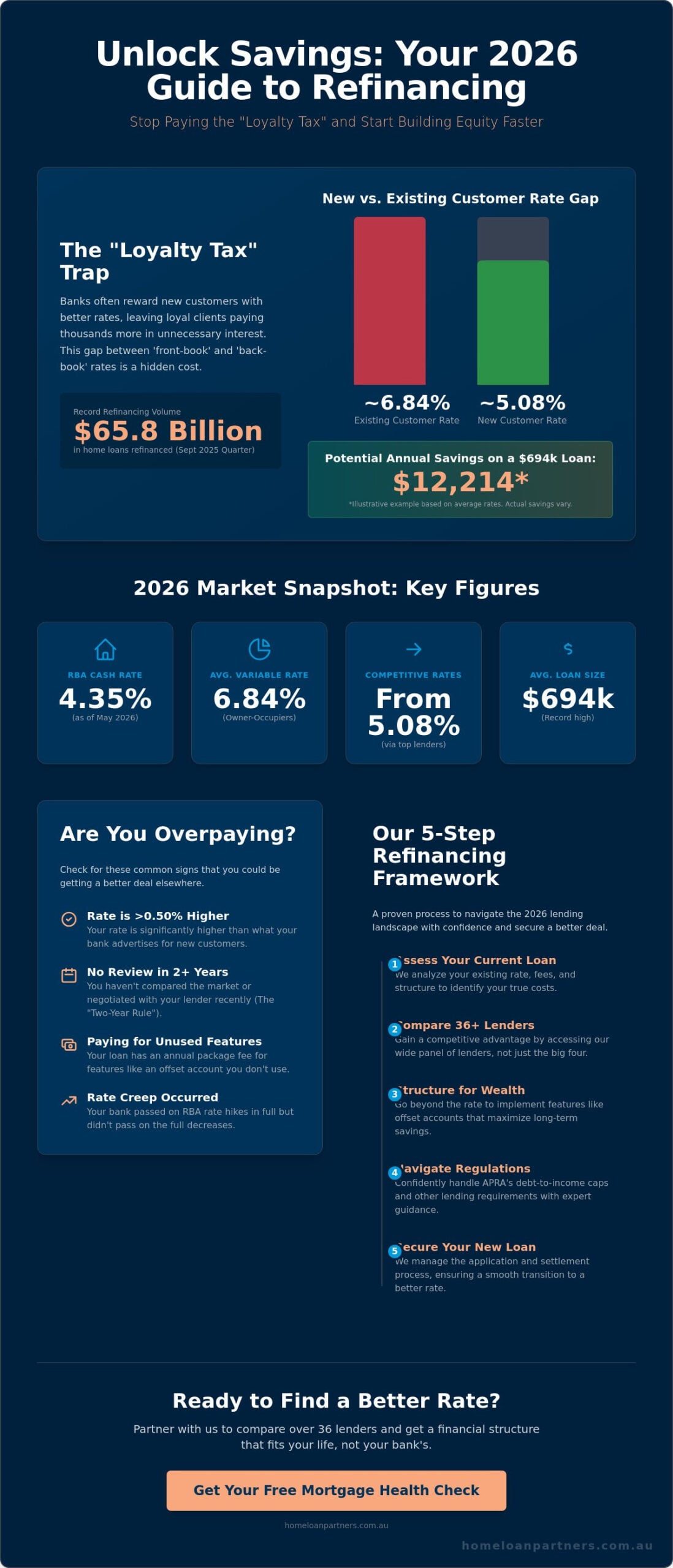
As of May 2026, the Reserve Bank of Australia (RBA) has maintained the official cash rate at 4.35%. While the average variable rate for owner-occupiers sits around 6.84% p.a., the most competitive lenders in the market are offering rates as low as 5.08% p.a. For a borrower with a record-high average loan size of $694,000, that gap represents thousands of dollars in annual interest. Banks rely on borrower inertia; they know that many people find the process of switching lenders daunting, so they maintain higher profit margins on their existing “back-book” of loans while aggressively chasing new “front-book” business.
The Gap Between “Front-Book” and “Back-Book” Rates
Lenders operate with two distinct pricing tiers. The “front-book” contains the sharp, discounted rates used to lure in new applicants. The “back-book” is where your loan ends up after the introductory period or once several RBA hikes have passed. Over time, “rate creep” occurs as lenders pass on the full cash rate increases to existing customers but only partial decreases. You can find your current “real” rate by checking your banking app or your most recent monthly statement. If your rate starts with a ‘7’ or is significantly higher than the 5.08% p.a. currently available, you’re likely paying for the bank’s marketing budget rather than your own equity.
When is the Right Time to Review Your Rate?
We recommend the “Two-Year Rule”: a comprehensive mortgage health check every 24 months. This frequency allows you to refinance to lower interest rate australia before the loyalty tax becomes a significant burden. With APRA’s 2026 debt-to-income caps now in effect, staying ahead of the curve is vital. You don’t want to wait until your financial situation changes or lending standards tighten further. By proactively reviewing your loan, you can identify “rate creep” early and secure a more sustainable path forward for your family’s future.
Signs you are currently paying too much:
- Your interest rate is more than 0.50% higher than the rates currently advertised for new customers.
- You haven’t negotiated with your lender or compared the market in over two years.
- You are paying an annual package fee for features like an offset account that you don’t actually use.
- Your bank has increased your variable rate more than the RBA cash rate has moved in the same period.
In the current 2026 economic environment, being proactive is the only way to protect your lifestyle. We’re here to help you navigate these complexities with a steady, expert hand, ensuring you can refinance to lower interest rate australia with confidence and precision.
Calculating the Real Savings: Interest Rates vs. Comparison Rates
The process to refinance to lower interest rate australia often starts with a search for the lowest headline number. However, the interest rate you see in big bold letters is rarely the full story. To find the real value, you must look at the comparison rate, which is a tool designed to help you understand the total cost of the loan over time. While the headline rate only covers the interest, the comparison rate factors in most upfront and ongoing fees. Understanding this distinction prevents you from falling for “teaser” rates that carry high hidden costs.
Decoding the Comparison Rate
A low headline rate can be a distraction if the loan is weighed down by high annual package fees or monthly service charges. The comparison rate is the only way to compare “apples with apples” across different lenders. It includes the interest rate, application fees, and ongoing service fees, all calculated over a standard loan term. It’s important to remember that comparison rates don’t include every cost; government charges and late payment fees are usually excluded. When switching your home loan, always use this figure as your baseline for a fair assessment.
The True Cost of Refinancing (Fees to Watch)
Switching lenders isn’t free, but the costs are usually manageable compared to the long-term savings. In 2026, the typical cost to refinance a home loan in Australia sits between $500 and $2,000. You’ll likely encounter a discharge fee from your current lender, typically ranging from $350 to $500. Additionally, the new lender may charge an application fee of up to $750, though many competitive lenders waive this to attract new business. Don’t forget government costs, such as mortgage deregistration and registration fees, which can range from $130 to $250 each. If you have less than 20% equity, you might also face the “LMI trap,” where Lenders Mortgage Insurance becomes payable again, potentially erasing your interest savings.
Calculating your breakeven point is the final step in this audit. If a 0.5% rate reduction saves you $300 a month and your total setup costs are $1,500, you’ll reach your breakeven point in just five months. On an average loan size of $694,000, that 0.5% drop could save you tens of thousands of dollars over the life of the loan. If you aren’t sure where your current loan stands, you can request a personalized rate comparison to see the numbers for your specific situation. By focusing on the comparison rate and total costs, you ensure that your move is a strategic financial gain rather than just a headline change.
Beyond the Rate: Structuring Your Loan for Long-Term Wealth
Securing a lower rate is a vital step, but the structure of your mortgage determines how much you actually save over thirty years. A “no-frills” loan might offer the lowest headline rate, yet it could leave you without the flexibility needed to manage life’s changing priorities. When you refinance to lower interest rate australia, we look past the initial percentage to ensure your loan features align with your broader goals, such as building an investment portfolio or funding a major renovation. A well-structured loan acts as a financial engine, while a poorly structured one can become a bottleneck to your wealth creation.
Choosing the right features requires a balance between cost and utility. While basic loans have fewer fees, they often lack the sophisticated tools that help you pay off your principal faster. You can find more detail on these trade-offs in Moneysmart’s guide to switching home loans, which highlights how different loan types impact your long-term costs. Our role is to help you weigh these options, ensuring you don’t trade away essential flexibility just to save a few basis points on the headline rate.
Offset Accounts: Your Secret Weapon Against Compound Interest
In the current high-rate environment, an offset account is one of the most powerful tools at your disposal. Because interest is calculated daily, every dollar sitting in your offset account reduces the balance the bank charges interest on. This doesn’t just save you money; it effectively earns you a “return” equal to your mortgage rate, completely tax-free. We often help clients set up multiple offset accounts to bucket their money for tax, emergencies, or school fees. This psychological clarity makes budgeting simpler while ensuring every cent of your hard-earned savings is working to shorten your loan term.
Debt Consolidation and Equity Release
Refinancing also provides a unique opportunity to tidy up your balance sheet. If you’re carrying high-interest debt on credit cards or car loans, rolling these into your home loan can significantly lower your total monthly outgoings. However, it’s vital to stay disciplined. Consolidating a two-year debt into a thirty-year mortgage can cost more in interest unless you maintain your previous repayment levels. Additionally, if your property has grown in value, you might choose to refinance to lower interest rate australia while simultaneously releasing equity. This capital can be used as a deposit for investment property loans or to fund construction loans for home improvements, turning your home’s growth into a springboard for future milestones.
By viewing your mortgage as a flexible financial tool rather than a fixed burden, you can navigate the 2026 market with precision. We’re here to help you design a structure that doesn’t just lower your rate, but actively supports the life you’re working to build.
The 5-Step Process to Refinance for a Lower Rate in Australia
Moving from a high-interest mortgage to a more competitive deal requires a structured approach to ensure no detail is overlooked. While the prospect of switching lenders can feel overwhelming, a clear path to refinance to lower interest rate australia involves more than just clicking a button. It’s a precise series of actions designed to prove your creditworthiness to a new lender while ensuring the new loan structure actually serves your long-term wealth goals. By following this five-step framework, you can transition from your current bank to a more supportive partner with total confidence.
The journey begins with a Mortgage Health Audit. You’ll need to review your current loan statement to identify your exact interest rate, any ongoing fees, and whether you’re currently in a fixed or variable period. Once you have your baseline, the second step is a Market Comparison. Instead of just looking at the Big Four banks, we scan over 36 lenders to find the sharpest rates and features available in May 2026. This broad search is essential because smaller or non-bank lenders often offer more aggressive pricing to attract high-quality borrowers away from the major institutions.
Preparing Your Paperwork for a Smooth Approval
Lenders in 2026 are operating under strict APRA guidelines, specifically regarding debt-to-income (DTI) ratios. No more than 20% of a lender’s new mortgages can go to borrowers with a DTI of six or more, so your paperwork must be impeccable. You’ll need recent payslips, tax returns, and bank statements that reflect a stable financial position. Lenders are looking closely at your “Living Expenses” to ensure you can comfortably manage repayments at the current 4.35% RBA cash rate plus a serviceability buffer. Cleaning up your discretionary spending for three months before applying can significantly strengthen your position.
The third step is the Property Valuation, which is a critical fork in the road. This determines your Loan-to-Value Ratio (LVR). If your property has increased in value, your LVR drops, which often unlocks even lower interest rate tiers. After valuation, you move into the Application and Approval phase, where the new lender formally assesses your file. Finally, Settlement occurs when your new lender pays off your old loan. This typically takes two to four weeks, after which you should perform a post-switch verification to ensure all offset accounts and features are linked correctly.
The Valuation Phase: What if Your Home Value has Changed?
A higher valuation is your best friend when you refinance to lower interest rate australia. If your LVR falls below 80% or 70%, lenders often reward you with their most competitive “front-book” pricing. If a desktop valuation comes in lower than expected, you can sometimes request a full physical inspection to account for recent renovations or unique property features. Understanding this phase helps you avoid the “LMI trap” mentioned earlier and ensures you aren’t paying for insurance that you no longer need.
If you’re ready to start your audit, you can book a strategy session with our team to review your current loan against the 36+ lenders on our panel. We’ll manage the heavy lifting and ensure your application is positioned for a smooth approval.
Why Partnering with a Mortgage Broker Beats the DIY Approach
While online comparison tables might seem like a quick way to find a deal, they only show you a tiny fraction of the 2026 lending market. When you attempt to refinance to lower interest rate australia on your own, you’re essentially walking into a bank’s “front door” and accepting their standard public offers. A mortgage broker acts as an expert collaborator, providing a bridge between your financial goals and a panel of over 36 lenders. This broad access ensures you aren’t just choosing the best of what one bank offers, but the best of what the entire market can provide.
The real advantage lies in professional negotiation and insider knowledge. Brokers have direct lines to credit managers and often have access to “broker-only” pricing or fee waivers that aren’t advertised on public websites. We understand the nuances of different lenders’ credit policies, which is vital now that APRA has tightened debt-to-income limits. Instead of you spending hours on hold or decoding complex terms, we manage the heavy lifting from application through to settlement, ensuring your path to a lower rate is smooth and predictable.
Tailored Loan Structures vs. Off-the-Shelf Products
Every household has a unique financial fingerprint. A standard “off-the-shelf” loan from a Big Four bank might not account for complex income types, such as self-employed earnings or seasonal bonuses. We take the time to understand your five-year and ten-year aspirations, matching you with a lender whose features actually support your growth. Whether you need specific redraw facilities for future renovations or multiple offset accounts for better budgeting, we ensure the structure fits your life. The Home Loan Partners provides unbiased advice to ensure a stress-free refinancing journey.
The Cost Benefit: Why Broker Services are Lender-Paid
One of the most reassuring aspects of partnering with a broker is the transparent cost structure. In the Australian mortgage industry, brokers are typically paid a commission by the lender you choose to settle with, which means our professional guidance comes at no additional cost to you. This allows us to act as your dedicated advocate for the life of the loan, not just during the transaction. We keep a watchful eye on your rate long after settlement, checking in regularly to ensure your lender hasn’t allowed “rate creep” to settle back in.
You don’t have to manage the complexities of the 2026 market alone. By having a steady hand to guide you, you can secure a more competitive future with total clarity. If you’re ready to see how your current mortgage compares to the rest of the market, you can Book a free mortgage health check with The Home Loan Partners to start your journey toward a more sustainable home loan.
Taking Control of Your Mortgage Future
Your home loan shouldn’t be a “set and forget” commitment that quietly drains your savings through a loyalty tax. By shifting your focus toward the comparison rate and auditing your loan structure, you’ve already begun the process of reclaiming your financial independence. A truly effective mortgage is more than just a low number; it’s a flexible tool that uses offset accounts and strategic features to help you build equity faster and secure your family’s long-term security.
When you decide to refinance to lower interest rate australia, you don’t have to manage the complexities of the 2026 market alone. We offer expert guidance through the latest lending landscape with direct access to over 36 leading Australian lenders. Our service is lender-paid, which means you receive professional advocacy and a personalized strategy at no cost to you. Secure your lower interest rate today with a free loan review.
We’re here to act as your steady hand and long-term partner throughout this journey. You’ve worked hard for your home, and you deserve a mortgage that works just as hard for you. Let’s start building a more sustainable financial path together.
Frequently Asked Questions
How much does it cost to refinance a home loan in Australia?
The total cost to switch lenders typically falls between $500 and $2,000. This includes a discharge fee from your current bank of about $350 to $500, government registration fees of $130 to $250 per registration, and potential application or valuation fees from the new lender. Many competitive lenders in 2026 waive their application fees to attract new customers, which can significantly lower your upfront expenses.
Will refinancing my home loan affect my credit score?
Refinancing usually causes a small, temporary dip in your credit score because the new lender performs a “hard inquiry” to assess your application. This is a standard part of the process and is generally not a cause for concern. Over time, successfully making lower repayments on your new loan often helps your credit score recover and grow as you demonstrate consistent financial reliability.
Can I refinance if I have less than 20% equity in my home?
You can still refinance with less than 20% equity, but you’ll likely need to pay Lenders Mortgage Insurance (LMI) again. This cost can be high, so it’s vital to calculate whether the long-term interest savings from a refinance to lower interest rate australia outweigh the insurance premium. We help you audit your equity levels to ensure the move makes genuine financial sense for your situation.
How long does the refinancing process typically take from start to finish?
The entire journey from your initial health audit to settlement usually takes between two and four weeks. This timeline includes the property valuation phase and the time your current bank takes to process the discharge of your old mortgage. Having your 2026 tax returns and recent payslips ready for the new APRA debt-to-income assessments will help ensure a smooth and predictable approval process.
Is it better to have a fixed or variable interest rate when refinancing in 2026?
The choice depends on whether you value repayment certainty or financial flexibility. With the RBA cash rate at 4.35% as of May 2026, variable rates offer the benefit of offset accounts that can help you pay off the principal faster. Conversely, fixed rates starting around 5.85% p.a. provide a steady hand for your budget, protecting you from any potential rate hikes later in the year.
What is the “breakeven point” and how do I calculate it?
The breakeven point is the date when your accumulated interest savings finally exceed the upfront costs of switching lenders. To find this, divide your total refinancing fees by your monthly repayment savings. If your setup costs are $1,200 and you save $300 per month on your new rate, you’ll reach your breakeven point in just four months, making the switch highly profitable.
Can I refinance my investment property loan to a lower rate as well?
Yes, refinancing investment property loans is a strategic way to manage cash flow, especially with the proposed 2026 changes to negative gearing. Lowering your interest costs helps maintain the profitability of your portfolio while lending standards tighten. We compare 36+ lenders to find investment structures that align with your long-term wealth goals and the latest tax regulations.
How many lenders do The Home Loan Partners have access to?
We provide you with direct access to a diverse panel of over 36 leading Australian lenders. This broad reach allows us to look beyond the Big Four banks to find a refinance to lower interest rate australia that specifically suits your income type and equity position. Our collaborative approach ensures you see a wide variety of the market rather than just a single bank’s limited products.