

Imagine finding your perfect home in a competitive market, only to have the bank pull your funding because of a small, well-intentioned lifestyle change. It is a heartbreaking scenario we see too often, and it usually happens because buyers aren’t aware of the common home loan pre-approval mistakes to avoid before they reach settlement. You likely feel that once you have that letter in hand, the hardest part is behind you and you can finally focus on the house hunt with total peace of mind.
The reality is that a pre-approval is a fragile commitment from a lender, not a guaranteed cheque. With the 30-year fixed mortgage rate currently at 6.47% as of May 2026, protecting your borrowing power is essential for your future financial security. We want to partner with you to make this journey as seamless as possible by acting as your expert guide. This article outlines seven critical pitfalls that can lead to a revoked approval and provides the clear rules you need to follow for a stress-free path to unconditional success.
Key Takeaways
- Understand that a pre-approval is an indication of intent rather than a guarantee, making it vital to protect your status until the keys are in your hand.
- Discover why maintaining “financial silence” by avoiding new debts or large purchases is the most effective way to sidestep critical home loan pre-approval mistakes to avoid.
- Learn how to manage the “credit card trap” by focusing on your total limits rather than just your monthly balance to improve your lender assessment.
- Identify how to conduct a proactive credit health check to fix reporting errors that could sabotage your application months in advance.
- Find out how an expert partner provides a clear advantage by accessing over 36 lenders to find the specific policy that fits your unique financial goals.
Understanding Home Loan Pre-Approval: Why It Is Not a Guarantee
When you start your property journey, a pre-approval feels like a green light from the bank. In reality, it is more of an “indication of intent” based on a preliminary look at your finances. It signals that a lender is likely to offer you a specific amount, provided your circumstances and the property you choose meet their criteria. At Home Loan Partners, we view this stage as the foundation of your strategy. It gives you the confidence to negotiate, but it is not a binding contract or a guaranteed cheque.
In the current 2026 market, where the 30-year fixed mortgage rate sits at 6.47%, having this document is essential for bidding at auction or making a competitive offer. Most sellers won’t even consider an offer without one. However, these documents typically come with a 90-day expiry date. If you don’t find a home within that window, your lender will need to refresh your application, which may involve checking if interest rates or lending policies have shifted. Understanding the nuances of this document is the first step in identifying home loan pre-approval mistakes to avoid before you commit to a purchase.
The Three Levels of Pre-Approval
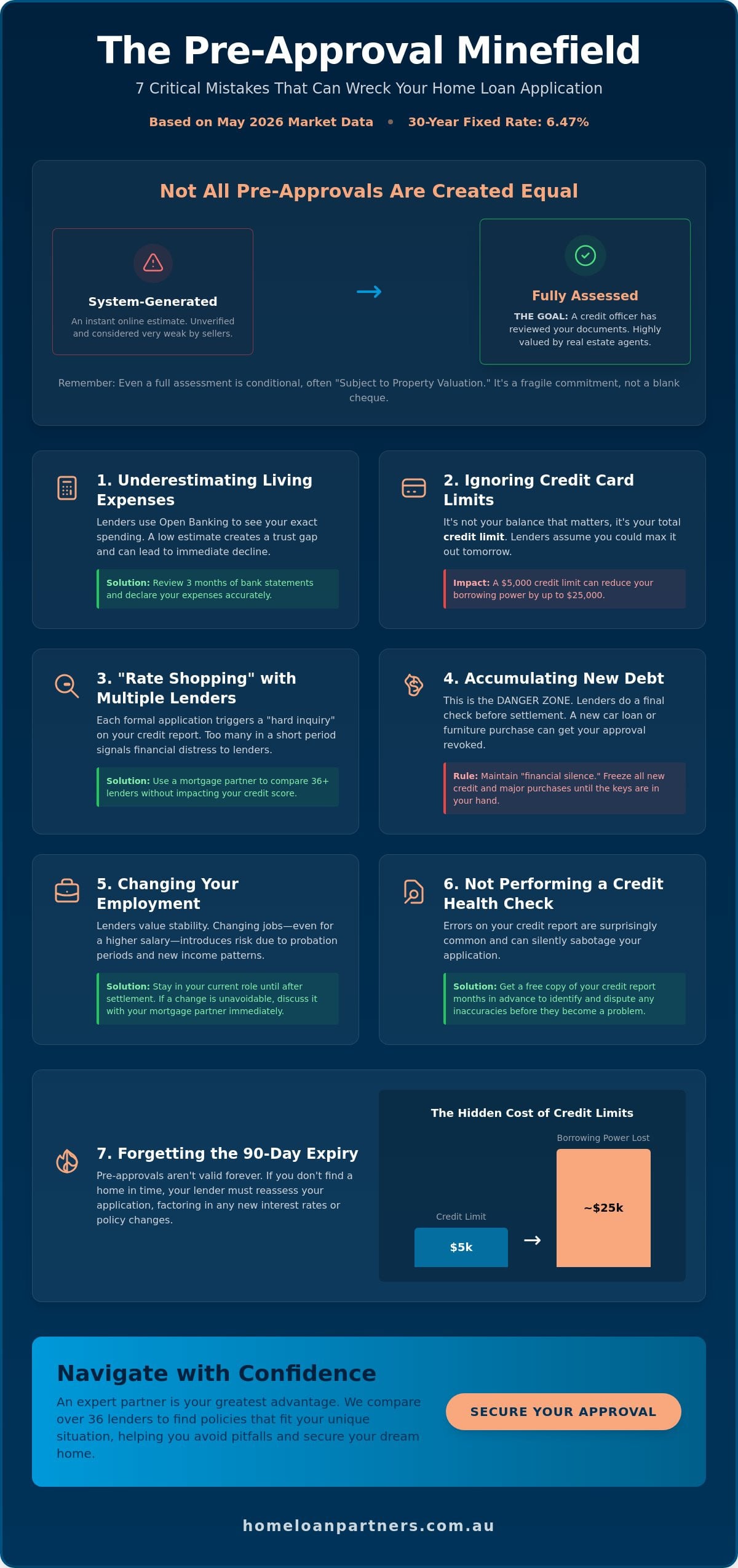
Not all pre-approvals carry the same weight. A system-generated version is often an “instant” online assessment that relies solely on the data you’ve typed into a website. While fast, it is incredibly weak because a human hasn’t verified your documents. We always recommend a “Fully Assessed” pre-approval. This version involves a credit officer reviewing your payslips and bank statements. Real estate agents value this much more because it shows you’ve already passed a rigorous check.
Even with a full assessment, your letter will almost always include a “Subject to Property Valuation” clause. This means the bank needs to ensure the home you’re buying is actually worth what you’re paying. If the valuation comes in low, your funding could still be at risk.
Why Lenders Can Change Their Minds
Lenders constantly re-evaluate their risk. External factors, such as new APRA regulations or sudden shifts in the economy, can cause a bank to tighten its belt and reduce your borrowing power overnight. Your personal risk profile is also under the microscope until the very end. The transition from pre-approval to “unconditional approval” happens during the formal mortgage underwriting process, where every detail is double-checked for accuracy.
If your income drops or your debt increases during this time, the lender has every right to revoke their offer. This is why staying in close contact with your partner at Home Loan Partners is vital. We help you navigate these shifts so your “indication of intent” successfully turns into a set of keys.
Common Pre-Application Blunders That Sabotage Your Borrowing Power
The lending landscape has changed significantly with the arrival of Open Banking. Gone are the days when you could provide a rough estimate of your monthly coffee habit or grocery bill. In 2026, lenders use digital transaction tracking to see exactly where your money goes. Underestimating your living expenses is one of the most frequent home loan pre-approval mistakes to avoid because the bank already has the data to disprove a low-ball estimate. If your declared expenses don’t match your actual spending patterns, it creates a trust gap that can lead to an immediate decline.
Your credit card habits also play a massive role in how much you can borrow. Many buyers believe that as long as they pay their balance in full every month, their credit card won’t affect their application. This is a common misconception. Lenders look at your total credit limit, not your current balance, because you could technically spend that entire limit tomorrow. To put this into perspective, a $5,000 credit limit can reduce borrowing capacity by approximately $20,000 to $25,000. Reducing these limits or closing unnecessary cards before you prepare for a mortgage is a simple way to boost your results.
We also see clients make the mistake of “rate shopping” by submitting formal applications to multiple banks at once. Each application leaves a “hard enquiry” on your credit report. Too many enquiries in a short window suggest financial distress to a lender’s automated system. Instead of applying everywhere, it’s better to partner with an expert who can compare options behind the scenes without marking your file. This protects your credit score while ensuring you still find a competitive deal tailored to your needs.
The Impact of “Buy Now, Pay Later” and Small Debts
In 2026, lenders treat Buy Now, Pay Later (BNPL) services as formal credit contracts. Even if you’ve never missed a payment, having active accounts can flag you as a higher-risk borrower. We recommend closing these accounts and any other small, unused debts at least three months before you plan to apply. This creates a clean financial slate and proves you can manage your lifestyle within your means. Consistency is your greatest asset during this phase.
Employment Stability and Income Verification
Banks value predictability. If you’re planning a career change or moving from a steady PAYG role to a contracting position, it’s usually best to wait until after your loan has settled. Most lenders are hesitant to approve borrowers who are still in a probation period, as it adds a layer of uncertainty to your future income. Additionally, be aware that banks often “shade” or reduce the value of bonuses and overtime by up to 20% when calculating your borrowing power. They want to ensure you can still afford the loan even if those extra payments stop.
The Danger Zone: Mistakes to Avoid AFTER Your Pre-Approval is Granted
Receiving your pre-approval letter is a milestone, but it doesn’t mean you’ve crossed the finish line. We often refer to the period between your pre-approval and your property settlement as the “Danger Zone”. During this time, your lender’s commitment is based entirely on the financial snapshot you provided during your application. Any deviation from that snapshot can lead to a revoked offer. To protect your home-buying dreams, you must practice “financial silence”. This means keeping your accounts, debts, and income exactly as they were when the bank first said yes.
One of the most heartbreaking home loan pre-approval mistakes to avoid is making a lifestyle change that seems positive but signals risk to a lender. For example, moving from a stable PAYG role to a higher-paying contracting position or starting your own business might feel like a step forward. However, to a bank, this resets your employment history and introduces uncertainty. Similarly, letting your pre-approval lapse without a formal extension can be costly. These documents generally expire after 90 days. If you haven’t found a home by then, you’ll need a refresh, which could be subject to updated interest rates or stricter lending policies.
New Debts and Credit Enquiries
It’s tempting to start shopping for the new lifestyle your home will provide. Buying a car on finance or taking advantage of an interest-free furniture deal might seem harmless, but it can nullify your pre-approval instantly. In 2026, banks use real-time credit monitoring services. They receive alerts the moment you apply for new credit or take on a liability. This includes acting as a guarantor for a family member. Even if you aren’t the one making the payments, the bank views that guarantee as a potential debt that reduces your ability to service your own loan.
Spending Your Deposit
Your deposit needs to remain liquid and easily accessible. We’ve seen cases where buyers move large sums of money into high-risk investments or between various accounts to “optimise” interest. This creates a messy paper trail that can trigger anti-money laundering red flags or leave the bank questioning the source of your funds. Lenders re-verify your bank statements right before final approval to ensure your financial position hasn’t deteriorated since the initial check. If the balance they see doesn’t match the deposit you promised, your unconditional approval could be denied at the eleventh hour. Keep your funds exactly where they are until your legal representative asks for them.
Building a Bulletproof Application: Your Pre-Approval Checklist
Preparation is the bridge between a hopeful offer and a successful settlement. While the previous sections highlighted the home loan pre-approval mistakes to avoid, this checklist focuses on the proactive steps you can take to present yourself as a low-risk, high-quality borrower. Lenders in 2026 are looking for consistency and clarity. By following these five steps, you allow us to position your application in the best possible light from the very beginning.
- Step 1: Conduct a credit health check. Don’t wait for the bank to find an error on your report. Access your file months in advance to ensure all listings are accurate and fix any discrepancies.
- Step 2: Consolidate and reduce. Close those unused store cards and reduce your credit limits to the absolute minimum. As we discussed earlier, even an unused limit eats into your borrowing capacity.
- Step 3: Cultivate “boring” bank statements. For 3 to 6 months before applying, aim for predictable spending. Avoid large, unexplained cash withdrawals or frequent gambling transactions that suggest financial instability.
- Step 4: Prepare a Statement of Position. Document every asset you own, from savings and superannuation to vehicles, alongside a clear list of every liability.
- Step 5: Match with the right niche. Every lender has a “type” of borrower they prefer. We help you identify the specific bank whose policies align with your unique employment or financial structure.
If you’re ready to start this process with a steady hand by your side, you can book a consultation with our expert team to review your current standing.
Document Preparation for 2026 Standards
The mortgage process is now almost entirely digital. You should be prepared to provide Open Banking consent, which allows lenders to view your transaction data securely and instantly. If you’re self-employed, ensure your tax returns are filed and up to date; banks won’t accept “draft” figures. Additionally, be clear about the source of your deposit. While a gifted deposit is helpful, most lenders still want to see “genuine savings” representing at least 5% of the purchase price held in your account for at least three months.
Setting a Realistic Safety Margin
It is tempting to bid right up to your maximum pre-approval limit, especially in the heat of an auction. However, your pre-approval is a ceiling, not a suggestion. We always advise leaving a safety margin to account for rising home values and increasing closing costs, which typically range from 2% to 5% of the loan amount. Remember to factor in stamp duty, conveyancing fees, and strata reports before you raise your paddle. A borrowing power calculator is a useful guide for early research, but it cannot replace the tailored advice of a partner who understands your long-term goals.
How a Mortgage Partner Navigates the Approval Minefield
Navigating the lending market alone is often like walking through a minefield without a map. While a single bank can only offer you their specific products and rigid criteria, a partner at Home Loan Partners provides access to over 36 lenders. This diversity is your greatest asset. It ensures that your application isn’t just “submitted,” but strategically placed with the lender most likely to appreciate your unique financial profile. We act as an intermediary that translates the complex language of banks into the practical language of your goals.
We perform what we call a “pre-flight” check on every application. Before a lender ever sees your file, we’ve already audited your bank statements and credit history to identify any potential home loan pre-approval mistakes to avoid. This proactive approach catches the small errors, like an undisclosed BNPL account or an incorrect credit limit, that could otherwise lead to an automatic rejection. We take the heavy lifting off your shoulders, managing the paperwork and bank jargon so you can focus on finding the right property.
Tailored Loan Structures
Every borrower has a different story. A nurse working significant overtime or a self-employed consultant requires a different assessment than a standard PAYG employee. We specialise in finding lenders that are “friendly” to your specific industry or employment structure. Our focus is never just on the lowest headline rate for today; we look at the long-term journey. It is a common trap to assume your current lender has your best interests at heart, but Why Your Bank’s ‘Loyalty’ Discount Might Be Costing You is a real risk for those who stay with one lender for too long without expert review.
Your Guide Through the Property Journey
Our involvement doesn’t end when you receive your pre-approval letter. We act as your steady hand during property negotiations, helping you interpret property valuations and contract conditions. When you finally find the perfect home, we move quickly to manage the transition from pre-approval to unconditional approval. This speed is often the difference between securing your dream home and losing out to another buyer in a competitive market. We stay by your side from the first conversation through to settlement and beyond, ensuring your loan continues to serve your lifestyle as it evolves.
The mortgage process doesn’t have to be a source of anxiety. We pride ourselves on creating a seamless, stress-free experience that prioritises your understanding and future security. If you want to move forward with confidence and a clear path to success, Speak with a Home Loan Partner to secure your pre-approval today and let us guide you home.
Take the Next Step Toward Your Australian Dream
Securing a home loan in 2026 requires more than just a good credit score; it demands a proactive strategy and a commitment to financial stability. We’ve explored the most critical home loan pre-approval mistakes to avoid, from underestimating digital transaction tracking to making large purchases during the “Danger Zone”. By understanding that your pre-approval is a conditional promise rather than a guaranteed cheque, you can navigate the property search with the caution and confidence it deserves.
You don’t have to walk this path alone. At Home Loan Partners, we act as your expert guide, providing access to over 36 lenders and offering specialised support for first home buyers. We focus on building personalised loan structures tailored to your long-term goals, ensuring your mortgage works for you well beyond settlement day. Ready to start your journey? Partner with us for a stress-free pre-approval.
The road to homeownership has its hurdles, but with the right preparation and a steady hand by your side, your dream home is well within reach. We look forward to helping you turn your aspirations into a reality.
Frequently Asked Questions
Does a home loan pre-approval affect my credit score?
Yes, a formal pre-approval involves a “hard enquiry” on your credit report, which can temporarily lower your score. This is why submitting multiple applications to different banks at the same time is one of the top home loan pre-approval mistakes to avoid. We help you compare options first so you only submit a formal application with the lender that best fits your specific financial goals.
How long does a pre-approval last in Australia?
Most pre-approvals in the Australian market remain valid for 90 days. This gives you roughly three months to find a property and sign a contract before the document expires. If you haven’t found a home within this window, your partner at Home Loan Partners can help you refresh the application by providing updated payslips and bank statements for the lender to review.
Can I buy a car after getting home loan pre-approval?
You should avoid buying a car on finance or taking on any new debt until after your property settlement. A new car loan adds a monthly liability that reduces the income you have available to service your mortgage. This change in your financial snapshot can cause a lender to revoke your pre-approval immediately, even if you have already found a home you love.
What happens if my pre-approval expires before I find a house?
If your pre-approval expires, you’ll need to submit updated financial documents for a refresh. The lender will re-evaluate your application based on current interest rates and any recent changes to their internal lending policies. We stay ahead of these expiry dates to ensure your property search continues without a gap in your borrowing confidence or a loss of negotiating power.
Is pre-approval the same as being guaranteed a loan?
Pre-approval is an indication of intent, not a legal guarantee of funding. It remains conditional upon a satisfactory property valuation and a final check of your financial stability by the bank’s underwriting team. The transition to unconditional approval only happens once the lender has verified every detail of the specific home you’re purchasing and confirmed your circumstances haven’t changed since the initial assessment.
Can I change jobs while I have a home loan pre-approval?
Changing jobs is generally discouraged during the pre-approval window because it can reset your employment history in the eyes of a lender. Most banks require you to be out of your probation period before they will grant final, unconditional approval. If a career move is unavoidable, talk to us first so we can find a lender with more flexible policy requirements for your situation.
Why did the bank reject my property even though I have pre-approval?
Banks may reject a property if the valuation comes in lower than the purchase price or if the property type falls outside their specific guidelines. Issues like small apartment sizes, high-density locations, or poor structural condition can often trigger a rejection. This is why your pre-approval is always “subject to property” rather than a blanket promise to fund any purchase you make.
How much does it cost to get a home loan pre-approval?
Most lenders and mortgage brokers do not charge a fee for a standard home loan pre-approval. Our service as your expert partner is focused on guiding you through the process at no upfront cost to you. You may, however, encounter costs later in the journey for things like property valuations or government search fees that occur during the formal application and settlement phase.