

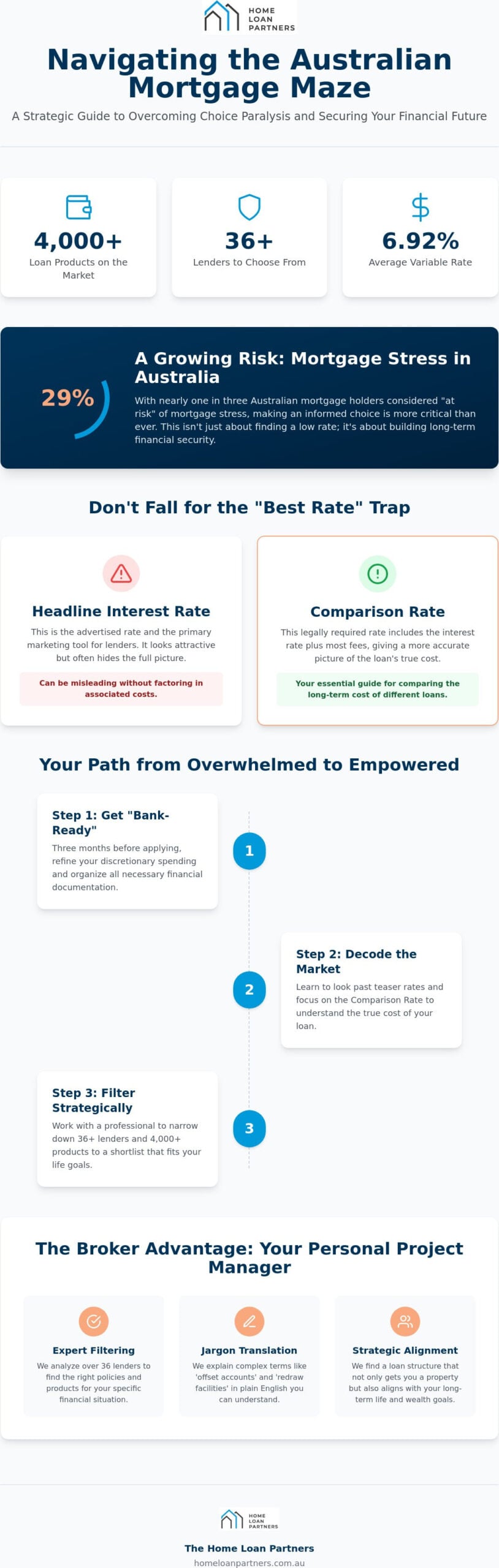
With 29% of Australian mortgage holders now considered “at risk” of mortgage stress, choosing the wrong home loan isn’t just a minor inconvenience; it’s a genuine financial risk. It is completely natural if you are currently feeling overwhelmed by mortgage options while the average variable rate sits at 6.92% and the market feels more complex than ever before. You likely want the security of a competitive rate, yet the constant talk of offset accounts, redraw facilities, and APRA debt-to-income caps can make anyone want to stall their search.
You deserve to feel confident that you aren’t overpaying for a product that doesn’t serve your long-term goals. We believe that professional filtering is the only way to turn this industry noise into a strategic advantage for your future. This guide will transform your decision paralysis into a clear, manageable financial strategy that prioritizes your peace of mind and long-term security.
We will walk you through the process of narrowing down over 36 lenders into a simplified shortlist tailored to your needs. We’ll explain technical jargon in plain English and outline a steady, stress-free path from your initial research right through to the final settlement day.
Key Takeaways
- Learn how to navigate the 4,000+ products in the Australian market to stop feeling overwhelmed by mortgage options and start building a clear strategy.
- Discover why the comparison rate is far more important than the headline interest rate when calculating the true long-term cost of your loan.
- Master the art of being “bank-ready” by refining your discretionary spending and organizing your documentation three months before you apply.
- Understand how a dedicated finance broker acts as your personal project manager, filtering over 36 lenders to find a structure that aligns with your life goals.
Understanding Mortgage Choice Paralysis in the 2026 Australian Market
The current Australian landscape presents borrowers with more than 4,000 different loan products across dozens of traditional and digital institutions. This abundance is theoretically a win for consumers, but in practice, it often leads to a psychological state known as choice overload. When you’re faced with a 30-year financial commitment, the pressure to find the “perfect” loan is immense. It’s no wonder so many people find themselves feeling overwhelmed by mortgage options. This isn’t a sign of being ill-prepared; it’s actually a sign that you’re a diligent borrower who understands the gravity of this investment.
The 2026 market has added layers of complexity that didn’t exist in previous decades. We’ve seen a surge in digital lenders offering hyper-specific tiered interest rates based on your exact equity position. Regulations from APRA regarding debt-to-income ratios have also become more nuanced. Feeling overwhelmed by mortgage options in this environment is a natural response to a system that has become increasingly fragmented. You aren’t just looking for a rate; you’re looking for a strategy that fits your life.
The 30% Rule vs. Decision Anxiety
Economists usually define mortgage stress by the “30% rule,” which is when a household spends more than 30% of its pre-tax income on repayments. However, this definition ignores the mental toll of selection stress. The fear of “missing out” on a slightly better rate can cause you to delay your decision for weeks or months. This hesitation has a real cost. In a fast-moving property market, the time lost to decision anxiety can lead to missed opportunities on homes that would have otherwise been perfect for your family.
Why More Choice Doesn’t Always Mean Better Results
Having access to 36+ lenders is only an advantage if you have a reliable way to filter them. Without a steady hand to guide you, more choice often leads to lower satisfaction with the final result. Lenders frequently use “teaser rates” to exploit researchers who are already feeling the weight of too many choices. These low headline figures often mask higher ongoing fees or a lack of flexible features like offset accounts or redraw facilities. Choice paralysis acts as a significant barrier to wealth creation because it keeps your financial progress stagnant while you search for a perfect solution that doesn’t exist. We act as your expert collaborator to help you move past this noise and focus on the products that actually align with your future security.
Decoding the Noise: Lenders, Features, and the “Best Rate” Trap
The search for a home loan often begins with a single number: the interest rate. It’s easy to see why so many borrowers end up feeling overwhelmed by mortgage options when every advertisement claims to have the market’s lowest offer. However, focusing solely on the headline rate is a common trap that can lead to higher costs over the life of your loan. The comparison rate is your true guide; it includes both the interest rate and most fees and charges associated with the loan. Taking the right steps to smooth your way through the home-buying process means looking past the marketing and understanding what you’ll actually pay each month.
- Portability: The ability to move your loan to a new property without refinancing.
- Repayment flexibility: Options to change your payment frequency or make lump-sum contributions.
- Fee-free structures: Loans that skip the monthly service charges in exchange for a slightly different rate.
Offset vs. Redraw: Which Tool Actually Reduces Your Interest?
Understanding the difference between an offset account and a redraw facility is essential for long-term savings. An offset account is a separate transaction account linked to your mortgage. Every dollar in that account reduces the balance the bank charges interest on. It offers maximum flexibility because your money is always accessible. A redraw facility, on the other hand, allows you to pull back extra repayments you’ve made directly into the loan. While often cheaper in terms of annual fees, redraws can have restrictions on how and when you access the funds. Seeing your daily savings actively chipping away at your debt provides a psychological boost that keeps you motivated on your financial journey.
Fixed, Variable, or Split: Choosing a Direction in 2026
Choosing a rate type depends heavily on your personal risk tolerance. A fixed rate provides certainty for a set period, which is helpful for budgeting, but it often comes with strict limits on extra repayments and high break costs. Variable rates offer more features and flexibility but leave you exposed to market fluctuations. Many of our clients find that a split loan offers the best of both worlds. You can fix a portion of your debt for security while keeping the rest variable to take advantage of offset features. If you’re still feeling overwhelmed by mortgage options, talking to a professional collaborator can help clarify which structure matches your lifestyle goals.
A Strategic Framework for Filtering Your Home Loan Options
Instead of scrolling through endless product lists, you need a filter that aligns with your specific life trajectory. If you are currently feeling overwhelmed by mortgage options, the best way forward is to start with your “Why.” A forever home requires a different debt structure than a stepping stone property or a pure investment. For example, a property you plan to keep for 30 years might benefit from a loan with high flexibility for renovations. Conversely, an investment loan should prioritize tax efficiency and potentially interest-only periods to maximize cash flow.
Before you spend your weekends at open houses, you must establish a firm baseline. It’s easy to fall in love with a property only to realize the bank won’t support the purchase. We recommend a “Stress Test” as part of your initial research. Ask yourself: “Can I still comfortably manage these repayments if interest rates rise by another 2%?” This simple check ensures your financial strategy remains robust even if the market shifts. It moves you from a place of uncertainty to a position of strength.
Assessing Your Borrowing Capacity
Lenders don’t all look at your bank statements the same way. Some are generous with overtime and bonuses, while others apply heavy “haircuts” to self-employed income. Existing debts like HECS-HELP, car loans, and credit card limits also play a major role in your final figure. Even an unused credit card with a $10,000 limit can reduce your borrowing power by significant amounts. To get a clear picture of your starting point, use a home loan calculator to establish a realistic baseline for your property search. Knowing your limit prevents the heartache of looking at homes that are out of reach.
Matching Loan Structure to Your Financial Personality
Are you a “set and forget” borrower, or do you enjoy active debt recycling to build wealth? Your financial personality should dictate your choice of lender. Some borrowers value a sleek digital interface for daily tracking, while others prefer a lender known for high service levels during complex life changes. If you anticipate marriage, kids, or a career shift in the next five years, the cheapest loan on the market might actually be the most restrictive. We help you prioritize features that support these milestones. This ensures your mortgage evolves alongside you rather than becoming a hurdle. When you stop feeling overwhelmed by mortgage options, you can focus on the excitement of your new home.
5 Practical Steps to Reduce Mortgage Stress During the Application
The transition from research to application is often when borrowers find themselves feeling overwhelmed by mortgage options. The theoretical search for a loan suddenly becomes a high-stakes reality involving bank statements and credit checks. To maintain your peace of mind, it’s essential to move from a passive observer to a proactive applicant. Taking control of your financial narrative before the bank sees it is the most effective way to ensure a smooth approval process.
One of the most impactful steps you can take is cleaning up your discretionary spending at least three months prior to your application. In 2026, lenders are scrutinizing living expenses with high precision. They aren’t just looking at your total income; they’re looking at your habits. Minimizing non-essential subscriptions and luxury spending during this 90-day window demonstrates a steady hand and financial discipline. Additionally, understanding Lenders Mortgage Insurance (LMI) is vital. While it’s a cost that protects the lender rather than you, it can be a strategic tool to enter the property market with a smaller deposit if your income is strong. If you’re ready to move forward, you can start your application with expert guidance to ensure every detail is managed correctly.
The Documentation Checklist
Lenders in 2026 require a comprehensive digital trail to verify your stability. You’ll need current proof of identity, at least two recent payslips, and your most recent group certificates or tax returns. If you’re relying on genuine savings, you must show a consistent history of deposits over several months. Be aware that “Buy Now, Pay Later” accounts can complicate your application, as banks often view these as active lines of credit that reduce your borrowing capacity. Organized paperwork is the fastest way to reduce loan anxiety and speed up the assessment time.
Navigating the Pre-Approval Process
Not all pre-approvals are created equal. A “system-generated” pre-approval is often just an automated estimate based on the data you provided. We always recommend a “fully assessed” pre-approval, where a credit officer has actually reviewed your documents. This provides a much higher level of certainty when you’re standing at an auction. Most pre-approvals last for 90 days, though they may require a re-assessment if interest rates rise significantly or your employment status changes. This document is your best defense against emotional over-bidding, as it sets a clear, unbreakable boundary for your property search. Engaging a professional collaborator to manage the communication between your lender, real estate agent, and solicitor ensures that you can focus on finding the right home while we handle the heavy lifting of the paperwork.
Moving from Overwhelmed to Empowered: The Home Loan Partners Advantage
The journey toward property ownership doesn’t have to be a solitary or stressful experience. While the sheer volume of data in the 2026 market can lead to anyone feeling overwhelmed by mortgage options, having a dedicated expert by your side changes the entire dynamic. A finance broker acts as your personal project manager, taking the complex requirements we’ve discussed and turning them into a streamlined, manageable checklist. We do the heavy lifting of researching 36+ bank and non-bank lenders so you can focus on the lifestyle milestones that matter most to you.
Our NSW-based team serves clients across the whole of Australia, providing a steady hand and local expertise regardless of where you’re looking to buy. We understand that a home loan isn’t a one-off transaction; it’s a long-term commitment that requires ongoing care. We don’t just help you reach settlement and then disappear. We remain your expert collaborator for the life of your loan, checking in to ensure your structure remains competitive as your life evolves and market conditions shift.
Unbiased Guidance vs. Single-Bank Limitations
When you walk into a local bank branch, the person behind the desk can only offer you that specific institution’s products. They can’t tell you if a competitor has a lower comparison rate or more flexible features for your unique profile. We operate with a fundamentally different philosophy. By comparing dozens of lenders through a single point of contact, we provide the unbiased perspective you need to make a confident choice. Our model, which follows the industry standard for Commission-based Loan Brokerage Fees, is designed to align our success with your satisfaction. Because we receive a trail commission, we are financially incentivized to ensure your loan remains the right fit for you year after year. If your situation changes, we’re already there to help you pivot.
The Next Steps in Your Property Journey
Transitioning from research to action is as simple as booking an obligation-free strategy session. In our first meeting, we won’t jump straight into paperwork. Instead, we’ll focus on your aspirations and any hurdles you’re currently facing. You don’t need to worry about having every document perfectly sorted or knowing exactly which loan you want. That’s what we’re here for. We’ll listen to your goals, assess your borrowing capacity, and begin the process of filtering the noise into a clear path forward. Contact The Home Loan Partners today to start your journey toward a stress-free application and a secure financial future.
Your Path to a Clear Financial Future
Navigating the Australian property market in 2026 requires more than just a search for the lowest rate. It demands a strategic approach that prioritizes your future security over industry noise. By looking past teaser rates to the true comparison rate and ensuring you are bank-ready before you apply, you can reclaim control of your financial journey. Stop feeling overwhelmed by mortgage options by shifting your focus from the thousands of products available to the specific life milestones you want to achieve.
Our team acts as your expert collaborator, providing access to over 36 bank and non-bank lenders to find the precise structure that fits your goals. Whether you’re a first home buyer or a seasoned investor, we provide the steady hand needed to navigate complex regulations and technical jargon. Our commitment doesn’t end at settlement; we provide ongoing support for the life of your loan to ensure it continues to serve you as your circumstances change.
You deserve a property experience that’s defined by confidence rather than confusion. Book a Stress-Free Strategy Session with The Home Loan Partners today. We look forward to helping you move forward with clarity and peace of mind.
Frequently Asked Questions
Why do I feel so overwhelmed by mortgage options?
You feel this way because the Australian market currently offers over 4,000 loan products with varying tiers and complex features. This phenomenon is known as choice overload, and feeling overwhelmed by mortgage options is a natural response to such a high-stakes decision. We help by acting as a professional filter, distilling those thousands of choices into a manageable shortlist that aligns with your specific life goals.
Is it better to go to my own bank or use a mortgage broker?
While your own bank can only offer you their internal products, a mortgage broker provides an unbiased view of the broader market. We compare options from over 36 bank and non-bank lenders to ensure you aren’t missing out on a better rate or more flexible features elsewhere. This collaborative approach saves you the time and stress of visiting multiple institutions yourself while providing a much wider range of choices.
How much does it cost to use a broker to help with my mortgage?
In most cases, there is no direct cost to you for using our services. Mortgage brokers are typically paid a commission by the lender you choose once your loan settles. This model ensures we are incentivized to find a product that keeps you satisfied long-term, as we provide ongoing support and management throughout the entire life of your loan.
What is the most important feature to look for in a home loan?
The most important feature is the one that aligns with your five-year life plan. While a competitive comparison rate is vital for daily savings, features like an offset account or redraw facility can save you thousands in interest over the long term. We help you identify which lifestyle features, such as loan portability or repayment flexibility, will provide the most value for your unique financial personality.
Can I still get a home loan if I have a small deposit or complex income?
Yes, you can still secure a home loan with a small deposit or non-traditional income. Many lenders specialize in serving self-employed borrowers or those with a 5% deposit through Lenders Mortgage Insurance or government support schemes. Having access to a broad panel of 36+ lenders allows us to find a home for applications that traditional banks might otherwise decline.
How often should I review my mortgage to ensure I still have the best deal?
You should ideally review your home loan every 12 to 18 months. Market conditions and interest rates shift frequently, and your current lender may no longer be the most competitive option for your needs. A regular health check ensures you aren’t paying a loyalty tax and allows us to adjust your structure if your financial goals or family needs have changed.
What happens if I feel overwhelmed AFTER I have already signed a mortgage?
If you find yourself feeling overwhelmed by mortgage options even after settlement, remember that your loan structure isn’t permanent. Refinancing is a common and effective strategy to secure a better rate or move to a lender with better service levels. We act as your steady hand during this process, managing the transition to a new product that better suits your current peace of mind.
How long does the mortgage application process usually take in 2026?
In the 2026 market, the timeline from application to unconditional approval typically takes between two and four weeks. This duration depends on the lender’s current assessment volumes and how quickly you provide your documentation. Being bank-ready with organized digital paperwork is the most effective way to ensure your application moves swiftly through the system toward a successful settlement.