

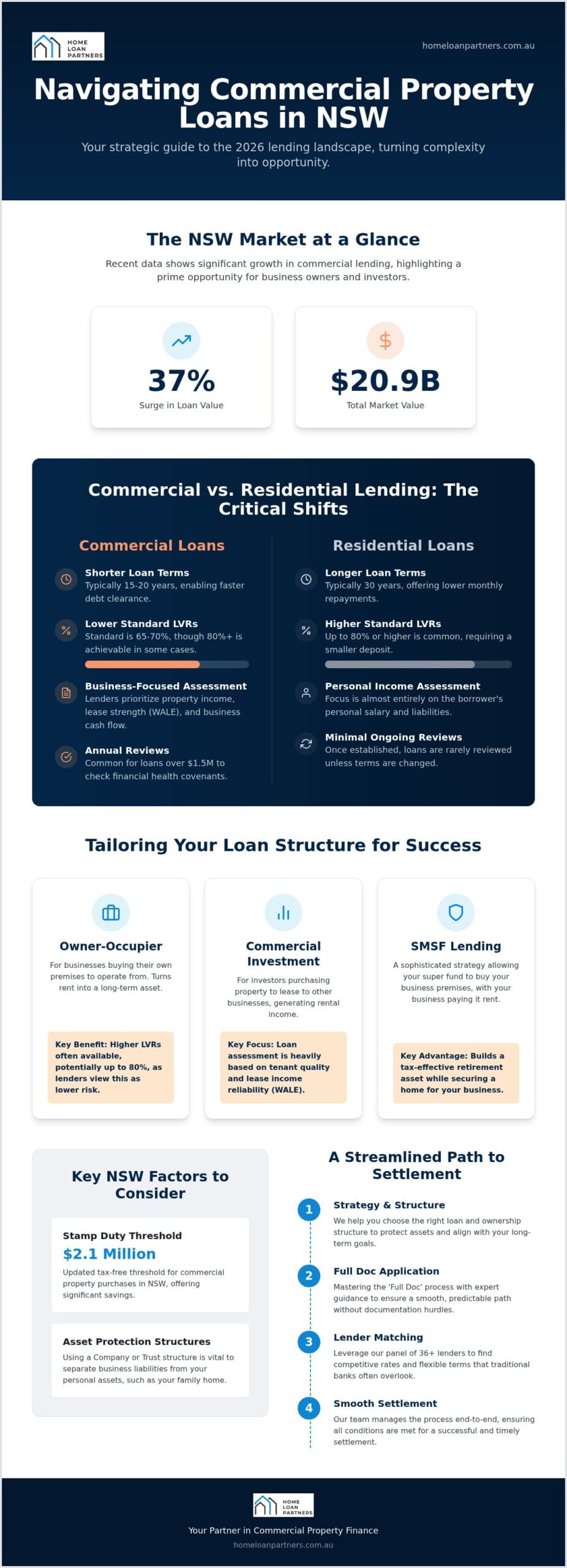
The value of commercial property loans in Australia surged by 37% to reach $20.9 billion by early 2025, yet many local business owners still feel sidelined by traditional bank hurdles. You’ve likely noticed that securing a commercial property loan nsw feels like a completely different world compared to residential lending. It’s a space where a 20% deposit is often just the starting point, and documentation requirements can feel like an endless mountain of paperwork. We understand that these complexities, along with NSW-specific costs like commercial stamp duty, can make even the most promising investment feel overwhelming.
Our goal is to act as your steady hand through this process, turning a complex transaction into a strategic partnership. This guide provides the expert insights you need to navigate the 2026 lending landscape with confidence. You’ll learn how to access high LVRs of 80% or more where possible, choose loan structures that protect your personal assets, and avoid the common pitfalls of annual reviews. We will preview current interest rate trends, explain the new $2.1 million tax-free threshold for commercial stamp duty, and map out a streamlined path to your settlement.
Key Takeaways
- Learn how to navigate standard 65% to 70% LVRs and identify specific opportunities to secure higher leverage for your business goals.
- Understand the impact of NSW zoning reforms and the updated $2.1 million tax-free stamp duty threshold on your next commercial property loan nsw.
- Discover how to tailor your loan structure to protect personal assets while aligning with your long-term tax and cash flow strategies.
- Master the ‘Full Doc’ application process to ensure a smooth, predictable path to settlement without the stress of unexpected documentation hurdles.
- Gain a competitive edge by leveraging a panel of 36+ lenders to find flexible terms that traditional banks often overlook.
Understanding Commercial Property Loans in the NSW Market
A commercial property loan nsw is a specialized finance solution designed for purchasing or refinancing assets used for business or investment purposes. Whether you’re looking at a retail storefront, an industrial warehouse, or a professional suite, the lending criteria differ significantly from the residential market. While a home loan relies heavily on your personal salary, commercial lenders prioritize the property’s income-producing potential and the operational strength of your business. Navigating these specialized requirements is where The Home Loan Partners excels, offering expert guidance tailored to your specific needs.
Understanding Commercial Property Loans requires a shift in mindset regarding how debt is serviced. Within the dynamic NSW commercial property market of 2026, lenders are increasingly focused on debt-to-income (DTI) ratios and the reliability of lease income. They don’t just want to know you can pay; they want to see that the asset or the business itself generates enough cash flow to cover the commitment comfortably. This results in a more collaborative assessment process where your business’s financial health takes center stage.
Commercial vs. Residential Lending: The Critical Shifts
The differences between these two worlds are stark. Residential mortgages typically offer 30-year terms, but commercial loans are often compressed into 15 to 20 years. This shorter timeframe means higher principal repayments, but it also helps you clear debt faster. You should also expect annual reviews for loans exceeding $1.5 million. These reviews allow the lender to check ‘covenants’, which are financial health markers like your interest cover ratio. Another key factor is the Weighted Average Lease Expiry (WALE). A high WALE indicates long-term tenant stability, which can be the deciding factor in securing a competitive interest rate or a higher LVR.
Why NSW Business Owners are Moving from Lease to Purchase
Many business owners in New South Wales are tired of the uncertainty that comes with commercial leases. Purchasing your own premises allows you to build equity in an asset you control, turning a monthly expense into a long-term investment. This move provides a fixed cost of occupancy, shielding your business from the rising commercial rents projected for 2026. Additionally, owning the property can offer significant tax advantages. You can often claim depreciation on the building and its fit-out, which reduces your taxable income while you grow your business’s net worth. It’s a strategic way to secure your financial future while providing a permanent home for your operations.
Evaluating Loan Structures: Owner-Occupier vs. Commercial Investment
Choosing the right commercial property loan nsw requires more than just comparing interest rates. You need to decide how the property fits into your broader financial picture. Owner-occupiers often secure higher LVRs, sometimes reaching 80%, because lenders view a business paying its own mortgage as a lower risk than a third-party tenant. In contrast, investment loans focus heavily on the quality of the tenant and the reliability of the lease income to cover the debt.
We often guide clients to look beyond purchasing in their personal names. Using a company or trust structure provides a vital layer of asset protection, effectively separating your business liabilities from your personal wealth. The RBA on commercial real estate lending highlights that while lending standards remain disciplined, the right structure is what truly safeguards a borrower’s long-term position. It’s about building a foundation that supports growth without exposing your family home to business risks.
SMSF Lending: Buying Your Premises with Your Super
Using a Self-Managed Super Fund (SMSF) to buy “business real property” is a sophisticated strategy for NSW directors. This arrangement allows you to become your own landlord, with your business paying rent directly into your super fund. This rent is typically taxed at a lower rate within the fund, helping you build a tax-effective retirement nest egg. You must follow the ‘arms-length’ rule strictly, ensuring the rent reflects current market rates. It’s a collaborative way to align your business needs with your future financial security.
Lease Income Loans for Savvy Investors
For those focused on portfolio growth, lease income loans allow the property’s rental yield to handle the debt servicing. Lenders prioritize ‘Tier 1’ tenants, such as government agencies or established corporations, because they offer the highest security. If you’re worried about potential vacancy, we can explore interest-only periods to help manage cash flow during tenant transitions. If you’re unsure which path fits your specific goals, looking at tailored loan structures can provide the clarity you need to move forward with confidence.
Navigating LVRs, Interest Rates, and Lending Criteria
Securing a commercial property loan nsw requires a clear understanding of how lenders view risk and security. While residential buyers often aim for small deposits, the commercial standard typically sits between 65% and 70% Loan-to-Value Ratio (LVR). This buffer protects the lender against market fluctuations. If you’re looking at specialized assets like cold storage or medical suites, you might find LVRs capped even lower, around 50% to 60%, reflecting the unique nature of those properties.
Interest rates in 2026 have evolved beyond simple fixed and variable options. Many business owners now encounter ‘bill-swap’ rates (BBSW), which are often used for larger facilities and fluctuate based on market liquidity. The type of property you choose also dictates your borrowing power. Industrial warehouses currently enjoy strong favor due to high demand, whereas office spaces may face stricter scrutiny. If you’re facing a deposit gap, bridging finance or using additional security can help you secure the asset without waiting years to save more capital.
Factors That Influence Your Commercial Interest Rate
Lenders assign a ‘risk grade’ to every application, which determines the margin they add to the base rate. A business with three years of clean ‘Full Doc’ tax returns and a low LVR will almost always receive a more competitive offer than a ‘Low Doc’ applicant. While Low Doc loans provide a faster path for those with complex tax structures, the trade-off is usually a higher interest margin. Your LVR has a direct correlation here; the more equity you bring to the table, the lower the risk grade the bank assigns to your file.
The Role of Security: Beyond the Property Itself
When structuring a commercial property loan nsw, lenders often require more than just the property as collateral. You’ll likely encounter General Security Agreements (GSA) over your business assets or personal Director Guarantees. These provide the bank with multiple layers of protection, which can be stressful if not managed correctly. However, this also opens up opportunities. By using the equity in your home, you can often achieve 100% finance for your commercial purchase without touching your cash reserves. We recommend using our home loan calculator to assess your current equity levels. This simple step can reveal if you have the hidden capacity to secure your business’s future today.
The Step-by-Step Commercial Loan Application Process
Securing a commercial property loan nsw involves a more rigorous journey than a standard home purchase. It begins with a strategy session to determine which of our 36+ lenders aligns with your specific industry and financial structure. We then move into the pre-qualification phase, where we establish your borrowing capacity before you even set foot in an inspection. This proactive approach ensures you’re looking at properties that fit your actual budget, saving you time and stress.
Gathering the ‘Full Doc’ pack is the most critical stage of the process. Lenders need a deep dive into your business’s health to feel confident in the investment. Once your paperwork is submitted, we move to the valuation phase. Commercial valuations often surprise first-time buyers because they are incredibly detailed and can take up to two weeks to finalize. They also carry a higher price tag than residential reports, often starting around A$1,500. After the valuation is cleared, we guide you through formal approval and the final weeks of legal conveyancing before settlement.
Documentation Checklist for NSW Applicants
Preparation is the key to a smooth approval. You’ll need to provide a comprehensive view of your financial position, including:
- Two years of financial statements and tax returns for the borrowing entity.
- Certified copies of current lease agreements and a detailed rent roll to prove income stability.
- A Personal Statement of Assets and Liabilities for all directors involved in the loan.
NSW Purchase Costs: Budgeting for More Than Just the Deposit
Budgeting for a commercial property loan nsw means looking closely at the specific costs associated with the state’s regulations. For the 2026/27 financial year, the premium property duty threshold is A$3,870,000. For properties exceeding this value, the duty is A$194,137 plus A$7.00 for every A$100 over the threshold. It’s vital to get these numbers right early on, so we recommend using our stamp duty calculator nsw to plan your cash flow accurately.
You should also consider GST implications. While commercial sales typically attract 10% GST, you may be eligible for a ‘Going Concern’ exemption if the property is sold with an active lease in place. This can significantly reduce your upfront capital requirement. If you’re ready to map out your path to ownership with a partner who handles the heavy lifting, book your strategy session with our team to get started.
Securing Your Commercial Future with a Specialist Finance Broker
Choosing the right commercial property loan nsw is rarely about finding the single lowest interest rate. It’s about finding a lender whose credit policy aligns with your specific industry, asset type, and growth trajectory. While a major bank might offer a familiar face, their rigid “one-size-fits-all” criteria often exclude perfectly viable business cases. This is where the power of choice becomes your greatest asset. By accessing a panel of 36+ bank and non-bank lenders, we ensure you aren’t limited by the narrow appetite of a single institution.
Many business owners mistakenly believe that long-term loyalty to their current bank will yield better terms. In the commercial space, the opposite is often true. Banks frequently rely on inertia, keeping existing clients on older, less competitive products. A specialist broker acts as your advocate, constantly scanning the market to ensure your finance remains optimized. We manage the complexities of the ongoing relationship, including the annual reviews required for larger facilities. Instead of facing a stressful audit alone, you have a partner who understands the bank’s requirements and prepares your documentation to highlight your strengths.
Why a Finance Broker is Your Best Commercial Ally
We do the heavy lifting by presenting your business case to multiple credit teams simultaneously. This creates a competitive environment where lenders must bid for your business. Our team negotiates better-than-advertised rates by leveraging our industry relationships and the high volume of quality loans we manage. We understand how to frame your financial story to mitigate perceived risks, whether you’re dealing with a complex trust structure or a specialized industrial asset. For more insights on how this partnership works, read our finance broker guide to understand our collaborative approach to your property journey.
Start Your Journey with The Home Loan Partners
At The Home Loan Partners, we view ourselves as expert collaborators in your success. We know that a commercial purchase is often a major life milestone, representing years of hard work and ambition. Our commitment is to provide a reassuring, professional experience that alleviates the inherent stress of complex finance. We handle the technical jargon and the back-and-forth with lenders, providing you with a clear, predictable path to settlement. Your next step is simple. Book a commercial strategy session with our team today, and let’s start building a finance structure that protects your assets and fuels your future growth.
Take the Next Step Toward Your Business Milestones
Securing a commercial property loan nsw is a significant step that requires more than just a signed application. It demands a strategic approach to loan structures, a clear understanding of LVR requirements, and a proactive plan for managing state-specific costs. By choosing the right path today, you’re not just buying a property; you’re building equity and securing a permanent home for your business aspirations. We’ve navigated these complexities for years, and we’re ready to share that expertise with you.
At The Home Loan Partners, we provide a steady hand throughout your entire journey. With access to 36+ bank and non-bank lenders, we ensure you have the power of choice and the benefit of tailored solutions. Our dedicated team manages the heavy lifting from your initial inquiry right through to settlement, allowing you to focus on what you do best: running your business. We invite you to Book Your Commercial Strategy Session with The Home Loan Partners today. Let’s work together to turn your commercial goals into a reality.
Frequently Asked Questions
How much deposit do I need for a commercial property loan in NSW?
Most lenders require a deposit of 30% to 35% for a commercial property loan nsw, which represents a 65% to 70% Loan-to-Value Ratio. While residential loans often allow for 5% or 10% deposits, commercial assets carry different risks. In specific scenarios where you are an owner-occupier with a strong business history, we can sometimes secure finance with a 20% deposit. Having a larger deposit often helps you access more competitive interest margins.
Can I use my residential home as security for a commercial loan?
Yes, you can use the equity in your residential home as additional security to cover the deposit and costs of a commercial purchase. This strategy often allows business owners to achieve 100% finance for the new property without using their cash reserves. It’s a powerful way to leverage your personal success to fuel your business’s growth. We’ll help you structure this carefully to ensure your personal assets remain protected while you expand your portfolio.
What are the current commercial property loan interest rates in 2026?
In 2026, indicative interest rates for specialized commercial loans start from 6.12%, while full-doc loans for amounts up to A$3 million typically range between 7.84% and 8.94% depending on your LVR. Rates fluctuate based on the property type and your business’s risk grade. Fixed rates for one-year terms are currently sitting between 6.09% and 6.29%. We recommend a strategy session to find the most accurate rate for your specific investment goals and financial position.
Is GST payable on the purchase of a commercial property in NSW?
GST is generally payable at 10% on commercial property sales, but you can often avoid this through the ‘Going Concern’ exemption. This applies if the property is sold with an active lease in place and both parties are registered for GST. It’s a critical area where professional advice is essential. If the exemption doesn’t apply, you’ll need to budget for the GST upfront, though you can usually claim it back in your next BAS.
How long does the commercial loan approval process typically take?
The approval process for a commercial property loan nsw typically takes between four and eight weeks from application to settlement. This timeline is longer than residential lending because commercial valuations are more complex and can take up to 14 days to complete. Preparing your ‘Full Doc’ pack early helps speed up the process. We manage the heavy lifting and keep you informed at every stage to ensure a smooth, predictable path to your settlement.
What is a ‘Low Doc’ commercial loan and do I qualify?
A ‘Low Doc’ loan is designed for business owners who have the income to service a loan but don’t have up-to-date tax returns or financial statements. Instead of full documentation, lenders may accept BAS statements or an accountant’s letter to verify your income. You might qualify if you’ve been trading for at least two years and have a clean credit history. These loans often come with slightly higher interest rates to reflect the increased risk the lender takes.
Can I buy a commercial property through my SMSF?
You can absolutely purchase “business real property” through a Self-Managed Super Fund (SMSF). This allows your business to pay rent directly into your super fund, which is a tax-effective way to build your retirement wealth. The property must be used solely for business purposes and the rent must reflect current market rates. It’s a sophisticated strategy that aligns your current business needs with your long-term financial security and retirement goals while providing a permanent business home.
What is the difference between a commercial loan and a business loan?
A commercial loan is specifically used to purchase or refinance a physical property asset. In contrast, a business loan is typically used for operational needs like working capital, equipment, or marketing. Commercial loans are secured by the property itself and usually offer longer terms and lower interest rates. Business loans might be unsecured or secured by other assets and focus more on your business’s cash flow rather than the specific value of real estate holdings.