

What if your home loan wasn’t just a monthly bill, but the primary engine for your long term wealth? With nearly 30% of Australians having never refinanced their home loan, many homeowners are missing out on a powerful opportunity to transform dormant equity into a productive asset. A cash out refinance to invest in shares australia allows you to tap into your home’s value, potentially converting non-deductible debt into a tax-effective investment strategy that works harder for your future.
We understand that the idea of leveraging your home can feel daunting, especially with the RBA cash rate sitting at 4.35% and significant tax changes for capital gains approaching in 2027. It’s natural to feel uncertain about how much equity is truly usable or how to manage market volatility safely. This guide provides a clear, steady framework for debt recycling and explains the specific tax benefits of investment debt. You’ll discover a practical roadmap to starting a share portfolio using your home equity, helping you move toward your major life milestones with a reliable and expert partner by your side.
Key Takeaways
- Learn how to calculate your usable equity using the 80% LVR rule to ensure your home remains protected while you grow your wealth.
- Discover how a cash out refinance to invest in shares australia can transform non-deductible mortgage interest into a tax-effective investment strategy.
- Understand the benefits of liquidity when comparing share portfolios to property, allowing for more flexible financial decisions as your needs change.
- Follow a structured roadmap to audit your current loan and identify any costs that might impact your refinancing journey.
- See how partnering with an expert to compare dozens of lenders ensures you find a policy that’s specifically designed for your investment goals.
Using Equity to Invest: What is a Cash Out Refinance?
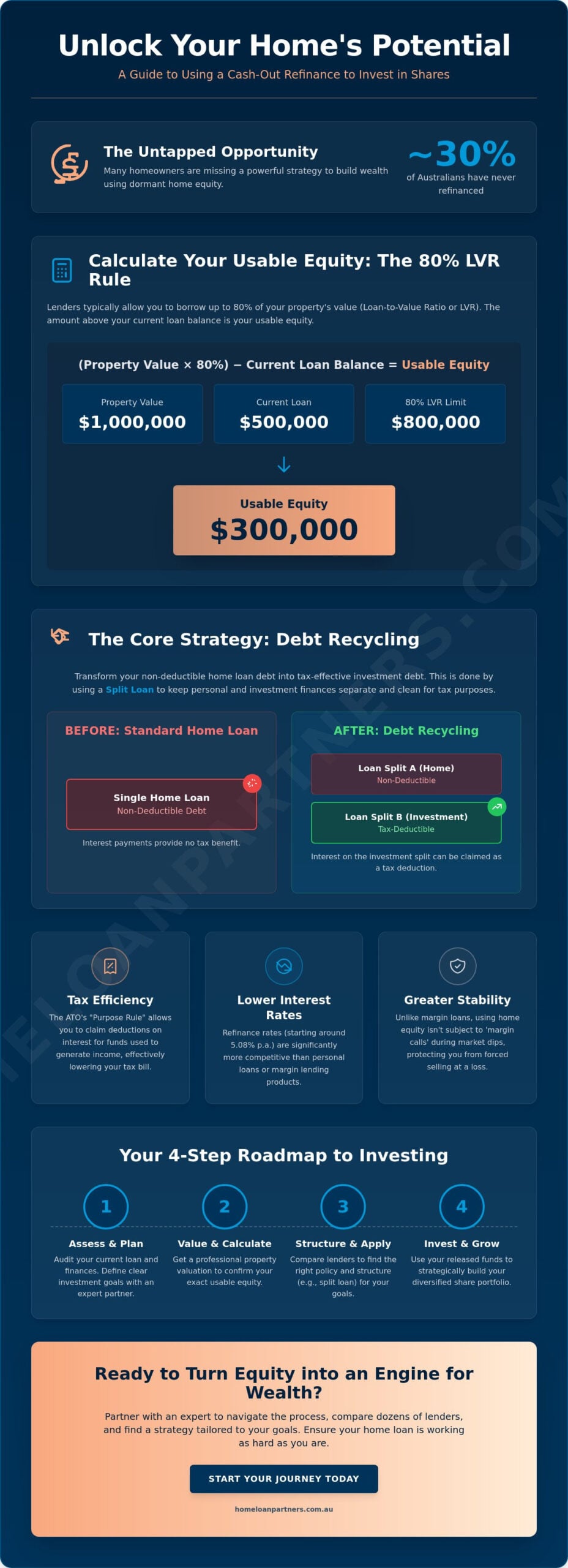
In the current Australian financial climate, your home is likely your most significant asset. As of May 2026, many homeowners have seen their property values stabilize or grow, even with the Reserve Bank of Australia maintaining the official cash rate at 4.35%. This environment creates a unique opportunity to look at your mortgage not just as a debt, but as a source of capital. To understand the mechanics, we first look at What is a Cash Out Refinance? in its simplest form: replacing your current debt with a new, larger arrangement. The “cash out” portion is the difference between your old loan balance and your new one, which is paid to you at settlement to fund your investment goals.
Using a cash out refinance to invest in shares australia is a deliberate choice to shift wealth from a single property asset into a diversified portfolio. Unlike margin lending, where a sudden market dip can trigger a “margin call” and force you to sell shares at a loss, using home equity generally offers more stability. You aren’t beholden to the daily fluctuations of the stock market in the same way. Additionally, the interest rates for a refinance, which currently start around 5.08% p.a., are typically much lower than the rates found on personal loans or specialized investment loans.
Understanding Your Usable Equity
There’s a vital distinction between your total equity and your “usable” equity. Total equity is the full market value of your home minus your current loan balance. However, lenders rarely allow you to strip all that value away. Most Australian banks adhere to the 80% Loan-to-Value Ratio (LVR) rule. This means they’ll lend you up to 80% of the property’s appraised value without charging Lenders Mortgage Insurance (LMI). Staying within this 80% threshold is a safer way to leverage your home while keeping a comfortable buffer against potential property price corrections.
A professional valuation is the cornerstone of this process. It determines exactly how much capital you can access. If your home is valued at $1,000,000 and you owe $500,000, your 80% limit is $800,000. This leaves you with $300,000 in usable equity to put toward your share portfolio.
Cash Out vs. Home Loan Top-Up
You might wonder if you should simply ask your current bank for a “top-up” instead of a full refinance. While a top-up can be faster, it often limits you to your current lender’s existing rates and policies. Refinancing to a new lender allows us to scan the broader market for more competitive features. Many investors prefer a cash out refinance to invest in shares australia because it allows them to create a “split loan” structure. This keeps your private mortgage debt entirely separate from your investment debt, making it much easier for your accountant to track tax-deductible interest at the end of the financial year.
The Strategy: Debt Recycling and Tax Efficiency
Debt recycling is a sophisticated yet accessible strategy that allows you to pay off your home loan faster while simultaneously building an investment portfolio. The goal is simple: you replace non-deductible debt (your home loan) with deductible debt (your investment loan). A cash out refinance to invest in shares australia acts as the engine for this transition. By drawing out equity and directing it toward shares, you’re not just increasing your total debt; you’re changing the tax nature of your liabilities. This proactive approach turns a standard mortgage into a powerful tool for long-term wealth creation.
The Australian Taxation Office (ATO) applies what is often called the “Purpose Rule.” This rule dictates that the deductibility of interest is determined by how the borrowed funds are used, regardless of the asset used as security. Because you’re using the cash-out portion to acquire assets that generate assessable income, the interest on that specific portion of the loan typically becomes a tax deduction. You can find more detail on how these earnings are treated in the ATO guidelines on share investing. This shift can result in significant tax savings, effectively reducing the “real” cost of your borrowing while you grow your asset base.
The Mechanics of Split Loans
Precision is your best friend when it comes to tax efficiency. You must never mix your investment funds with your daily spending or your existing home loan balance. Doing so creates a “polluted” loan, making it nearly impossible for an accountant to calculate your deductions accurately. We solve this by setting up a split loan structure. Split A remains your standard home loan for personal use, while Split B is a separate account dedicated solely to your share investments. A split loan is the essential tool for tax-compliant debt recycling, ensuring every cent of investment interest is clearly documented and separated from personal debt.
Maximising Deductibility with Dividends
The true power of this strategy lies in the circular flow of capital. When your shares pay dividends, you don’t just spend that cash. Instead, you direct those dividends toward Split A, the non-deductible part of your mortgage. This reduces your personal debt faster, which in turn creates more usable equity. You can then increase Split B to buy more shares, continuing the cycle. To stay on the right side of the law, ensure you’re buying income-producing assets like blue-chip shares or diversified ETFs. If you’re unsure how your current bank handles multiple splits, reaching out for a refinancing review can clarify your options and help you build a more robust financial future.
Evaluating the Risks and Rewards of Share Investing
Every investment strategy requires a balance between potential growth and the comfort of security. When you choose a cash out refinance to invest in shares australia, you’re essentially betting that the long term returns of your share portfolio will outperform the cost of your debt. With variable refinance rates currently starting around 5.08% p.a. and inflation sitting at 4.6%, the margin for error is something we must manage with precision. However, shares offer a level of liquidity that property simply cannot match. You can’t sell a kitchen or a bathroom to access cash, but you can sell a portion of a share portfolio in days if your circumstances change.
We often speak with clients who worry about market volatility. It’s a valid concern. We manage this by focusing on diversification and dollar cost averaging. Instead of dropping your entire equity lump sum into the market on a single Tuesday, you might choose to invest it in stages. This smooths out the purchase price over time. For a broader perspective on how different assets behave, the Moneysmart guide to investing in shares provides an excellent foundation for comparing risk profiles across the Australian market.
Market Volatility and Equity Protection
One of the most reassuring aspects of using a home loan for this strategy is the protection of your collateral. In a traditional margin loan, a sharp drop in share prices can trigger a “margin call,” requiring you to find extra cash immediately or sell your shares at the worst possible time. With a home loan refinance, your house is the security, not the shares. As long as you maintain your mortgage repayments, the bank won’t force you to sell your portfolio just because the market had a bad month. This allows you to maintain a non-negotiable 5 to 10 year horizon, which is essential for weathering short term storms.
Interest Rate Risk Management
With the RBA cash rate at 4.35%, we must plan for the possibility of further shifts. A successful strategy requires a “buffer” between your dividend yield and your loan interest rate. If your loan costs 5.08% but your portfolio only yields 3%, you’re relying entirely on capital growth to break even. We often help clients explore a mix of fixed and variable loan splits. Fixing a portion of your investment debt can provide a sense of calm, as you’ll know exactly what your obligations are for the next few years, regardless of what happens in the wider economy.
Step-by-Step: How to Refinance to Invest in Shares
Moving from a wealth strategy to real world execution requires a steady hand and a clear checklist. To begin a cash out refinance to invest in shares australia, we first conduct a comprehensive equity audit. This starts with a professional property valuation to confirm your usable equity balance. During this phase, it’s vital to review your current mortgage for any exit fees or break costs. Typical refinancing costs in Australia often range between $500 and $2,000. These include discharge fees, which usually sit between $150 and $500, and settlement fees ranging from $100 to $1,000. While these are standard industry costs, we focus on ensuring the long term wealth gains of your new portfolio far outweigh these initial setup expenses.
Preparing Your Application
A successful application depends on clarity and documentation. You’ll need your latest proof of income, current mortgage statements, and a basic outline of your investment plan. When we submit your application, we state “Investment in Shares” clearly as the loan purpose. This transparency is essential. It ensures the lender’s policy aligns with your goals and provides the first piece of evidence for your future tax claims. Before we apply, we also review your credit score together. A clean credit profile helps us secure the most competitive rates, which currently start from approximately 5.08% p.a. for variable options.
Implementing the Debt Recycle
Once your refinance is approved, the way you handle the funds is critical for tax compliance. We guide you to direct the cash out funds into a separate, “clean” bank account that has no other transactions. From there, you transfer the capital directly to your chosen brokerage platform, such as CommSec, Pearler, or Stake. This direct path creates an undeniable paper trail for the ATO. It proves that every dollar borrowed was used specifically to purchase income producing assets. By keeping these funds separate from your personal spending, you protect the integrity of your tax deductions for the life of the loan.
If you’re ready to see how much usable equity is sitting in your home, you can request an equity assessment to start your investment journey with confidence.
Why Partnering with a Mortgage Broker Makes the Difference
Executing a cash out refinance to invest in shares australia is a sophisticated move that requires more than just a standard loan approval. While a single bank can only offer you its own limited suite of products, we act as your expert collaborator by comparing options from over 36 different lenders. This broad market access is vital because no two banks view investment risk the same way. We take the time to understand your long term aspirations, ensuring the loan structure we build today supports the wealth you intend to grow over the next decade. Our role is to provide a steady hand, navigating the technical hurdles so you can focus on your portfolio.
Navigating Lender Policies
Lender policies regarding “cash out” for investment purposes vary significantly across the Australian market. Some institutions are cautious, categorizing share investing as an unregulated or higher risk activity. For instance, one major bank may limit your cash out to just $50,000. Another might allow you to access up to $250,000 without requiring heavy documentary evidence, provided your LVR remains at or below 80%. There are even lenders who will approve up to $500,000 for equity release if the application is structured correctly. We identify the lenders with the highest appetite for your specific strategy, ensuring you aren’t held back by restrictive internal caps or unnecessary red tape.
Beyond the loan amount, we prioritize finding lenders that offer superior split loan functionality. As we discussed in earlier sections, keeping your investment debt separate is non-negotiable for tax clarity. We look for lenders that provide clean, easy to manage sub-accounts with competitive variable rates, which currently start around 5.08% p.a. for many refinancers. By matching your goals with the right lender’s policy, we help you avoid the frustration of a declined application or a poorly structured debt arrangement.
The Collaborative Approach
We believe that your financial journey is a marathon, not a sprint. This is why we take a collaborative approach, often working alongside your accountant or financial planner to ensure your new loan structure aligns perfectly with your tax strategy. We manage the heavy lifting of the application process, from the initial equity audit to the final settlement, reducing the stress that often accompanies complex financial shifts. It’s about more than just a transaction; it’s about a long term relationship built on trust and precision. You might find that Why Your Bank’s ‘Loyalty’ Discount Might Be Costing You is a common hurdle, as staying with one lender for too long often leads to higher “back book” rates that eat into your investment margins.
Our support doesn’t end once your shares are purchased. As your portfolio grows and market conditions evolve, we continue to review your loan. Whether the RBA adjusts the cash rate from its current 4.35% or you decide to recycle more debt as your home value increases, we remain your reliable guide. We’re here to ensure your mortgage remains a proactive tool for your future security, helping you achieve major life milestones with confidence and calm expertise.
Build Your Future with Strategic Equity
You’ve seen how a cash out refinance to invest in shares australia can turn your home into a powerful wealth generator. By utilizing a clean split loan structure and adhering to the 80% LVR rule, you can safely navigate the tax landscape while building a diversified portfolio. This strategy isn’t just about accessing cash; it’s about a disciplined transformation of your debt that aligns with your long term financial goals. We’ve explored how proper structure protects your collateral and how the right lender policy can maximize your investment potential.
We’re here to manage the heavy lifting and provide the steady expertise you need to move forward. As specialists in debt recycling structures, we offer access to more than 36 Australian lenders to find the perfect fit for your aspirations. Your journey toward long term wealth starts with a single, clear step. Book a Strategy Session with The Home Loan Partners today to receive personalized, professional financial guidance tailored to your specific needs. We look forward to being your reliable guide on this rewarding journey toward your major life milestones.
Frequently Asked Questions
Is interest on a cash out refinance tax deductible if I buy shares?
Yes, interest is generally tax deductible if you use the borrowed funds to purchase shares that are expected to produce assessable income, such as dividends. The ATO determines deductibility based on the purpose of the loan rather than what the loan is secured against. By using a cash out refinance to invest in shares australia, you create a clear connection between the debt and the income-generating asset. It’s vital to keep these funds in a separate loan split to make claiming these deductions simple for your accountant.
How much equity can I realistically cash out in Australia?
Most Australian lenders allow you to access usable equity up to 80% of your property’s current market value. This 80% threshold is a standard benchmark that helps you avoid the cost of Lenders Mortgage Insurance while maintaining a sensible safety buffer. While some individual banks have internal caps on the total dollar amount for “cash out” purposes, we compare dozens of lenders to find those whose policies align with the specific scale of your investment goals.
Do I need a financial advisor to refinance for share investing?
While a financial advisor isn’t a legal requirement for the refinancing process, consulting one is a proactive way to ensure the strategy fits your risk profile. We act as your expert collaborator for the mortgage and debt structuring, but an advisor provides the specific guidance needed to select a diversified share portfolio. This partnership between your broker and advisor ensures your debt structure and your investment choices are working together to build your future security.
What is the risk of a margin call when using home equity for shares?
There is no risk of a margin call when you use a standard home loan to invest in shares. In traditional margin lending, the shares themselves are the security, meaning a market drop can force an immediate sale. With a refinance, your home is the security. As long as you continue to meet your scheduled mortgage repayments, the bank won’t force you to sell your portfolio, even during periods of high market volatility.
Can I use an offset account with an investment loan split?
Yes, many lenders offer offset accounts on investment loan splits to provide you with maximum flexibility. An offset account allows you to reduce the interest charged on your investment debt while keeping your cash accessible for future opportunities. You should discuss this with a tax professional first, as reducing the interest paid will also reduce the amount you can claim as a tax deduction at the end of the financial year.
What happens if the shares I buy with my equity decrease in value?
If your shares decrease in value, your loan balance stays the same even though your investment value has dipped. This is why a long term perspective is non-negotiable when you use a cash out refinance to invest in shares australia. Because your home is the collateral, a temporary market downturn doesn’t put your loan at risk. However, it’s important to have a cash buffer to manage repayments during these cycles until the market recovers.
Is it better to use a redraw facility or a new loan split for shares?
A new loan split is significantly better than a redraw facility for maintaining tax compliance. Using a redraw on your existing home loan often creates “mixed purpose” debt, which makes it very difficult for the ATO to distinguish between personal and investment interest. A dedicated loan split provides a clean, transparent paper trail. This ensures every cent of interest on that specific split is clearly documented and easier for your accountant to manage.
How long does the cash out refinance process typically take?
The refinance process generally takes between four and six weeks from your initial application through to settlement. This period includes the time needed for a professional property valuation, the lender’s credit assessment, and the legal discharge of your previous mortgage. We take care of the heavy lifting and coordinate with the lenders to ensure the transition is as smooth and stress-free as possible, keeping you informed at every milestone.