

What if your most valuable financial asset isn’t your savings account, but the four walls you already live in? Many Australians are sitting on a goldmine of “dead money” simply because they aren’t sure exactly how to use equity to buy an investment property without risking their family home. It’s a common hurdle, especially as we navigate the unique market shifts of 2026.
You likely feel the weight of recent headlines, from the 2026-27 Federal Budget’s changes to negative gearing on established properties to the caution required with lender serviceability buffers. It’s natural to feel anxious about over-leveraging or confused by the gap between your total equity and what a bank will actually let you access. We believe that property investment should feel like a steady, purposeful step forward rather than a stressful gamble. Our approach is to act as your expert collaborator, distilling these complex financial arrangements into a clear and manageable path.
This guide will show you how to unlock your hidden wealth to build a property portfolio without needing a cash deposit. We’ll explain how to calculate your usable equity, navigate the new tax laws for established homes, and structure your debt to maximize your long term security.
Key Takeaways
- Understand how the gap between your home’s current market value and your mortgage balance can act as a deposit-free gateway to your next purchase.
- Master the calculation for how to use equity to buy an investment property by identifying your ‘usable equity’ while maintaining a safe 20% buffer.
- Protect your financial independence by learning how to structure loans without cross-collateralising your existing family assets.
- Gain a clear, step-by-step roadmap for the 2026 market, emphasizing why pre-approval is your most important first move before visiting open homes.
- See how to turn a single investment into a long-term journey by using a ‘review and repeat’ strategy to grow your portfolio over time.
Unlocking the Wealth in Your Home: Understanding Equity in 2026
For most Australians, a home is more than just a place to live; it’s a powerful financial engine. As of May 2026, the national median property value sits between $910,000 and $940,000, meaning many homeowners are sitting on a significant amount of wealth without even realizing it. Equity is the difference between what your property would sell for in the current market and the balance remaining on your mortgage. It represents the ‘stored energy’ of your previous repayments and capital growth, ready to be channeled into your future goals.
A foundational step in learning how to use equity to buy an investment property is distinguishing between ‘paper wealth’ and ‘accessible wealth’. While your home’s value may have jumped significantly over the last year, you cannot simply spend every cent of that increase. Lenders require a safety buffer to ensure your financial stability. Our role is to help you identify the ‘lazy’ capital sitting in your mortgage and transform it into a working asset that generates long-term wealth.
Why Your Home is Your Best Investment Engine
The concept of leverage is what makes property such a compelling wealth-creation tool. By using the value of your existing home as security, you can control a much larger asset without needing to save a six-figure cash deposit. This requires a psychological shift from being a ‘homeowner’ who pays down debt to an ‘investor’ who manages debt strategically. Since Australian tax laws continue to offer specific advantages for those using equity to fund income-producing assets, this strategy remains a cornerstone for those looking to secure their financial future.
A deeper Understanding Home Equity reveals that it isn’t just a static number on a statement. It’s a dynamic resource that grows as you pay down your principal and as the market moves upward. When you understand how to use equity to buy an investment property, you stop trading your time for money and start letting your existing assets do the heavy lifting for you.
The Role of Market Growth in Your Equity Strategy
Recent national property trends have been a major driver for equity growth. With national values increasing by up to 9.8% in the year leading to April 2026, many homeowners have gained tens of thousands of dollars in equity through market movement alone. However, the 2026 market is diverse. While some areas are surging, others are cooling, which makes a professional bank valuation essential.
Relying on an online estimate can be risky when planning a significant investment. A formal bank valuation provides the precise data a lender needs to approve your loan. It acts as a steady hand, ensuring your investment strategy is based on verified facts rather than optimistic guesses. This professional assessment is the foundation of your investment power, giving you the confidence to move forward with your portfolio expansion.
Calculating Your ‘Usable Equity’: The Real Numbers Behind Your Next Deposit
Learning how to use equity to buy an investment property starts with a clear-eyed look at your actual borrowing capacity. While your total equity might look impressive on paper, lenders won’t let you access every dollar. They require a safety margin to protect both you and the bank from market fluctuations. In the Australian lending environment of 2026, the industry standard remains the 80% Loan-to-Value Ratio (LVR) rule. This means you can typically borrow up to 80% of your home’s current value, minus your existing mortgage balance.
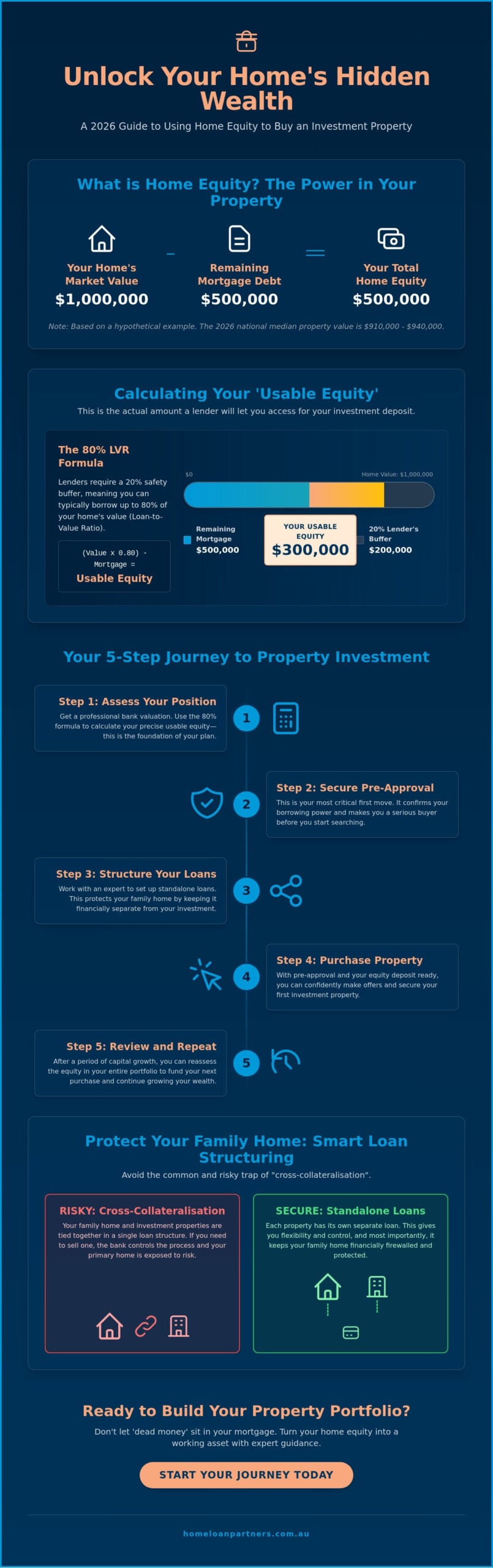
The formula is straightforward: (Market Value x 0.80) – Current Mortgage = Usable Equity. For example, if your home is valued at $1,000,000 and your mortgage is $500,000, your usable equity is $300,000. This is the “working capital” you can use to fund a deposit and costs for a new property. Understanding The Power of Leverage allows you to see how this $300,000 could potentially secure a significant investment asset without you touching your cash savings.
The 80% Rule and Lenders Mortgage Insurance (LMI)
You can technically borrow more than 80% of your property’s value, but it comes with a cost. If you push into a higher LVR, you’ll likely need to pay Lenders Mortgage Insurance (LMI). While LMI can help you enter the market sooner, it’s an added expense that doesn’t protect you; it protects the lender. In 2026, with variable investment rates starting around 5.74% p.a., lenders are also looking closely at your serviceability. They assess your ability to pay at a “buffer rate,” which is usually 3% above the actual interest rate. Even if you have high equity, your income must prove you can handle these higher theoretical repayments.
Hidden Costs to Deduct from Your Equity Calculations
Don’t make the mistake of assuming your usable equity is entirely for the property price. You must account for the “acquisition costs” of the new investment. These include:
- Stamp Duty: Often the largest upfront cost, varying by state.
- Legal and Conveyancing: Professional fees to manage the transfer.
- Refinancing Costs: Establishing a new loan structure typically ranges from $500 to $2,000.
- Building and Pest Inspections: Vital due diligence before any purchase.
We recommend keeping a small liquidity buffer within your equity rather than maxing out your limit. This provides a safety net for unexpected repairs or short-term vacancies. If you’re ready to see your specific numbers, exploring your refinancing options is a proactive way to confirm exactly how much “working capital” you have available for your next move.
Structuring Your Investment Loan: Avoiding the Cross-Collateralisation Trap
Structuring your debt correctly is just as vital as finding the right property. Many major lenders will encourage you to “link” your home and your new investment under one loan agreement. This is known as cross-collateralisation. While banks prefer this because it secures their risk across multiple assets, it can create significant hurdles for your future flexibility. If you decide to sell your investment property, a cross-collateralised structure allows the bank to dictate how you use the proceeds; they may even force you to pay down your home loan rather than allowing you to reinvest that capital elsewhere.
Understanding how to use equity to buy an investment property means recognizing that debt should be partitioned, not bundled. Strategic investors often look beyond the initial purchase. By learning more about Using an Investment Property to Pay Off Your Home, you can see how a well-structured portfolio eventually supports your primary residence. This long-term vision requires a loan setup that keeps you in the driver’s seat, not the bank.
Why Standalone Loans Offer More Protection
Standalone loans are the gold standard for maintaining financial control. By keeping your loans separate, you retain the freedom to switch lenders for a better interest rate on one property without needing to move your entire portfolio. This structure also ensures that if you sell an investment, the profit stays in your pocket after you’ve cleared that specific debt and met your tax obligations. Standalone loans keep your family home firewalled from your investment risks.
The Power of an Equity Release (Top-Up) Loan
Instead of linking properties, we often help clients set up an equity release, or “top-up,” on their current home. This creates a separate loan account specifically for the 20% deposit and acquisition costs of the new property. This method is a key part of how to use equity to buy an investment property because it keeps your investment-related debt clearly partitioned for tax purposes. Here is how that process typically looks:
- The Equity Loan: A new loan account is created against your home for the deposit amount.
- The Investment Loan: A second, separate loan is established to cover the remaining 80% of the investment property purchase price.
- Tax Clarity: Because the equity loan was used solely for investment purposes, the interest is generally tax-deductible, even though it’s secured by your home.
This “two-loan” strategy provides a clear paper trail for your accountant and protects your primary residence from being unnecessarily tied to the performance of your investment. It turns your home into a silent partner in your wealth-building journey, providing the foundation without being put on the front line.
The Step-by-Step Journey: From Your Current Home to Your First Investment
Moving from the theory of equity to a tangible property purchase requires a disciplined roadmap. In the competitive 2026 landscape, the speed of your execution often depends on the quality of your preparation. Understanding how to use equity to buy an investment property is about more than just having the numbers; it is about coordinating a sequence of events that keeps you protected while you scale your portfolio. This journey transitions you from a cautious homeowner to a strategic investor with a clear path forward.
The process typically involves two separate but simultaneous loan applications. One handles the release of equity from your existing home, while the other secures the finance for your new asset. Managing these moving parts can be complex, but having a steady hand to guide you ensures that each milestone is met with precision and minimal stress.
Step 1-3: Valuation, Strategy, and Pre-approval
Your journey begins with a formal bank valuation of your current home. While online estimates give you a rough idea, a lender’s valuation is the only figure that determines your actual borrowing power. Once this figure is confirmed, we help you develop a strategy. This involves comparing options from 36+ lenders to find a structure that suits your long term goals, as your current bank may not always offer the most competitive investment product or the highest borrowing capacity.
Securing a formal pre-approval is your most critical move before visiting open homes. In May 2026, with the national rental vacancy rate sitting at a low 1.6% to 1.7%, the market for high-yield properties is moving fast. A pre-approval confirms your budget and gives you the confidence to make an offer the moment you find the right opportunity. It also accounts for the current 3% serviceability buffer, ensuring your investment remains sustainable even if rates fluctuate.
Step 4-6: Property Selection, Approval, and Settlement
With your pre-approval in hand, you can focus on property selection. In 2026, we are seeing a “flight to affordability,” with investors gravitating toward high-growth markets like Perth and Brisbane, which have seen annual growth rates exceeding 17%. Once you sign a contract of sale, your lender will conduct a valuation of the new property to finalize the loan approval. This is the stage where your strategy truly takes shape.
The final step is settlement. Your conveyancer or solicitor will coordinate with the lenders to ensure the equity release and the new investment loan settle simultaneously. This ensures the funds are ready to pay the vendor and cover those acquisition costs we discussed earlier. If you are ready to take the first step, we invite you to apply for an investment property loan pre-approval today to see exactly where you stand in the current market.
Managing Your Multi-Property Portfolio: Why Expert Guidance is Your Greatest Asset
Successful property investment isn’t a one-time event; it’s a lifelong financial journey. Once you’ve mastered how to use equity to buy an investment property for your first acquisition, the focus shifts to sustainability and growth. The “Review and Repeat” cycle is the engine of a multi-property portfolio. As your new investment property grows in value and you pay down the debt, you create a fresh pool of equity. This allows you to potentially fund property number three using the same principles you applied to your first purchase, creating a compounding effect on your wealth.
Managing multiple assets requires a shift in perspective. You’re no longer just managing a mortgage; you’re overseeing a complex financial ecosystem. This is where the value of a dedicated partner becomes clear. We act as a steady hand, ensuring your structures remain robust even as market conditions shift. By maintaining a clear partition between your family home and your growing portfolio, you can scale with confidence and security.
The Importance of Ongoing Loan Maintenance
Adopting a “set and forget” mentality is a common mistake that can cost thousands in unnecessary interest. With investment variable rates starting from 5.74% p.a. in May 2026, even a small percentage difference across multiple loans significantly impacts your monthly cash flow. We recommend annual equity check-ups to ensure your loan structures still align with your goals. This includes checking if your offset accounts are working effectively on your primary residence to reduce non-deductible interest, while your investment debt remains partitioned for tax efficiency.
Regular reviews also allow you to capture new opportunities. In a market where cities like Perth have seen growth over 21%, having a proactive strategy ensures you’re always positioned for the best possible outcome. Annual check-ups reveal when your properties have gained enough value to trigger your next move, ensuring your capital never stays “lazy” for long.
Partnering for the Long Haul
Building a portfolio involves complex negotiations and constant market monitoring. Our role as your expert collaborator is to manage the heavy lifting of lender discussions and loan structuring. We don’t just facilitate a transaction; we guide you through every market cycle with a steady hand. This long-term partnership means we’re here to help you navigate interest rate fluctuations and regulatory changes, such as the 2026 shifts in negative gearing, with precision and calm expertise.
We believe in celebrating your milestones, from your first investment to the day your portfolio supports your retirement. If you’re ready to see what your future looks like, you can start your investment journey with a personalized equity assessment from The Home Loan Partners. Let’s work together to unlock the hidden wealth in your current assets and build a legacy that lasts.
Take the First Step Toward Your Investment Future
Unlocking your home’s potential is a powerful turning point in your financial story. You’ve learned how to distinguish between paper wealth and usable equity, and why a standalone loan structure is the safest way to protect your family home. Mastering how to use equity to buy an investment property is about more than a single transaction; it’s about building a foundation for a lifelong journey of security and growth.
Our team acts as your dedicated collaborator, providing the steady expertise you need to navigate the 2026 market. We offer access to over 36 Australian lenders and provide expert guidance to ensure your loans are structured for maximum flexibility. From Greenwich to Port Macquarie and beyond, we provide the personalized care you deserve while we manage the heavy lifting of lender negotiations.
Your aspirations are within reach. Book a stress-free equity strategy session with our expert brokers today to begin your journey. We look forward to walking this path with you and helping you achieve your major life milestones.
Frequently Asked Questions
Can I use equity to buy an investment property without a cash deposit?
Yes, you can use your usable equity to cover the entire 20% deposit plus all associated purchase costs like stamp duty and legal fees. This strategy allows you to acquire an investment asset without touching your personal savings. By using your home as security for a deposit-sized loan, you effectively fund the purchase using the “dead money” currently sitting in your mortgage.
What is the maximum LVR I can use when accessing equity for investment?
Most Australian lenders allow you to access up to 80% of your property’s value without requiring Lenders Mortgage Insurance (LMI). While some specialized investment loan products may allow you to stretch to a 90% or 95% Loan-to-Value Ratio, doing so often incurs significant LMI costs and higher interest rates. Staying at or below 80% is generally the most cost-effective way to manage your debt.
Is using equity to buy a second home a good idea in 2026?
Using equity is a strategic way to build wealth, but its success in 2026 depends on your specific property selection and tax strategy. With the recent Federal Budget changes to negative gearing for established homes, many investors are now prioritizing new-build properties or high-yield units. It’s a great idea if you focus on areas with low vacancy rates, such as the current 1.6% national average, to ensure strong rental support.
How much does it cost to access equity from my current home loan?
The cost typically involves a combination of bank and government fees, ranging from a few hundred to a couple of thousand dollars. You will likely encounter a professional valuation fee, a loan establishment fee, and government charges for mortgage registration. If you decide to refinance to a new lender to find a more competitive investment rate, you might also pay a discharge fee to your current bank.
What happens if my property value decreases after I’ve accessed the equity?
If your property value falls, your Loan-to-Value Ratio will increase, which means you own less of the home’s value relative to the debt. As long as you continue to meet your monthly repayments, banks generally won’t ask you to pay back the difference immediately. However, a higher LVR can limit your ability to refinance or access further equity until the market recovers or you pay down more of the principal.
Do I need to stay with my current bank to use my home’s equity?
No, you’re free to move to any lender that offers a better deal for your specific situation. Many homeowners find that how to use equity to buy an investment property most effectively involves switching to a lender that specializes in investment structures. We often help clients refinance to a different bank to secure higher borrowing capacities or more flexible loan terms that their current bank may not provide.
Can I use equity for a deposit on a construction loan for an investment?
Yes, equity is a common way to fund the initial stages of a construction project. You can use an equity release to pay for the land deposit or the first progress payment to the builder. This is a particularly popular strategy in 2026 because new-build properties remain exempt from the latest negative gearing restrictions, making them a tax-effective choice for many portfolio builders.
How does using equity affect my monthly mortgage repayments?
Your total monthly repayments will increase because your overall debt level has grown. It’s vital to ensure your household budget and the new rental income can cover the combined cost of your home loan and the new investment debt. When we help you calculate how to use equity to buy an investment property, we always include a 3% interest rate buffer to ensure your repayments remain manageable even if market conditions change.