

Solo homeownership in 2026 isn’t about having a massive salary; it’s about strategic lender selection and leveraging specific national support schemes. You might feel that the 4.35% cash rate and rising property prices have pushed your dream out of reach, but learning how to get a home loan on a single income is more achievable than the headlines suggest. It’s natural to worry about lower borrowing capacities or the weight of managing a mortgage alone, especially when major banks seem focused on dual-income couples.
We understand that the process feels daunting, and the fear of rejection is a heavy burden to carry. You don’t have to do this alone. This guide provides a clear roadmap to help you secure approval and build your future with confidence. You’ll discover how to access the Help to Buy scheme’s 2% deposit option or use the expanded 5% Deposit Scheme which now has no income caps. We’ll break down the practical steps to maximize your borrowing power and identify the specific grants designed to support solo buyers in today’s market.
Key Takeaways
- Solo homeownership remains a practical goal in 2026 when you focus on strategic lender selection and specific national support programs.
- Discover the exact steps for how to get a home loan on a single income by optimizing your serviceability and understanding how lenders assess individual expenses.
- Learn how targeted debt reduction and a dedicated power saving phase can significantly strengthen your application in a competitive market.
- Leverage expanded government schemes that allow eligible solo buyers to secure a property with a deposit as low as 2% or 5% without the burden of mortgage insurance.
- Gain a steady partner to navigate the complexities of the 2026 market, ensuring you find a loan that aligns with your long-term financial security.
Is Buying a Home on a Single Income Still Possible in 2026?
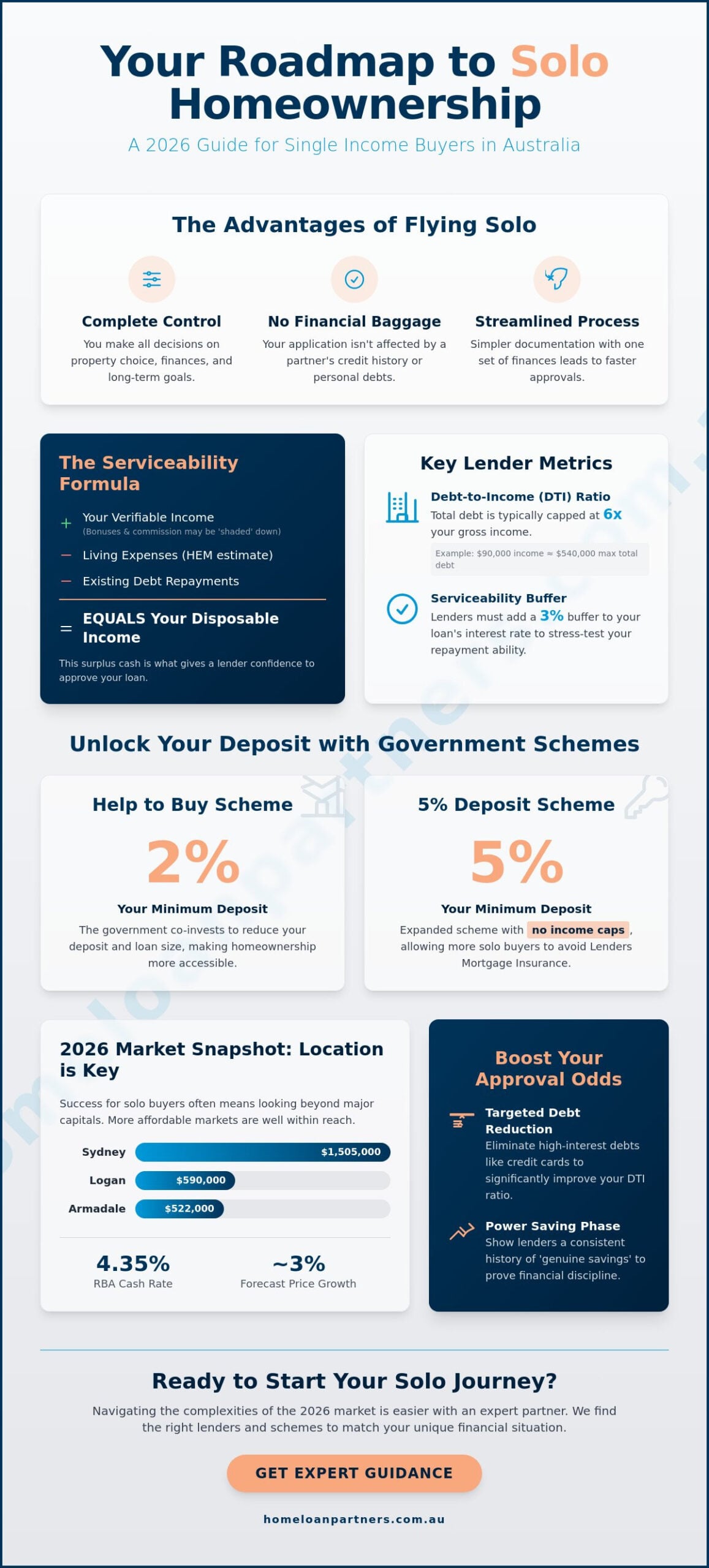
The May 2026 property market presents a unique landscape for solo buyers. While the Reserve Bank of Australia has set the official cash rate at 4.35%, the frantic price growth of previous years has finally begun to steady. National home prices are forecast to rise by a modest 3% this year, offering a much-needed breather for those looking to enter the market alone. Many people assume that a dual income is a prerequisite for a mortgage, but the reality is that lenders are increasingly comfortable with single-income professionals who demonstrate financial discipline.
Success in this environment depends on setting realistic expectations based on current national data. For instance, while Sydney’s median house price remains high at $1,505,000, more affordable markets like Logan ($590,000) or Perth’s Armadale ($522,000) remain within reach for single applicants. Understanding what is a mortgage? and how it functions as a long-term commitment is the first step toward security. When you learn how to get a home loan on a single income, you’re not just looking for a house; you’re building a foundation for your future independence.
The Reality of Solo Homeownership Today
It’s time to break the myth that you need two salaries to buy property. Single-person households are a significant and growing segment of the Australian mortgage market. Lenders have adapted their assessment tools to better reflect the spending habits of solo buyers, who often have more predictable expenditure than large families. From February 2026, the Australian Prudential Regulation Authority (APRA) capped new home loans with a Debt-to-Income (DTI) ratio of six times for most bank lending. For a single person on a $90,000 income, this roughly translates to a borrowing capacity between $480,000 and $560,000. This range aligns perfectly with many entry-level homes and apartments in thriving regional hubs.
The Advantages of Flying Solo
Applying for a loan by yourself offers several strategic benefits that couples often lack. You have complete control over your financial decisions, property choice, and long-term goals. There’s no risk of a partner’s poor credit history or existing personal debts dragging down your application. This lack of “financial baggage” often results in a much cleaner application process. Documentation is typically streamlined, leading to faster approval times because there’s only one set of bank statements and payslips to verify. We see many clients find peace of mind knowing their home is entirely theirs, providing a sense of achievement that is deeply personal. Whether you’re looking at first home buyer loans or planning for the future, being a single applicant allows for a level of agility and precision that dual-income households can’t always match.
Understanding How Lenders Calculate Borrowing Power for Solo Applicants
Lenders don’t just look at your gross salary; they focus on what’s left over after life happens. The core pillars of serviceability include your income, your recurring expenses, and any existing debt. In May 2026, banks apply a mandatory 3% serviceability buffer to your application to ensure you can handle future fluctuations. For solo applicants, this stress test is often the most significant hurdle. It’s why understanding choosing a home loan requires a deeper look at how different banks view your specific financial profile.
Your job stability and industry also carry immense weight. A single-income professional in a high-demand field might find lenders more flexible than someone in a volatile industry. Lenders use the Household Expenditure Measure (HEM) to estimate your living costs. As a solo buyer, you don’t share fixed household costs like utilities or internet, which can make your HEM baseline higher relative to your income. However, by showing a clean track record of genuine savings, you can prove that your actual expenses are lower than the bank’s generic estimates.
Decoding the Serviceability Calculation
For a single earner, the Debt-to-Income (DTI) ratio is your total debt divided by your gross annual income. Credit assessors also “shade” certain income types to manage risk. If you rely on bonuses, commissions, or overtime, a bank might only count 80% of that money toward your application. They’re looking for your “disposable income,” which is the surplus cash you have after tax, living expenses, and debt repayments are all settled. This surplus is what gives a lender the confidence to say yes.
Variable Lending Criteria Across the Market
One of the biggest secrets in the industry is that borrowing power isn’t a fixed number. It’s a variable result based on which lender’s specific model you use. While a tier-1 bank might have strict rules about DTI caps, a non-bank lender might offer more generous serviceability models for solo professionals. This is where having a steady hand to guide you makes the difference. A broker can identify which of the 36+ lenders currently “gets” your unique situation. If you’re feeling unsure about your capacity, our team at The Home Loan Partners can help you compare these different lending models to find your best path forward. Discovering how to get a home loan on a single income often starts with finding the right lender who values your financial discipline.
5 Proven Strategies to Boost Your Single-Income Loan Approval Odds
Securing a mortgage alone requires a shift from passive saving to active financial engineering. While a bank’s assessment of your borrowing power relies on rigid formulas, you have the power to influence the data they use. When you are researching how to get a home loan on a single income, the goal is to present a profile that looks remarkably low-risk. This involves more than just a high salary; it’s about the clean, consistent management of every dollar that enters your account. For those with variable earnings, ensuring your tax returns are up to date and reflect your maximum consistent income is vital for a smooth application.
Start by eliminating small debts that have a disproportionate impact on your serviceability. Paying off a HECS/HELP debt or a small car loan can significantly increase your monthly disposable income in the eyes of a credit assessor. If your income is close to the threshold for the property you want, these minor adjustments often make the difference between a decline and an approval. Additionally, consider rentvesting as a strategic entry point. By buying an affordable investment property in a high-growth area while continuing to rent where you live, you can build equity and use the rental income to support your loan serviceability.
Cleaning Up Your Financial Profile
Lenders now scrutinize bank statements with surgical precision. Buy Now Pay Later (BNPL) services are often viewed as a sign of financial strain, even if you never miss a payment. We recommend a “Power Saving” phase of at least six months where you eliminate these services and demonstrate genuine savings. During this time, audit your statements for recurring subscriptions or luxury spending that could be misinterpreted. Lenders assess your credit card limit rather than your balance; a $5,000 credit card limit reduces your borrowing power by more than $20,000 because banks must factor in the potential for you to max out that debt at any moment. Closing unnecessary accounts is one of the fastest ways to improve your standing.
Alternative Path: The Guarantor Home Loan
For many solo buyers, the biggest hurdle isn’t the monthly repayments, but the upfront deposit. A guarantor arrangement allows a family member to use the equity in their own home as security for a portion of your loan. This is the primary way singles bypass the 20% deposit requirement while avoiding the high cost of Lenders Mortgage Insurance (LMI). It’s a collaborative path that requires clear legal and financial protections for both parties, but it provides a steady hand to help you enter the market years earlier than you could alone. Understanding how to get a home loan on a single income through a guarantor can be a game-changer for first home buyer loans where the gap between savings and property prices feels the widest.
Government Grants and Schemes for Single Home Buyers in Australia
The Australian government has introduced several initiatives to help bridge the gap between solo savings and property prices. For many, the traditional 20% deposit is the biggest obstacle to homeownership. In 2026, you don’t need to wait years to reach that milestone alone. These programs are designed to act as a steady hand, providing the security you need to enter the market sooner. Understanding how to get a home loan on a single income becomes much simpler when you leverage these national supports, which can effectively replace the need for Lenders Mortgage Insurance (LMI).
State-based stamp duty concessions also offer significant relief for solo buyers. In many parts of Australia, first home buyers are eligible for full exemptions or significant discounts on properties within certain price brackets. When combined with the First Home Guarantee (FHG), which allows for a 5% deposit with no LMI and now features expanded access with unlimited places, the upfront costs of buying a home drop dramatically. These schemes aren’t just about lower deposits; they’re about giving you a clear, stress-free path toward owning your own space without the pressure of a dual-income requirement.
The Family Home Guarantee: A Game Changer for Single Parents
The Family Home Guarantee is a vital resource for single parents or guardians looking to provide a stable home for their children. For the 2025/2026 financial year, there are 5,000 places available for eligible applicants to purchase a home with a deposit as low as 2%. This scheme allows you to bypass the cost of LMI entirely. It applies to both new and existing homes, provided they fall under the current property price caps. For example, the cap for capital cities and regional centres in New South Wales is $1,500,000, while in Victoria, it’s $950,000. This targeted support recognizes the unique challenges of solo parenting and provides a practical solution to achieve a major life milestone.
Maximising the First Home Super Saver Scheme
The First Home Super Saver Scheme (FHSSS) is an excellent tool for solo savers to accelerate their deposit growth. By making voluntary before-tax contributions to your superannuation, you can save for a home while paying less tax. This strategy is often more effective than a standard savings account because of the concessional tax treatment within the super system. When you’re ready to buy, you can withdraw these contributions plus associated earnings. Single applicants should be mindful of the withdrawal timelines and limits, but for those with a steady income, it’s a precision-oriented way to build your deposit. If you’re ready to explore your options, our team at The Home Loan Partners can help you identify which of these first home buyer loans and grants best suit your individual goals.
Why a Mortgage Broker is Your Essential Partner for a Solo Home Loan
Attempting to manage a mortgage application alone can feel like a full-time job. Our team at The Home Loan Partners takes pride in managing the heavy lifting for you, ensuring your journey is steady and predictable. With access to over 36 lenders, we don’t just find a loan; we identify the specific institution whose serviceability model aligns with your unique financial profile. This level of precision is essential when you are figuring out how to get a home loan on a single income, as it turns a complex process into a clear, manageable path forward. When you partner with us, you gain a reliable guide who knows exactly how to navigate the 2026 market requirements.
We act as your expert collaborator, translating dense bank jargon into practical language you can actually use. Whether you are looking at first home buyer loans or exploring refinancing options down the track, our commitment to your future security remains constant. We prioritize transparency, helping you understand every step of the application so you can move forward with total confidence. Our goal is to alleviate the inherent stress of the financial world by projecting a sense of calm, steady expertise throughout our entire relationship. This supportive approach ensures you never feel like just another transaction number.
Beyond the Interest Rate
A successful solo mortgage is built on more than just a low rate. We focus on personalized loan structuring, ensuring you have the right features to manage life’s unexpected turns. Offset accounts, for example, are vital safety nets for single-income households, allowing you to reduce interest while keeping your cash accessible. We also help you structure your loan for future flexibility, ensuring you understand how to get a home loan on a single income that remains sustainable for years to come. Our relationship doesn’t end at settlement; we stay by your side throughout the duration of your loan to ensure it continues to serve your major life milestones.
Taking the First Step Toward Your New Home
In the competitive 2026 market, having a pre-approval is your most powerful tool. It signals to sellers that you are a serious, verified buyer, giving you a distinct advantage during negotiations. We invite you to book an obligation-free consultation with our expert team to discuss your aspirations and review your borrowing capacity. We’ll provide the calm, steady expertise you need to start your application process without the stress. Ready to see what you can achieve? Contact The Home Loan Partners today.
Secure Your Future with Confidence
Navigating the 2026 property market alone requires a blend of financial discipline and expert strategy. By leveraging expanded government initiatives like the Family Home Guarantee or the First Home Guarantee, you can overcome the deposit hurdle and bypass the costs of mortgage insurance. When you combine these supports with a clean financial profile and a strategic choice of lender, the path to your own front door becomes much clearer. Learning how to get a home loan on a single income isn’t just about finding a house; it’s about establishing long-term security on your own terms.
We are here to act as your steady hand throughout this process. With access to 36+ Australian lenders, we specialize in identifying the right first home buyer schemes for your specific needs. Our no-fee service for most home loan applications ensures that you receive professional guidance without added financial pressure. We manage the heavy lifting so you can focus on finding a place to call home. Let us find the right loan for your solo journey and start your next chapter today. Your goal is within reach, and we look forward to helping you achieve it.
Frequently Asked Questions
Can I get a home loan on a single income with a low deposit?
Yes, you can certainly secure a property with a low deposit through various national support programs. The Help to Buy scheme allows eligible solo buyers to enter the market with just a 2% deposit, while the First Home Guarantee supports purchases with a 5% deposit. These initiatives are designed to help you bypass the high cost of mortgage insurance, making your dream of homeownership more accessible without a massive upfront sum.
How much can I borrow on a single income of $80,000 in 2026?
On an $80,000 salary, your borrowing capacity typically ranges between $420,000 and $500,000, depending on your current debts and living expenses. Lenders apply a 3% serviceability buffer to ensure you can manage repayments if interest rates rise above the current variable averages. To maximize this figure, focus on reducing credit card limits and demonstrating a consistent pattern of genuine savings over a six-month period before you apply.
Do I need to pay Lenders Mortgage Insurance (LMI) if I buy solo?
You don’t necessarily have to pay LMI when buying solo if you qualify for specific government schemes or use a family guarantor. The 5% Deposit Scheme and the Family Home Guarantee specifically allow you to avoid this upfront cost even with a small deposit. This can save you thousands of dollars, allowing those funds to remain in your offset account as a safety net for your future financial security.
Is it better to buy an apartment or a house on a single income?
The choice depends on your long-term goals and your specific borrowing capacity. Apartments in growth areas like Logan or Armadale often provide a more affordable entry point for solo buyers with prices starting around $522,000. While houses generally offer higher land value growth, an apartment can be a strategic first step to build equity while keeping your monthly maintenance expenses manageable on a single salary.
What happens if I lose my job and I have a single-income mortgage?
If your circumstances change, the first step is to contact your lender immediately to discuss hardship variations or temporary repayment pauses. This is why we emphasize the importance of an offset account and personalized loan structuring from the start of your journey. Having a financial buffer provides a steady hand during career transitions, ensuring your home remains secure while you find your next professional opportunity.
Can I use a gift from my parents as a deposit for a solo home loan?
Yes, many lenders accept gifted deposits from family members, provided you have a signed statutory declaration confirming the funds don’t need to be repaid. However, most banks still require you to demonstrate “genuine savings” equivalent to 5% of the property price through your own bank statements. This dual approach proves to the lender that you have the financial discipline required for how to get a home loan on a single income.
How does HECS/HELP debt affect my borrowing power as a single applicant?
Your HECS/HELP debt reduces your take-home pay, which directly lowers the amount a bank is willing to lend you. Because lenders assess your net income after all mandatory repayments, a large student debt can decrease your borrowing power by tens of thousands of dollars. Clearing this debt before you apply is often a highly effective strategy for those learning how to get a home loan on a single income.
What is the minimum income required for a home loan in Australia?
There is no official minimum income requirement set by law, as your eligibility depends on the price of the property you wish to buy. Lenders focus on your “disposable income” after tax and expenses are settled. If your income covers the loan repayments plus the mandatory 3% serviceability buffer, you can secure a mortgage. We help you identify which lenders have the most flexible criteria for your specific earning level.