

What if the figure your online bank calculator provided is actually $100,000 lower than what you could truly qualify for with the right strategy? It’s a common frustration in the current Australian market, where the RBA cash rate has climbed to 4.35% and inflation remains sticky at 4.6%. If you’re searching for how to improve my borrowing capacity, you’ve likely realized that the old rules of thumb no longer apply in 2026.
We understand how discouraging it feels when high interest rate buffers and new APRA debt-to-income caps make your home ownership goals feel out of reach. You’re doing everything right, yet HECS debts and rising living expense benchmarks continue to shrink your loan potential. We’re here to provide a steady hand and a clear path forward through these complexities.
This guide reveals the professional strategies and lender-specific insights used to maximize mortgage eligibility today. You’ll learn exactly how to present your income more favourably, which financial habits to adjust, and how to identify lenders whose internal policies suit your specific debt profile. We’ll help you move past the generic calculators and toward a solution that fits your long-term journey.
Key Takeaways
- Understand how the mandatory 3% serviceability buffer and 2026 interest rates directly influence a lender’s initial assessment of your loan.
- Discover exactly how to improve my borrowing capacity by addressing “invisible” factors like Debt-to-Income ratios and unclosed credit card limits.
- Identify which debts, such as HECS or personal loans, are most likely to restrict your serviceability and how to strategically clear them.
- Learn to follow a six-month roadmap that aligns your lifestyle spending with the benchmarks lenders use to verify your financial stability.
- Find out how working with a dedicated partner provides access to flexible lender policies that may suit your unique career or income profile.
What Is Borrowing Capacity and Why Does It Change in 2026?
At its heart, borrowing capacity is a lender’s calculation of how much debt you can safely manage while maintaining your lifestyle. When you research What is Borrowing Capacity, you’ll see it’s a dynamic figure that shifts with the economy. In May 2026, with the Reserve Bank of Australia (RBA) setting the official cash rate at 4.35%, banks have become more conservative. This shift is why many people ask how to improve my borrowing capacity after seeing disappointing results from basic online tools. These calculators often provide a false sense of security because they don’t account for the complex internal policies and regulatory hurdles that lenders must follow.
Your capacity isn’t just a reflection of your salary. It’s a snapshot of how your income, existing debts, and daily spending align with current market risks. With national home values sitting between $910,000 and $940,048, the margin for error is smaller than it used to be. Lenders are looking for stability and proof that you can handle your commitments even if the economic environment changes again.
The Role of the Serviceability Buffer
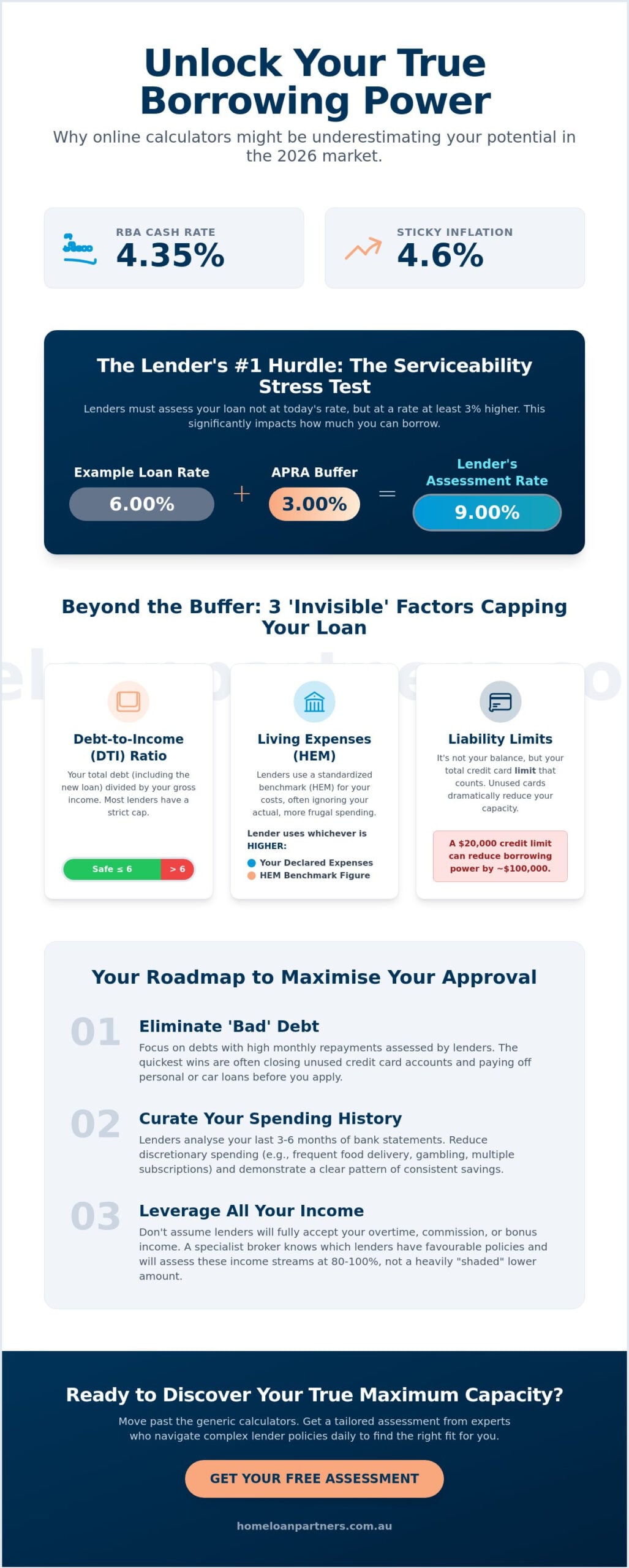
Lenders don’t just check if you can afford today’s interest rates. They apply an APRA-mandated 3% serviceability buffer to protect you against future rate hikes. If you apply for a loan with a 6% interest rate, the bank assesses your ability to meet repayments as if the rate were 9%. With inflation currently at 4.6%, this buffer is a critical safety net for the banking system. However, it can significantly reduce the loan amount for middle-income earners whose disposable income is already impacted by the rising cost of living. Understanding this “stress test” is a vital part of learning how to improve my borrowing capacity.
Maximum vs. Responsible Borrowing
There’s a big difference between what a bank is willing to lend and what you should actually borrow. Lenders use the Household Expenditure Measure (HEM) as a baseline for your living costs. They’ll use the higher of your declared expenses or the HEM figure, which is updated every quarter to reflect inflation. While a lender might approve a high loan limit, borrowing at your absolute maximum can leave you “house poor.” We focus on finding a balance that achieves your property goals without sacrificing your financial breathing room. A comfortable repayment level ensures you can still enjoy your life while building equity in your new home.
The ‘Invisible’ Factors: How Lenders Calculate Your Power
While the serviceability buffer sets the stage, lenders use a secondary set of “invisible” calculations that can cap your loan amount before you even reach the buffer limit. These metrics often explain why two people with identical salaries receive vastly different loan offers. Lenders evaluate more than just your pay slip; they look at your broader financial footprint to see How Lenders Calculate Your Power. If you’re wondering how to improve my borrowing capacity, you must first understand the Debt-to-Income (DTI) ratio and how banks “shade” your earnings.
The Household Expenditure Measure (HEM) is another silent factor. Lenders use this benchmark to estimate your living costs based on your income and family size. If you’re highly frugal, the bank might still ignore your actual bank statements and use the higher HEM figure instead. This is particularly true for families, as each dependent child adds a fixed “cost” to the bank’s assessment, which can reduce your borrowing power by tens of thousands of dollars. Evaluating your current Investment Property Loans strategy with a professional can help you see how these benchmarks apply to your specific portfolio.
Understanding the Debt-to-Income (DTI) Cap
As of February 2026, APRA has tightened the rules on high DTI lending. Most banks now cap their high-DTI loans at six times your gross annual income. To calculate your own ratio, divide your total debt (including the new loan, credit card limits, and HECS) by your gross income. If the result is above six, you fall into a restricted category where only 20% of a bank’s new customers can be approved. Reducing your existing debt levels is often the fastest way to stay under this cap and ensure your application moves forward without friction.
How Lenders View Different Income Streams
Banks don’t treat every dollar of income equally. While they typically use 100% of your base salary, they often “shade” other sources to protect against volatility. For example, many lenders only count 80% of your bonuses, overtime, or commissions. Rental income is similarly shaded, often at 75% or 80%, to account for potential vacancies and management fees. For the self-employed, lenders usually average your profit over the last two years. However, some specialized policies allow for the most recent year’s profit to be used if the business shows consistent growth. Knowing which lender views your specific career path most favorably is a key part of how to improve my borrowing capacity effectively.
Strategic Wins: Specific Steps to Boost Your Capacity
Improving your position isn’t just about earning more; it’s about refining how your current finances appear to a credit assessor. Many applicants feel stuck after using a basic Mortgage borrowing calculator, but those tools rarely account for the strategic adjustments you can make in the months leading up to an application. By focusing on high-impact areas like credit limits and specific debt types, you can unlock significant lending potential that remains hidden from standard assessments. If you’re looking for how to improve my borrowing capacity, these practical wins offer the most direct path to a higher approval limit.
The Credit Card Limit Reduction Strategy
Lenders don’t care if your credit card balance is zero every month. They assess the total limit of the card, usually assuming a monthly repayment of approximately 3% of that limit. For example, a credit card with a $10,000 limit is viewed as a $300 monthly expense, regardless of whether you actually use the card. This “invisible” expense can reduce your total borrowing power by $25,000 to $35,000. Closing unnecessary accounts or reducing limits to a bare minimum is one of the fastest ways to see an immediate boost. We often recommend the “one card rule” to help First Home Buyer Loans applicants maintain a healthy credit score while maximizing their capacity.
HECS/HELP Debt: To Pay or Not to Pay?
HECS is often the single biggest “hidden” drag on serviceability for professionals. Unlike other loans where the repayment is based on the balance, HECS repayments are calculated as a percentage of your total gross income. If you earn $120,000, your HECS repayment might be several hundred dollars every fortnight. If your remaining HECS balance is relatively small, paying it off entirely can be far more effective than adding that same amount to your deposit. This “tipping point” can sometimes increase your borrowing capacity by $50,000 or more because it removes a significant, mandatory monthly commitment from your cash flow assessment.
Salary Packaging and Fringe Benefits
Fringe benefits like novated leases or mortgage packaging can be a double-edged sword. While they offer tax advantages, some lenders treat packaged items as a direct reduction of your take-home pay, while others might “add back” the value if it’s a recurring benefit. If you’re investigating how to improve my borrowing capacity, it’s vital to review your latest PAYG summary. Some lenders penalize packaging heavily, while others have policies that recognize the tax savings. Consolidating high-interest personal loans or car finance into a single, lower-interest commitment can also free up the cash flow lenders want to see before they commit to a larger mortgage.
A 6-Month Roadmap to Maximising Your Eligibility
Achieving a successful loan application is rarely about a single moment in time. It’s a structured journey of financial refinement. While you might be eager to start your property search today, taking a proactive approach over half a year can dramatically change the outcome of your application. If you are focused on how to improve my borrowing capacity, following a chronological plan allows you to address issues before a credit assessor ever sees them. This steady preparation replaces the stress of uncertainty with the confidence of a well-documented financial history.
- Month 6: The Audit. Download your credit report from providers like Equifax or Experian. Look for “zombie” accounts, which are old credit cards or store accounts you haven’t used in years. Even with a zero balance, these limits reduce your power. Close them now so your report is updated by the time you apply.
- Month 4: Expense Management. This is the window where your bank statements begin to matter most. Lenders typically scrutinize the most recent 90 to 180 days of spending. Start aligning your discretionary habits with the HEM benchmarks discussed earlier to show a consistent surplus.
- Month 2: Debt Reduction. Use this time to pay down the specific debts identified in your strategy, such as high-interest personal loans or that final HECS balance. Clearing these now ensures your debt-to-income ratio is at its healthiest when the lender runs their final check.
- Month 1: Pre-Approval Prep. Gather your documents, including your latest PAYG summaries and bank statements. This is when you select a lender whose specific policy matches your career profile and debt structure.
Cleaning Up Your ‘Financial Footprint’
Three months of clean bank statements are the gold standard for modern lenders. They look for patterns that suggest reliability and financial discipline. One of the biggest red flags in 2026 is a reliance on “Buy Now, Pay Later” (BNPL) services. Even small, regular payments for consumer goods can signal to a lender that you struggle to manage cash flow without credit. We recommend pausing these services entirely at least 90 days before applying. Ensure all your utility bills and existing loan commitments are set to direct debit. This prevents accidental late marks on your internal banking records that could derail an otherwise strong application. If you’re ready to start this journey, our team can help you prepare for First Home Buyer Loans with a clear, step-by-step strategy.
Presenting Your Expenses Accurately
Lenders categorize your spending into discretionary and non-discretionary buckets. While you can’t change the cost of groceries or petrol, you can control lifestyle spending like dining out or multiple streaming subscriptions. Temporarily “living like a monk” for three months can lower your declared expenses, potentially shifting the bank’s assessment in your favor. Be wary of undeclared expenses that are easily spotted on statements, such as private school fees or regular transfers to investment platforms. Transparency is key. It’s better to account for these items upfront than to have a lender discover them during the audit process. Accurate presentation is a core part of how to improve my borrowing capacity because it builds trust with the credit assessor from day one.
The Mortgage Broker Advantage: Navigating Lender Policy
If you’ve followed the roadmap in the previous sections, your financial profile is now in its strongest possible shape. However, even a perfect applicant can face rejection if they apply to the wrong institution. Most people assume every bank uses the same calculator, but the reality is far more fragmented. One lender might decline your application based on a strict interpretation of your HECS debt, while another might see your career trajectory and offer the full amount you need. Understanding these nuances is often the most effective way to address how to improve my borrowing capacity without waiting years for a salary increase.
We act as your expert collaborator, presenting your financial “story” to credit assessors in a way that highlights your strengths and mitigates any perceived weaknesses. This might involve explaining a recent career change or demonstrating how your Investment Property Loans are supported by strong rental yields. By tailoring the presentation of your application, we help lenders see the person behind the percentages.
Lender Policy Variance: The Secret Weapon
Lenders maintain internal playbooks that dictate how they treat specific types of income and expenses. For instance, some banks distinguish between “essential” living costs and “basic” costs, allowing for more flexibility if you can prove your discretionary spending is easily reduced. Others may accept 100% of your overtime or casual income after you’ve been in a role for only six months, whereas a competitor might require a two-year history and only count 80% of those earnings. Identifying these specific policy niches is the key to unlocking an extra $100k in capacity that a standard bank calculator simply won’t show.
In the current 2026 environment, non-bank lenders have become a vital resource. Because they aren’t subject to the same APRA-mandated Debt-to-Income (DTI) caps as the major authorised deposit-taking institutions, they can often provide more flexible terms for borrowers who fall just outside the traditional 6x income limit. We help you navigate these Tier 2 options with precision, ensuring you find a lender whose policy suits your specific career or debt profile.
Partnering for the Long Term
Our role goes beyond just submitting paperwork. We help you structure your loan with tools like offset accounts or split loan arrangements to ensure your debt works for you, not against you. We also believe that your financial journey doesn’t end at settlement. As your income grows and the market shifts, we provide professional reviews every 12 months to ensure your structure still serves your aspirations. If you’re ready to move past generic advice and discover your actual potential, Book a strategy session with The Home Loan Partners to calculate your true capacity. We’ll help you manage the heavy lifting of how to improve my borrowing capacity with a steady, reliable hand.
Secure Your Financial Future with Expert Guidance
Navigating the property market in 2026 requires more than just a healthy deposit. It demands a strategic approach to your financial profile. By following a structured roadmap and addressing the invisible factors like serviceability buffers, you put yourself in the best position for a successful approval. Understanding how to improve my borrowing capacity is the first step toward moving from uncertainty to a confident property settlement. We’re committed to acting as your steady guide throughout this entire journey.
Our team offers deep expertise in managing complex DTI and HEM ratios, providing you with direct access to over 36 different lenders. We take the stress out of the application process by conducting no-obligation serviceability audits that reflect the current regulatory environment. This personalized support ensures you don’t just get a loan, but the specific structure that supports your long-term security. Calculate your actual borrowing power with a Home Loan Partners expert today. Let’s work together to turn your property aspirations into a reality with precision and care.
Frequently Asked Questions
How much does a $10,000 credit card limit reduce my borrowing capacity?
A $10,000 credit card limit can reduce your borrowing capacity by approximately $25,000 to $35,000. Lenders calculate your serviceability based on 3% of the total limit rather than your actual monthly balance. Closing high-limit cards is a proven way to address how to improve my borrowing capacity before you submit an application.
Does having a child really reduce how much I can borrow for a home?
Yes, each dependent child reduces your calculated capacity because lenders must factor in the cost of their care. Banks use the Household Expenditure Measure (HEM) to assign a fixed monthly cost to each child. This lowers the amount of disposable income available to service a mortgage, which can impact your total loan amount.
Can I increase my borrowing power if I’m self-employed?
You can often increase your power by choosing lenders who accept the most recent year’s profit instead of a traditional two-year average. We also look for “add-backs” such as depreciation or one-off business expenses. These adjustments help show a more accurate and favorable picture of your actual earnings to the credit assessor.
Is it better to have a larger deposit or pay off my car loan first?
Paying off a car loan usually provides a greater boost to your capacity than adding that same amount to your deposit. A car loan with a $600 monthly payment can reduce your borrowing power by significantly more than the interest savings a larger deposit would provide. Clearing the debt removes a mandatory monthly commitment from the bank’s calculation.
Will a pay rise immediately increase my borrowing capacity?
A pay rise will typically increase your capacity as soon as you can provide a new employment contract or your first updated pay slip. This extra income directly lowers your Debt-to-Income (DTI) ratio. It allows you to meet the stricter 2026 lending criteria and serviceability buffers more easily.
How do lenders view Buy Now, Pay Later services like Afterpay?
Lenders view Buy Now, Pay Later (BNPL) services as a form of credit that signals potential cash flow stress. Frequent use of these services during the 90 days before your application can lead to a lower assessment of your financial discipline. Most banks now treat these as a line of credit that must be factored into your total debt.
Why is my bank’s calculator different from a broker’s calculator?
Bank calculators use a single set of rigid internal rules, while a broker’s tools account for the vast policy differences across dozens of lenders. This variance is exactly how to improve my borrowing capacity; we find the specific lender whose rules for income shading or living expense benchmarks suit your unique financial situation.
Can I use a guarantor to improve my borrowing capacity?
A guarantor typically helps you avoid Lenders Mortgage Insurance (LMI) by providing additional security, but they don’t usually increase your borrowing capacity. To borrow a larger amount, you generally need to improve your own serviceability. The alternative is having the guarantor join the loan as a co-borrower, which involves different legal and financial risks.