

What if a home loan rejection isn’t a final judgment on your financial health, but simply a sign that your data didn’t align with one bank’s rigid policy? Receiving a decline letter is incredibly stressful, especially when you’re worried about missing out on a property or seeing a mark on your credit file. You aren’t alone in feeling confused by complex serviceability math; with the RBA cash rate sitting at 4.35% and lenders applying a mandatory 3% interest rate buffer, the criteria for success have become much stricter. Understanding the common reasons for home loan rejection australia is the first step toward transforming your next application into an approval.
We’ve created this guide to help you decode lender feedback and identify exactly where your application might have stumbled. You’ll discover the specific triggers that cause Australian banks to say no in the current 2026 market and receive a practical checklist to strengthen your financial profile. We’ll show you how to move past these hurdles with precision, helping you find a path forward that leads directly to your new home.
Key Takeaways
- Understand why a decline is often a policy mismatch rather than a financial failure, helping you identify the specific reasons for home loan rejection australia to improve your outcome.
- Learn how current 2026 serviceability buffers and debt-to-income limits affect your borrowing capacity and what you can do to meet these stricter standards.
- Discover why the property itself might be the hurdle, including how lenders view specific postcodes and high-density developments during their security assessments.
- Follow a strategic roadmap to protect your credit score after a rejection, ensuring you don’t damage your file with multiple unsuccessful applications.
- Explore how a professional “Pre-Flight” assessment identifies the right lender for your unique situation, saving you time and reducing the stress of the application process.
Common Reasons for Home Loan Rejection in Australia
Receiving a formal “no” from a lender can feel like a crushing blow to your aspirations. For many, achieving The Great Australian Dream is a lifelong goal, and a rejection letter seems like a permanent barrier. It’s vital to realize that a decline is often just a policy mismatch rather than a total financial failure. Understanding the common reasons for home loan rejection australia is the first step toward fixing the issue. Banks aren’t judging your character; they’re checking if your current profile fits into their specific, often rigid, “credit box” at this exact moment.
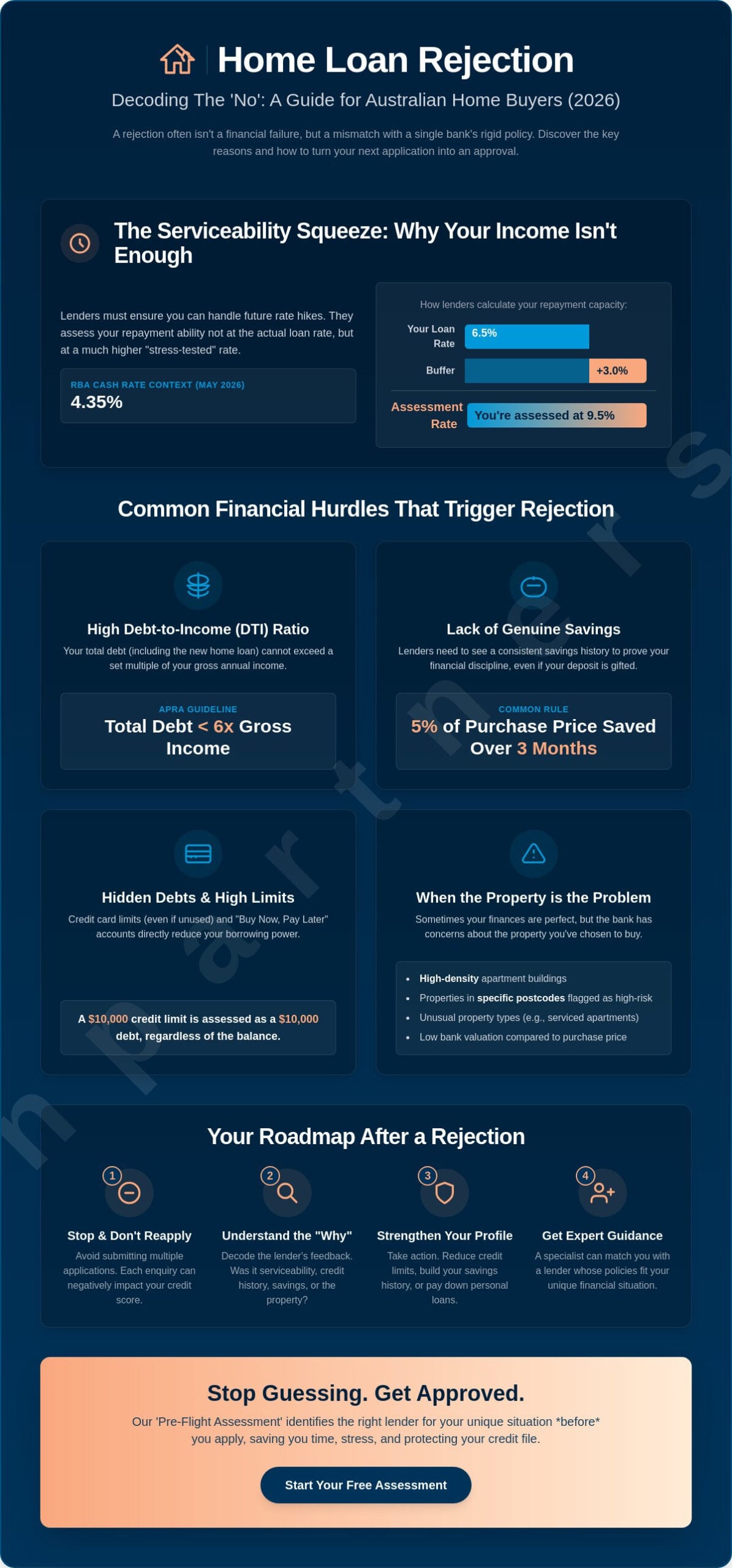
One of the primary reasons for home loan rejection australia right now involves the shifting serviceability buffer. Lenders use these buffers to ensure you can handle future rate hikes. With the Reserve Bank of Australia setting the official cash rate at 4.35% as of May 2026, lenders must assess your ability to pay at a rate at least 3.0 percentage points higher than the actual product rate. This means if your loan is at 6.5%, the bank tests your budget at 9.5%. If your numbers don’t balance under that hypothetical stress, a rejection is likely.
You should also distinguish between a “hard decline” and a “request for further information.” A hard decline means the lender won’t proceed under any circumstances with the current data. A request for information is a more positive sign. It suggests the bank wants to say yes but needs more clarity on a specific expense or income source to make it happen. Lender appetite also shifts throughout the year. A bank might be aggressive in January but pull back in June once they’ve reached their quarterly lending targets.
The Difference Between Pre-Approval and Final Approval
A pre-approval is a helpful indicator of your borrowing power, but it isn’t a guarantee of funding. Many borrowers feel blindsided when a full assessment leads to a decline. This often happens because the bank’s policy changed while you were house hunting, or your financial situation shifted slightly. Triggers like a new credit card or a change in employment status can derail a pre-approval during the final checks. The bank also needs to approve the specific property you’ve chosen, which only happens at the very end of the process.
Why One Bank Says No While Another Says Yes
Lending standards aren’t universal across Australia. While the Big 4 banks often have very similar, conservative criteria, non-bank lenders frequently have a different appetite for risk. One lender might dislike self-employed income, while another specializes in it. Finding the right fit is about matching your unique financial profile to a lender’s current “sweet spot.” Understanding these nuances is often the key to turning a previous rejection into a successful approval with a different provider.
The Financial Factors: Serviceability, Credit, and Debt
Your financial profile is more than just a salary figure; it’s a complex equation that lenders scrutinize to meet their responsible lending obligations. In 2026, the math has become significantly tighter. One of the primary reasons for home loan rejection australia is the Debt-to-Income (DTI) ratio. As of February 2026, APRA has capped high DTI lending, meaning most banks can’t allow your total debt to exceed six times your annual gross income for more than 20% of their new customers. If you have existing car loans or personal debt, your capacity to borrow for a home shrinks rapidly.
Lenders also apply a mandatory 3% serviceability buffer. Even if you’re applying for a loan at a 6.8% variable rate, the bank tests your ability to make repayments at 9.8%. This ensures you aren’t vulnerable if the RBA raises the cash rate again. Small financial habits also carry heavy weight. A $10,000 credit card limit, even if the balance is zero, is treated as a fully drawn debt. Similarly, “Buy Now, Pay Later” accounts are viewed as ongoing liabilities that directly reduce your monthly surplus. If you’re planning a purchase, speaking with a specialist about First Home Buyer Loans can help you restructure these debts before you apply.
A common stumbling block for many is the “Genuine Savings” rule. While a gift from parents is a wonderful leg up, most lenders require you to demonstrate that at least 5% of the purchase price has been saved in your own account over a period of three months. This proves you have the financial discipline to manage a mortgage. Without this history, a bank may decline the application regardless of how large your total deposit is.
Living Expenses and the HEM Benchmark
Banks use the Household Expenditure Measure (HEM) as a baseline, but they’ll also conduct a deep audit of your last three to six months of bank statements. They aren’t just looking for big purchases. Frequent Uber Eats orders, high-cost gym memberships, and forgotten streaming subscriptions are all tallied. If your actual spending is higher than the HEM benchmark, the bank will use your higher personal figures, which can lead to a rejection based on insufficient surplus cash.
Credit Score Nuances: Beyond the Number
Thanks to Comprehensive Credit Reporting (CCR), lenders now see “positive data,” such as your history of on-time utility and rent payments. However, they also see every “hard enquiry” you’ve made. Applying for multiple credit cards or different home loans in a short window signals financial desperation to a credit officer. To protect your file, it’s better to resolve any minor defaults or late payment marks before your formal application reaches the bank’s desk.
Property Rejections: When the House is the Problem
While much of the focus during an application is on your income, the property itself must also pass a strict “Security Assessment.” Lenders aren’t just providing you with funds; they’re essentially becoming a silent partner in the asset. If the bank determines that a property would be difficult to sell in the event of a default, they’ll likely decline the application. This is one of the most frustrating reasons for home loan rejection australia because it can happen even if your personal finances are perfect. The bank needs to know that the collateral is sound, marketable, and correctly zoned.
Zoning issues are a frequent deal-breaker. If you’re looking at a property that sits on a commercial title or has a mixed-use designation, a standard residential home loan won’t apply. Similarly, “low valuations” create a significant hurdle. If you sign a contract for $850,000 but the bank’s independent valuer estimates the worth at $800,000, a “valuation shortfall” occurs. Since lenders base their loan-to-value ratio (LVR) on the lower of the two figures, you’d be responsible for covering the $50,000 gap yourself. If you don’t have the extra cash, the loan cannot proceed. This scenario is a staple among the common reasons for home loan rejection in competitive markets where auction prices often outpace bank valuations.
Small Apartments and Unique Dwellings
Size matters to a credit officer. Many Australian lenders enforce a “40sqm rule,” refusing to finance apartments with less than 40 square meters of internal living space, excluding balconies and car spots. These studios are viewed as higher risk due to a more limited resale market. Off-the-plan purchases carry a different risk; the market value can shift significantly between the day you sign the contract and the day the building is completed. If the value drops during construction, your final approval may be denied. Unconventional homes, such as tiny houses on wheels or dwellings built from shipping containers, also rarely fit within standard lending policies.
Location and Postcode Restrictions
Lenders constantly monitor “concentration risk.” If a bank already holds a large number of mortgages in a specific high-density building or a particular suburb, they may stop lending in that postcode altogether to balance their books. Regional and remote properties often face lower LVR limits, meaning you might need a 30% deposit instead of the usual 10% or 20%. In 2026, environmental factors are also a primary concern. Properties located in high-risk flood or bushfire zones may be rejected if the lender decides the risk is too great or if the cost of required insurance makes the loan unserviceable for the borrower.
The Roadmap: What to Do After a Loan Rejection
Finding out your application was declined is a setback, but it’s also a valuable diagnostic tool. The first step in your recovery roadmap is to obtain the specific “Reason for Decline” from the lender. While some banks provide a generic response, you or your broker should push for clarity. Was it a serviceability issue, a low valuation, or a specific mark on your credit file? Identifying the exact trigger allows you to stop guessing and start fixing. This clarity is essential because the reasons for home loan rejection australia vary wildly between different institutions.
Once you have the answer, your most important move is to do nothing. It’s tempting to immediately lodge an application with a different bank, but this often leads to a second rejection and further damage to your credit score. Every “hard enquiry” signals a level of risk to future lenders. Instead, use this time to conduct a full financial health check. If the rejection was due to high debt-to-income ratios, focus on closing unused credit cards. If the bank flagged your living expenses, commit to three months of “clean” bank statements to prove your financial discipline.
Finally, you must target a lender whose policy actually accommodates your unique situation. This might mean moving away from the Big 4 banks to a provider that has a higher appetite for your specific income type or property choice. If you’re ready to turn that “no” into a “yes,” our team can help you build a stronger application for Investment Property Loans or your first home purchase.
Repairing Your Credit and Financial Profile
Patience is your greatest asset during this phase. We generally recommend a “3-6 month rule” before reapplying. This window allows you to flush out old spending habits and replace them with a consistent savings history. If your rejection stemmed from a one-off financial blip, like a late utility bill during a house move, a “Letter of Explanation” can be powerful. This document provides context to a credit officer, showing that the event was an anomaly rather than a pattern of poor conduct.
Exploring Alternative Lending Options
If your profile doesn’t fit the strict “credit box” of a major bank, “B-Tier” or non-conforming lenders can be a strategic bridge. These lenders often have more flexible views on credit history or employment types. While you might face a slightly higher interest rate initially, getting your foot in the door is often the priority. You aren’t locked into that rate forever. Many clients use a short-term alternative loan to secure their property, then use Refinancing to move to a prime lender once their financial profile has matured.
How The Home Loan Partners Prevent Rejection
The most effective way to handle a decline is to ensure it never happens in the first place. At The Home Loan Partners, we act as a protective filter between you and the banks. Our proprietary “Pre-Flight” assessment process involves a meticulous review of your financial data before any formal application is lodged. We simulate the bank’s internal credit scoring and serviceability tests, allowing us to identify potential red flags in your bank statements or credit history. By proactively addressing the common reasons for home loan rejection australia, we ensure your application only reaches a lender when it’s positioned for success.
We provide you with access to more than 36 lenders, ranging from the Big 4 banks to specialized non-conforming providers. This breadth of choice is vital because every lender has a different “appetite” for risk. Our team maintains direct relationships with Business Development Managers (BDMs) at these institutions. This allows us to present your specific scenario to a human credit officer for a preliminary opinion before you commit to a “hard enquiry” on your credit file. We don’t just submit paperwork; we advocate for your future, acting as a steady hand to guide you through the complexities of the 2026 lending environment.
Tailored Loan Structuring
Success often depends on how your financial story is told. We package your application to highlight your strengths, such as stable employment or strong asset growth, while providing clear context for any perceived weaknesses. For instance, we recently assisted a client who faced a rejection due to a “valuation shortfall” on a unique studio apartment. By identifying a lender with a specific policy for small dwellings and a more flexible valuation panel, we secured an approval that the client thought was impossible. We are dedicated to providing a smooth, stress-free property navigation experience that prioritizes your long-term security over a simple transaction.
Your Next Steps to Success
A rejection doesn’t have to be the end of your property journey. It’s simply a signal that you need a more precise strategy and a partner who understands the regional nuances of the Australian market. We invite you to book a no-obligation strategy session with our team. We’ll review your previous application, analyze your current borrowing capacity, and map out a clear, predictable path toward your next milestone. Whether you’re looking at First Home Buyer Loans or complex SMSF Loans, our national expertise is here to support you. Let’s turn your rejection into an approval today.
Your Path Toward a Confident Approval
A home loan rejection doesn’t have to be the final word on your property goals. It’s often just a sign that your financial profile didn’t align with a specific bank’s rigid credit box at a single point in time. By understanding the common reasons for home loan rejection australia, you can take proactive steps to clean up your bank statements, manage your debt-to-income ratios, and select properties that meet strict security assessments. Success in the current 2026 market requires a strategic approach rather than a series of guesses.
The Home Loan Partners specialize in navigating complex serviceability requirements with a professional, client-centric focus. We provide national service and access to a panel of over 36 bank and non-bank lenders to find the specific solution that fits your unique situation. Our team manages the heavy lifting, using our expertise in DTI ratios and lender policy to protect your credit file from unnecessary enquiries. We’re here to act as your steady guide throughout this journey.
Book a Free Strategy Session with The Home Loan Partners to review your situation and build a clear roadmap to success. Let’s work together to turn your aspirations into a reality.
Frequently Asked Questions
Does a home loan rejection hurt my credit score in Australia?
A rejection itself isn’t recorded on your credit report, but the initial application is. Every time you apply for finance, the lender performs a “hard enquiry,” which is visible to other banks. If you make multiple applications in a short window, it can lower your credit score and signal financial stress to future lenders. It’s best to resolve any underlying issues before making another attempt to protect your credit health.
How long should I wait to apply for a mortgage after being declined?
You should typically wait between three and six months before submitting a new application. This timeframe allows you to demonstrate a consistent pattern of improved financial behavior, such as reducing debt or increasing your savings. Applying too soon after a decline often leads to a second rejection, which further impacts your credit file. Use this period to address the specific feedback provided by the lender and strengthen your profile.
Can I get a home loan if I have a default on my credit file?
Yes, it’s possible to secure a home loan with a default, though your options with major banks will be limited. You may need to look toward non-conforming or specialist lenders who assess risk differently. Often, these lenders require the default to be paid or a larger deposit to be provided. Our team can help you identify which providers are most likely to accept your specific credit history while helping you plan for a future refinance.
Why was my loan rejected after I received a pre-approval?
A pre-approval is only an initial assessment and doesn’t guarantee final funding. Rejections often occur at the full assessment stage due to changes in bank policy, a low property valuation, or a shift in your personal circumstances like a new job or additional debt. Since the bank also needs to approve the specific property you intend to buy, any issues with the security itself can trigger a decline at the final hurdle.
Can a mortgage broker help if I have already been rejected by my bank?
A mortgage broker is often the best resource after a bank rejection because they have access to a much wider panel of lenders. While your bank only has one set of rules, a broker can compare your profile against dozens of different credit policies. We can identify the specific reasons for home loan rejection australia in your case and match you with a lender whose “sweet spot” aligns with your current financial situation.
What is the most common reason for home loan rejection in 2026?
In 2026, the most common reason for rejection is failing the serviceability stress test. With the cash rate at 4.35%, lenders assess your ability to repay the loan at a rate 3% higher than the actual product rate. Many borrowers also struggle with the strict Debt-to-Income (DTI) caps introduced by APRA, which limit total debt to six times their annual income for the majority of new lending.
How much “genuine savings” do I really need to avoid rejection?
Most Australian lenders require you to demonstrate that at least 5% of the property’s purchase price consists of “genuine savings.” This money must have been held in your bank account for at least three months to prove financial discipline. While gifts or inheritances can form part of your total deposit, banks typically insist on seeing this 5% history to confirm you can manage the ongoing commitment of a mortgage.
Will a bank tell me exactly why they declined my application?
Banks are required to provide a reason for the decline, but the explanation is often brief or technical. You might receive a generic letter stating you didn’t meet their credit criteria without specific details on your living expenses or debt levels. Working with a professional allows you to dig deeper into these reasons for home loan rejection australia, as we can often speak directly with lender representatives to get the clarity needed to fix the problem.