

Is your current mortgage rewarding your long-term loyalty, or are you quietly paying a loyalty tax that could cost you over A$2,000 every year? It’s a common concern for many Australians who feel their bank has forgotten them as interest rates have fluctuated since the RBA began its tightening cycle in May 2022. We believe your home loan should be a tool for growth, not a source of stress. Whether you’re looking to refinance or purchase your first home, understanding how a major lender like westpac structures their 2026 offerings is the first step toward protecting your financial future.
You probably already know that the lending environment has become more complex, with stricter serviceability buffers and changing product features. This guide provides the professional insights you need to manage these shifts with confidence. We’ll demystify technical features like offset accounts versus redraw facilities and explain exactly what Westpac’s 2026 lending criteria mean for your specific application. By the end of this article, you’ll have a clear, stress-free path to choosing a loan structure that saves you money and supports your long-term property goals.
Key Takeaways
- Understand how Westpac stacks up against the other Big Four banks and challenger lenders in 2026 to ensure you secure a competitive deal for your property journey.
- Discover the unique features of the Flexi First and Rocket Repay products to determine which westpac home loan best aligns with your budget and offset needs.
- Navigate the application and approval process with a clear roadmap designed to help you prepare documentation and move toward a seamless settlement.
- Learn how partnering with a mortgage expert can unlock discretionary pricing and unlisted rate discounts that are often unavailable to those who go direct.
- Gain the professional insights needed to choose a lending structure that supports your long-term security and helps you achieve the Australian dream of homeownership.
Westpac’s Role in the 2026 Australian Mortgage Landscape
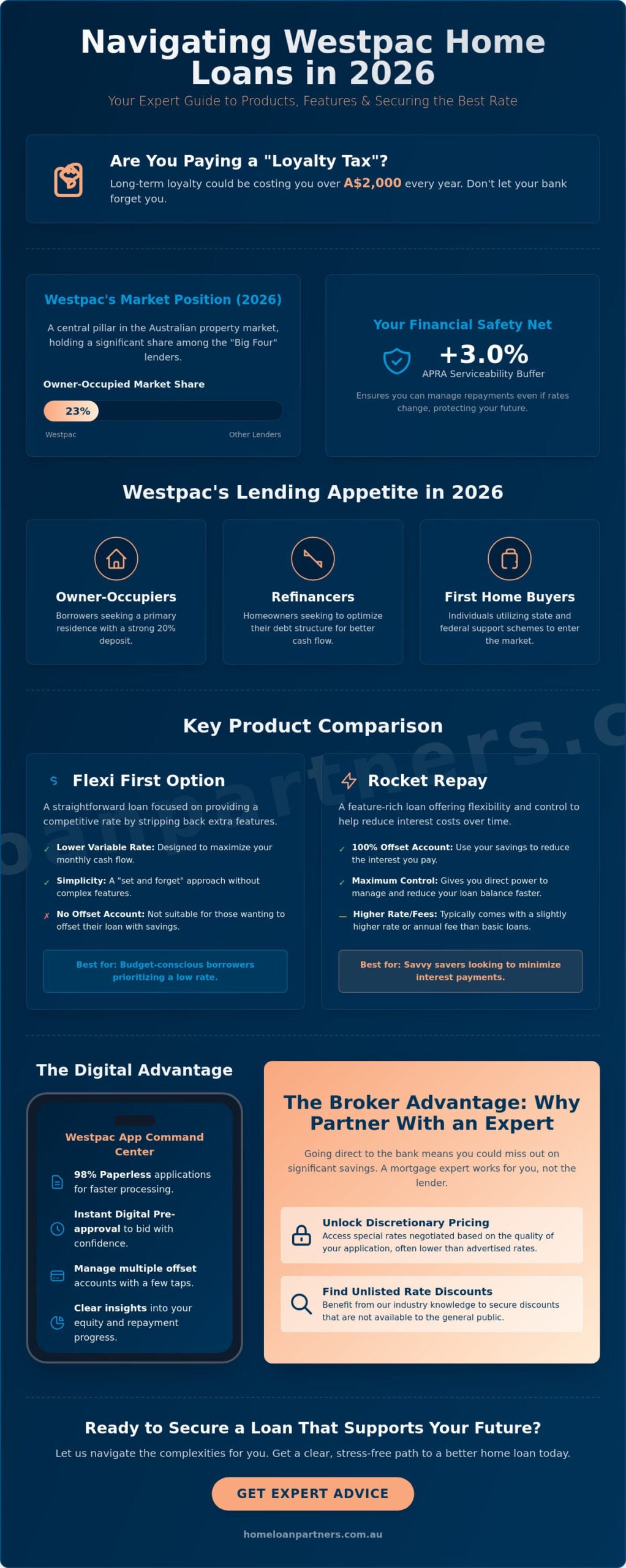
The institution stands as a central pillar in the Australian property market, maintaining a significant presence that shapes how millions of people approach homeownership. As we move through 2026, they continue to hold a commanding position among the “Big Four” lenders, managing approximately 23% of the nation’s owner-occupied home loan market. This scale provides a sense of security for borrowers who value a bank with deep roots in the local economy. Understanding Westpac’s corporate history reveals a legacy dating back to 1817, which informs their steady approach to modern lending cycles.
In the current environment, the lender acts as a stabilizer for the broader market. They’ve shifted their focus toward sustainable growth, prioritizing long-term relationships over high-volume, short-term transactions. This makes them a reliable partner for those looking to build a future in their own home. Their role isn’t just about providing capital; it’s about offering a structured path through the complexities of the Australian real estate market. By maintaining a vast network of local experts, they ensure that borrowers have access to professional guidance regardless of their location.
The 2026 Economic Context for Borrowers
Lending in 2026 requires a nuanced understanding of interest rate stability and regulatory oversight. The bank has refined its fixed and variable offerings to reflect a post-inflationary environment where predictability is highly valued. They strictly adhere to APRA’s 3.0% serviceability buffer, which acts as a protective measure for your financial future. This buffer ensures that you can comfortably manage repayments even if the economic climate shifts unexpectedly. Their current lending appetite is particularly strong for:
- Owner-occupiers: Borrowers looking for a primary residence with a 20% deposit.
- Refinancers: Families seeking to optimize their current debt structure for better cash flow.
- First-home buyers: Individuals utilizing specific state and federal support schemes.
Digital Transformation: The Westpac App in 2026
Technology has transformed the mortgage experience from a paper-heavy chore into a seamless digital journey. The westpac app now serves as a comprehensive command center for your home loan, allowing you to manage every aspect of your debt from a smartphone. In 2026, the platform has achieved a 98% paperless application rate, significantly reducing the time between your initial inquiry and a formal approval. This speed is crucial in competitive property markets where every hour counts.
Beyond the application, the digital tools provide clear insights into your equity and repayment progress. You can set up multiple offset accounts with a few taps, helping you reduce interest costs while keeping your savings accessible. The app also features an instant digital pre-approval tool that provides a reliable borrowing limit based on real-time financial data. This transparency empowers you to bid at auctions with confidence, knowing exactly where you stand. By removing the stress of manual tracking, the bank allows you to focus on the excitement of finding your perfect home.
Deep Dive: Westpac Home Loan Products and Features
Westpac offers a diverse range of lending solutions designed to match the evolving needs of Australian property owners. Whether you’re a first-time buyer or a seasoned investor, their product suite prioritizes flexibility. The Flexi First Option stands out for those focused on the bottom line. It provides a lower variable rate by stripping away costly features like offset accounts, making it a practical choice for borrowers who want to maximize their monthly cash flow. This product is particularly effective for those who don’t intend to hold large sums of cash and prefer a “set and forget” approach to their mortgage.
For homeowners seeking more control, the Rocket Repay Home Loan remains a popular choice. It integrates a 100% offset account, allowing you to use your savings to reduce the interest charged on your loan balance. Looking ahead to the 2026 market, Westpac’s strategy emphasizes a balance between fixed-rate security and variable-rate flexibility. Many borrowers are opting for split loans to hedge against potential rate fluctuations. If you’re planning a new build or a transition between properties, Westpac provides specialized construction finance and bridging loans to ensure your project stays on track. Understanding these options is easier when you partner with an expert advisor who can compare these features against your long-term goals.
The Power of the Westpac Offset Account
Westpac’s offset account is a separate transaction account linked directly to your mortgage. Unlike a redraw facility, where extra payments are technically the bank’s funds until you withdraw them, an offset account keeps your cash accessible while still reducing interest. Citing Australian housing statistics, we see that high-interest environments make these tools essential for wealth preservation and debt reduction.
Consider a practical case study. On a A$600,000 loan at a 6.15% interest rate, maintaining a consistent A$45,000 in your offset account could save you over A$170,000 in interest over a 30-year term. It also shaves nearly three years off the life of the loan. Westpac allows you to manage multiple offset accounts, which helps you bucket your savings for tax purposes or specific goals without losing the interest-saving benefits.
Westpac Rewards and Package Benefits
The Premier Advantage Package is the premium offering for borrowers who want a bundled experience. For an annual fee, usually priced at A$395, you gain access to discounted interest rates that sit below the standard advertised rates. The package also includes waivers on monthly service fees for your transaction accounts and annual fees for certain credit cards. This structure is designed to simplify your financial life by keeping your primary banking under one roof.
Evaluating this package requires a simple cost-benefit analysis. If the interest rate discount saves you more than the A$395 annual fee, the package pays for itself. Most borrowers with loan balances exceeding A$250,000 find the savings significant. You also receive discounts on home and contents insurance, which adds another layer of value to your overall financial structure. Our team can help you calculate if these package savings outweigh the ongoing costs for your specific situation.
Comparing Westpac to Australia’s Other Major Lenders
Westpac operates in a fierce landscape alongside CBA, NAB, and ANZ. While all four banks offer similar core products, Westpac often distinguishes itself through specific policy niches that favor seasoned investors. In the 2026 market, Westpac has focused heavily on digital speed, often providing a faster “time to yes” than its traditional rivals. This efficiency helps your expert partner secure your property before the next weekend auction.
The rise of challenger banks like Macquarie and digital-first lenders has forced westpac to become more aggressive on price. However, the “Loyalty Tax” is still a reality for many. Statistics from late 2025 indicated that existing major bank customers were paying an average of 52 basis points more than new customers. We act as your guide to bridge this gap, ensuring you don’t pay a premium for your long-term relationship with the bank.
Serviceability remains the biggest hurdle for most Australians. Westpac often wins on serviceability because of how they treat specific income types. While some lenders might take a conservative view on commission or bonus income, Westpac frequently applies a more generous calculation. This nuanced approach allows us to find a path forward when other major lenders might hesitate. It’s about finding the lender whose calculator likes your specific financial situation the most.
Big Four vs. Non-Bank Lenders
Choosing a major bank provides a sense of security and a physical branch network that many Australians still value. Non-bank lenders, often funded by wholesale markets, provide flexibility for borrowers with unique needs. In 2026, these wholesale lenders have gained a 15% market share by targeting “near-prime” borrowers. We help you weigh the rock-solid stability of a major institution against the tailored features of a smaller, agile lender to find your perfect fit.
Assessing Credit Policy Nuances
Westpac offers a supportive framework for self-employed borrowers, sometimes requiring only one year of financial statements for established entities. This is a significant advantage over lenders requiring a two-year average. For apartment buyers, Westpac maintains specific postcode restrictions to manage risk. In high-density areas, they may limit the Loan-to-Value Ratio (LVR) to 70% or 80%. Additionally, their treatment of rental income is often more favorable, frequently allowing up to 90% of projected rent to be used in serviceability calculations for certain investment properties, which can significantly boost your borrowing power.
The Westpac Application and Approval Process
Moving from your initial enquiry to holding the keys involves several distinct stages. Westpac uses a digital-first approach to speed up the journey, but preparation remains your best tool for success. The process begins with a preliminary assessment of your borrowing capacity. Once you provide your documentation, the bank moves toward a pre-approval. After you find a property, Westpac orders a valuation. For standard residential homes in metropolitan areas, these valuations often take 48 to 72 hours. Once the property value is confirmed and credit criteria are met, you receive unconditional approval, leading to the final settlement through the PEXA platform.
To keep the momentum of your application, you’ll need a standard suite of documents. This includes your two most recent payslips, three months of bank statements showing your genuine savings, and a valid form of Australian identification. If you’re self-employed, you’ll need the last two years of personal and business tax returns. Delays often occur when borrowers overlook small details. Common pitfalls include failing to disclose the full limit of a credit card or forgetting to mention “buy now, pay later” accounts. These obligations impact your debt-to-income ratio and can lead to a lower than expected loan offer.
Securing a Pre-Approval with Westpac
It’s vital to distinguish between a “System Generated” pre-approval and one that’s “Fully Assessed.” A system-generated response is an algorithm’s estimate based on the data you entered. We always recommend our clients push for a fully assessed pre-approval. This means a credit officer has physically reviewed your payslips and bank statements. In the 2026 market, these approvals generally last for 90 days. If your property search extends past this window, you don’t need to start over. Usually, providing your most recent month of financial data is enough to refresh the approval for another 90 days.
Lenders Mortgage Insurance (LMI) at Westpac
If you have a deposit smaller than 20%, you’ll likely encounter LMI. This is a one-off insurance premium that protects the lender. However, Westpac maintains specific policies that benefit certain professionals. Healthcare workers, including doctors and registered nurses, as well as legal experts and accountants, can often secure an LMI waiver with a deposit as low as 10%. This can save you tens of thousands of dollars upfront. For other borrowers, Westpac allows you to capitalise the LMI. This means the fee is added to your total loan amount, which helps you keep your hard-earned cash for moving costs or furniture.
As your dedicated mortgage partner, we handle the heavy lifting of the paperwork so you can focus on finding the right home. Contact our expert team to start your Westpac application today.
The Broker Advantage: Why Partner with an Expert for a Westpac Loan
Walking directly into a bank branch might seem like the simplest path, but it often restricts your horizon to a single suite of products. A bank employee is trained to sell their specific brand, regardless of whether a competitor offers a more suitable feature for your unique needs. Working with a dedicated broker changes this dynamic entirely. We act as your professional advocate, ensuring your application is positioned for success from the very first day.
According to data from the Mortgage & Finance Association of Australia (MFAA), 74.1% of all new residential home loans were facilitated by mortgage brokers in the June 2024 quarter. This record high reflects a growing understanding that brokers provide access to “unlisted” discretionary pricing. Banks often empower brokers to negotiate rates that are 0.15% to 0.25% lower than the advertised “special” offers found on public websites, especially for borrowers with strong equity or high incomes.
Trust is the foundation of our partnership. Since January 2021, Australian mortgage brokers have been legally bound by the Best Interests Duty (BID). This statutory requirement ensures we must prioritize your financial well-being over any lender’s interests. While bank staff are exempt from this specific legal duty, we embrace it as a core part of our service, providing you with a transparent comparison that justifies why a particular westpac product or an alternative is the right fit for your future.
Beyond the Product: Tailored Loan Structuring
The interest rate is only one piece of the puzzle. The way your debt is structured can save you more over ten years than a minor rate discount ever could. We help you decide if a split loan, an offset account, or a specific repayment frequency aligns with your cash flow. Our role as your partner doesn’t end at settlement. We conduct annual reviews to ensure you still hold a competitive edge as the market evolves, often renegotiating with your current lender to keep your costs down without the need for a full refinance.
Reducing the Stress of Home Buying
The mortgage process involves significant “heavy lifting” that can overwhelm even experienced investors. We manage the entire communication chain, from the initial data collection to the final settlement day. You’ll have a single point of contact who understands your story, rather than a revolving door of call center staff. We translate complex credit policies into clear choices, giving you the confidence to move forward with your property goals.
Navigating the 2026 Mortgage Market with Confidence
The 2026 Australian property market presents unique opportunities and challenges for every borrower. While westpac remains a cornerstone of the Big Four with a robust suite of offset accounts and flexible features, the right choice depends entirely on your personal financial goals. Success in today’s lending environment requires more than just looking at a headline rate; it’s about understanding how a loan structure supports your long-term security and lifestyle aspirations.
You don’t have to navigate these complex financial decisions alone. At Home Loan Partners, we act as your steady guide through the entire process. Our team provides access to over 36 lenders, ensuring you aren’t limited to just one bank’s criteria. We provide professional guidance tailored to your specific needs and offer ongoing support for the life of your loan, well beyond the settlement date.
Ready to find a mortgage that works for your future? Book a personalised strategy session with our expert brokers today. We’re here to turn your homeownership dreams into a stress-free reality.
Frequently Asked Questions
Is Westpac a good bank for first home buyers in 2026?
Westpac remains a strong choice for first home buyers because they’re a major participating lender in the Australian Government’s Home Guarantee Scheme. This program allows eligible buyers to purchase with as little as a 5% deposit without paying Lenders Mortgage Insurance. We’ll guide you through the 2026 eligibility criteria to ensure your application is seamless and your path to homeownership stays stress-free.
How much can I borrow from Westpac based on my salary?
Your borrowing capacity typically ranges from 4 to 6 times your gross annual income. Westpac calculates this figure by applying a 3% serviceability buffer required by APRA to ensure you can manage repayments if interest rates rise. For example, a couple earning a combined A$180,000 might see their borrowing limit shift based on their existing credit card limits and monthly living expenses.
Does Westpac offer a better rate for green home loans?
Yes, you can access discounted rates through the Sustainable Upgrades loan for homes with energy-efficient features. You’ll qualify for lower interest rates if your property meets specific criteria, such as a 7-star NatHERS rating or the installation of solar panels. This initiative helps you reduce your carbon footprint while lowering your monthly mortgage repayments over the long term through tailored financial rewards.
What is the difference between Westpac’s redraw and offset accounts?
An offset account is a separate transaction account where every dollar balances out your loan principal to reduce interest charges. In contrast, redraw allows you to access extra repayments you’ve already made directly into your loan account. While both features help you pay off your home sooner, an offset account offers more flexibility for daily spending and potential tax benefits for future property investors.
How long does Westpac take to approve a home loan in 2026?
You can generally expect an unconditional approval from Westpac within 3 to 10 business days. While simple applications might see a turnaround in 48 hours, complex files involving self-employed income or unique property types often take longer. We manage the heavy lifting and follow-ups with the bank to keep your purchase on track for a smooth, predictable settlement experience.
Can I switch my existing Westpac loan to a lower interest rate?
You can request a rate review or switch to a different loan product if your current rate isn’t competitive. Approximately 70% of borrowers find themselves paying a loyalty tax where new customers receive better deals than existing ones. We partner with you to negotiate with the bank or help you switch to a more tailored product that aligns with your long-term financial security.
What happens if Westpac declines my home loan application?
If your application is declined, the bank provides a specific reason such as a low credit score or insufficient serviceability. It’s best to wait at least 6 months before applying again to avoid multiple hard hits on your credit report. We’ll help you analyze the feedback and build a stronger financial profile to ensure your next attempt at securing a mortgage is successful.
Does Westpac charge exit fees if I refinance to another lender?
Westpac doesn’t charge early exit fees on variable rate loans following the 2011 Australian government ban on these charges. You’ll still need to pay a standard discharge administration fee, which typically ranges between A$300 and A$600. If you’re currently on a fixed-rate term, break costs may apply depending on current market interest rates at the time you decide to exit the loan.