

What if your superannuation balance wasn’t just a number on a screen, but a proactive tool for securing your family’s future through property? Most Australians understand that property is a powerful wealth builder, yet the technical hurdles of the SIS Act and the perceived complexity of Limited Recourse Borrowing Arrangements often keep great investment strategies on the shelf. You’re right to be cautious; the rules around lending to smsf are strict for a reason, and nobody wants to risk their retirement on a compliance error.
We’re here to be your expert partner in this journey. This guide promises to simplify the 2026 regulatory environment, showing you exactly how to safely leverage your super for property while meeting the latest lender requirements. We’ll walk through the essential LRBA structures and the specific steps you need to take to ensure your fund remains fully compliant. By the end of this article, you’ll have a clear, stress-free path toward purchasing property within your super fund.
Key Takeaways
- Discover how a Limited Recourse Borrowing Arrangement (LRBA) provides a secure framework for your fund to purchase property while protecting your other retirement assets.
- Understand the essential rules of lending to smsf to ensure your fund remains compliant while leveraging your super for strategic property growth.
- Gain clarity on the 2026 lending landscape, including typical Loan-to-Value Ratios (LVRs) and the specific requirements for residential versus commercial assets.
- Learn how to align your borrowing strategy with the “Sole Purpose Test” to guarantee your investment serves your long-term retirement goals.
- Discover how a specialist partner can help you navigate the fragmented lending market to secure a tailored, stress-free path forward for your investment journey.
Understanding Lending to SMSF: Borrowing vs. Lending Out
When we talk about lending to smsf, we’re looking at a two-way street. Most Australians use their Self-Managed Super Fund to borrow money to buy property. However, the law also allows the fund itself to act as a lender under very specific conditions. Understanding the difference between these two paths is the first step in building a secure retirement strategy that lasts. We see our role as your partner in this journey, helping you understand how lending to smsf fits into your long-term goals without the usual stress of complex financial jargon.
Most trustees focus on the borrowing side because it allows them to control larger assets sooner. By using your super balance as a deposit and borrowing the remainder, you can acquire high-value commercial or residential property. This strategy aims to accelerate the growth of your retirement nest egg through both rental yields and capital growth. It’s a proactive way to build wealth that might otherwise stay locked away in a standard industry fund.
The Fund as a Borrower: How LRBAs Work
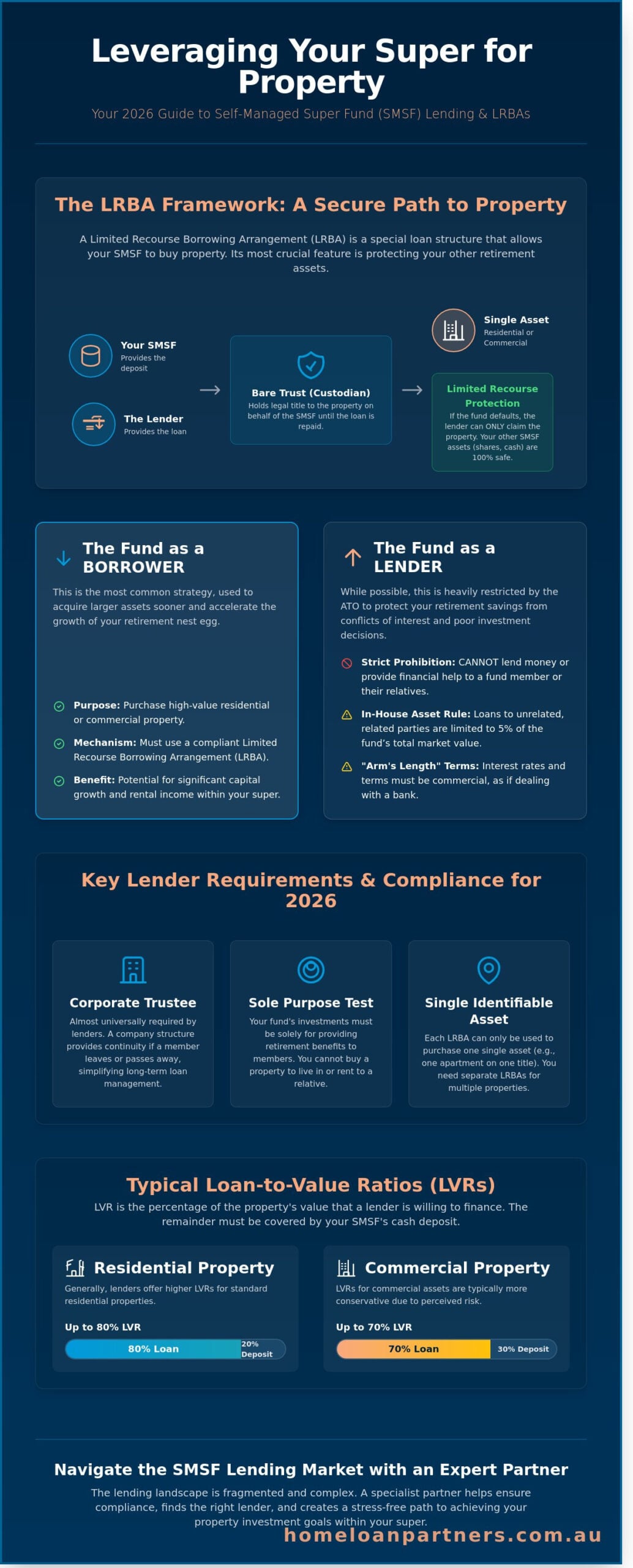
Borrowing within an SMSF requires a specific structure called a Limited Recourse Borrowing Arrangement (LRBA). Under this setup, your fund takes out a loan to purchase a single identifiable asset, such as a residential house or a commercial warehouse. A separate entity, known as a Bare Trust, holds the legal title to the property on behalf of the fund until you pay off the loan. This structure creates a vital safety net for your future. “An LRBA ensures that if the fund defaults, the lender has no claim over the SMSF’s other retirement savings.” This protection means your existing shares, cash, or other properties remain safe even if the specific property investment doesn’t perform as expected. It’s a tailored approach designed to protect your hard-earned savings while you grow your portfolio.
The Fund as a Lender: Can Your SMSF Lend Money?
While it’s possible for your fund to lend money, the Australian Taxation Office (ATO) enforces strict boundaries to protect your retirement interests. You can’t lend money or provide financial assistance to a fund member or any of their relatives. Doing so violates the sole purpose test and can lead to heavy penalties or the fund being declared non-complying. For unrelated parties, the 5% in-house asset rule applies. This rule limits loans to related entities to no more than 5% of the fund’s total market value. Every loan must also be executed on Arm’s Length terms. This means the interest rates, repayment schedules, and security must mirror what a commercial bank would offer in the open market. We guide you through these rules to ensure your fund stays compliant while exploring every opportunity for growth.
- Borrowing: Used to acquire property via an LRBA.
- Lending: Strictly prohibited to members or relatives.
- Compliance: Must follow the 5% in-house asset rule for unrelated parties.
- Security: Bare Trusts protect other fund assets from lender claims.
The Limited Recourse Borrowing Arrangement (LRBA) Framework
The Superannuation Industry (Supervision) Act 1993, specifically Section 67A, dictates the strict rules for lending to smsf. You can’t simply take out a standard mortgage; you must use a Limited Recourse Borrowing Arrangement (LRBA). This structure is designed to protect your retirement savings. If the fund defaults on the loan, the lender’s rights are limited to the specific property held within that arrangement. They cannot pursue other assets in your SMSF, such as your cash accounts or share portfolios, to recover their money.
A Corporate Trustee is almost always a requirement for these loans in 2026. While individual trustees are allowed under law, most Australian lenders insist on a company structure to ensure continuity. If a member passes away or leaves the fund, a Corporate Trustee remains a constant legal entity, which simplifies the long-term management of the debt. The lifecycle of an LRBA begins with the establishment of the trust, continues through years of steady repayments, and concludes with the “vesting” of the property. Once you’ve paid the final cent of the mortgage, the legal title is transferred from the custodian to the SMSF Trustee, and the bare trust is dissolved.
The “Single Identifiable Asset” rule is a vital component of this framework. You cannot use one loan to purchase a portfolio of properties. Each LRBA must relate to a single asset. For example, if you want to buy two separate apartments on different titles, you’ll need two separate loan agreements and two distinct bare trust structures. This clarity ensures that the limited recourse protections remain enforceable and transparent for both the fund and the bank.
The Bare Trust and Custodian Structure
Lenders require a Bare Trust to hold the legal title of the property throughout the loan’s duration. In this setup, the Custodian (the Bare Trust Trustee) is the legal owner on paper, but your SMSF Trustee holds the “beneficial interest.” This means your fund receives all the rent and pays all the expenses. It’s a specialized legal separation that protects the asset. Before you apply, we’ll help you verify that your SMSF trust deed explicitly permits borrowing, as many older deeds don’t include the necessary clauses to satisfy modern compliance checks.
Repairs vs. Improvements: What You Can and Cannot Do
The ATO’s ruling SMSFR 2012/1 provides clear boundaries on how you can maintain your investment. You can use borrowed money to “repair” or “maintain” the property, such as replacing a broken fence or fixing a damaged roof. However, you’re prohibited from using borrowed funds to “improve” the asset. Adding a swimming pool, building an extension, or converting a garage into a bedroom fundamentally changes the asset’s character. If you plan to add value through renovations, you must use the fund’s existing cash rather than the loan proceeds. Partnering with an expert mortgage broker helps you navigate these nuances so your fund stays compliant while your property grows in value.
Qualifying for an SMSF Loan: What Lenders Require in 2026
In 2026, the Australian market for lending to SMSF is defined by a focus on sustainable growth and fund safety. Lenders act as your expert partner during this process, but they’ve maintained strict criteria to ensure your retirement savings remain protected. They don’t just look at the property’s value; they scrutinize your fund’s entire financial ecosystem. This includes your history of contributions, the reliability of tenants, and the cash reserves you keep aside for emergencies.
LVR and Deposit Requirements
Lenders require larger deposits for SMSF loans because these are structured as Limited Recourse Borrowing Arrangements (LRBAs). If the loan defaults, the lender can’t touch other assets in your fund. To offset this risk, most banks cap the Loan-to-Value Ratio (LVR) at 70% or 80% for residential properties. If you’re eyeing a commercial warehouse or office space, expect to provide a deposit of 35% or more. These higher entry points ensure your fund starts with significant equity. You can use a mortgage repayment calculator to model how these different deposit levels impact your fund’s monthly cash flow and long-term earnings.
The liquidity buffer is another non-negotiable requirement. Most lenders insist that your fund retains a cash reserve equal to 10% to 15% of the property’s value after the purchase is complete. This cash ensures you can cover unexpected repairs, periods of vacancy, or changes in interest rates without jeopardizing your members’ futures. Some trustees also explore an interest only home loan structure during the early years of the LRBA to preserve this liquidity buffer and keep the fund’s monthly outgoings manageable while the property grows in value.
The Importance of Member Contributions
Serviceability is the net cash flow available within the fund to meet all loan obligations comfortably. To calculate this, lenders look at two primary streams: the rental income from the new property and the ongoing contributions from fund members. In 2026, lenders typically require a serviceability cover of 1.2 to 1.5 times the annual debt repayments.
- Concessional Contributions: Lenders view these as a steady, reliable source of income, especially when members have stable employment.
- Non-Concessional Contributions: While these are voluntary, a consistent history of making these payments demonstrates a fund’s strength and commitment to the investment strategy.
- Contribution Stability: Banks will often review the last 24 months of your superannuation history to ensure the flow of money is predictable.
Lenders prioritize stability over high-risk gains. They want to see that your fund’s strategy is diversified and that the property investment won’t drain your total liquid assets. By presenting a clear, documented history of contributions, you position your fund as a reliable borrower. Our team helps you organize this data, acting as a steady guide to ensure your application meets these high standards with precision. Trustees who also hold personal property outside their SMSF may find that a debt recycling strategy can complement their SMSF investment by converting non-deductible mortgage debt into tax-effective wealth outside of super.
Compliance Essentials: Investment Strategy and Sole Purpose Test
Compliance isn’t just about paperwork; it’s about protecting your future. Every decision regarding lending to smsf must align with your fund’s governing rules and the Superannuation Industry (Supervision) Act 1993. The foundation of this compliance is the “Sole Purpose Test.” This rule requires that your fund is maintained for the single purpose of providing retirement benefits to its members. If you use fund assets to provide a present-day benefit to yourself or a family member, you risk failing this test and facing significant legal trouble.
The Australian Taxation Office (ATO) monitors these rules strictly. If your fund falls out of compliance, the financial impact is immediate. As of July 2023, the administrative penalty unit is A$313. A single breach can result in multiple units per trustee, quickly reaching thousands of dollars in personal fines. Beyond civil penalties, the ATO has the power to disqualify trustees or remove a fund’s tax-concessional status. This would see your fund’s income and assets taxed at the highest marginal rate of 45%. Your annual SMSF audit is the primary tool used to verify that your loan remains legitimate and your fund stays on the right side of the law.
Updating Your Investment Strategy
Before you commit to a loan, your written Investment Strategy must reflect the move. You need to document how a leveraged property fits your fund’s goals, specifically addressing risk, return, and liquidity. Liquidity is vital; you must prove the fund can cover loan repayments, insurance, and land tax even if the property sits vacant. The ATO also looks closely at diversification. If a single property represents 90% of your fund’s value, your strategy needs to explain why this concentration of risk is appropriate for your members’ retirement goals. We suggest reviewing this strategy at least once every 12 months to stay ahead of market shifts.
Avoiding Related Party Pitfalls
The rules for residential property are absolute. You, your relatives, or your business associates cannot live in or rent a residential property owned by your SMSF. There’s a helpful exception for “Business Real Property.” This allows your fund to purchase a commercial premises, such as a warehouse or office, and lease it back to your own business. To satisfy an audit, this must be an “Arm’s Length” transaction. You must pay market-rate rent and have a formal lease agreement in place. Keeping these boundaries clear ensures your strategy for lending to smsf remains a secure path toward wealth creation.
Success in SMSF borrowing requires a steady hand and expert guidance. Partner with our specialists to secure a compliant loan tailored to your goals.
Navigating the SMSF Lending Market with a Specialist Partner
The landscape for lending to smsf has shifted significantly since the big four banks largely withdrew from this sector in 2018. Today, the market is fragmented and requires a steady hand to find the right path. While traditional institutions might offer limited options, specialized non-bank lenders have stepped in with competitive, tailored products designed specifically for superannuation structures. Choosing the wrong lender can lead to high interest rates or, worse, a structure that fails to meet strict ATO compliance standards.
Success in SMSF property investment depends on more than just a low rate. It requires a collaborative effort. We act as your central point of contact, coordinating with your accountant and legal team to ensure the Limited Recourse Borrowing Arrangement (LRBA) is executed perfectly. This integrated approach removes the burden from your shoulders, allowing you to focus on your fund’s long-term growth while we manage the technical heavy lifting. We understand that your SMSF is a vehicle for your future security, and we treat every application with the care it deserves.
Accessing a Panel of Over 36 Lenders
Finding the right fit for your fund isn’t about luck; it’s about choice. At The Home Loan Partners, we compare options from over 36 lenders to identify the most favorable terms for your specific situation. Our team analyzes various fee structures, including upfront costs and ongoing rates, to ensure your fund retains as much capital as possible. This unbiased advice is vital when lending to smsf structures, as every fund has unique liquidity requirements and retirement goals. We translate complex bank jargon into clear, practical choices that make sense for your future.
Your Roadmap to Settlement
Securing a loan for your SMSF is a journey that requires precision at every turn. We guide you through each stage to ensure a seamless experience:
- Strategy and Pre-approval: We assess your fund’s borrowing capacity to give you a clear budget before you start your property search.
- Structure Verification: Our team works with your legal advisors to confirm your Bare Trust and Corporate Trustee documents meet lender requirements.
- Application and Valuation: We manage the paperwork and coordinate property valuations to keep the process moving forward without delays.
- Settlement and Beyond: Once the keys are in hand, our role doesn’t end. We provide ongoing reviews to ensure your loan remains competitive as the market evolves.
Building wealth within your super should be an empowering experience, not a source of stress. Partner with us to secure your SMSF property loan today and take the first step toward a more secure retirement with confidence.
Take the Next Step Toward Your 2026 Retirement Goals
Navigating the landscape of lending to smsf in 2026 requires a firm grasp of the Limited Recourse Borrowing Arrangement (LRBA) framework and a commitment to the sole purpose test. You’ve seen how lender requirements have evolved, making a clear investment strategy more critical than ever for compliance. Success isn’t just about finding a property; it’s about structuring the debt correctly to protect your fund’s assets while maximizing long-term growth. The path to property ownership within your super doesn’t have to be a solo journey.
We’re here to act as your expert partner, simplifying complex financial jargon into a clear roadmap for your retirement goals. With access to over 36 Australian lenders and deep expertise in intricate LRBA structures, we provide the personalized, unbiased guidance you need to move forward with confidence. We’ll handle the heavy lifting of the mortgage process so you can focus on building your future security. Speak with an SMSF Lending Expert at The Home Loan Partners to begin your journey today. Your retirement dreams are within reach, and we’re ready to help you secure them.
Frequently Asked Questions
Can my SMSF borrow money to buy a residential property?
Yes, your Self-Managed Super Fund can borrow money to purchase a residential investment property through a Limited Recourse Borrowing Arrangement (LRBA). Under Section 67A of the Superannuation Industry (Supervision) Act 1993, the fund can use these specific loan structures to acquire a single acquirable asset. You can’t live in the property or rent it to family members. It must meet the sole purpose test of providing retirement benefits to your members.
What is the maximum LVR for an SMSF loan in 2026?
Most Australian lenders cap the Loan-to-Value Ratio (LVR) for lending to smsf at 80% for residential properties and 70% for commercial assets. While some specialized lenders offered 90% in the past, the 2024 APRA guidelines led to tighter capital requirements that remain in place for 2026. You’ll generally need a 20% deposit plus enough liquidity in the fund to cover stamp duty and legal costs during the acquisition process.
Do I need a separate trust to borrow money in my SMSF?
You must establish a separate Bare Trust, also known as a Holding Trust, to legally hold the property title while the loan is active. This structure ensures the lender’s rights are limited to the property itself and doesn’t put your other super assets at risk. Once you’ve paid off the loan in full, the legal title of the property can be transferred from the Bare Trust directly to your SMSF bank account.
Can an SMSF lend money to a fund member?
No, your SMSF is strictly prohibited from lending money or providing financial assistance to a member or their relatives. The Australian Taxation Office (ATO) monitors this closely. Breaches can result in your fund being declared non-complying. If your fund is non-complying, you could lose 45% of its total assets in tax penalties. It’s vital to keep your personal finances and your super fund’s investments completely separate at all times.
What happens if my SMSF cannot make the loan repayments?
The lender only has a right to the property held in the Bare Trust and cannot claim any other assets within your super fund. This is the limited recourse part of the borrowing arrangement that protects your remaining retirement savings. However, if you’ve provided a personal guarantee for the loan, the lender may be able to pursue your personal assets outside of super to recover their losses. We’ll help you understand these risks clearly.
Can I use my own money to pay for repairs on an SMSF property?
You can’t use personal funds to pay for repairs unless you process the payment as a formal non-concessional contribution to the fund. All property expenses, including maintenance and repairs, must be paid directly from the SMSF bank account to avoid breaching ATO rules. Using your own money without proper documentation can lead to compliance issues and potential fines. It’s best to keep a cash buffer for these types of costs.
What are the typical interest rates for lending to an SMSF?
Interest rates for lending to smsf are generally 1% to 2.5% higher than standard residential investment loans. As of late 2025, market data shows SMSF loan rates typically range between 7.5% and 9.5% depending on the lender and your deposit size. These higher rates reflect the increased compliance costs and the limited recourse nature of the loan. This structure increases the risk profile for the bank compared to standard mortgages.
Is an SMSF loan more expensive than a standard investment loan?
Yes, SMSF loans carry higher setup costs and ongoing fees than traditional mortgages. You’ll likely pay between A$2,000 and A$5,000 in setup fees. This includes legal reviews of the trust deed and the creation of the Bare Trust. Because these loans require specialized processing and strict adherence to the SIS Act, lenders charge a premium for the expertise required to manage the facility over the long term. We’ll guide you through every cost.