

What if the simple act of clicking ‘redraw’ on your home loan today permanently stripped away your ability to claim thousands in tax deductions five years from now? It’s a valid concern for many Australians, especially with the RBA cash rate sitting at 4.35% as of May 2026. You likely feel the pressure to pay down debt quickly, yet the confusion surrounding an offset account vs redraw facility for tax purposes often leads to a paralyzing fear of accidentally contaminating your loan and losing vital future benefits.
We understand that you’re looking for more than just a bank feature; you’re looking for a secure foundation for your long-term wealth. This guide will clarify the ATO’s “purpose of the loan” rule and show you how to protect your investment deductions before you make a costly mistake. We’ll explore how current data-matching programs impact your choices and provide a steady, stress-free path toward a truly tax-efficient loan structure that supports your major life milestones.
Key Takeaways
- Distinguish between a separate transaction account and a loan balance reduction to keep your financial records audit-ready and clear.
- Master the ATO’s “purpose of the loan” rule to correctly evaluate an offset account vs redraw facility for tax purposes and protect your future wealth.
- Secure your ability to claim maximum interest deductions if you ever decide to transition your home into a high-performing investment property.
- Evaluate the trade-off between bank fees and tax benefits to ensure your loan structure delivers the best possible return on your investment.
- Learn how split loans can offer a sophisticated balance of debt reduction and tax efficiency for your long-term property journey.
Defining the Mechanics: Redraw Facility vs Offset Account
To build a truly tax-efficient property portfolio, you first need to understand the structural plumbing of your loan. While both features aim to lower your interest costs, they do so through very different legal pathways. Choosing between an offset account vs redraw facility for tax purposes isn’t just about convenience; it’s about who technically owns the cash sitting against your debt. We see many clients feel a sense of relief once they understand that these aren’t just bank marketing terms, but distinct financial tools that impact your long-term journey. Whether you’re looking into refinancing or securing new investment property loans, the structure you choose today dictates your tax position tomorrow.
Both features share a common goal: reducing the interest you pay by ‘offsetting’ your principal balance. In an environment where the RBA cash rate has climbed to 4.35%, every dollar you keep against your loan works harder for you. However, the core difference lies in ownership. An offset is your money sitting in your account. A redraw is the bank’s money that you’ve already used to pay down the loan, which you then have the potential to borrow back.
How an Offset Account Operates
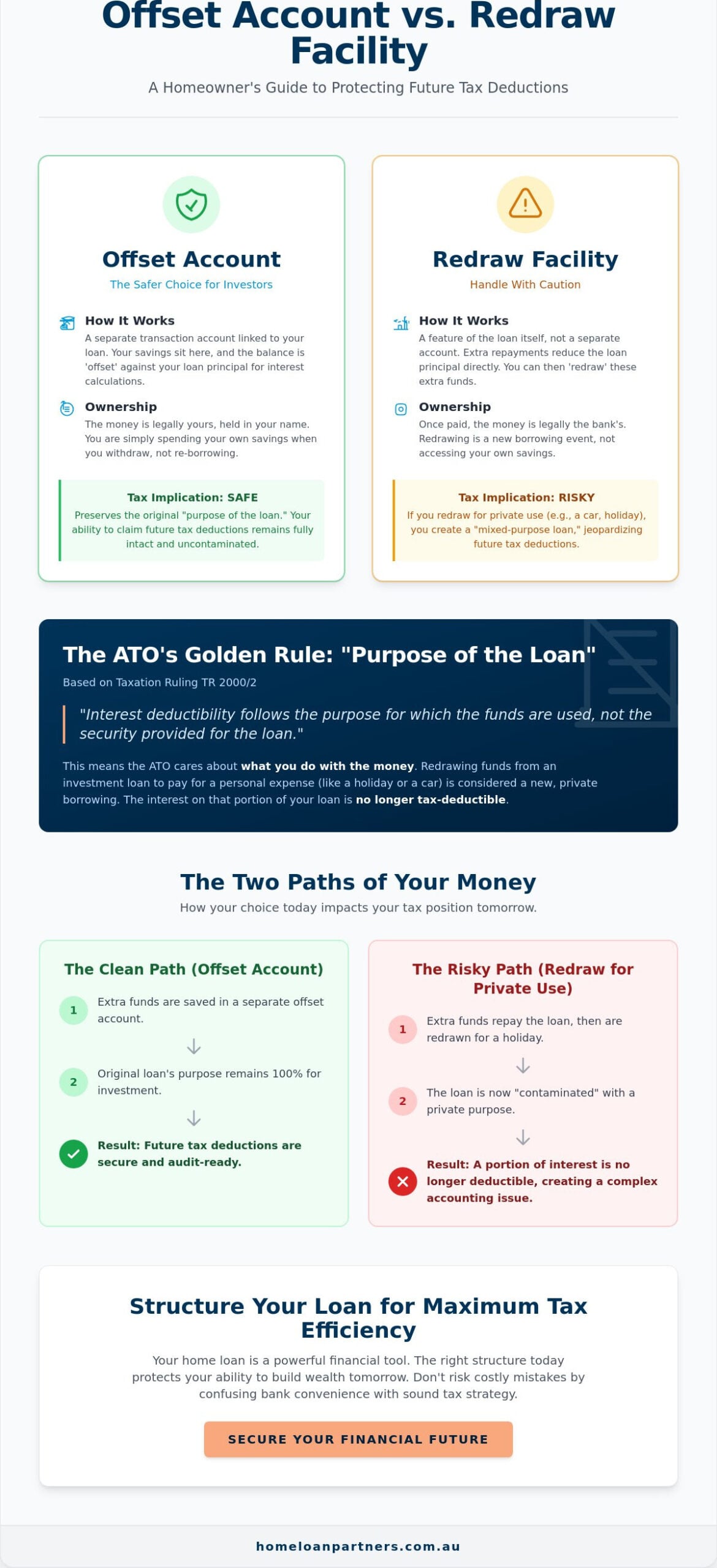
An Offset Account functions as a separate transaction account that’s linked to your home loan. It works exactly like a standard savings account, complete with its own BSB and account number. The bank looks at your loan balance, subtracts the balance in your offset, and only charges interest on the difference. Because the money remains in your name and is ‘at call,’ you can withdraw it at any time via a debit card or bank transfer. You aren’t borrowing the money back; you’re simply spending your own savings. This provides a high level of flexibility while keeping your original loan principal intact.
How a Redraw Facility Operates
A redraw facility is not a separate account. Instead, it’s a feature within your loan that tracks any extra repayments you’ve made above your minimum requirement. When you put extra cash into a redraw, it’s legally considered a repayment of the loan principal. This reduces your debt immediately. If you decide you need that money back later, you’re technically asking the bank to let you ‘re-borrow’ those funds. This distinction is subtle but vital. In the eyes of the law, once that money hits the loan, it becomes the bank’s money until they agree to lend it back to you. Understanding this difference is the first step in deciding on an offset account vs redraw facility for tax purposes, as it sets the stage for how the ATO treats your future interest claims.
The ‘Purpose of the Loan’ Rule: How the ATO Views Your Money
The Australian Taxation Office (ATO) operates on a fundamental principle: interest deductibility follows the purpose of the funds, not the security of the loan. This means the ATO doesn’t care if your loan is secured by an investment property or your family home. They only care about what you did with the money you borrowed. When evaluating an offset account vs redraw facility for tax purposes, this distinction becomes the line between a healthy tax refund and a costly audit. Under Taxation Ruling TR 2000/2, the ATO views any money taken from a redraw facility as a brand-new borrowing event. If you use that redrawn cash to buy a jet ski or pay for a wedding, the interest on that specific portion of the loan is no longer tax-deductible, even if the loan itself is for an investment property.
Legal Ownership vs Banking Convenience
Banks often market redraw facilities as a flexible way to manage your “savings,” but this terminology clashes with tax law. When you make an extra repayment into your loan, that money legally ceases to be yours; it’s used to satisfy your debt to the bank. Choosing between Offset vs Redraw requires understanding that “re-borrowing” via redraw creates a new legal contract. An offset account avoids this hurdle because the money stays in your name. It never touches the loan balance, so the original “purpose” of the loan remains intact and uncontaminated.
The Concept of Debt Contamination
Debt contamination occurs when you mix private spending with investment debt within a single loan account. Once you redraw funds for a personal expense, you’ve created a “mixed-purpose loan.” This is a nightmare for accountants. Every subsequent repayment you make must be apportioned between the deductible and non-deductible parts of the loan. With the ATO currently conducting a data-matching program for the 2021-22 to 2025-26 period, they’re specifically looking for these discrepancies. Un-mixing a contaminated loan is often expensive and requires complex accounting work. Keeping your finances clean from the start is much simpler. If you’re unsure how your current setup measures up, we can help you explore Investment Property Loans that prioritize tax efficiency and long-term security.
The Investment Pivot: Why Redraw Can Kill Your Tax Deductions
Many Australians start their property journey with a home they intend to live in, but their long-term goal often involves keeping that first house as a rental property. This transition, known as the “investment pivot,” is where the debate over an offset account vs redraw facility for tax purposes becomes most critical. When your home becomes an investment, your strategy shifts toward maximizing tax-deductible interest to offset your rental income. If you’ve been using a redraw facility to store your extra cash, you might find that you’ve unintentionally sabotaged your future tax benefits.
The core issue lies in how the ATO views the reduction of a loan. When you put money into a redraw, you’re paying down the debt. When you later decide to move out and turn that property into an investment, the “new” loan balance for tax purposes is the lower, repaid amount. You can’t simply redraw that money to buy your next home and expect the interest to be deductible on the rental property. This is a permanent structural change that can cost you thousands every year.
Scenario: The $100,000 Redraw Mistake
Imagine you have a $500,000 mortgage on your home. Over five years, you diligently pay an extra $100,000 into your redraw facility. Your loan balance is now $400,000. When you decide to buy a new family home and turn the old one into a rental, you redraw that $100,000 to use as a deposit. Under How the ATO Views Your Money, that redrawn $100,000 is now considered a loan for your new private residence. You can only claim interest deductions on the $400,000 balance for the rental property. You’ve effectively “lost” the ability to deduct interest on $100,000 of debt forever because the original loan was permanently reduced.
The Flexibility of the Offset Account
Contrast this with using an offset account. If you had kept that same $100,000 in an offset, your loan balance would have remained at $500,000 throughout those five years. When the time comes to pivot to an investment property, you simply withdraw the $100,000 from your offset account to fund your new purchase. Because the original loan principal of $500,000 was never actually repaid, the entire interest amount on that $500,000 remains tax-deductible against your rental income. This simple choice provides the flexibility to move your cash to where you need it most while keeping your investment debt at its maximum deductible level. It’s a powerful way to support your property portfolio’s growth without the stress of “cleaning up” a contaminated loan later.
Comparing Offset vs Redraw for Long-Term Wealth Strategy
Deciding between an offset account vs redraw facility for tax purposes often comes down to a choice between immediate cost savings and long-term financial agility. While many borrowers gravitate toward the cheapest option, professional investors look at the “net” benefit over several years. We often see clients focus on the absence of a monthly fee for a basic redraw facility, but they may overlook how much that “free” feature could cost them in lost tax deductions later. In the current environment, with the RBA cash rate at 4.35%, the stakes for your cash flow are higher than ever. Choosing the right tool is about more than just interest; it’s about maintaining control over your capital.
Cost Analysis: Fees vs Flexibility
In 2026, many lenders still charge an annual package fee for loans with offset accounts. For example, the Bank of Melbourne’s Standard Variable Rate Home Loan includes a $395 annual fee for its offset package. In contrast, many basic home loans offer a redraw facility with no ongoing annual fees and free online redraws. If you are an owner-occupier with no plans to ever rent out your home, the $395 saving might seem attractive. However, for a future investor, that fee is a small price to pay to preserve the tax-deductibility of your loan. If an offset account saves you from losing the ability to deduct interest on $100,000 of debt, the tax benefit at a 30% or 45% marginal rate will far exceed the annual bank fee. You should always weigh the yearly cost against the potential thousands in tax savings you’ll gain during your property’s life as an investment.
Risk Management and Accessibility
Accessibility is another area where the two features diverge. An offset account is your money, held in a separate transaction account, and is generally considered “at call.” A redraw facility, however, is a sub-feature of the loan. It’s important to understand that banks often reserve the legal right to reduce or freeze redraw facilities, particularly during periods of financial hardship or significant market volatility. If you are using your extra repayments as an emergency buffer, an offset account provides a more secure layer of protection. You don’t have to “ask” the bank for your money back. This security is why many of our clients prefer the certainty of an offset, especially when managing complex portfolios. If you’re ready to secure your financial future, we can help you with refinancing your current debt into a structure that offers both safety and efficiency.
Most professional investors prefer using multiple offset accounts. This allows them to bucket money for different goals, such as property maintenance, tax provisions, or personal savings, without ever touching the actual loan balance. This clean separation ensures that your paper trail remains pristine for the ATO while your money continues to work hard to reduce your interest bill.
Structuring Your Loan for Maximum Tax Efficiency
Building a tax-efficient property portfolio requires you to start with the end in mind. Before deciding between an offset account vs redraw facility for tax purposes, you must ask a fundamental question: is this property your “forever home” or a “future rental”? If there’s even a small chance you’ll rent the property out later, the structural choices you make today will dictate your financial flexibility for years to come. We aim to manage the heavy lifting of this setup for you, ensuring your loan architecture aligns perfectly with your long-term journey and major life milestones.
The ‘Split Loan’ Solution
A split loan strategy is often the most effective way to balance certainty with flexibility. Most fixed-rate products in the 2026 market don’t allow for a full offset account, or they place strict limits on extra repayments. By dividing your mortgage into two portions, you can secure a fixed rate for the majority of the debt while keeping a variable portion attached to an offset account. This variable “sleeve” acts as your financial buffer. You can park your savings there to reduce interest costs immediately, while still having the freedom to move those funds if you decide to purchase a new principal place of residence. This structure effectively isolates your debt, keeping your investment options open without the risk of “contaminating” the entire loan.
While we’ve discussed how redraw can be a trap, it can also be a powerful tool when used for debt recycling. This strategy involves paying extra funds into a redraw facility and then “re-borrowing” them specifically to invest in income-producing assets, such as shares or Investment Property Loans. Because the *purpose* of the redrawn funds is for investment, the interest on that portion becomes tax-deductible. However, this requires surgical precision. A single mistake, like accidentally redrawing for a personal bill, can mix the debt and create a complex accounting headache. This is why we always recommend a collaborative approach, working alongside both your mortgage broker and your tax accountant to ensure every transaction is audit-ready.
Actionable Steps for Homeowners
Your property goals will likely evolve over the next 5 to 10 years. A structure that works for a first-time buyer might not serve a growing family looking to upgrade. To ensure your loan remains a supportive tool rather than a hurdle, consider these practical steps:
- Review your current loan features to confirm if your extra repayments are sitting in a redraw facility or a true 100% offset account.
- Assess your long-term intentions for the property, specifically whether it will eventually become a source of rental income.
- Evaluate your current tax bracket, as the 2025-2026 resident rates (ranging from 16% to 45%) significantly impact the “real” value of your interest deductions.
- Contact The Home Loan Partners to audit your current structure and ensure it’s optimized for your future security.
Taking the time to refine these details now provides the calm, steady expertise needed to navigate a high-interest environment. By prioritizing clarity and precision today, you protect your wealth for tomorrow.
Secure Your Tax Deductions with a Strategic Loan Structure
Navigating the nuances of an offset account vs redraw facility for tax purposes is a vital step in protecting your long-term wealth. You now understand that while a redraw facility might offer immediate simplicity, it carries the risk of permanent debt contamination that can strip away future deductions. By contrast, a well-structured offset account acts as a flexible bridge. It preserves your loan’s original purpose and allows you to pivot from a homeowner to a savvy investor with total confidence.
We are here to manage the heavy lifting of these complex arrangements for you. With access to 36+ lenders and deep expertise in complex investment structures, our team provides the steady hand you need to navigate the current environment. We invite you to book a personalised loan structure review with The Home Loan Partners to ensure your debt is working as hard as possible for your future goals. Your property journey is a long-term commitment, and we’re dedicated to being your expert collaborator every step of the way. Let’s build a tax-efficient foundation that supports your major life milestones.
Frequently Asked Questions
Is interest on a redraw facility tax deductible if I use it for an investment?
Yes, the interest is generally deductible if you use the redrawn funds specifically to purchase an income-producing asset. Because the ATO treats a redraw as a new borrowing event, you must maintain a clear paper trail from the loan account to the investment. If you mix these funds with personal cash in a standard bank account, you risk contaminating the debt and losing the deduction.
Can the ATO penalise me for using a redraw facility incorrectly?
The ATO can deny your interest deductions if you cannot prove the funds were used for a deductible purpose. Under their current data-matching program for the 2021-22 to 2025-26 period, they’re actively cross-referencing residential loan data with tax returns. Claiming personal expenses as investment interest can lead to back-taxes, interest charges, and penalties for failing to maintain accurate records of your loan’s purpose.
What is the ‘purpose of the loan’ rule in simple terms?
This rule states that tax deductibility depends on what you do with the borrowed money, not what property secures the loan. If you borrow against your family home to buy a rental property, the interest is deductible. If you borrow against an investment property to pay for a private holiday, that interest is not deductible. The intent of the spending is the only factor the ATO considers.
Do offset accounts have higher interest rates than loans with redraw?
Loans with offset accounts often carry slightly higher interest rates or annual package fees compared to basic loans. For example, some lenders charge an annual fee of approximately $395 for an offset account package. You should weigh this cost against the potential tax benefits of an offset account vs redraw facility for tax purposes, especially if you plan to convert your home into a rental later.
Can I change from a redraw facility to an offset account later?
You can switch features by refinancing or requesting a product swap with your lender, but this won’t reverse past tax mistakes. If you’ve already paid extra into a redraw and later withdrew it for personal use, you’ve already reduced your deductible limit. Switching to an offset today only protects the tax-efficiency of your future savings; it cannot “restore” deductions lost through previous redraw activity.
What happens to my tax deductions if I refinance a loan with a redraw balance?
When you refinance, the deductible limit of your new loan is usually the actual balance of the old loan at the time of discharge. If you had $50,000 sitting in a redraw facility, your new deductible debt is limited to the lower, net amount. You cannot simply “top up” the new loan to the original limit and claim the full interest unless those extra funds are used for a new investment.
Is an offset account better than a high-interest savings account for tax?
An offset account is usually more tax-efficient because it reduces your interest expense rather than earning you interest income. Interest earned in a savings account is taxable at your marginal rate, which could be as high as 45% in 2026. By using an offset, you effectively “earn” a return equal to your mortgage rate without increasing your taxable income or your tax bill at the end of the year.
How many offset accounts can I have on one home loan?
Many professional lenders allow you to link multiple offset accounts to a single variable loan, often up to 10 separate accounts. This is a popular strategy for investors who want to “bucket” their cash for property maintenance, tax provisions, and personal savings. It keeps your finances organized and provides a clean paper trail for your accountant while ensuring every dollar works to reduce your interest bill.