

Choosing a 50/50 split for your mortgage isn’t a strategy; it’s a gamble that often leaves homeowners paying more than they should. In a year where the average variable rate has climbed to 6.84% and the RBA has already delivered three consecutive hikes, the pressure to find a “safe” path is immense. You likely want the peace of mind that comes with fixed repayments, yet you don’t want to lose the flexibility of an offset account. Understanding how to split home loan fixed and variable components allows you to stop guessing and start planning with precision.
We believe your mortgage should adapt to your life, not the other way around. By mastering this balance, you can secure a stable budget while keeping the door open for the financial features that help you pay off your debt faster. This guide provides a clear 2026 strategy to help you navigate new APRA debt-to-income regulations and current rate trends. You’ll learn how to calculate the ideal ratio for your specific surplus cash flow; this ensures your home loan remains a supportive tool for your future security.
Key Takeaways
- Learn how to protect your offset account utility by identifying the specific feature gaps that often limit fixed-rate mortgage accounts.
- Discover a precision-based strategy for how to split home loan fixed and variable portions based on your actual surplus cash flow rather than a generic 50/50 guess.
- Follow a guided five-step process to audit your budget and compare lender policies, ensuring your new structure meets 2026’s updated lending requirements.
- Understand the importance of looking beyond your current bank to access a wider range of split-loan policies that prioritize your financial flexibility.
- Master the art of balancing repayment certainty with the freedom to make extra contributions, helping you reach major life milestones sooner.
What is a Split Home Loan and Why is it Essential in 2026?
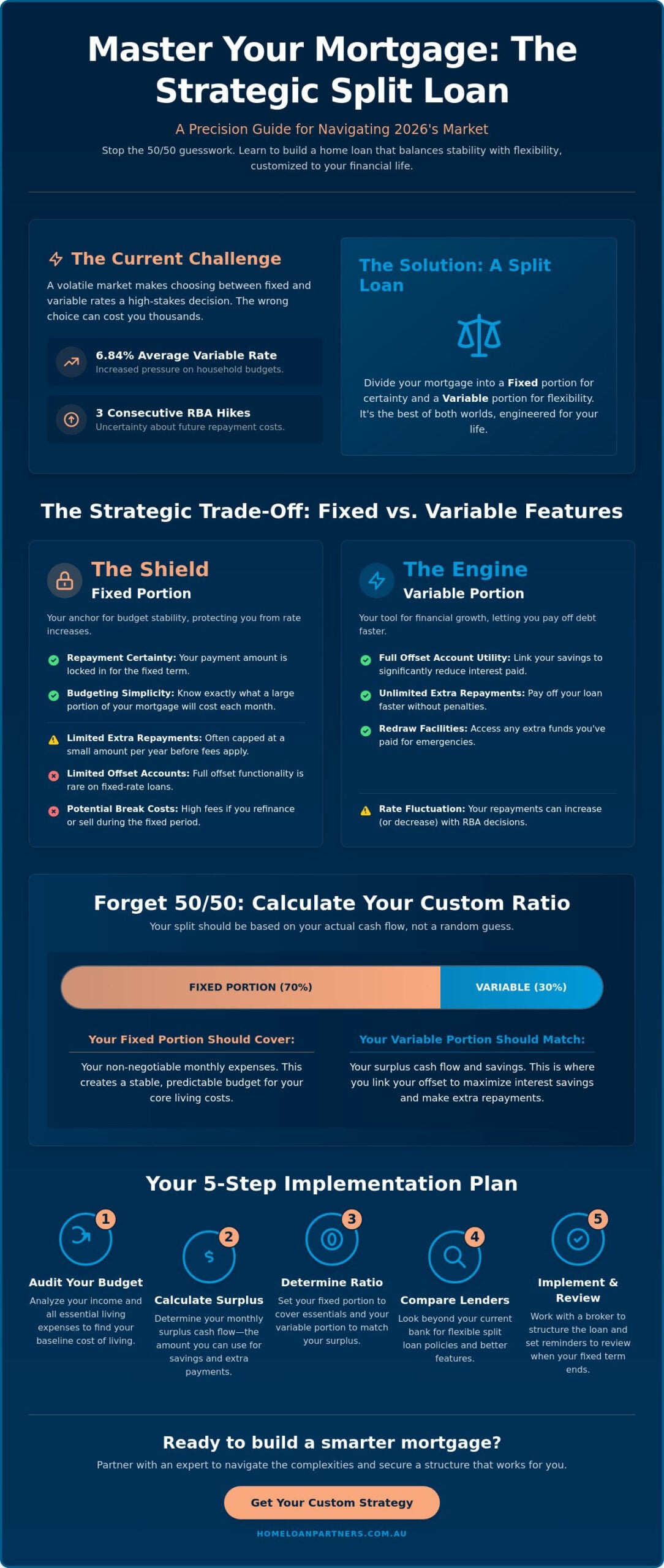
A split home loan is a strategic division of your total mortgage into two or more separate sub-accounts. Instead of committing your entire debt to a single interest rate type, you distribute it across both fixed and variable portions. This structure isn’t just about picking a random ratio. It’s about engineering a mortgage that respects your need for certainty while protecting your financial growth. In 2026, the economic environment has shifted significantly. With the average variable rate now at 6.84% and the Reserve Bank of Australia having delivered three consecutive hikes early in the year, the “all or nothing” approach to interest rates feels increasingly risky for many households.
Many borrowers are moving away from 100% fixed or 100% variable structures because they want to avoid being trapped by market volatility. A fully fixed loan offers peace of mind, but it can lock you out of using an offset account effectively. On the other hand, a fully variable loan leaves your monthly budget vulnerable to the next RBA decision. Learning how to split home loan fixed and variable components creates a protective hedge. You stabilize a portion of your budget against rising costs while maintaining enough liquidity to take advantage of Flexible Mortgage Features on the variable side. This balance is why split loans have become a foundational tool for those managing the new APRA debt-to-income regulations implemented in February 2026.
The Core Components: Fixed vs Variable
The fixed portion of your split acts as a repayment ceiling. It ensures a significant part of your monthly commitment stays exactly the same for a set period, which is vital for long-term household budgeting. Think of the variable portion as a flexibility valve. This is the account where you can typically make unlimited extra repayments or link an offset account to reduce your interest charges. These aren’t two separate loans with different lenders; they are distinct sub-accounts that sit under your primary mortgage. Understanding how to split home loan fixed and variable buckets allows you to customize your interest exposure to match your actual monthly surplus.
Who Should Consider a Split Structure?
First home buyers often find this structure provides a necessary safety net as they adjust to the costs of homeownership in a high-rate environment. For those managing Investment Property Loans, a split allows for precise forecasting of tax-deductible interest costs on the fixed side. If you are currently considering Refinancing, a split structure can help you optimize your debt against the 2026 market trends. It’s a particularly effective choice for anyone who expects their income to change or those who plan to make significant lump-sum repayments in the near future.
The Strategic Trade-offs: Comparing Features and Limitations
Every financial decision involves a trade-off between certainty and flexibility. When you decide how to split home loan fixed and variable portions, you’re essentially choosing which risks you’re willing to accept. A fixed-rate account acts as a shield against market volatility, but that protection comes with strings attached. Most lenders view fixed loans as a static contract; they expect you to stick to a rigid schedule. This is why fixed accounts often lack the dynamic features that help you reduce interest over time. If you need a hand reviewing your current structure, refinancing to a more flexible product could unlock the features your current bank might be withholding.
Understanding What Is a Split Rate Home Loan? requires looking at the “break fees” and repayment caps. While the variable side allows you to pay off as much as you like whenever you like, the fixed side is far more restrictive. Exceeding your annual repayment limit on a fixed account can trigger significant costs. Similarly, if you decide to sell your property or refinance before the fixed term ends, you may face break costs that vary based on market movements. In contrast, the variable side remains your primary tool for emergency cash through redraw facilities, providing a safety net that doesn’t penalize you for accessing your own funds.
Offset Accounts and the Variable Advantage
The most common mistake homeowners make is trying to link an offset account to a fixed-rate loan. In the 2026 market, very few lenders offer full offset utility on fixed products. To maximize your savings, you should link your offset account to the variable portion only. We recommend calculating how much variable debt you need to “cover” your total savings. If you have $50,000 in savings, your variable portion should be at least $50,000. This creates an “Interest Neutralization” strategy where you effectively pay 0% interest on that portion of your debt, while the rest of your loan remains protected by the fixed rate.
Fixed Rate Restrictions You Need to Know
Fixed portions typically come with a cap on additional repayments, often limited to $10,000 or $20,000 per year. If you receive a bonus or an inheritance, you won’t be able to funnel all of it into the fixed side without penalty. In 2026, we’re seeing a trend where fixed terms are shorter, often between one and three years, as borrowers wait to see if the RBA will pivot. When these terms end, the loan “rolls over” to the standard variable rate. Learning how to split home loan fixed and variable accounts helps you prepare for this rollover, ensuring you aren’t hit with a sudden repayment shock when your fixed protection expires.
Choosing Your Ratio: Which Split Strategy Fits Your Goals?
Many homeowners default to a 50/50 split because it feels like a fair compromise, but this “middle of the road” approach is rarely the most efficient path. Deciding how to split home loan fixed and variable portions requires a personalized calculation based on your actual spending habits rather than a generic bank template. If you fix too much of your loan, you might find yourself with idle savings that aren’t working for you. Conversely, if you leave too much to the variable market, a series of rate hikes could strain your monthly budget beyond its comfort zone. Choosing Your Loan Type is the first step toward building a structure that actually supports your life milestones.
To find your ideal ratio, we suggest a simple “Cash Flow Test.” Look at your bank statements from the last six months to determine your average monthly surplus. If you consistently save $2,000 every month, that is $24,000 a year you could be using to offset your interest. If your variable portion is only $20,000, you’ll hit your offset limit in less than a year. Your risk tolerance also plays a significant role. “Sleepers” are borrowers who gladly pay a slight premium for the certainty of fixed repayments, while “Gamblers” prefer a larger variable component to capitalize on potential market dips. You must also consider upcoming life events, such as planning for Renovation Loans or taking parental leave, which may require more liquid cash or lower guaranteed repayments.
Three Common Split Models for 2026
In the current environment, we see three primary frameworks that help clients manage their debt effectively. The Conservative Hedger (80% Fixed / 20% Variable) provides maximum protection against rising rates, making it ideal for those with tight budgets or limited savings. The Balanced Optimizer (50% Fixed / 50% Variable) offers a moderate safety net while leaving room for significant extra repayments. Finally, the Aggressive Payer (20% Fixed / 80% Variable) is designed for high-income earners or those with large cash reserves who want to prioritize aggressive debt reduction through their offset account.
The ‘Savings-Matched’ Variable Strategy
A precision-engineered split ensures your variable balance is always slightly ahead of your projected savings. If you have $60,000 in an offset account today and expect to save another $20,000 over the next two years, your variable portion should be at least $80,000. This prevents the “Over-Fixing Trap,” which occurs when your offset savings exceed your variable balance, leaving your extra cash unable to reduce the interest on your fixed-rate debt. Understanding how to split home loan fixed and variable components correctly ensures every dollar you save is actively working to shorten your loan term.
The 5-Step Process: How to Implement Your Split Loan
Moving from a traditional mortgage to a split structure requires more than just a simple request to your bank. It demands a deliberate roadmap to ensure your new arrangement survives market shifts and supports your long-term goals. Implementing this strategy correctly means you aren’t just reacting to the RBA; you’re proactively engineering a debt structure that respects your lifestyle. If you’re ready to take control, following a clear, evidence-based process is the most reliable way to achieve a balanced result.
Step 1 & 2: The Audit and Market Comparison
Your journey begins with a 12-month budget audit. We recommend looking back at a full year of spending to find your true “Surplus Cash” after all expenses, including rising utility costs and insurance. This data tells you exactly how much of your debt should remain variable to maximize your offset benefits. Once you have your numbers, you must compare lender split policies. Don’t just look at the headline rate; focus on the comparison rate, which includes annual package fees that generally range between $300 and $400 in 2026.
You should also check Refinance charges in Australia before making a move. Switching lenders to access a better split policy might involve discharge fees of $150 to $400 or settlement fees up to $1,500. We often help clients identify lenders that allow multiple splits, such as a three-way split. This advanced tactic allows you to fix portions for different durations, such as one part for two years and another for five, creating a “ladder” of protection that matures at different times.
Step 3 to 5: Execution and Management
Step 3 is determining your fixed term length. With the lowest 2-year fixed rate currently at 5.71%, many borrowers find this a comfortable middle ground compared to the average variable rate of 6.84%. Avoid locking in 100% of your loan during what might be a high-interest peak. In Step 4, we structure the variable side with an offset account. This ensures your liquid savings are always working to reduce your interest bill. Finally, in Step 5, you finalize the application. A broker manages the heavy lifting here, coordinating the paperwork for two separate sub-accounts and ensuring the “Portability” features are active. This means if you move house, you can often take your split structure with you without triggering break fees.
If you want to ensure your 2026 mortgage strategy is built on precision rather than guesswork, reach out to our team for a tailored loan review to see which split ratio fits your life.
Why Partnering with a Broker Simplifies the Split
Deciding how to split home loan fixed and variable components is a sophisticated financial maneuver that requires a deep understanding of lender-specific policies. While a single bank can only offer you their own limited products, we provide access to over 36 lenders. This breadth of choice is essential because every institution has different rules regarding offset utility and additional repayment caps. By looking across the entire market, we ensure you find a split policy that aligns with your specific cash flow needs rather than settling for a generic package that might restrict your future freedom.
Your current bank might not offer the most flexible split structure because their priority is their own bottom line. We provide an unbiased advantage by acting as your advocate. We move beyond standard banking templates to build bespoke solutions, such as the multiple-split “ladder” strategy or specific interest-neutralization models. This tailored approach is particularly valuable when managing the 2026 APRA debt-to-income regulations, as different lenders interpret these macroprudential safeguards with varying levels of flexibility. We do the heavy lifting of comparing these nuances so you don’t have to.
The Home Loan Partners Collaborative Approach
We pride ourselves on being more than just a service provider; we are your expert collaborator. Our team translates complex banking jargon into a clear 2026 financial roadmap that you can actually understand and follow. We focus on the long-term journey, meaning our relationship doesn’t end once your loan settles. If you’ve ever wondered why use a mortgage broker in Australia, it’s this commitment to ongoing support that makes the difference. We monitor your fixed term expiry dates proactively. This ensures you never roll onto a high default rate without a plan in place to refinance or restructure.
Ready to Secure Your Financial Future?
Securing a stable budget in a volatile market starts with a single, stress-free step. We offer a no-obligation strategy session where we model various split scenarios based on your current savings and income. Whether you’re a first-time buyer or looking to optimize Investment Property Loans, we handle the application process from start to finish. Our goal is to alleviate the stress of complex paperwork while securing the most competitive features available. Book a consultation with The Home Loan Partners today to start your journey toward a more flexible and secure mortgage structure.
Secure Your Financial Stability in 2026
Mastering your mortgage structure is about finding the right balance between the security of a fixed rate and the flexibility of an offset account. We’ve explored how a strategic split allows you to hedge against rising interest rates while still using your surplus cash to reduce your overall debt. By moving away from a default 50/50 approach and using a data-driven cash flow test, you can build a loan that truly reflects your lifestyle and long-term aspirations.
Understanding how to split home loan fixed and variable components is the first step toward a more predictable financial future. With access to over 36 Australian lenders, we provide the expert, unbiased advice you need to navigate 2026’s unique challenges. Our team offers ongoing support throughout your home loan journey; we ensure you stay on the most competitive path as the market evolves.
Take the stress out of your mortgage; let us find your perfect split ratio today. You don’t have to manage these complex decisions alone. We’re here to guide you toward your major life milestones with precision and care.
Frequently Asked Questions
Can I change my split ratio after the loan has started?
Yes, you can change your ratio, but it’s much easier to do so once your fixed term expires. If you want to change it earlier, you’ll likely face break fees on the fixed portion of your debt. Many borrowers wait for their one or two year term to end before rebalancing. This allows you to adjust to your current income and the latest market rates without incurring unnecessary penalties.
Do I pay two sets of monthly fees for a split loan?
No, you typically won’t pay two sets of monthly account fees. Most lenders include split loans under a single annual package fee, which in 2026 generally ranges between $300 and $400. This fee covers all your sub-accounts, credit cards, and offset accounts. It’s a streamlined way to manage your debt without the stress of multiple overlapping charges across different accounts.
Is it better to fix more or less of the loan when rates are rising?
Fixing a larger portion provides a safety net against rising repayments, but you must leave enough in the variable bucket to match your savings. If you fix too much, you lose the ability to use your offset account effectively. The goal is to protect your budget while ensuring your surplus cash still works to reduce your interest. We help you find that precise balance based on your actual spending.
Can I have an offset account on both the fixed and variable parts?
Most lenders only allow a 100% offset account to be linked to the variable portion of your loan. While a few specialized products offer offset features on fixed rates, they often come with higher interest rates or limited functionality. For most households, linking your savings to the variable side is the most efficient way to manage how to split home loan fixed and variable accounts.
What happens when the fixed term of my split loan ends?
When your fixed term expires, that portion of the loan usually rolls over to the standard variable rate automatically. This is a critical time to review your strategy, as the default rate is often higher than what’s available elsewhere in the market. We proactively monitor these dates for our clients to ensure you can refinance or refix before your monthly repayments jump unexpectedly.
Are split home loans more expensive than standard loans?
Split loans are not inherently more expensive than standard loans, as the interest rates for each portion are usually the same as their standalone counterparts. The primary cost is the annual package fee mentioned earlier. In fact, by using the variable side’s offset account, many homeowners find they pay less total interest over the life of the loan compared to a fully fixed structure.
How much can I save by splitting my home loan?
Your savings depend on how effectively you use the variable portion’s offset account. If you have significant savings, you could save thousands in interest by neutralizing the variable debt. Additionally, fixing a portion at a rate lower than the current variable average of 6.84% provides immediate monthly relief. It’s about combining market timing with smart cash management to protect your household wealth.
Can I split an investment property loan as well as a home loan?
Yes, you can definitely split Investment Property Loans just as you would an owner-occupier mortgage. Many investors choose to fix a larger portion to make their tax-deductible interest costs more predictable for their annual tax planning. Learning how to split home loan fixed and variable components for an investment property can help you manage your portfolio’s cash flow while maintaining liquidity for future maintenance or renovations.