

Did you know that 72% of Australian refinancers were offered a better deal by their existing lender the moment they mentioned switching? It’s a powerful reminder that while the big banks want your loyalty, they often wait until you’re halfway out the door to reward it. It’s completely natural to feel stuck with a high-rate lender because of confusing exit fees or the worry that a valuation might be a waste of money. When you’re trying to figure out how much does it cost to refinance a mortgage australia, the jargon and hidden costs can make a smart financial move feel like a risky gamble.
We’re here to clear the fog by providing a transparent, dollar-for-dollar breakdown of every fee you’ll encounter in 2026, from state-specific registration costs to discharge fees. You deserve a steady hand to guide you through these numbers and ensure your transition to a more competitive loan structure is stress-free. We’ll show you how to calculate your break-even point and identify opportunities for fee-waivers or cashback offers that put money back in your pocket.
Key Takeaways
- Break down the total financial impact by identifying exactly how much does it cost to refinance a mortgage australia, including lender discharge fees and state-specific government charges.
- Identify the “Loyalty Tax” your current bank may be charging and compare the costs of staying put versus the savings of switching to a more competitive external lender.
- Navigate significant hidden expenses like Lenders Mortgage Insurance (LMI) and fixed-rate break costs to ensure these upfront outlays don’t outweigh your long-term benefits.
- Master the break-even calculation to pinpoint the exact month your new loan structure pays for itself, providing a clear path to genuine financial security.
- Discover how a negotiation-first approach and access to over 36 lenders can help you secure fee-waivers or cashback incentives that minimize your initial investment.
The 2026 Refinance Landscape: What Are the Standard Charges?
The 2026 mortgage market requires a clear-eyed look at your balance sheet. With the Reserve Bank of Australia maintaining a cash rate of 4.35% as of May 2026, lenders are increasingly transparent about their fee structures to remain competitive. Before diving into the specifics, it’s helpful to understand what is refinancing? at its core. It’s the process of replacing your current debt with a new loan under different terms, ideally to secure a better rate or more flexible features.
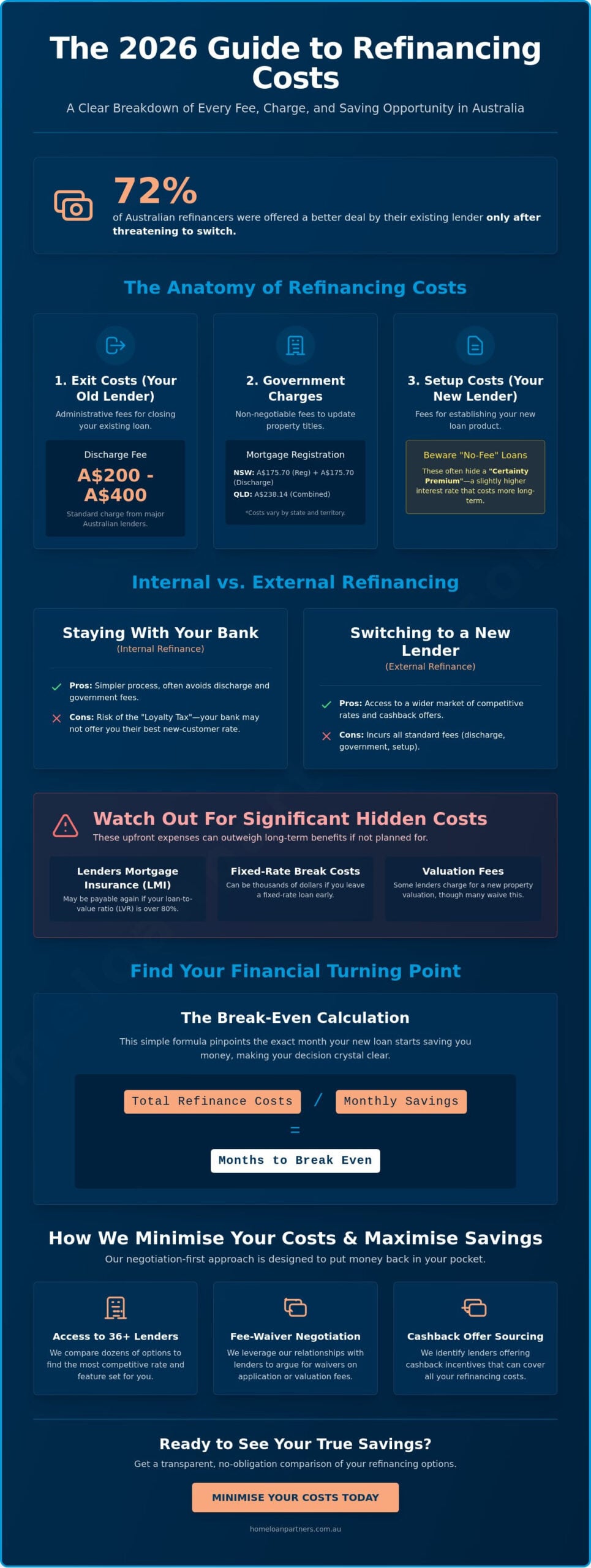
When calculating how much does it cost to refinance a mortgage australia, we categorize expenses into three distinct areas: exit costs from your old lender, setup fees for your new one, and statutory government charges. You’ll also need to decide between paying these costs “upfront” or “capitalising” them into your loan. While capitalising fees feels easier on your immediate budget, it increases your total debt and interest costs over the life of the loan. We often help clients weigh this choice carefully to ensure the long-term savings remain intact.
Be wary of “no-fee” loan offers that seem too good to be true. These often carry a “Certainty Premium,” where the lender waives upfront costs but charges a slightly higher interest rate. In the current 2026 environment, where the average mortgage rate sits around 5.92%, a loan with a A$0 setup fee but a 0.15% higher interest rate could cost you thousands more over the next few years. We prioritize finding the balance between low entry costs and a rate that supports your future security.
Closing Your Current Loan: Discharge Fees
Your current bank will likely charge a discharge fee when you move your mortgage elsewhere. This fee typically ranges between A$200 and A$400 for major Australian lenders. A discharge fee is the administrative cost of closing your loan file and preparing the necessary paperwork to release the mortgage. Banks charge this to cover the manual processing required to end the legal contract between you and the institution.
Government and Statutory Charges
Government and statutory charges are the only truly non-negotiable costs in the process. Every state and territory has its own pricing for mortgage registration and deregistration. For instance, in New South Wales, you’ll pay A$175.70 to register and A$175.70 to discharge. In Queensland, these combined fees sit at A$238.14. These charges ensure your new lender is legally recorded on the property title. Because these costs are set by state governments, they remain the same regardless of which lender you choose for your refinancing journey.
Internal vs. External Refinancing: Comparing the Price Tags
Choosing between staying with your current lender or moving to a new one is a pivotal decision for your financial future. When evaluating how much does it cost to refinance a mortgage australia, you’ll find that ‘internal refinancing’ (or repricing) is often the path of least resistance. It’s administratively simpler because you don’t need to worry about discharging your mortgage or re-registering titles with state authorities. However, many Australians fall victim to the ‘Loyalty Tax.’ This is where banks offer enticingly low rates to attract new customers while keeping existing clients on higher, less competitive interest rates. Research indicates that 72% of refinancers were offered a better deal by their current bank only after they signaled their intent to leave.
We often recommend a ‘Split Loan’ structure for clients who want to manage both cost and risk. This allows you to keep a portion of your balance on a fixed rate for repayment certainty while leaving the remainder variable to access features like an offset account. This strategy can help you navigate the 2026 market’s interest rate uncertainty without committing entirely to one path. If you’re unsure which direction offers the most value, our team can help you compare refinancing options tailored to your specific goals.
The Cost of Staying (Internal Refinance)
A simple rate review or product switch is frequently the most cost-effective move. Since you aren’t leaving the institution, you typically avoid the A$200 to A$400 discharge fee and government registration costs. Instead, you might encounter a ‘Switching Fee.’ This is a one-off charge banks apply to move you from one loan product to another, such as shifting from a basic variable loan to one with an offset account. If your goal is purely a lower rate without changing your loan’s features, a successful negotiation can sometimes reduce your costs to zero.
The Cost of Moving (External Refinance)
Moving to a new lender is a more involved process. While it carries higher upfront costs, the long-term savings often justify the investment. You should prepare for an ‘Application or Establishment Fee,’ which can reach up to A$750 in the 2026 market. Additionally, switching your home loan usually requires a fresh property valuation. Lenders charge between A$300 and A$600 to assess your home’s current market value, though some competitive lenders may waive this to win your business. For a deeper look at the process, check out our Home Loan Refinancing: A Complete 2026 Guide.
The Hidden Risks: LMI, Valuation Fees, and Break Costs
The 2026 market contains nuances that standard calculators often miss. While we’ve discussed visible application and government fees, the true answer to how much does it cost to refinance a mortgage australia often lies beneath the surface. Unexpected variables like property valuations and rate lock fees can quickly change the financial outlook of your switch. A property valuation, which generally costs between A$300 and A$600, is a mandatory step for most external refinances. If the valuation comes in lower than your own estimate, your borrowing power shrinks. This might force you to stay with your current lender or pay a higher interest rate than you initially planned.
Rate lock fees are another consideration in an environment where economists are divided on future RBA movements. Paying a fee to lock in your interest rate during the application phase provides a vital safety net. It ensures that the competitive rate you see today is the one you actually receive at settlement, regardless of market fluctuations in the meantime. We see this as a form of insurance for your peace of mind while we manage the heavy lifting of your application.
The LMI Trap: Why Equity Matters
Lenders Mortgage Insurance (LMI) is perhaps the most significant hidden expense you might face. It’s a one-off insurance premium that protects the lender, not you, if you default on your loan. Crucially, LMI is not transferable. If you paid it when you first bought your home and your equity is still below 20%, you’ll likely need to pay it again when switching to a new lender. When calculating how much does it cost to refinance a mortgage australia, overlooking LMI can be a costly mistake that adds tens of thousands of dollars to your debt. We often help clients explore strategies to avoid this, such as utilizing a guarantor or waiting until their property value increases enough to reach that 20% equity threshold.
Calculating 2026 Break Costs
For those currently on a fixed-rate contract, break costs are a major hurdle. These aren’t static administrative fees. Instead, they’re calculated based on wholesale market interest rates at the time you decide to exit. Break costs are highest when market rates fall after you have fixed. If you locked in a rate during a peak and market rates have since declined, your bank will charge you for the loss of interest they expected to earn. Always request an official quote for break costs from your current lender before making a move, as these figures can change daily.
The 2026 Decision Framework: Calculating Your Break-Even Point
Securing a lower interest rate is only half the battle. To truly understand how much does it cost to refinance a mortgage australia, you must identify your “Break-Even Point.” This is the specific month where your total interest savings finally overtake the upfront costs of switching. In a 2026 market where the average mortgage rate sits at 5.92%, even a small reduction can lead to significant long-term gains; however, the math only works if you plan to stay in the loan long enough to recoup your initial investment.
Before committing, we encourage you to assess your “Budget Buffer.” With the RBA cash rate at 4.35%, you need to know if your household can handle a potential 0.25% or 0.50% rate rise in the latter half of the year. Your “Life Timeline” also plays a critical role. If you intend to sell your property or start major renovations within the next 18 months, the upfront fees of an external refinance might outweigh the short-term interest savings. You can run these scenarios yourself using our mortgage repayment calculator to see how different rates impact your monthly cash flow.
Step 1: Total Your Refinance Charges
Start by summing every fee we’ve discussed. This includes the A$200 to A$400 discharge fee from your current lender, the new application fee (which can reach A$750), and the A$300 to A$600 valuation cost. Many 2026 lenders are offering cashback incentives to attract new business; you should subtract these from your total to find your true “net cost.” Be aware that your Debt-to-Income (DTI) ratio will influence your eligibility for the most competitive, low-fee products. We act as your collaborator to ensure your application is positioned to qualify for these premium offers.
Step 2: Calculate Monthly Interest Savings
Next, determine how much interest you’ll save each month on the new rate. This isn’t just about the headline figure. You must factor in the impact of your offset account, which can drastically reduce the interest charged on your principal balance. Understanding the difference between Redraw vs Offset Account: Which Is Better For You? is essential here, as the right structure can accelerate your break-even point by months or even years. Once you have your monthly savings figure, divide your total net costs by this amount to find your break-even month.
Ready to see your personalized numbers? Talk to our experts today to find the most cost-effective path for your home loan journey.
How The Home Loan Partners Minimise Your Refinancing Costs
We understand that seeing the total figure for how much does it cost to refinance a mortgage australia can feel overwhelming. Our role is to act as your expert collaborator, transforming a complex financial transition into a structured path toward long-term savings. We don’t just find you a new rate; we actively work to reduce or eliminate the entry costs we’ve detailed throughout this guide. By managing the heavy lifting, we ensure your transition is as smooth and stress-free as possible.
Before we even look at moving your loan to a new institution, we employ a “Negotiation First” strategy. We leverage our professional relationships to ask your current bank to waive fees and lower your rate before you move. Since nearly three-quarters (72%) of refinancers are offered a better deal by their existing lender once they signal an intent to leave, this simple step can often save you from paying discharge and registration fees entirely. If your current bank won’t meet the market, we then identify cashback incentives from our panel of over 36 lenders. These offers can completely offset your refinancing costs, sometimes even leaving you with a surplus to put toward your mortgage balance.
Beyond the Big Four Banks
Smaller lenders often lack the massive marketing budgets of the major banks. To compete, they frequently offer more aggressive fee waivers and specialized features to win your business. For those managing investment property loans, these institutions can provide tailored structures that reduce long-term costs while maximizing your flexibility. Understanding Why Use a Mortgage Broker in Australia? becomes clear when you realize we have the keys to these specialized markets that you won’t find on a standard comparison site. We help you look past the headline rates to find the true value in the fine print.
Your Stress-Free Path to Savings
Our team provides the calm, steady expertise you need in a volatile 2026 market. We offer an unbiased, precision-oriented review of your specific financial situation, ensuring that every move you make is backed by data rather than marketing hype. Our involvement doesn’t end at the completion of your transaction; we continue to monitor the market to ensure your loan remains competitive throughout your homeownership journey. We’re here to help you achieve your major life milestones with confidence and clarity.
For those whose future plans include international moves or property research abroad, resources such as the Morgan Financial guide to the best places to live in Brevard County can provide valuable context for a global financial strategy.
Ready to unlock a more competitive future for your home loan? Book a free strategy session with our expert brokers today and let us handle the hard work of securing your savings.
Take the Next Step Toward Your Mortgage Goals
Refinancing is more than just a transaction; it’s a strategic move to protect your household budget from the uncertainties of the 2026 market. By understanding the breakdown of discharge fees, government charges, and potential setup costs, you’ve already moved past the confusion that keeps many homeowners stuck. Determining exactly how much does it cost to refinance a mortgage australia is the first step toward long-term savings. Remember that calculating your break-even point and accounting for hidden risks are essential to ensuring your new loan structure delivers genuine value.
You don’t have to navigate these complex financial calculations alone. We provide personalized guidance for homeowners and investors across Australia, offering expert, unbiased advice that prioritizes your future security. With access to a panel of over 36 lenders, we can identify the most competitive fee-waiver or cashback opportunities tailored to your specific needs. Our team is ready to act as your steady hand, managing the heavy lifting so you can focus on achieving your major life milestones.
Let’s find the right refinance strategy for your future; contact us today
Your path to a more competitive home loan is closer than you think, and we’re here to guide you every step of the way.
Frequently Asked Questions
Is it worth refinancing my home loan for a 0.5% lower rate?
Yes, a 0.5% reduction can lead to substantial savings, provided you stay in the loan long enough to recover your setup costs. On a A$500,000 mortgage, this rate drop could save you approximately A$2,500 in interest every year. If your total switching costs are A$1,500, you’ll reach your break-even point in just over seven months. We’ll help you run these numbers to ensure the move supports your long-term security.
Can I add the cost of refinancing to my new home loan amount?
You can often “capitalise” these fees by adding them to your total loan balance. This means you don’t have to pay for application or valuation fees out of your own pocket on day one. While this helps your immediate cash flow, it’s important to remember that you’ll pay interest on these fees over the life of the loan. We’ll show you how this impact compares to paying the costs upfront.
How much are the typical discharge fees in Australia for 2026?
Typical discharge fees in the 2026 market range between A$200 and A$400 per loan account. Your current lender charges this to cover the administrative work of closing your file and releasing the mortgage title. When you’re calculating how much does it cost to refinance a mortgage australia, this is one of the most common costs you’ll encounter. Some lenders may waive this fee if you’re performing an internal refinance.
What is a refinance cashback offer and how does it work?
A cashback offer is a financial incentive paid by a new lender to win your business, often ranging from A$2,000 to A$4,000. These funds are usually deposited into your linked transaction account shortly after your new loan settles. This payment can effectively wipe out the total figure of how much does it cost to refinance a mortgage australia, making the transition virtually cost-free for many households.
Will I have to pay stamp duty again when I refinance my mortgage?
No, you don’t pay stamp duty again because the ownership of the property isn’t changing. You’re simply replacing one debt contract with another. You’ll only be responsible for state government mortgage registration and deregistration fees. These statutory charges, which vary by state, ensure the new lender’s legal interest is correctly recorded on your property title without the heavy cost of transfer duty.
How long does the refinancing process usually take from start to finish?
The process typically takes between four and six weeks from your initial application to the final settlement. This timeline allows for the property valuation, credit assessment, and the mandatory notice period required by your current bank to process the discharge. We manage the heavy lifting throughout this period to ensure the transition remains steady and predictable, keeping you informed at every milestone.
Can I avoid paying for a new property valuation when I switch lenders?
Yes, it’s often possible to avoid this cost as many lenders offer free valuations to attract new clients. While a standard valuation fee can range from A$300 to A$600, we frequently identify competitive loan products that waive this expense entirely. This is a great way to reduce your upfront outlays while still getting an expert assessment of your property’s current market value.
What happens to my offset account balance when I refinance?
Your offset account balance remains your money, but it doesn’t automatically transfer to your new lender. You’ll need to move these funds manually once your new offset account is active after settlement. It’s vital to coordinate this move quickly so you don’t lose out on interest savings. We’ll guide you through the timing to ensure your hard-earned savings continue to work for you without interruption.