

With APRA’s February 2026 debt-to-income limits restricting borrowing to six times your gross annual income, many Australians are finding that a solo application no longer reaches the front door of their dream home. It’s a common frustration to feel like you’re falling behind despite your best efforts to save. You might be worried about how a partner’s credit history could affect a joint home loan application australia, or perhaps the legal complexities of shared liability feel overwhelming.
We believe that property ownership should be a source of security, not stress. This guide provides everything you need to know about applying with a partner, friend, or family member to reach your goals sooner. We’ll walk you through how to maximise your borrowing power under current 2026 regulations, explain the different ownership structures available, and provide a clear roadmap to help you sign your contract with total confidence.
Key Takeaways
- Learn how applying with a partner, friend, or sibling can help you bypass solo savings hurdles and achieve your property goals sooner.
- Discover how a joint home loan application australia allows you to combine incomes and deposits to significantly increase your total borrowing capacity under 2026 regulations.
- Understand the crucial concept of joint and several liability to ensure you and your co-borrower are fully prepared for the legal responsibilities of shared debt.
- Gain clarity on how lenders assess combined credit scores and how to manage the application process if one partner has a weaker financial history.
- See how expert guidance helps you compare over 36 lenders to find a loan structure that prioritises your long-term flexibility and financial security.
What is a Joint Home Loan Application in Australia?
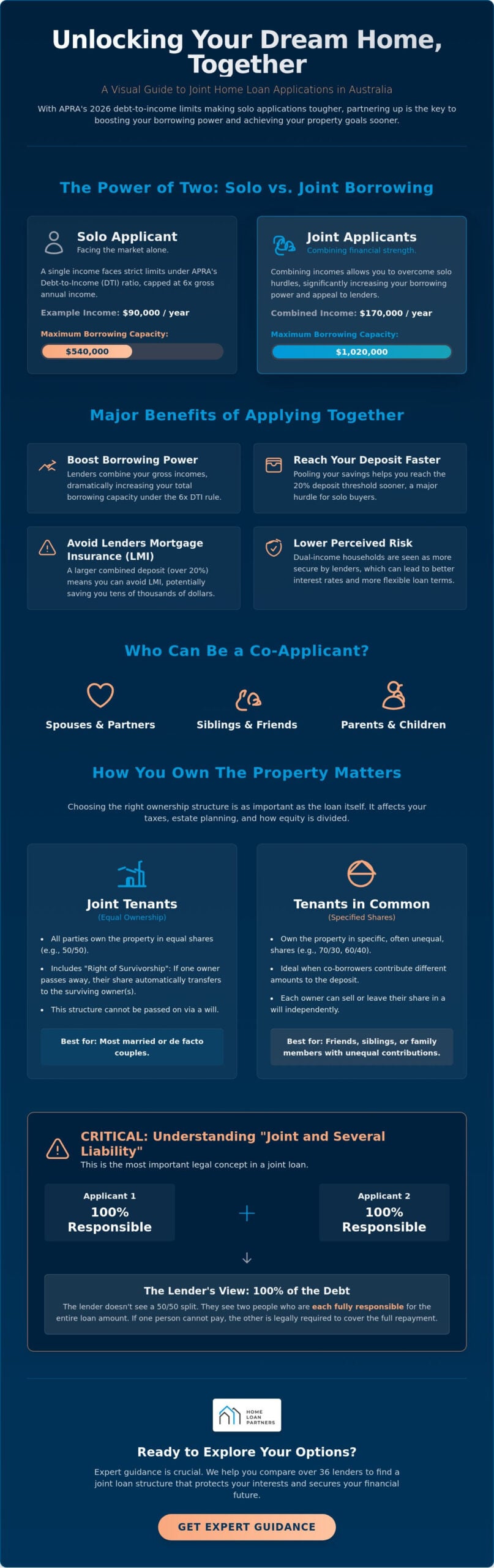
A joint home loan application australia is a collaborative financial arrangement where two or more people apply for a single mortgage loan together. It’s a legal merger of your financial profiles. By combining your incomes, debts, and savings, you present a unified front to a lender. In the current 2026 lending environment, this is often the most effective way to overcome the strict debt-to-income limits set by APRA. It transforms a solo struggle into a shared mission, allowing you to pool resources to reach a 20% deposit faster or access a higher loan amount than you could ever achieve alone.
It’s vital to understand that this isn’t just about “splitting the bill.” When you sign a joint mortgage, you enter into what’s known as joint and several liability. This means the lender doesn’t see two people paying 50% each. They see two people who are each 100% responsible for the entire debt. If one person can’t meet their obligations, the other must cover the full repayment. This shared responsibility is why choosing the right partner and the right loan structure is the most important decision you’ll make in your property journey.
Who Can Be a Co-Applicant?
While spouses and de facto partners remain the most common joint applicants, the definition of a co-borrower has expanded significantly. We frequently help siblings who are tired of the rental trap and want to build equity together. We also see parents and children partnering to secure a first home, or close friends entering into co-ownership agreements to get a foot on the property ladder. As long as every applicant meets the lender’s eligibility criteria and can demonstrate a clear, long-term commitment to the debt, the partnership is a viable path forward.
This collaborative approach to high-value assets is also gaining traction in the luxury lifestyle sector. For example, Neptune Oceanic allows individuals to experience premium boating through shared vessel management, mirroring the benefits of pooling resources to reduce individual costs and complexity.
Joint Tenants vs. Tenants in Common
How you hold the title to your property is just as important as how you borrow the money. Your ownership structure has major implications for your 2026 tax position and your future estate planning. There are two primary ways to structure your ownership:
- Joint Tenants: All parties own the property equally. If one person passes away, their share automatically transfers to the surviving owner. This is the standard choice for most couples.
- Tenants in Common: This allows you to own the property in specific, often unequal, shares. For example, one person might own 70% while the other owns 30%. This is a popular choice for friends or family members who are contributing different amounts to the deposit.
The structure you choose today will dictate how your equity is treated in the years to come. We always recommend discussing these options with us early so we can align your loan structure with your specific ownership goals.
Boosting Your Borrowing Power: The Benefits of Applying Together
In a market where the average variable home loan rate sits at 6.95%, strength in numbers is a genuine game-changer for many Australians. When you submit a joint home loan application australia, you aren’t just doubling your paperwork; you’re significantly expanding your financial potential. Lenders often view dual-income households as inherently lower risk because the mortgage isn’t dependent on a single person’s employment stability. This perceived security, combined with a stronger deposit, can help you access competitive variable rates as low as 5.69%, which is significantly better than the June 2026 market average.
By pooling your savings with a partner or family member, you can reach the 20% deposit threshold much faster. This isn’t just about speed; it’s about substantial cost savings. Avoiding Lenders Mortgage Insurance (LMI) can save you tens of thousands of dollars upfront. Furthermore, a lower Loan-to-Value Ratio (LVR) signals to the bank that you are a “safe” borrower, which often leads to more flexible loan features and better long-term terms.
Income Aggregation and Serviceability
Lenders calculate your total borrowing capacity by adding your gross annual incomes together. However, they don’t just look at what you earn today. Under 2026 regulations, banks apply a strict serviceability buffer, testing your ability to repay the loan if interest rates were to rise even further. If you’re approaching the APRA-mandated debt-to-income limit of six times your earnings, having a second income is often the only way to secure the loan amount you need. Serviceability is a lender’s formal assessment of whether your combined net income can comfortably cover your loan repayments alongside all other financial commitments.
Shared Expenses and Household Costs
A common concern is that lenders will simply double the expected living expenses for two people. Fortunately, the math is usually more favourable. Lenders use the Household Expenditure Measure (HEM), which acknowledges that two people living together share many core costs like utilities, insurance, and groceries. While having shared dependents will reduce your borrowing power, the “per person” cost is typically lower for a couple than for two single individuals. To get the best result, it’s wise to audit your combined discretionary spending three months before applying. If you’re ready to see how your partnership changes the numbers, we can help you calculate your combined borrowing potential based on your unique financial profile.
The Legal Reality: Understanding Joint and Several Liability
Entering into a joint home loan application australia is a significant financial merger that carries heavy legal weight. While combining resources is a smart strategy to secure property, you must understand the principle of joint and several liability. In simple terms, this means the lender doesn’t just hold you responsible for your portion of the loan. They hold every individual applicant responsible for the entire debt. If your co-borrower faces a financial crisis and stops making repayments, the bank expects you to cover the full amount immediately. There’s no legal provision that limits your liability to just your “half” of the mortgage.
This shared responsibility also affects your personal financial future. If you decide to apply for a car loan or a credit card in your own name later, lenders will view the entire mortgage as your personal liability. They won’t divide the debt by two when calculating your serviceability. This is why absolute transparency about existing debts, spending habits, and future goals is the non-negotiable foundation of any successful partnership. You aren’t just sharing a house; you’re sharing a financial reputation. Clear communication today prevents painful surprises in the years ahead.
What Happens if the Relationship Ends?
Life is unpredictable, and sometimes partnerships change. If a relationship ends, the mortgage doesn’t automatically dissolve. To remove a name from the title and the debt, the remaining partner must usually go through a process of refinancing to prove they can handle the loan solo. If that isn’t possible, the property may need to be sold to clear the shared debt. We strongly encourage our clients to establish a Co-ownership Agreement or a Binding Financial Agreement early on. These documents act as a roadmap, clearly outlining how the asset will be divided or managed if circumstances change, protecting everyone’s interests from the start.
Protecting Each Other with Insurance
Protecting your investment means planning for the “what ifs.” We often discuss how Life and Total & Permanent Disability (TPD) insurance can act as a crucial safety net for joint owners. If the unthinkable happens to one partner, an insurance payout can clear the mortgage, ensuring the surviving partner isn’t left with a debt they can’t manage alone. Income protection is equally vital. If one person can’t work due to illness or injury, having a policy that covers their share of the repayments keeps the mortgage current and protects your shared credit history. It’s about creating a protective circle around your home and your future.
The Application Process: Documentation and Credit Checks for Two
Preparing a joint home loan application australia requires a level of coordination that goes beyond just signing on the dotted line. You’re presenting a unified financial profile to a lender, and they’ll examine every corner of both your lives. Both applicants must undergo a rigorous credit history assessment; lenders don’t simply average your scores to find a middle ground. Instead, they often focus on the “weakest link” in the partnership. If one applicant has a history of defaults or late payments, it can overshadow the pristine record of the other borrower.
Total transparency is your best tool during this stage. You’re required to list all individual debts, including personal loans, car finance, and credit card limits. Many applicants accidentally omit their HECS/HELP debts, but these are vital because they reduce your take-home pay and impact your serviceability. Even a credit card you rarely use can lower your borrowing capacity because lenders look at the total available limit rather than just your current balance. Being upfront allows us to manage these hurdles before they become roadblocks.
Developing a broader understanding of how various credit products are structured can assist in managing your overall financial profile; for instance, you can learn more about Pixie Loans and their guide to transparent borrowing in the UK.
Managing Disparate Credit Scores
When one partner has a lower credit score, lenders typically weigh the lower score more heavily as it represents the highest risk factor for the debt. This doesn’t mean your application will be rejected, but it does mean we need a clear strategy. We often suggest taking six months to “polish” a credit profile by ensuring every bill is paid on time and reducing high-interest debt. These small, disciplined steps can significantly improve your standing with a lender and help you secure a more competitive interest rate.
Required Documentation Checklist
Gathering your paperwork early is the best way to keep the process moving smoothly. For a joint application in 2026, you’ll need to provide:
- Identity Verification: Current passports or drivers licences for both applicants.
- Income Evidence: Three months of consecutive payslips and the most recent Group Certificates for both parties.
- Comprehensive Financial Snapshot: A full list of assets and liabilities, including individual bank accounts, shares, and any existing loans.
If you’re worried about how your combined credit history might look to a bank, speak with us for a confidential assessment of your application’s strength before you apply.
Navigating Joint Applications with The Home Loan Partners
Applying together is a powerful strategy, but it requires precision. We manage the heavy lifting of your joint home loan application australia by coordinating with a panel of over 36 lenders. This access allows us to find the specific institution whose lending criteria best match your combined profile. We don’t just submit forms; we negotiate on your behalf to ensure the loan structure supports your long-term flexibility and financial security. This is particularly important as we navigate the 2026 APRA debt-to-income limits together, ensuring your application is positioned for success from the very first submission.
Our team treats your application as a partnership rather than a transaction. We understand that buying a home with someone else is a major life milestone; we act as your steady guide through every negotiation. By distilling complex lender requirements into clear, manageable steps, we help you maintain your confidence from the initial assessment through to settlement. We’re here to ensure the process remains transparent and supportive for everyone involved.
Why a Broker is Essential for Joint Applicants
Start Your Shared Journey Today
Choosing to buy property together is a bold step toward your future. Our calm, professional approach is designed to reduce the inherent stress of the process, allowing you to focus on the excitement of your new home. We are committed to being your long-term collaborator, supporting you well beyond the initial transaction as you reach new financial milestones. Whether you’re looking at your first home or an investment property, we provide the steady hand you need to navigate the market with ease.
Ready to unlock your combined potential? Book a consultation with The Home Loan Partners to explore your joint borrowing power and take the first step toward your property goals. We’ll handle the complexities so you can focus on building your future together.
Secure Your Property Future Together
Navigating the path to homeownership is more achievable when you don’t have to walk it alone. By pooling your resources, you can overcome the strict lending hurdles of 2026 and turn your shared property goals into a reality. We’ve explored how combining incomes and deposits can unlock significant borrowing potential, provided you approach the legal and financial responsibilities of a joint home loan application australia with total transparency and care.
At The Home Loan Partners, we’re here to simplify the complex. With access to over 36 Australian lenders and a team of expert brokers who specialise in complex joint scenarios, we provide the unbiased guidance you need to choose the right path. We’ll manage the heavy lifting and the fine print so you can focus on the journey ahead. Check your joint borrowing power with The Home Loan Partners today to see what’s possible. You’re not just securing a mortgage; you’re building a foundation for your future life milestones. We’re ready to help you take that first step with confidence.
Frequently Asked Questions
Can I apply for a home loan with a friend in Australia?
Yes, you can certainly apply for a home loan with a friend. This strategy is becoming increasingly popular for those who want to enter the property market sooner by pooling their deposits and incomes. While it’s a great way to boost your borrowing power, we always recommend having a legal co-ownership agreement in place to outline how the property and debt will be managed if one person wants to sell in the future.
Does a joint home loan application affect my credit score?
A joint home loan application australia creates a formal financial link between you and your co-borrower on your credit reports. This means that the conduct of the loan will reflect on both of your scores. If the mortgage is managed perfectly, it can help build a strong credit history; however, any missed payments or defaults will negatively impact both individuals regardless of who was “supposed” to pay that month.
What happens if my partner has a bad credit history?
If your partner has a poor credit history, lenders will typically focus on the lower score when assessing the risk of the application. This can lead to a lower borrowing limit or a higher interest rate. In some cases, it might be better to postpone the application for six months to improve their score or look for a lender that specialises in “non-conforming” loans that offer more flexibility for minor credit issues.
Can we get a joint home loan if one person is not working?
You can still submit a joint application if one person is currently unemployed or not working. The lender will simply use the single active income to calculate your combined serviceability. However, the non-working partner remains legally liable for the full debt. This structure is often used when one partner has a significant deposit or other assets that strengthen the overall application even without a current salary.
How is borrowing power calculated for two people?
Lenders calculate combined borrowing power by adding both gross annual incomes together and then subtracting your total shared and individual liabilities. They also apply the Household Expenditure Measure (HEM) to estimate your living costs. Under the 2026 regulations, banks also apply a serviceability buffer to ensure you can still manage repayments if interest rates rise beyond the current market average.
Can we have different ownership percentages on a joint mortgage?
Yes, you can hold different ownership shares by choosing a “Tenants in Common” structure. This allows you to specify exactly what percentage each person owns, such as a 70/30 or 60/40 split. This is a common choice for friends or family members who are contributing different amounts toward the initial deposit or the ongoing mortgage repayments.
What is the First Home Guarantee for joint applicants in 2026?
The First Home Guarantee in 2026 allows eligible joint applicants to purchase a home with a deposit as low as 5% without paying Lenders Mortgage Insurance (LMI). This government-backed scheme is now available to friends and family members who are buying together, not just married or de facto couples. It’s a powerful tool for those who have the income to service a loan but are struggling to save a full 20% deposit.
Is it better to have a single or joint mortgage for tax purposes?
The choice between a single or joint mortgage for tax purposes depends on whether the property is an investment or your primary home. For investment properties, tax benefits like negative gearing are split according to the ownership percentages on the title. If one partner is in a significantly higher tax bracket, you should seek professional advice to determine if a specific ownership structure could offer better long-term tax outcomes for your joint home loan application australia.