

Most homeowners treat an offset account like a standard savings feature, but it’s actually a surgical debt-reduction tool that only pays off if you hit a specific mathematical tipping point. When you’re looking at your monthly bank statements, it’s natural to feel a sense of unease about how much interest you’re paying. With the RBA cash rate at 4.35% as of June 2026, the question of are offset accounts worth it has never been more relevant for your household budget.
We understand that the choice between offset accounts and redraw facilities can feel overwhelming, especially when you’re trying to protect your family’s future. You want to ensure every dollar works as hard as possible without being swallowed by bank fees or unnecessary interest. We’ve designed this guide to clear away that confusion and replace it with steady, expert clarity. Our goal is to act as your reliable guide through these complex financial decisions.
You’ll discover the exact break-even math that determines if the higher interest rates and annual fees are justified by your savings balance. We will also explore the unique tax advantages available in Australia and provide a clear path to deciding which loan structure aligns with your long-term journey toward financial freedom.
Key Takeaways
- Learn how an offset account acts as a surgical tool to reduce daily interest charges by linking your transaction funds directly to your loan balance.
- Apply our simple break-even formula to calculate your minimum average balance and determine if are offset accounts worth it after accounting for annual fees.
- Understand the vital lifestyle and tax differences between offset accounts and redraw facilities to ensure your loan structure remains flexible as your life evolves.
- Discover the ATO “purpose of the loan” rule and why keeping your savings in an offset account is a critical strategy for future property investors.
- Follow a practical action plan to audit your bank statements and confidently choose a lender tier that accelerates your journey toward financial freedom.
What is an offset account and how does it work in 2026?
An offset account is essentially a standard transaction account that is linked directly to your home loan. Think of it as a bridge between your daily spending and your long-term debt. Instead of earning interest on your savings, the bank subtracts your account balance from your loan balance before calculating how much interest you owe. You can find a foundational, neutral explanation of this structure by exploring What is an offset loan? to see how it differs from traditional banking.
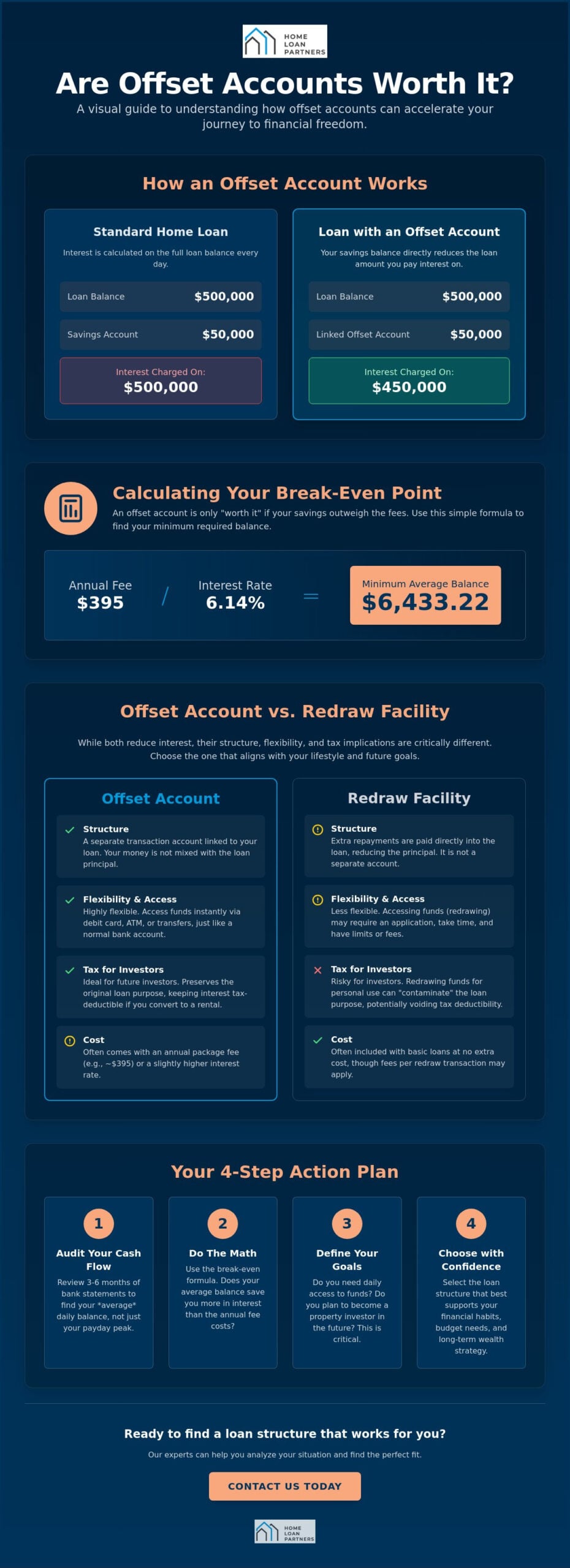
The math behind this is powerful and immediate. If you have a $500,000 mortgage and $50,000 sitting in your linked offset account, the bank only charges interest on $450,000. This isn’t a marketing gimmick; it’s a direct reduction in your debt’s footprint. Unlike many high-interest savings accounts that cap your earnings or use complex tiered rates, 100% of your offset balance works for you from the moment it hits the account. Determining if are offset accounts worth it for your family often starts with this simple realization: your money is working harder here than in a separate savings bucket.
It’s vital to understand how this affects your monthly cash flow. Your scheduled repayments usually stay exactly the same each month. However, because the bank is charging you less interest on the total balance, a larger portion of that payment goes toward the principal. You’re effectively chipping away at your debt faster and building equity sooner without ever having to change your lifestyle or increase your out-of-pocket costs.
The mechanics of daily interest offsetting
Lenders calculate interest on a daily basis and charge it to your loan monthly. This means having your salary paid directly into your offset account maximizes your savings every single day. Even if that money stays in the account for only a few days before you pay your electricity bill or grocery shop, it has already reduced your interest bill for that period. The effective interest rate represents the true cost of your debt once these savings are factored in. While most modern products offer a 100% offset, you should always check if a loan only provides a partial offset, as this significantly changes the value proposition.
Multiple offset accounts: Organizing your life
The Math of “Worth”: Calculating your break-even point
While the concept of offsetting interest is appealing, the mathematical reality determines if this strategy truly serves your financial goals. Most lenders apply what we call an “Offset Premium.” This usually comes in the form of an annual package fee, often around $395, or a slightly higher interest rate compared to basic “no-frills” loans. To find out if are offset accounts worth it for your specific situation, you need to calculate your break-even point. This is the moment where the interest you save exactly matches the extra costs you’re paying for the feature.
You can use a simple formula to find this threshold: (Annual Fee / Interest Rate) = Minimum Average Balance. For example, if your loan has a $395 annual fee and an interest rate of 6.14%, you would need to maintain a minimum average balance of $6,433.22 just to cover the fee. If your lender also charges a higher interest rate for the offset feature, you must add that extra interest cost to the annual fee before running the calculation. For a more detailed look at these variables, the government guide to offset accounts provides excellent foundational context.
It’s vital to focus on your average daily balance rather than your peak balance on payday. Since interest is calculated daily, a large sum that sits in your account for only 48 hours won’t have the same impact as a smaller, consistent amount that stays there all month. If you find your savings frequently dip below that break-even mark, refinancing to a basic loan might actually put more money back in your pocket.
Offset vs. High-Interest Savings Accounts (HISA)
The true value of an offset account often lies in the tax treatment. Interest earned in a HISA is considered taxable income, meaning the ATO takes a cut based on your marginal tax bracket. Conversely, interest saved in an offset account isn’t “earned,” so it’s completely tax-free. If your mortgage rate is 6%, you might need to find a HISA offering nearly 9% to achieve the same net benefit after tax. An offset account is often the best risk-free investment for Australians because it provides a guaranteed return equal to your mortgage rate without any tax obligations.
When is an offset account NOT worth it?
There are specific scenarios where this tool might not be the right fit. If your average daily balance consistently stays under $10,000, the annual fees and potential rate premiums can quickly outweigh the interest savings. We often see first home buyers with very tight cash flow who would benefit more from the absolute lowest entry rate available on a basic variable loan. Additionally, if the interest rate premium for the offset feature is significantly higher than a basic loan, the “cost” of the account might exceed the benefit unless you have a very substantial amount of cash sitting idle.
Offset vs. Redraw: Which strategy wins for your lifestyle?
Choosing between an offset account and a redraw facility often comes down to how you want to interact with your money daily. Both mechanisms serve the primary goal of lowering your interest bill, but they operate through very different structures. While an offset account is a separate transaction account, a redraw facility is a feature within the loan itself that allows you to withdraw extra repayments you’ve made. We see both as powerful tools, yet they cater to different psychological needs and tactical goals.
An offset account feels like a standard bank account. You get a debit card, you can use ATMs, and your funds are available instantly. Redraw facilities can feel more restrictive. Some lenders require a minimum withdrawal amount, or there might be a delay of 24 to 48 hours before the funds hit your spending account. When deciding are offset accounts worth it, you must weigh this instant accessibility against your own financial habits. For a deeper dive into the technicalities, Moneysmart’s guide to mortgage offset accounts offers a clear breakdown of how these features differ in practice.
Both options successfully reduce the interest you’re charged because they lower the net balance the bank uses for its daily calculations. However, the “atmosphere” of each is distinct. One keeps your savings visible and liquid, while the other keeps your extra cash tucked away inside the mortgage itself, acting more like a repository for surplus funds than a daily spending hub.
The flexibility factor
Many families prefer the offset structure because it provides a safety net that doesn’t require permission from the bank. You simply transfer the money or tap your card. There’s also the rare but real risk of “redraw capture,” where a lender may technically restrict access to redraw funds if your financial circumstances change or the economic environment shifts. By using a debit card linked to your offset for daily expenses, you keep your cash working against your debt until the very second you spend it. This proactive approach ensures your money never sits idle.
Why Redraw might be the “Simple” choice
Redraw facilities are frequently found on basic variable loans. These products often skip the annual package fees we discussed earlier, making them a cost-effective alternative for many. There’s also a psychological benefit to redraw. Because the money is “hidden” inside the loan, you’re less likely to spend it on a whim. For the “set and forget” borrower who wants to pay down debt without the temptation of a visible savings balance, this simplicity confirms that are offset accounts worth it only if you actually need the high-frequency access an offset provides.
Tax benefits and strategic planning for investors
For property investors, the question of are offset accounts worth it often moves beyond simple interest savings and into the territory of long-term tax efficiency. In Australia, the ATO determines interest deductibility based on the “purpose of the loan” rather than the security used for the mortgage. If you make extra repayments into a redraw facility and then withdraw that money to buy a private car, the ATO views that withdrawal as a new loan for a non-income-producing purpose. You then lose the ability to deduct the interest on that specific portion of the debt, even if the loan is secured against a rental property.
An offset account avoids this trap entirely. Because the money stays in a separate transaction account, withdrawing it doesn’t change the original purpose of the underlying mortgage. This distinction is vital for anyone who might turn their current home into an investment property later. By keeping your savings in an offset rather than paying down the loan balance directly, you preserve the maximum possible tax-deductible debt for the day that property becomes a rental. This protects your future cash flow from unnecessary tax leakage.
We also see advanced clients using these accounts as a central component of “Debt Recycling” strategies, as discussed in our 2026-04-02 guide. This process involves systematically turning non-deductible home equity into deductible investment debt. Even within specialized SMSF loan structures, an offset can provide a flexible way to manage fund liquidity while minimizing the interest expenses within your superannuation environment. It’s a precision tool for those looking to build wealth steadily over time.
Preserving tax deductibility
Drawing from an offset account is simply spending your own savings. Drawing from a redraw facility, however, is technically taking out a new loan from the bank. This “one-way street” means you can never undo a redraw for tax purposes once the money is spent on a personal item. It’s a common mistake that can cost thousands in lost deductions. We always recommend consulting a professional to ensure your loan structure supports your 10-year plan, rather than just solving today’s cash flow needs.
Offset accounts for investment property loans
Strategic investors often use a “Master Offset” strategy to manage cash flow across multiple properties. This involves keeping your liquidity against your non-deductible owner-occupier debt to minimize interest there, while allowing your deductible investment debt to remain as high as possible for tax efficiency. The Home Loan Partners help structure loans for long-term portfolio growth by ensuring your accounts are aligned with these complex tax rules. If you’re ready to optimize your portfolio, reach out for a comprehensive investment property loan review.
How to choose the right account: Your 2026 action plan
Deciding on the right loan structure is a deliberate step toward your long-term financial security. Now that you understand the mechanics and tax implications, it’s time to apply a steady, logical approach to your own situation. To truly determine if are offset accounts worth it for your household, you must look at your actual spending habits rather than best-case scenarios. This clarity helps replace anxiety with a sense of calm expertise as you move forward.
Your first step is a simple audit. Review your last six months of bank statements to identify your average daily balance. This is the consistent baseline of cash that remains in your accounts after all bills and lifestyle expenses are paid. If this number is consistently higher than the break-even threshold we discussed earlier, the offset feature is likely a winning strategy. You should also consider your plans for the next three years. If you anticipate needing those funds for a significant non-property purchase, such as a wedding or a new vehicle, the instant liquidity of an offset account remains superior to a redraw facility.
We recommend comparing the total cost of ownership across various lender tiers. This means looking past the headline interest rate to account for every annual fee and potential rate premium. By doing this, you ensure that the “worth” of the account isn’t swallowed by hidden costs. Accessing a panel of 36+ lenders allows you to see how these features vary across the market, from major banks to specialized lenders who might offer more competitive structures for your specific profile.
The Mortgage Broker advantage
Approaching a bank directly often limits your perspective to a handful of products. A single lender might not highlight the trade-offs between a “Basic” loan and a “Packaged” one, potentially leaving you in a high-fee environment that doesn’t suit your balance. We take the time to analyze your unique spending patterns to recommend a mathematically superior loan structure. This is particularly important for self-employed or SMSF borrowers who require specialized offset products that align with complex income streams. Our role is to act as your expert collaborator, managing the heavy lifting so you can focus on your life milestones.
Ready to optimize your mortgage?
Transitioning to a more efficient loan structure should be a stress-free experience. Whether you’re staying with your current lender or exploring refinancing options, the goal is to ensure your money works as hard as possible for your future. Taking a proactive stance today can save you thousands in interest over the life of your loan, accelerating your path to true financial freedom. We are here to provide the steady hand you need to navigate these choices with precision. Book a discovery call with The Home Loan Partners to audit your current loan structure and discover exactly how much you could be saving.
Securing your financial path with the right structure
Determining if are offset accounts worth it for your home or investment portfolio comes down to a balance of mathematical precision and your long-term life goals. By auditing your average daily balance and understanding the unique tax protections these accounts offer, you can transform your mortgage from a burden into a strategic wealth-building tool. Whether you prioritize instant liquidity or the simplicity of a basic loan, the key is making a choice that aligns with your specific financial rhythm.
We’re here to help you navigate these complex options with a steady hand. With access to 36+ Australian lenders and expert guidance on investment loan structures, we can build a personalized financial roadmap for your major life milestones. Let us help you find the loan structure that fits your life; contact The Home Loan Partners today. We manage the heavy lifting so you can move forward with confidence and clarity. Your journey toward financial freedom is a marathon, not a sprint, and having the right partner makes every step more secure.
Frequently Asked Questions
Does an offset account reduce my monthly repayments?
An offset account generally does not lower your scheduled monthly repayment amount. Instead, it changes the composition of that payment so that a larger portion goes toward the principal and less toward interest. This helps you pay off the total debt faster and build equity sooner without changing your monthly cash flow requirements. It’s a proactive way to shorten your loan term while maintaining your current budget.
Is it better to put money in an offset account or pay off the mortgage?
Choosing between an offset account and direct repayments depends on your need for liquidity and future plans. While both reduce interest identically, an offset account keeps your cash accessible for emergencies or future investments. Paying off the mortgage directly might be better if you want to remove the temptation to spend, but you’ll need a redraw facility to access those funds later. We often suggest the offset for its superior flexibility.
Can I have multiple offset accounts linked to one home loan?
Many modern lenders allow you to link multiple sub-offset accounts to a single home loan. This structure is excellent for organizing your finances into specific categories like tax, holidays, or emergency funds. Every dollar in these various accounts still works to reduce your interest bill. It provides a powerful way to manage your budget while staying focused on your long-term journey toward financial freedom.
What is the downside of an offset account?
The primary downside is the potential for higher annual fees or a small interest rate premium compared to basic loan products. If your average balance remains low, these costs can outweigh the interest savings. It’s essential to run the math to determine if are offset accounts worth it for your specific financial habits before committing to a packaged loan. We can help you audit your statements to find that tipping point.
Is interest earned on an offset account taxable in Australia?
Interest saved in an offset account is not considered taxable income in Australia. Unlike a standard savings account where you pay tax on the interest you earn, an offset simply reduces the interest you owe. This tax-free benefit often makes the effective return on an offset account higher than most traditional savings products. It’s a highly efficient way to grow your net wealth without increasing your tax obligations.
Do I still have instant access to my money in an offset account?
You maintain full, instant access to the funds in your offset account just like a standard transaction account. Most lenders provide a debit card for daily spending and allow for real-time transfers through online banking. This high level of liquidity is a major advantage for families who want their savings to work hard while remaining available for unexpected expenses. You don’t need to ask the bank for permission to use your own money.
Can I use an offset account with a fixed-rate home loan?
Most lenders do not offer full offset features on fixed-rate home loans, though some allow for partial offsetting or limited caps. If you want the certainty of a fixed rate with the benefits of an offset, a split loan might be a better structure. This involves fixing a portion of your debt while keeping the remainder variable and linked to your offset account. This gives you the best of both worlds.
How much money do I need in an offset account to make it worth the fee?
You generally need enough in your account so that the interest saved exceeds the annual fee and any interest rate premium. For a typical loan with a $395 fee and a 6% interest rate, a consistent balance of at least $6,600 is required to break even. Calculating this threshold is the most reliable way to decide if are offset accounts worth it for your current savings level. We can provide a precise calculation based on your specific loan offer.