

In 2026, a construction loan isn’t just a debt; it’s a protective cash-flow system that ensures your builder is only paid for work successfully completed. If you’re asking how do construction loans work in australia, you’re likely balancing the excitement of a new home with the stress of managing a complex budget. It’s common to feel a bit overwhelmed by interest-only periods or the pressure of bank valuations. We believe that building your dream shouldn’t feel like a financial gamble.
We’re here to act as your steady hand through every stage of this partnership. This guide helps you master progressive payments and explains the 2026 approval requirements in plain English. We’ll show you how to protect your cash flow and use smart interest-saving strategies while construction is underway. From the first slab to the final handover, we’ll help you ensure a smooth flow of funds to your builder. Our goal is to make your transition to a standard mortgage simple and stress-free so you can focus on the long-term journey in your new home.
Key Takeaways
- Understand how progressive drawdowns protect your investment by ensuring your builder is only paid for completed milestones rather than work promised.
- Learn exactly how do construction loans work in australia by following the five standard building stages and your essential role in authorizing bank payments.
- Discover how interest-only repayment structures and offset accounts can maximize your cash flow while you’re still paying rent or another mortgage.
- Identify the documents needed for 2026 approval, including why fixed-price contracts are now the gold standard for securing finance in the current market.
- See how partnering with a specialist broker like Your Mortgage Coach simplifies the journey by managing the complex communication between your builder and a wide panel of lenders.
The Mechanics of Construction Finance: Progressive Drawdowns Explained
A construction loan is a specialized financial tool designed specifically for building projects. Unlike a standard mortgage where you receive the full amount on settlement day, these loans release funds in stages. This process is known as a progressive drawdown. It ensures that your lender only pays for work that your builder has actually finished, rather than work they promise to do in the future. To understand the basics of how mortgage loans work, it helps to see this as a security-first approach. In the 2026 Australian market, this structure provides a vital safety net. It protects your capital against builder insolvency or unexpected delays by keeping the funds in the bank’s hands until they are needed.
Lump Sum vs. Progressive Payments
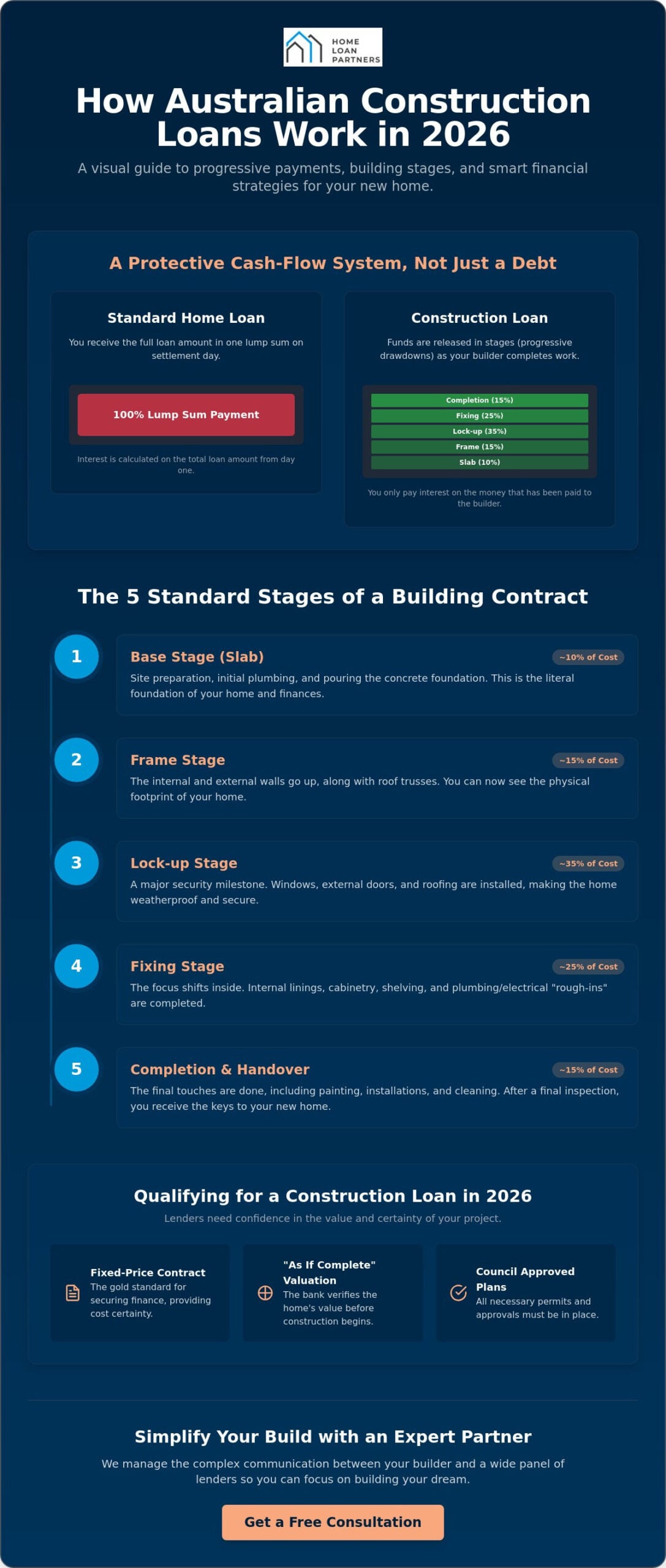
Standard home loans operate on a lump sum basis. You buy an existing house, and the bank pays the seller the full price immediately. Construction finance works differently. Progress payments are the lifeblood of an Australian building project. Banks refuse to pay the full amount upfront because it would leave both you and the lender exposed to too much risk. If a builder received A$600,000 before laying a single brick, there would be little incentive or security if they faced financial trouble. By using a staged release, the bank acts as a guardian for your investment. You also benefit from a lower initial cost. You only pay interest on the amount actually drawn down to pay the builder, not the total loan limit you were approved for.
The Role of the Bank Valuation
Before your loan is approved, the lender performs a valuation “as if complete.” They look at your land value plus the cost of your building contract and specifications. This determines your borrowing power. In 2026, these valuations are more critical than ever for calculating your Loan-to-Value Ratio (LVR). The bank needs to be certain that the finished home will be worth enough to cover the debt. This “on-completion” valuation serves as the benchmark for your total borrowing capacity. It provides peace of mind that you aren’t overcapitalizing on your block. Understanding how do construction loans work in australia means recognizing that the bank isn’t just a source of money; they are an active partner in verifying the value of your future home at every milestone.
The Five Standard Stages of an Australian Building Contract
The building journey in Australia follows a very specific rhythm. Most lenders rely on a standardized schedule to manage risk and ensure the project stays on track. When you look at how do construction loans work in australia, you’ll see that your role as the borrower is vital. You aren’t just a bystander; you’re the one who verifies that a stage is truly finished before the bank releases any funds to your builder. This collaborative process ensures that the quality of work meets the standards set by organizations like Master Builders Australia. While some lenders allow for minor variations, sticking to this industry-standard structure keeps your finance predictable and secure.
From Slab to Lock-up
The first three stages lay the groundwork for your home’s structure. It begins with the Base Stage, often called the Slab. This includes the initial site preparation, plumbing under the floor, and the pouring of the concrete foundation. It’s the literal foundation of your finance. Once the slab is dry, the Frame Stage begins. This is when the internal and external walls go up, along with the roof trusses. It’s an exciting time because you can finally see the physical footprint of your future life.
The Lock-up Stage is a major milestone for your security. At this point, the windows, external doors, and roofing are installed. Your home is now effectively “locked up” and protected from the weather. In the 2026 market, reaching this stage quickly is a priority to protect internal materials from environmental damage or potential site theft. If you’re feeling uncertain about these milestones, speaking with a specialist broker can help clarify exactly what your specific lender expects at each turn.
Fixing to Completion
Once the shell is secure, the focus shifts to the interior. The Fixing Stage involves installing internal linings, cabinetry, shelving, and finishing the plumbing and electrical “rough-ins.” This is often a detailed stage where the house starts to feel like a home. Most lenders will require a progress inspection here to ensure the value of the build matches the funds released so far.
The final step is Practical Completion. This isn’t just about the builder finishing their work; it’s about a rigorous final inspection and handover process. You’ll walk through the home to identify any minor issues that need rectifying. Before the bank releases the final payment, they will require a Certificate of Occupancy. This legal document confirms the house is safe and habitable. It’s the most important piece of paper in your building journey, signaling that your construction loan is ready to transition into a standard mortgage. Successfully reaching this point means your long-term journey in your new home is finally ready to begin.
Financial Benefits: Interest-Only Payments and Offset Facilities
Building a home is a major life milestone, but it often involves a dual-living period where you pay rent or an existing mortgage while your new house is under construction. This is where the specific financial structure of a construction loan becomes a protective asset. When exploring how do construction loans work in australia, you’ll find that almost all lenders start these products as interest-only. This means you aren’t forced to pay down the principal debt while the builder is still on-site. It’s a deliberate design to keep your monthly outgoings manageable during the most expensive phase of the project.
Maximising Your Cash Flow
The difference between interest-only and principal and interest (P&I) repayments can be significant. For example, on a drawn-down balance of A$500,000 at an interest rate of 6% p.a., your interest-only repayment would be approximately A$2,500 per month. A standard P&I repayment on that same balance could be closer to A$3,000. Over a typical 12-month build, that A$500 monthly difference keeps A$6,000 in your pocket to cover rent, moving costs, or new furniture.
In 2026, many savvy borrowers are using construction offset accounts to further reduce costs. You can park your savings or funds intended for final-stage upgrades in this account to offset the interest charged on your loan balance. We are also seeing a trend toward split loans during construction. This allows you to fix a portion of your debt for rate security while keeping a variable portion with an offset facility for maximum flexibility. This dual approach helps you navigate the build with a sense of financial control and predictability.
The Reversion to Standard Mortgage
The transition happens once the final builder invoice is paid and you receive your keys. Your loan will typically revert to a standard principal and interest mortgage. This is the perfect time to review your financial position with a broker. Many lenders offer discounted rates once the property is fully built and occupied, as the risk to the bank decreases significantly. We treat this as the beginning of the next chapter in your long-term journey. By reviewing your rate at this milestone, you ensure your new home remains a secure and sustainable investment for your family’s future.
Qualifying for a Construction Loan in 2026: What Lenders Look For
Securing approval for a building project requires a higher level of detail than a standard property purchase. In the 2026 market, lenders are looking for total transparency and certainty before they commit to your project. To understand how do construction loans work in australia from an approval perspective, you must start with the documentation. You’ll need a Fixed Price Building Contract and Council Approved Plans. These documents prove to the bank that the project is legal and the costs are capped. Lenders also mandate Builder’s Insurance and Home Warranty Insurance to protect the asset against unforeseen events; to ensure your project is fully protected, you can visit AllCover Insurance Brokers for expert advice. If you’re planning an owner-builder project, be aware that many big banks are hesitant due to the increased management risk. Finding a specialist lender for owner-builder scenarios is often necessary, and we can help you navigate those specific requirements.
The Importance of the Fixed Price Contract
Lenders prioritize fixed-price contracts because they protect both your budget and the bank’s security. In a volatile construction environment, “Cost-Plus” contracts have become increasingly difficult to finance. Banks simply won’t take the risk of a price tag that could shift mid-build. Even within a fixed contract, lenders will scrutinize “Provisional Sums” and “Prime Cost” items. These are essentially estimates for things like site works or high-end fittings. If these estimates are too high, the bank may ask for more information or a larger buffer. In 2026, it’s also common for lenders to perform their own due diligence on your builder’s financial stability. They want to ensure your partner on this journey is well-positioned to see the project through to completion.
Maintaining this level of security often requires looking at broader insurance frameworks; for businesses undertaking significant developments, Paterson Insurance Brokers offers expert risk management and tailored insurance solutions that provide peace of mind throughout the project lifecycle.
Deposit and Equity Requirements
Your deposit is the first piece of the financial puzzle. Most lenders require a deposit between 5% and 20%, depending on whether you want to avoid Lenders Mortgage Insurance (LMI). If you already own the block of land, you can often use the equity in that land as your deposit. However, a common point of confusion is how lenders value unbuilt land. Different banks have vastly different appetites for land valuations, and some may be more conservative than others. This can significantly impact your total borrowing power. It’s a standard rule that lenders usually require you to spend your own contributed funds first before they begin releasing the loan balance. If you’re ready to see which lender’s policy fits your specific project, get a tailored construction loan assessment today and let us manage the heavy lifting for you.
Understanding how do construction loans work in australia means preparing for these specific 2026 hurdles early. By having your fixed-price contract and insurance ready, you project a sense of readiness that lenders value. This professional approach helps smooth the path toward your formal approval and the start of your build.
The Broker Advantage: Navigating the Build with The Home Loan Partners
Choosing the right finance is just as important as choosing the right builder. While many people start by asking their own bank how do construction loans work in australia, they often miss out on the diverse policies available across the broader market. We compare options from over 36 lenders to find the specific policy that aligns with your project’s unique needs. This isn’t just about finding the lowest rate; it’s about finding a lender whose valuation appetite and progress payment schedule match your builder’s requirements. Our role is to act as your steady hand, providing expert, unbiased advice in a 2026 property market that demands precision and patience.
Managing the Heavy Lifting
The most stressful part of building often isn’t the construction itself, but the administration behind it. We take the weight off your shoulders by managing the progress payment requests on your behalf. This ensures your builder is paid on time, keeping the project moving forward without awkward delays. If variations occur or if there are supply chain hurdles—which might involve coordinating with logistics specialists like Freight and More Pty Ltd for imported materials—we act as the intermediary between the bank and your builder. This collaborative approach protects your relationship with your builder while ensuring the bank’s requirements are met. We’re here to manage the back-and-forth so you can focus on the excitement of seeing your new home take shape.
Our commitment to your journey doesn’t end when you get the keys. Most guides focus only on the build, but we prioritize the “End Loan” transition. Once your home is complete, we review your position to ensure you’re transitioning into a highly competitive principal and interest mortgage. We treat our clients as long-term partners, not just one-off transactions. This means we’ll continue to monitor your loan’s health to ensure it remains a sustainable foundation for your family’s future security.
Your 2026 Mortgage Health Check
If you’re planning to build, the best first step is a “Construction Readiness” review. This simple assessment helps you understand your borrowing power and identifies any hurdles before you sign a contract. We can provide a tailored construction loan quote that reflects the current 2026 market conditions. Our goal is to guide you toward this major life milestone with a clear, stress-free path forward. Building a home is a long-term journey, and we’re proud to be the reliable guide that helps you achieve it with confidence and calm expertise.
Start Your Building Journey with Confidence
Building a home is a major life milestone that deserves a clear, predictable path. You now have the tools to understand how do construction loans work in australia, from the security of progressive drawdowns to the cash-flow benefits of interest-only periods. These mechanisms are designed to protect your capital and ensure your builder is only paid for work that meets the highest standards. By preparing your fixed-price contract and council approvals early, you’re already ahead of the curve for a successful 2026 build. For those also interested in exploring international opportunities for new residential developments, you can learn more about current projects in Barrie, Ontario.
We’re ready to act as your expert collaborator throughout this process. Our team provides personalized support to manage builder payments and bank valuations, ensuring nothing stalls your progress. With access to a panel of over 36 Australian lenders, we’ll find the right fit for your specific goals. Book your stress-free construction loan review with The Home Loan Partners today. We look forward to helping you move into your new home with total peace of mind and a secure financial future.
Frequently Asked Questions
Can I get a construction loan as a first home buyer in 2026?
Yes, first home buyers can certainly access construction loans in 2026. You may be eligible for the First Home Owner Grant, which offers up to A$10,000 for new builds in several states, or the Home Guarantee Scheme which allows for deposits as low as 5%. These initiatives are specifically designed to help you enter the property market while building your first home. We can help you navigate the specific eligibility criteria for these federal and state based programs.
How long does it take for the bank to pay the builder at each stage?
Banks typically take between five and ten business days to release funds once they receive a valid progress claim. This timeframe allows the lender to review the builder’s invoice and, if necessary, send a valuer to the site to confirm the milestone is complete. To avoid any unnecessary delays, ensure you sign the claim form promptly and provide any required photos of the completed work to your lender.
What happens if my building costs increase during the construction?
If your building costs increase due to variations, you will generally need to cover the difference with your own savings. Lenders base their initial approval on the fixed price contract, so any additions like high-end kitchen upgrades or structural changes mid build are viewed as extra costs. It is vital to maintain a small cash buffer to manage these unexpected expenses without putting your project’s flow of funds at risk.
Do I need a separate loan for the land and the house construction?
Can I use an offset account with a construction loan?
Yes, many Australian lenders now offer offset accounts on the variable portion of a construction loan. This is a powerful strategy to reduce your interest costs by offsetting your savings against the drawn down balance. It’s particularly useful during the later stages of the build when the loan balance is higher. We can help you identify which lenders on our panel provide this specific feature to help you maximize your cash flow.
What is a ‘Certificate of Occupancy’ and why does the bank need it?
A Certificate of Occupancy is a legal document issued by a building surveyor or local council confirming the home is safe and habitable. The bank requires this document before they will release the final Practical Completion payment to your builder. It serves as essential proof that the project meets the National Construction Code 2025 standards and is officially ready for you to move in and enjoy.
Is it harder to get a construction loan than a regular home loan?
Applying for a construction loan is more complex than a standard mortgage because it requires significantly more documentation. Lenders need to see council approved plans, a fixed price contract, and builder’s insurance before they can provide formal approval. While the criteria for your income and credit remain similar, the extra layers of project due diligence mean the process requires a more steady, expert hand to navigate.
What are ‘break costs’ in the context of a construction loan?
Break costs are fees charged by a lender if you end a fixed rate loan period earlier than agreed. In the context of building, this might happen if you decide to refinance or sell the property shortly after completion while still in a fixed term. Because some construction loans offer fixed rate options for the build phase, it is important to discuss your long term journey with us to ensure your loan structure remains flexible.