

With Australia’s annual inflation hitting 4.6 percent in March 2026, staying on a mortgage that no longer serves you is more than just a missed opportunity; it’s a drain on your future security. You likely worry that the hidden costs of refinancing home loan australia, such as discharge fees or complex LMI requirements, will eat up your potential savings. It’s stressful to feel like you’re being “ripped off” simply for trying to find a better deal, especially when you’re already managing the heavy lifting of a household budget.
We believe that clarity is the best antidote to financial stress. Our guide strips away the technical jargon to help you move forward with absolute confidence. You’ll learn how to identify every potential charge and use our break-even framework to justify the switch. Our goal is to ensure your transition to a better loan is smooth and focused on your long-term life milestones.
We will look at the current 2026 landscape where the RBA cash rate sits at 4.35 percent. We’ll also provide a clear dollar-value estimate of common lender and government fees along with a step-by-step path to recouping those costs quickly. By the end of this article, you’ll have a predictable roadmap to turn your mortgage into a strategic tool for wealth rather than a source of confusion.
Key Takeaways
- Identify the split between exit fees from your current lender and entry fees for your new mortgage to avoid financial surprises during the transition.
- Uncover the true costs of refinancing home loan australia, specifically how to manage state government levies and avoid unnecessary Lenders Mortgage Insurance charges.
- Use our break-even framework to determine exactly when your interest savings will outweigh your initial setup expenses, typically within 12 to 18 months.
- Learn practical strategies to minimize switching costs by utilizing lender cashback offers and professional negotiation techniques with your existing bank.
- Gain a clear, stress-free path forward with a transparent fee disclosure that compares options from over 36 Australian lenders to find your ideal match.
What Are the Real Costs of Refinancing a Home Loan in Australia?
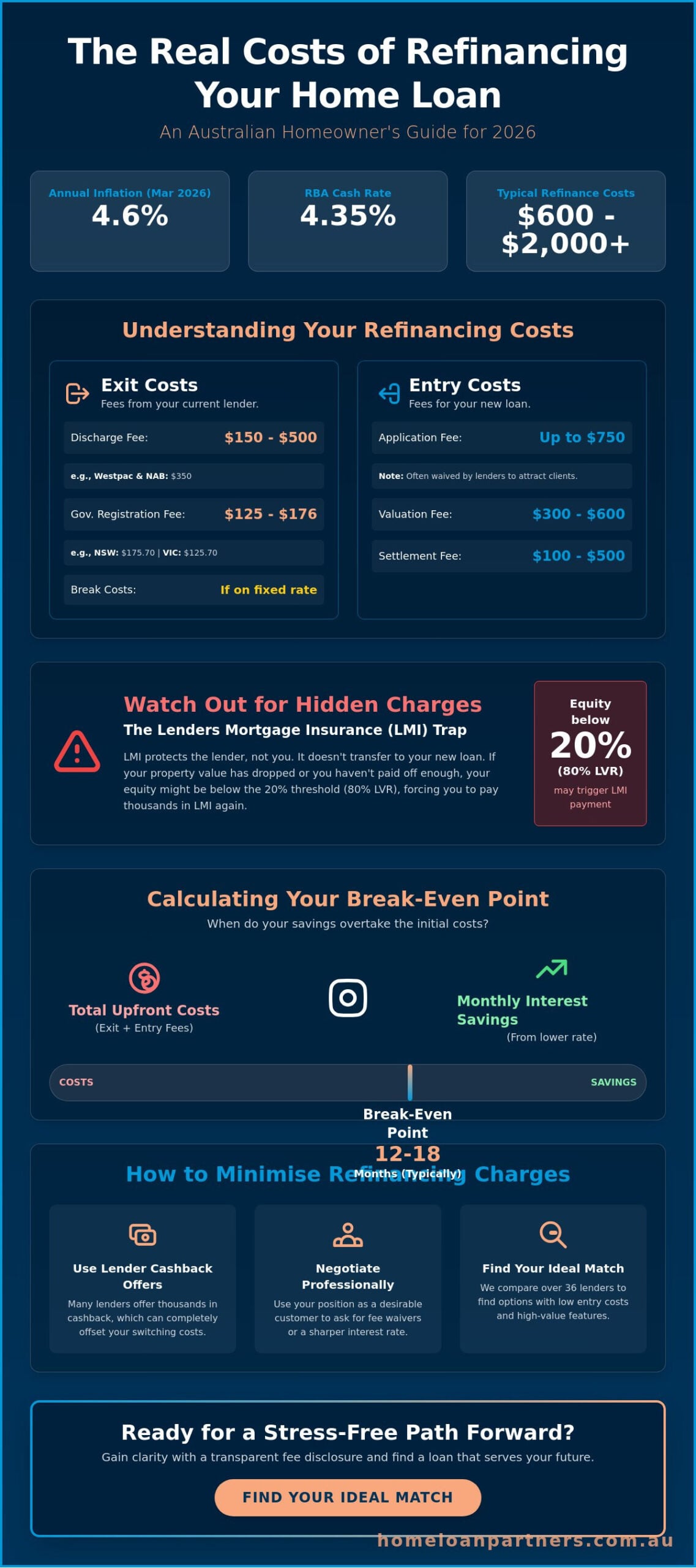
Refinancing involves replacing your existing mortgage with a new one that better suits your current lifestyle or financial goals. To put it simply, What is refinancing? It’s the process of paying off your old loan with the proceeds from a new one, usually to secure a more competitive interest rate or different features. While the potential for long-term savings is significant, you need to account for the upfront expenses required to make the move. In the 2026 market, the average costs of refinancing home loan australia typically range from $600 to over $2,000, depending on your specific loan structure and property location.
Thinking about these costs in two distinct categories helps simplify the process. You’ll encounter ‘Exit Fees’ from your current lender and ‘Entry Fees’ from your new one. Our role is to help you ensure that your total interest savings over the next year or two comfortably outweigh these initial charges. This creates a clear path toward a more secure financial future without the stress of unexpected bills.
The ‘Exit’ Costs: Leaving Your Current Lender
Closing your old loan account involves a few administrative steps. Most Australian lenders charge a discharge fee to cover the paperwork involved in releasing your mortgage. You can expect this to cost between $150 and $500 per loan. For example, Westpac and NAB currently charge $350 for this service. If you’re on a fixed-rate loan, you might also face break costs. These are calculated based on how much interest rates have changed since you started your fixed term and how much time remains on the contract. Finally, you’ll need to pay a mortgage discharge registration fee to your state government. In New South Wales, this is $175.70, while in Victoria, it’s $125.70. These fees ensure the title of your home is correctly updated to reflect your new lending arrangement.
The ‘Entry’ Costs: Starting With a New Lender
Your new lender will have their own set of requirements to get your loan started. Application or ‘upfront’ fees can reach up to $750, though many banks now waive these to attract new clients. You’ll also likely need a professional valuation to confirm your property’s current market value, which generally costs between $300 and $600. Some lenders might offer this for free as part of a promotional package. Lastly, settlement fees of $100 to $500 cover the legal completion of the new loan. While these numbers might seem overwhelming, many of them are negotiable. We focus on finding lenders who offer the best balance of low entry costs and high-value features, ensuring your transition is as affordable as possible.
Hidden Charges: LMI and Government Levies You Might Forget
While the bank’s own fees are usually the first thing you’ll check, the statutory and insurance costs of refinancing home loan australia are often the most significant part of your budget. These charges aren’t set by your lender. They are mandated by state governments or triggered by your financial position. Because they don’t appear on a bank’s flashy promotional banner, they can easily catch you off guard. We’re here to help you shine a light on these hidden corners so your final calculation is accurate and stress-free.
Understanding these levies is about more than just numbers; it’s about protecting your equity. You can find detailed government advice on switching loans to help you prepare. If you’re unsure where your equity stands or how these fees apply to your specific state, our team at homeloanpartners.com.au can help you assess your current position before you commit to a move.
The LMI Trap: Why Equity Matters
Lenders Mortgage Insurance (LMI) is perhaps the most frustrating hurdle for many homeowners. It’s a one-off payment that protects the lender, not you, if you default on your loan. Crucially, LMI doesn’t follow you to a new bank. If you originally paid LMI when you bought your home because your deposit was less than 20 percent, you might have to pay it again if your equity is still below that 80 percent Loan-to-Value Ratio (LVR) threshold.
This becomes a “trap” if your property’s value has dipped. Even if you’ve been diligent with repayments, a drop in the local market could push your LVR back above 80 percent. In this scenario, the cost of a new LMI policy could wipe out any interest rate savings. We always recommend getting a fresh valuation to ensure your equity has grown enough to avoid this unnecessary expense.
Statutory and Government Charges
Government charges are non-negotiable and vary depending on where your property is located. Every state has its own schedule for registering and discharging mortgages. These fees ensure the public record correctly reflects who holds the security over your home. Consider these current standard rates for mortgage registration:
- Queensland: $238.14
- Western Australia: $216.60
- South Australia: $198.00
- New South Wales: $175.70
- Victoria: $125.70
You may also encounter “Search fees.” These are small costs, usually under $100, that the lender pays to check your property title for any legal encumbrances or caveats. While a Transfer of Land fee is typically reserved for buying or selling, it can occasionally apply if you’re changing the names on the title during the refinance. Keeping these state-based costs in mind ensures your “break-even” math is based on reality, not just bank estimates.
Calculating Your Break-Even Point: Is Refinancing Worth It?
When evaluating the total costs of refinancing home loan australia, the most important metric isn’t the interest rate alone. It’s your break-even point. This calculation tells you exactly how many months it will take for your interest savings to “pay back” the upfront fees you spent to switch. We believe a successful refinance should ideally reach this point within 12 to 18 months. If it takes longer than two years to recoup your costs, the move might not be strategic unless you’re gaining essential features like an offset account or a more reliable banking partnership.
With the RBA cash rate sitting at 4.35 percent as of May 2026, many homeowners feel the pressure of rising repayments. However, rushing into a new loan without doing the math can be counterproductive. We focus on providing a clear, stress-free framework so you can decide if the transition truly serves your long-term life milestones or if you’re better off staying put for now.
The Break-Even Formula
The break-even point in refinancing is the specific month when your cumulative monthly interest savings exactly match the total upfront fees paid to switch lenders. To find this number, use this simple equation: Total Refinance Costs / Monthly Interest Savings = Months to Break Even.
A lower interest rate isn’t always the winner. For instance, a “no-frills” loan with a slightly higher rate but zero application or valuation fees often breaks even much faster than a market-leading low rate that carries $2,000 in setup charges. We help you look past the headline numbers to find the most efficient path to real savings. Calculating your break-even point ensures that the costs of refinancing home loan australia result in a genuine financial gain rather than a lateral move.
Ongoing Costs vs. One-Off Charges
Don’t let a low interest rate distract you from annual package fees. Many lenders charge around $395 per year for “premium” packages that include offset accounts and credit card fee waivers. While these features are powerful tools for debt reduction, they add nearly $4,000 to your costs over a decade. You must decide if the utility of an offset account justifies that recurring expense.
On the other hand, there’s a significant cost to “doing nothing.” This is often called the loyalty tax, where long-term customers end up on higher rates than new borrowers. With inflation at 4.6 percent, every dollar saved on interest is a dollar protected against rising living costs. The table below illustrates how a small rate difference impacts a typical $500,000 loan balance.
| Loan Detail | Current Loan | Refinanced Loan | Monthly Difference |
|---|---|---|---|
| Loan Balance | $500,000 | $500,000 | – |
| Interest Rate | 6.00% p.a. | 5.50% p.a. | 0.50% saving |
| Monthly Interest Cost | $2,500 | $2,291 | $209 saved |
If your total switching costs are $2,500, you’ll break even in roughly 12 months. After that first year, every cent of that $209 monthly saving goes directly into your pocket or back into your home equity, helping you achieve your financial goals sooner.
How to Minimise Refinance Charges and Maximise Value
While the initial costs of refinancing home loan australia might seem fixed, they are often more flexible than banks lead you to believe. You don’t have to accept every fee as a given. By taking a proactive approach, you can often offset these expenses entirely or even come out ahead. Our role is to act as your expert collaborator, identifying which charges can be waived and which lenders are currently offering the most generous incentives to win your partnership.
One of the most effective first steps is to negotiate with your current lender. Before you look elsewhere, ask them to match the competitive rates you’ve seen online. If they value your history as a client, they might waive your discharge fees or lower your interest rate to keep you. This “internal refinance” can save you from the state government registration fees and valuation costs associated with switching banks. If you’re ready to explore how much you could save through a more strategic loan structure, we invite you to speak with the team at Home Loan Partners.
Leveraging Cashback Offers
In the current 2026 market, many lenders are competing aggressively for high-quality refinancers. This competition often takes the form of cashback offers ranging from $2,000 to $4,000. These payments are designed to cover the entirety of your switching costs, effectively making the transition cost-neutral from day one. However, it’s vital to look past the upfront cash. Some lenders use these promotions to mask a higher interest rate or ongoing package fees. We help you scrutinize the fine print to ensure the long-term interest savings aren’t being sacrificed for a quick cash injection. Timing your application to catch seasonal promotions, often around the end of the financial year, can also maximize the value you receive.
The Power of Negotiation
You have more leverage than you might think, especially when you have a reliable guide navigating the options with you. A professional broker’s relationship with over 36 Australian lenders provides significant negotiation power that an individual borrower rarely possesses. We can often request a “fee-free” valuation, saving you between $300 and $600 right at the start.
When speaking to your bank, use specific language. Instead of asking for a general discount, ask for a “discharge fee waiver” based on your perfect repayment history. You can also consider consolidating other high-interest debts, like car loans or credit cards, into your new mortgage. While this simplifies your financial structure, it’s a move that requires precision to ensure you aren’t paying long-term interest on short-term debt. By bundling your requirements and presenting a strong case to the lender, we can often strip away the administrative friction that makes refinancing feel daunting.
How The Home Loan Partners Simplify the Cost of Switching
We believe your mortgage should adapt to your life milestones, not the other way around. While we’ve explored the various costs of refinancing home loan australia, knowing the numbers is only half the battle. The other half is having a reliable guide to navigate the process with precision. We act as your expert collaborator, providing a ‘No-Surprise’ fee disclosure long before you commit to a new lender. This transparency ensures you move forward with a sense of calm, steady expertise by your side.
Our team doesn’t just look at the headline interest rate. We perform a deep-dive analysis, calculating your break-even point across 36+ Australian lenders to find the most efficient path to savings. We also take the heavy lifting off your shoulders by managing all communication with your current bank. This includes coordinating the discharge process to ensure a smooth, professional transition that respects your time and your financial goals.
Expert Guidance Through the Paperwork
The technical density of mortgage contracts and government forms can feel overwhelming. We simplify this by translating complex financial jargon into practical, everyday language. Our supportive approach helps to alleviate the inherent stress of switching lenders, as we identify the hidden fees that generic online calculators often miss. Whether it’s a specific title search cost or a nuanced discharge requirement, we ensure every detail is accounted for. Our commitment is to find the right structure for your 2026 financial goals, prioritizing your understanding and future security above all else.
A Stress-Free Path Forward
Our partnership begins with a comprehensive audit of your current loan and continues well beyond the final settlement. We view our involvement as a long-term journey rather than a cold, transactional encounter. This focus on longevity means we stay connected with you, ensuring your loan remains competitive as the 2026 property market evolves. You can navigate the current economic environment with confidence, knowing you have a steady hand guiding your investment decisions. Take the first step toward a better rate today with our free assessment.
Secure Your Financial Future with Clarity
Refinancing is a strategic step toward long-term security. While the initial costs of refinancing home loan australia require careful calculation, the potential for significant interest savings remains high in the 2026 market. You now have the tools to identify hidden state levies, navigate the LMI threshold, and determine your exact break-even point. This knowledge transforms a complex process into a manageable roadmap for your household budget and future aspirations.
You don’t have to manage this transition alone. Our team provides expert guidance across Australia, offering you access to more than 36 lenders to find a structure that truly fits your life goals. We handle the heavy lifting of the discharge process to ensure your settlement is professional and entirely stress-free. Book a free refinancing consultation with The Home Loan Partners to gain a clear, no-surprise disclosure of your options. We look forward to being your steady hand and reliable guide throughout this journey and beyond.
Frequently Asked Questions
How much does it cost to refinance a home loan in Australia on average?
Standard costs of refinancing home loan australia typically fall between $600 and $2,000 for most borrowers. This total includes discharge fees from your old bank, state registration fees, and potential application costs for the new mortgage. We focus on identifying these charges early so you can plan your budget with absolute certainty and avoid any financial surprises.
Can I add the cost of refinancing to my new home loan?
You can often capitalise your refinancing costs by adding them to the total balance of your new loan. This approach removes the need for an immediate cash payment, which can alleviate short term financial pressure during the transition. It’s important to remember that you’ll pay interest on these fees over the life of the loan, so we help you weigh this convenience against the long term expense.
Is it worth refinancing if I have less than 20% equity in my home?
Refinancing with less than 20 percent equity requires a careful analysis of Lenders Mortgage Insurance (LMI) costs. If the interest rate saving is substantial enough to recoup the LMI premium within a reasonable timeframe, it can still be a strategic move. We perform a detailed equity check to ensure the transition doesn’t accidentally erode your financial position or future security.
What are break costs and how do they impact my refinance?
Break costs are fees charged by your current lender if you exit a fixed rate loan before the term ends. These are calculated based on current market interest rates compared to your fixed rate and can be quite high depending on the remaining term. We provide a clear breakdown of these potential charges to help you decide if waiting for the fixed term to expire is a more cost effective strategy.
How long does the refinancing process typically take?
The refinancing process generally takes between four and six weeks from your initial application to final settlement. This timeline depends on how quickly your current lender processes the discharge and the efficiency of the new lender’s valuation and approval systems. Our team manages the heavy lifting and communication with all parties to ensure the transition is as smooth and predictable as possible.
Will refinancing my home loan affect my credit score?
Refinancing will result in a small, temporary dip in your credit score because the new lender performs a hard credit inquiry. This is a standard part of any loan application process and usually resolves within a few months. Maintaining consistent, on time repayments on your new mortgage will help strengthen your credit profile and overall financial standing over the long term.
Do I have to pay stamp duty again when I refinance?
You don’t have to pay stamp duty again when you refinance your existing debt with a new lender in Australia. Stamp duty is a tax on property transfers, and since the ownership of the home isn’t changing, the tax doesn’t apply to a standard refinance. You’ll only encounter similar charges if you decide to add or remove a name from the property title during the refinancing process.
Can a mortgage broker help me avoid refinancing fees?
A mortgage broker acts as an expert collaborator who can help you minimize the costs of refinancing home loan australia by negotiating directly with banks. We have access to 36+ lenders and can often secure fee waivers or cashback offers that aren’t easily available to the general public. Our goal is to ensure your move to a better rate is as affordable and stress-free as possible.