

Last month, a digital agency owner in Sydney discovered their local Big 4 branch rejected their application simply because they lacked two full years of tax returns, despite a 35% revenue increase in 2025. It’s a common hurdle for many of the 2.4 million small business owners across Australia who find their current success ignored by rigid lending algorithms. You’ve worked hard to build a profitable enterprise, and it’s only natural to feel anxious when banks focus on your past rather than your present. We believe your mortgage should reflect your business as it stands today. That’s why securing a self employed home loan 1 year financials is not only possible but can be a seamless experience with the right guidance.
We’ll partner with you to demystify the difference between “Low Doc” and “Full Doc” options so you don’t pay more than you should. You’ll discover the specific 2026 lender criteria that allow for a single year of tax returns and the exact document checklist required to avoid any processing delays. This guide provides a clear, steady path to a tailored loan that respects your business growth and secures your Australian dream of homeownership.
Key Takeaways
- Learn why securing a mortgage with only twelve months of trading is a standard industry product, allowing you to bypass the traditional two-year bank requirement.
- Discover the three primary pathways to securing a self employed home loan 1 year financials through major bank fast-track programs or specialized second-tier lenders.
- Understand the critical documentation differences between “Full Doc” and “Low Doc” options to ensure your tax returns and BAS are prepared for a seamless assessment.
- Identify how to use “add-backs” to boost your calculated serviceability, presenting a stronger financial picture of your business success to potential lenders.
- See how partnering with an expert to navigate 36+ Australian lenders can help you avoid common application pitfalls and find a loan tailored to your long-term goals.
Is It Possible to Get a Home Loan with 1 Year of Financials?
Yes, it’s absolutely possible to secure a home loan with just one year of business records. This isn’t a “loophole” or a risky workaround. In 2026, a self employed home loan 1 year financials assessment is a legitimate, standard product offered by a diverse range of Australian lenders. Banks and specialist credit providers have updated their policies to better serve the 1.5 million Australians who now work as independent contractors or small business owners. We’ve moved past the era where every borrower needs a decade of history to prove their reliability.
The core benefit of this approach is simple: it gets you into the property market faster. Instead of waiting for another full tax cycle to finish, you can use your most recent success to buy a home now. This proactive path helps you avoid being priced out by rising property values while you wait for a second year of paperwork to be finalized. Our role as your partner is to handle the heavy lifting, matching your specific business performance with a lender that values your current momentum.
The “Two-Year Rule” vs. The “One-Year Reality”
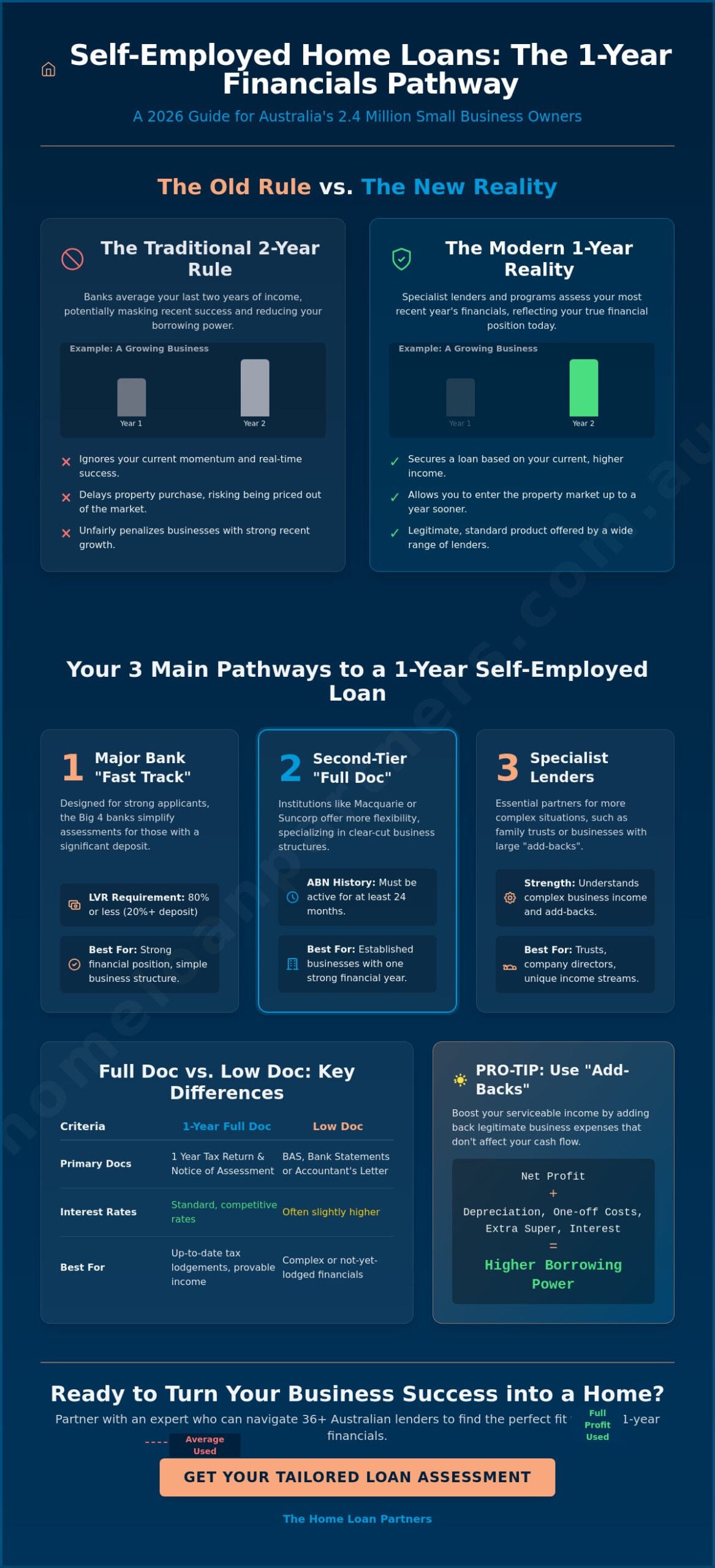
Traditional banks usually ask for two years of tax returns because they want to average your income. This protects the bank from “one-off” lucky years, but it often hurts growing businesses. If your turnover increased by 25% in the last 12 months, a two-year average actually masks your true borrowing power. The 1-year reality is often a more accurate reflection of your current financial health. We help you find lenders that look at your most recent figures to ensure your mortgage loan capacity is based on where your business is today, not where it was when you were just starting out.
Who Qualifies for a 1-Year Financial Assessment?
Qualification depends on the stability of your business and your professional background. While lenders are more flexible in 2026, they still look for specific markers of security. Most will require your ABN to have been active for at least 12 to 24 months, even if you only have one year of lodged tax returns. Your industry also plays a role in the assessment process.
- Sole Traders and Partners: You typically need a lodged personal tax return and a corresponding Notice of Assessment for the most recent financial year.
- Company Directors: Lenders will look at your company tax return and financial statements, focusing on net profit and any director wages.
- Industry Type: Professional services like IT consulting or healthcare often find it easier to qualify than businesses in highly seasonal industries like tourism or retail.
At Home Loan Partners, we’ve seen that borrowers with a solid 20% deposit often have the widest range of choices for a self employed home loan 1 year financials application. We guide you through the specific requirements for your business structure, ensuring you feel confident and supported at every step of the journey.
The Three Main Pathways for 1-Year Self-Employed Lending
Securing a self employed home loan 1 year financials depends heavily on your Loan-to-Value Ratio (LVR). This percentage represents the loan amount compared to the property value; it serves as the primary gatekeeper for which lender will welcome your application. In the 2026 market, three distinct pathways have emerged for business owners who are ready to move into a new home without waiting for a second year of tax returns.
- Pathway 1: Major Bank “Fast Track” programs. These are designed for borrowers with an LVR of 80% or less. If you have a 20% deposit, the Big 4 often simplify their assessment to focus on your most recent year of performance rather than a multi-year average.
- Pathway 2: Second-tier “Full Doc” lenders. Institutions like Macquarie or Suncorp often specialize in clear-cut business structures. They accept one year of financials provided your ABN has been active for at least 24 months.
- Pathway 3: Specialist and Non-conforming lenders. These partners are essential for complex business structures, such as discretionary trusts or companies with significant depreciation add-backs that traditional banks might struggle to interpret.
Major Bank 1-Year Assessments
The Big 4 banks usually maintain a strict 80% LVR threshold for anyone applying with only 12 months of financial data. To move forward, you’ll need to present your latest personal and business tax returns prepared by a qualified accountant. Australian lenders also require your latest ATO Notice of Assessment (NOA) to verify your declared income. The Notice of Assessment is the ultimate proof of income for Australian lenders. While global guides on the Best Mortgage Lenders For Self-Employed highlight various criteria, the NOA remains the gold standard for local verification because it confirms the figures you’ve officially lodged with the government.
Non-Bank and Specialist Lender Options
Non-bank lenders provide a vital alternative if you have a deposit smaller than 20%. These institutions are often more comfortable with a 10% or 15% deposit, even when you only have one year of tax returns available. You’ll likely see a trade-off in the form of interest rates that are 0.75% to 1.25% higher than standard products. However, these loans act as a powerful stepping stone. They allow you to secure your property now and refinance to a prime lender once you hit the two-year milestone. We focus on being your expert partner to ensure this transition is seamless and well-timed for your business growth.
Comparing 1-Year Full Doc vs. Low Doc Home Loans
Distinguishing between these two paths is the first step toward securing your property with confidence. While both options cater to business owners, a self employed home loan 1 year financials arrangement is technically a Full Doc loan. You’re providing the bank with verified tax returns, just for a shorter period than the traditional two-year requirement. This differs from a Low Doc loan, which relies on alternative evidence like Business Activity Statements (BAS) or bank statements because the formal tax returns aren’t yet lodged with the ATO.
Choosing the 1-year Full Doc route often leads to significant savings for your household budget. Because the lender can verify your income through official tax documentation, they view the application as lower risk. This transparency typically unlocks standard variable rates that are often 1.0% to 1.5% lower than those found in the Low Doc market. Additionally, Full Doc loans may allow for Lenders Mortgage Insurance (LMI), meaning you could potentially borrow up to 90% or 95% of the property value. Most Low Doc products cap the loan-to-value ratio (LVR) at 80% to mitigate risk, which requires you to provide a larger upfront contribution.
When Should You Choose a Low Doc Loan Instead?
Low Doc loans serve as a vital bridge for businesses with high growth but unlodged paperwork. If your most recent tax returns don’t reflect your current 2026 earnings, or if you haven’t finalized last year’s filing with your accountant, this is your best path. You’ll generally need 12 months of BAS or a signed Accountant’s Declaration to prove your cash flow. Keep in mind that lenders usually require a 20% to 30% deposit for these products to offset the lack of formal tax data.
The Power of 1-Year Full Doc
Securing a loan with one year of lodged tax returns is a game changer for your borrowing power. By providing your personal and business tax returns alongside the official Notice of Assessment (NOA), you prove your income is verified and stable. This simple shift in documentation can save you thousands of dollars over the life of your mortgage. Our team acts as your expert partner to ensure your 1-year financials are presented in the strongest light possible. To understand how professional guidance simplifies this process, read our article on Why Use a Mortgage Broker in Australia? today. We focus on the long-term journey, helping you transition from a specialized product to a standard rate as your business grows.
Strengthening Your Application: Beyond the Balance Sheet
Your tax return tells one story, but your actual borrowing capacity often tells another. When you apply for a self employed home loan 1 year financials, lenders don’t just glance at your taxable income and move on. They search for the true cash flow available to service a mortgage. In the 2026 lending environment, presenting a narrative of growth is just as vital as the numbers themselves. We work with you to ensure your application reflects your business’s true strength rather than just its tax-effective position.
Common “Add-Backs” That Boost Your Income
Lenders understand that business owners use legitimate deductions to reduce their tax liability. To find your real “serviceability” income, they allow us to “add back” certain expenses. Depreciation is the most common example. If you invested A$45,000 in new equipment or a vehicle in the last financial year, that’s a non-cash expense. It appears as a loss on your profit and loss statement, but it didn’t actually leave your pocket this year.
- Superannuation: Any contributions you’ve made above the mandatory guarantee are considered discretionary and can be added back to your income.
- One-off Expenses: If you paid a large, non-recurring legal fee or a rebranding cost in 2025, we can argue this won’t happen again.
- Interest Expenses: If you’re refinancing business debt or closing a high-interest equipment loan, that interest cost can be added back to increase your borrowing power.
The Importance of a Clean Financial Trail
Consistency creates confidence in the eyes of a credit assessor. They don’t just want to see a profitable year; they want to see a history of responsibility. Timely GST and tax payments serve as a primary trust signal. If your Integrated Client Account with the ATO shows no late fees or payment plans, you’re already ahead of 20% of other applicants. A credit assessor is looking for business vitality, not just a bottom-line figure. They want to see that your enterprise is healthy, growing, and capable of sustaining itself over the long term.
Managing your existing liabilities is equally critical. Car leases and equipment finance are common for Australian business owners, but they eat into your monthly surplus. In 2026, the APRA mandated 3% interest rate buffer remains a significant hurdle. This means if your actual mortgage rate is 6.2%, the bank tests your ability to pay at 9.2%. We help you review your current debts to see if consolidating or closing small business lines can significantly jump your borrowing limit.
If your income fluctuated between 2024 and 2025, don’t panic. A “letter of explanation” is a powerful tool. Whether you shifted your business model, took on a major new contract, or were affected by a specific industry event, we help you frame that story clearly. This transparency removes the guesswork for the lender and provides the reassurance they need to approve a self employed home loan 1 year financials. To see how your specific business expenses can be used to your advantage, speak with an expert partner today and let us guide you through the process.
How The Home Loan Partners Navigate the Lender Panel for You
Approaching your current bank for a self employed home loan 1 year financials is often the first instinct for business owners. It’s usually the biggest mistake you can make. Most major Australian banks use rigid credit scoring systems that automatically decline applications without two years of consecutive tax returns. A “no” from your current bank isn’t just a setback; it leaves a footprint on your credit file that can complicate future applications.
We take a different path. Our team compares the specific 1-year policies of over 36 lenders across Australia. We know which credit managers look favorably on growth trends in the 2025 and 2026 financial years. Instead of trying to fit your business into a standard box, we act as your advocate. We package your 1-year financials to tell a winning story, highlighting your business’s stability and future potential to the lenders most likely to approve your specific scenario.
Our support is a long-term commitment. If your current business age means you start with a specialist lender, we won’t leave you there. We provide a clear roadmap to transition you from a specialist rate to a prime market rate as your business matures. This proactive strategy ensures you don’t pay more interest than necessary over the life of your loan.
Customized Loan Structuring
We don’t just find you a loan; we structure it to protect your cash flow. For business owners, managing tax set-asides is a constant challenge. We prioritize features like offset accounts and redraw facilities. If you’re holding A$40,000 for an upcoming GST or income tax payment, placing it in an offset account ensures that money reduces your mortgage interest until the day you pay the ATO. This keeps your capital liquid for business expansion while lowering your personal debt costs. You can learn more about these features in our Redraw vs Offset Account support article.
Your Next Steps to Property Ownership
The most vital step in your journey is a professional pre-assessment. Before you spend your weekends at open homes, you need a realistic understanding of your position. We can provide a free borrowing power estimate based on your 2025/2026 tax data, giving you the confidence to bid when you find the right property. Our goal is to make the process of securing a self employed home loan 1 year financials as seamless and stress-free as possible.
Your Path to Australian Property Ownership
Securing a self employed home loan 1 year financials is no longer the hurdle it once was for local business owners. You have clear pathways through both Full Doc and Low Doc options, provided you present a strong application that looks beyond the basic balance sheet. By identifying legitimate “add-backs” like one-off expenses or non-cash items, you can often unlock higher borrowing power than a standard bank assessment might suggest.
Home Loan Partners acts as your dedicated guide throughout this process. We provide access to a panel of 36+ Australian lenders, including those with niche policies specifically designed for the self-employed sector. Our national team takes a client-centric approach, ensuring you aren’t just another transaction but a partner for the life of your loan. We do the heavy lifting to find a tailored solution that fits your unique 2026 financial goals. It’s time to move forward with confidence.
Book a free consultation with our self-employed lending specialists to start your journey today. We’re here to help you turn your business success into a place you can call home.
Frequently Asked Questions
Can I get a home loan if I have been self-employed for only 12 months?
Yes, you can certainly secure a mortgage after one year of trading. While many traditional banks prefer two years of history, several specialist lenders now offer a self employed home loan 1 year financials option for business owners with a solid first year of performance. We act as your partner to identify the specific lenders that recognize your hard work and business potential early in your journey.
What is the minimum deposit for a self-employed home loan with 1 year of financials?
You typically need a 20% deposit to access the widest range of lenders and avoid the cost of Lenders Mortgage Insurance. Some specialist programs allow for a 10% deposit if your business shows 15% year-on-year growth or strong cash flow. Providing a larger deposit reduces the lender’s risk and helps us negotiate a more favorable outcome for your specific situation.
Do I need my 2026 tax return lodged to apply for a home loan now?
You need your most recent tax return lodged with the Australian Taxation Office to verify your income. If you are applying in the second half of 2026, lenders will require your 2025-2026 financial year figures to be finalized. This documentation acts as the foundation of your application, and we guide you through exactly what your accountant needs to provide for a seamless process.
Will my interest rate be higher because I only have one year of records?
Your interest rate may be 0.5% to 1.2% higher than standard rates when you apply for a self employed home loan 1 year financials. Lenders view a shorter business history as an increased risk, which is reflected in the pricing. Our role is to find the most competitive rate available now and then help you refinance once you reach the two-year milestone to reduce your costs.
Can I use my 1-year financials to buy an investment property?
Yes, you can use your first year of business records to purchase an investment property in Australia. Lenders will include 80% of the projected rental income in your serviceability assessment to help boost your borrowing power. This strategy allows you to start building your wealth through property while your business is still in its early growth phase.
What happens if my income dropped slightly in the last quarter but the yearly total is high?
Lenders focus on your total annual net profit rather than minor month-to-month fluctuations. If your income decreased by 5% or 10% in the final quarter due to seasonal trends or a one-off capital purchase, we provide a clear explanation to the lender. This ensures the credit assessor looks at the steady 12-month trend rather than a short-term dip.
What is the difference between a sole trader and a company director for home loans?
Sole traders are assessed based on their individual net profit, while company directors are evaluated on their salary, dividends, and any profit retained within the business. If you own 100% of your company, we can often use the full business profit to support your application. We help you navigate these structures to ensure every dollar of your hard-earned income is counted by the bank.
How long does the approval process take for a self-employed borrower?
The approval process usually takes between 10 and 14 business days once we submit your completed application. This timeframe allows the lender’s credit team to perform a detailed review of your financial statements and tax returns. We stay by your side throughout these two weeks, managing all communication with the bank to keep your path to homeownership stress-free and predictable.