

What if the casual label on your payslip didn’t mean an automatic rejection from your bank? With 2.7 million Australians currently working in casual roles according to the Australian Bureau of Statistics, the traditional lending model is finally evolving to meet your needs. It’s common to feel frustrated when you have a consistent work history and a solid deposit, yet still worry that your income won’t be treated fairly. You’re likely looking for a way to secure home loans for casual employees australia without being forced into high interest rates or complex sub-prime products.
We’re here to act as your expert partner and simplify this process for you. This 2026 guide explains exactly how to prove your income stability and unlock the same competitive deals available to permanent staff. We will cover the specific lenders accepting six months of history, the documents you need to maximize your borrowing power, and the steps to ensure a seamless approval.
Key Takeaways
- Understand that casual employment is not a barrier to homeownership, as we guide you through how lenders assess income predictability over permanence.
- Discover how to navigate “income shading” and time-in-industry requirements to secure home loans for casual employees australia with confidence.
- Learn the proactive steps to refine your financial profile, from managing HECS debt to maintaining clean bank statements six months before you apply.
- Explore how partnering with an expert broker provides access to specialized credit policies that can turn a bank’s “no” into a successful approval.
- Gain clarity on the vital difference between standard pre-approvals and those tailored specifically for the unique needs of casual workers.
Can You Get a Home Loan as a Casual Employee in Australia?
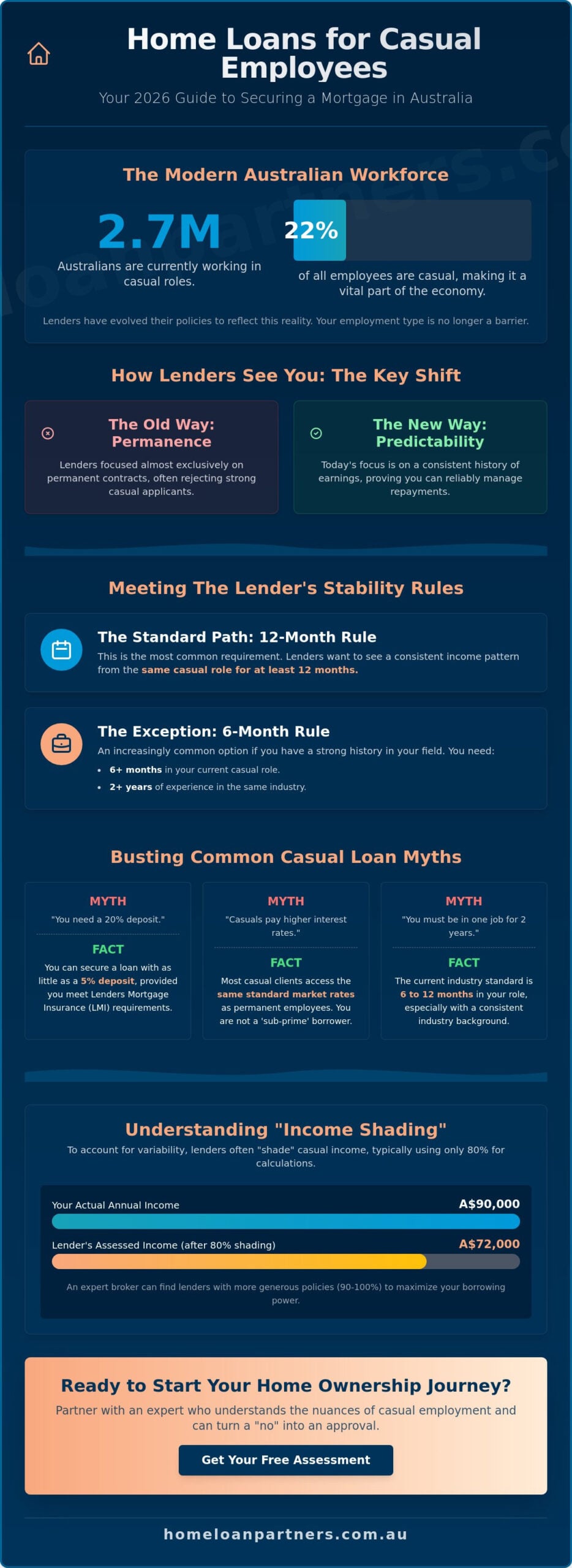
The short answer is yes. You can absolutely secure a mortgage while working in a casual capacity. While some believe that a lack of a permanent contract is an automatic rejection, the reality in 2026 is far more optimistic for casual workers. Australian lenders have significantly updated their criteria to reflect the modern workforce. At Home Loan Partners, we act as your expert guide to help you identify which banks see your casual status as a strength rather than a hurdle.
Lenders have shifted their primary focus from ‘permanence’ to ‘predictability.’ A credit assessor isn’t just looking for a full-time contract; they’re looking for a consistent history of earnings that suggests you can comfortably manage your repayments. This shift reflects the evolving nature of the Great Australian Dream, where modern career paths often include flexible or gig-based arrangements. If you can prove your income is stable, the door to homeownership remains wide open.
Your timeline for approval usually depends on two specific benchmarks. The ’12-month rule’ is the standard expectation, where lenders prefer to see you in the same casual role for at least a year. However, the ‘6-month exception’ is becoming increasingly common. If you have been in the same industry for at least two years, many lenders will consider your application after only six months in your current casual position. We partner with you to determine which timeline fits your current situation best.
The Reality of Casual Lending in 2026
Data from the Australian Bureau of Statistics shows that casual employment remains a significant pillar of the economy, accounting for roughly 22% of all employees. Because of this, banks have evolved their risk models. If you work in ‘essential services’ like nursing or teaching, lenders often provide even greater flexibility because these roles are in high demand. It’s also vital to distinguish between roles. While a casual employee has no guaranteed hours, a contractor often has a set end date, and part-time staff have pro-rata benefits. Knowing these distinctions helps us tailor your application for home loans for casual employees australia.
Common Myths About Casual Home Loans
- Myth: You need a 20% deposit if you’re casual. Fact: You can still access home loans for casual employees australia with a 5% deposit, provided you meet the requirements for Lenders Mortgage Insurance (LMI).
- Myth: Casuals always pay higher interest rates. Fact: Most of our casual clients access the same standard market rates as full-time employees. Being casual doesn’t mean you’re a ‘sub-prime’ borrower.
- Myth: You must be in the same job for two years. Fact: While longevity helps, 6 to 12 months is the current industry standard for most competitive products.
Our team works to simplify these complex financial requirements into a clear, manageable path. We do the heavy lifting by comparing policies across a wide panel of lenders to ensure your casual income is shaded correctly and your borrowing power is maximized. You don’t have to wait for a permanent contract to start your property journey.
How Lenders Assess Casual Income: The Stability Rules
Lenders prioritize “serviceability,” which is your practical ability to meet monthly repayments without financial strain. For home loans for casual employees australia, banks typically look for a 12-month history in your current role to establish a clear pattern of earnings. However, your previous employment history carries significant weight. If you’ve worked in the same industry for at least 2 years, lenders often view your income as more reliable even if you’ve recently changed employers. They will scrutinize your Year-To-Date (YTD) earnings on payslips and compare them against your most recent ATO Notice of Assessment to ensure your income isn’t just a temporary peak.
Banks essentially look for a “floor” in your weekly pay cycles. They want to see the minimum amount you consistently bring home. This data helps them feel confident that you won’t default during a week where shifts are scarce. Understanding these internal bank rules is a key part of the government guide to buying a house, which emphasizes the need for a clear financial paper trail before you apply for any significant credit.
The ‘Shading’ Mechanism Explained
Most lenders apply a “shading” buffer to casual earnings. This means they might only use 80% of your total income for their debt-to-income (DTI) calculations. If you earn A$90,000 annually, the bank’s software might treat your application as if you only earn A$72,000. This 20% reduction acts as a safety net for the lender against future hours being cut. You can mitigate this by providing 2 years of Group Certificates that show a steady or increasing income trend. When you partner with an expert broker, we can often find lenders who accept 100% of your income if you work in certain high-demand sectors. Securing home loans for casual employees australia often comes down to which bank’s shading policy is the most generous for your specific situation.
Industry-Specific Lending Niches
Lenders don’t treat all casual roles equally. Certain professions benefit from more flexible “niche” rules that recognize the nature of the work:
- Healthcare and Nursing: Many banks waive the 12-month requirement for casual nurses. If you’ve been in the job for 3 to 6 months and have a history in the medical field, you’re often viewed as highly employable and low risk.
- Education and Teaching: Relief teachers often face challenges during the December and January school holidays. Lenders who specialize in this sector will average your income over 52 weeks rather than just looking at the most recent, non-working month.
- Hospitality and Retail: These roles often see “peak season” surges. Lenders will look for a 2-year average to ensure that a busy Christmas period isn’t skewing your perceived borrowing power.
By presenting a case that highlights your industry longevity rather than just your current contract, we help lenders see the person behind the payslip. This steady, logical approach to your application ensures the bank focuses on your strengths rather than your employment status.
Strengthening Your Application: A Strategy for Casual Workers
Your journey toward homeownership begins long before you sign a contract. For those seeking home loans for casual employees australia, the preparation phase ideally starts 180 days before you submit an application. Lenders look for “clean” bank statements during this six-month window. This means avoiding overdrafts, missed payments, or excessive discretionary spending. We partner with you to audit these statements early, ensuring your financial behavior reflects the stability banks crave.
Reducing non-essential liabilities is your next priority. A A$30,000 car loan or a A$5,000 credit card limit can slash your borrowing capacity by tens of thousands of dollars. Even HECS/HELP debts and Buy-Now-Pay-Later services like Afterpay are factored into your debt-to-income ratio. We recommend closing unused credit accounts and paying down small debts to maximize your serviceability. It’s about showing the bank that your income is dedicated to your future home, not past consumption.
A larger deposit serves as a powerful risk mitigator. Aiming for a 20% deposit, which results in an 80% Loan-to-Value Ratio (LVR), often removes the need for Lenders Mortgage Insurance (LMI). This lower LVR signals to the bank that you have significant equity, making them more comfortable with your casual employment status. Proving continuity is equally vital. If you work across multiple casual roles, gathering 12 to 24 months of consistent earning evidence demonstrates that your “casual” status is a reliable career choice rather than a temporary fix.
The Essential Casual Document Checklist
- Tax Returns: Provide the last two years of ATO Notice of Assessments. This proves your earning history is stable over a long period.
- Employment Letter: Ask your employer to confirm your start date and state that your hours are regular and ongoing.
- Payslip Analysis: Ensure your year-to-date (YTD) figures match your claims. Lenders use these to verify that your income isn’t just a temporary spike during a busy season.
Managing Your Financial Footprint
Lenders scrutinize living expenses for casual workers with extra care. They want to see a clear savings habit where you consistently set aside a portion of your pay. This behavior offsets the perceived volatility of casual work. Be mindful of credit cards. Banks calculate your borrowing capacity based on the total credit limit, not just the balance you owe. Reducing a A$10,000 limit to A$2,000 can provide a vital boost to your application’s strength. We guide you through these adjustments to ensure your financial footprint tells a story of reliability and readiness.
Securing home loans for casual employees australia is entirely possible with the right lead time. By cleaning up your statements and minimizing debt, you present a professional profile that banks find difficult to ignore. Our team acts as your expert partner, navigating these requirements so you can focus on finding the right property.
Why a Mortgage Broker is Essential for Casual Employees
Securing home loans for casual employees australia requires more than just a standard application. It requires a strategy. While a full-time professional might walk into their local branch and get an approval based on a simple algorithm, casual workers often face immediate hurdles. This is where the expertise of a broker becomes your greatest asset. We provide access to over 36 lenders, ensuring that a “no” from one institution doesn’t end your homeownership journey.
One of the most critical factors we manage is “income shading.” Many traditional lenders don’t count your full earnings. Instead, they might only recognize 80% of your casual income to account for potential fluctuations. If you earn A$90,000 per year, a bank might assess you as if you only earn A$72,000. We know which specific lenders in the Australian market accept 100% of your casual income, which can significantly boost your borrowing power. We don’t just find a loan; we structure your story to show credit assessors that your “casual” role is actually a stable, long-term career path.
Bank vs. Broker: The Casual Worker Perspective
Banks often rely on rigid, automated scorecards. If you don’t fit their exact “permanent employee” box, the system may automatically decline your application. This creates a “one-shot” risk. Every time you apply for a loan and get rejected, it leaves a hard inquiry on your credit report. Too many of these can lower your credit score and make future approvals even harder.
Brokers take a different path. We use human relationships with credit managers and Business Development Managers (BDMs). We can pick up the phone and discuss your specific situation before a formal application is ever lodged. We also have access to niche lenders that specialize in irregular income or specific industries like nursing, teaching, or mining, where casual work is the standard. This targeted approach protects your credit score and increases your chances of a “yes” on the first try.
The Home Loan Partners Approach
At Home Loan Partners, we don’t just see you as a file. We act as your guide through the entire process. We start by deeply analyzing your employment history and your specific industry. If you have been a casual nurse for three years across different hospitals, we highlight that consistency as a strength rather than a weakness. Our goal is to make the process feel seamless and stress-free. You can learn more about our commitment to your journey by exploring Why use a Mortgage Broker in Australia?
We handle the heavy lifting, from negotiating competitive interest rates to ensuring your paperwork is polished and professional. We want to ensure you aren’t penalized with higher rates just because of your employment type. Our focus is on your long-term financial security and helping you achieve the Australian dream of owning your own home.
Ready to see what your borrowing power looks like? Contact our expert team at Home Loan Partners today for a tailored assessment of your options.
Your Path to Homeownership: Next Steps for Casuals
Securing home loans for casual employees australia requires a proactive approach that begins long before you attend an open house. Your first priority is obtaining a precise borrowing power assessment. Unlike permanent staff who have a fixed salary, your borrowing capacity fluctuates based on how a lender “shaves” or discounts your casual earnings. Getting this right early prevents the heartbreak of finding a home you can’t actually finance.
We recommend a strategy that focuses on stability and documentation. Lenders look for patterns. If you’ve maintained consistent hours over the last 12 months, you’re in a strong position. However, you must avoid making major life changes while your application is active. Staying in your current role is essential; switching employers mid-application can reset the clock on your eligibility, often requiring another 6 months of tenure before a bank will reconsider your income.
The Pre-Approval Process for Casuals
A pre-approval provides a “conditional” green light from a lender, which is vital for participating in auctions where contracts are often unconditional. For casual workers, this step is more rigorous because the bank must manually verify your year-to-date (YTD) income against your tax returns. In the context of casual income, serviceability refers to the lender’s assessment of whether your average earnings can comfortably cover loan repayments alongside a 3.00% interest rate stress test and your daily living costs.
Most Australian lenders issue pre-approvals for a 90-day period. It’s a common mistake to assume this is a guarantee. Your approval can be revoked if:
- Your average weekly hours drop significantly.
- You take out new credit, like a car loan or a “buy now, pay later” account.
- The lender’s internal policy for casual employment changes.
Start Your Journey Today
Homeownership is a realistic goal for casual employees who use a structured plan. You don’t need to find your way through the complex credit policies of dozens of banks alone. We act as your expert partner, translating the technical requirements of lenders into a clear, stress-free path forward. We’ll help you organize your payslips and highlight the strengths of your employment history to secure the best possible outcome for home loans for casual employees australia.
Ready to see what’s possible? Book a strategy session to review your casual income and identify the right lenders for your situation. You can book a consultation with The Home Loan Partners to begin your journey toward settlement with confidence.
Take the Next Step Toward Your Australian Home
Securing home loans for casual employees australia in 2026 isn’t about fitting into a rigid bank mold; it’s about presenting your unique financial story with clarity. While traditional lenders might hesitate at casual work histories, showing at least 6 to 12 months of consistent employment in the same industry significantly boosts your approval odds. Stability is the currency that matters most to credit assessors, and a well-prepared application makes all the difference in achieving a positive outcome.
You don’t have to navigate these complex lending criteria alone. We act as your expert partner, providing direct access to over 36 Australian lenders who understand and value non-traditional employment structures. Our team handles the heavy lifting, offering personalized guidance from your initial deposit strategy through to the moment you reach settlement. We’re committed to simplifying the process so you can focus on finding the perfect property without the usual stress.
Let us help you find the right home loan for your casual income. The Australian dream of homeownership is well within your reach, and we’re here to ensure your journey is both smooth and rewarding.
Frequently Asked Questions
How long do I need to be in my casual job to get a home loan?
Most Australian lenders require you to have been with your current employer for at least 12 months to qualify. However, some specialist lenders may consider your application after just 6 months if you can demonstrate a 2-year consistent history in the same industry. We act as your expert partner to identify which banks value your specific work history, ensuring your path to homeownership remains steady and predictable.
Can I get a home loan if I have multiple casual jobs?
You can certainly qualify for a home loan using income from multiple casual roles. Banks typically look for a 12 to 24-month track record of holding these positions simultaneously to ensure the combined income is stable. We guide you through the process of documenting every A$ earned, helping the lender see the full strength of your earnings. This tailored approach makes the complex task of proving multi-job stability feel seamless.
Will I pay a higher interest rate because I am a casual worker?
You won’t pay a higher interest rate simply because you’re a casual worker. If you meet the standard lending criteria, you’ll have access to the same competitive rates as permanent employees. While some lenders might apply a risk premium if your deposit is less than 20%, we help you compare options from over 30 lenders to find a deal that fits your long-term financial security and personal goals.
Does Lenders Mortgage Insurance (LMI) cost more for casual employees?
Lenders Mortgage Insurance costs are determined by your loan-to-value ratio and the total loan amount, not your employment status. If you have a deposit smaller than 20%, the LMI premium remains the same whether you’re casual or permanent. Our role is to guide you through these costs, ensuring you understand how your A$ deposit affects your total borrowing power without any hidden surprises or unnecessary stress during the process.
Can I use my casual income if I’ve only been in the role for 3 months?
Getting home loans for casual employees australia is possible with 3 months of tenure, though it requires a specific type of lender. While major banks often require a full year of service, certain specialist partners might accept a shorter duration if you have a 2-year continuous history in the same field. We act as your steady hand, navigating these niche lending policies to find a solution that respects your career progression.
What happens if my casual hours fluctuate significantly each week?
Lenders typically manage fluctuating hours by averaging your year-to-date income or looking at your lowest weekly earnings over a 6-month period. Most banks apply a 20% shading to casual income to account for potential variations in your schedule. We help you present your pay slips clearly, demonstrating to the bank that your earnings are reliable enough to support a long-term mortgage commitment while maintaining your lifestyle and financial comfort.
Can I buy an investment property while working casually?
You can buy an investment property as a casual employee by following the same core approval steps as an owner-occupier. Lenders will factor in 70% to 80% of the projected rental income alongside your casual wages to calculate your total borrowing capacity. This dual-income focus often strengthens your application, and we’ll partner with you to ensure the investment aligns with your broader strategy for future security and wealth creation.
How does the bank calculate my annual income if I’m casual?
Banks generally calculate your annual income by taking the lower figure between your most recent group certificate and your current year-to-date average. This conservative 2-year assessment ensures you aren’t overcommitting financially. By translating these complex bank calculations into plain English, we provide a clear view of your borrowing power, making the journey toward your Australian dream of homeownership feel much more manageable and less daunting for you.