

What if the same “big brand, big savings” logic you use every time you step into a chemist warehouse could actually shave years off your mortgage? You likely already know the frustration of watching the cost of living climb in 2026, where even a simple A$10 grocery item feels like a luxury. It’s exhausting to feel as though you’re paying a loyalty tax to a big bank that doesn’t reward your years of commitment with better rates. You deserve the same transparency and value in your home loan that you expect when shopping for your daily health needs.
We’ll show you how to apply a savvy discounter mindset to your mortgage to potentially save thousands in interest. We’ll simplify the complex financial jargon and help you identify a warehouse style deal that suits your specific goals. You’ll discover a clear, stress-free path to reducing your monthly outgoings and securing your financial future with a partner who truly understands the Australian market. By the end of this article, you’ll have a practical roadmap to help you stop overpaying and start building your equity faster.
Key Takeaways
- Discover how to apply the same high-value, low-margin mindset used at chemist warehouse to your mortgage to unlock significant long-term interest savings.
- Learn why focusing on the “Mortgage Effect” can save your household A$500 or more per month, far outweighing smaller daily budgeting wins.
- Identify the “Loyalty Tax” in Australian banking and learn why you should never settle for a lender’s standard “RRP” interest rate.
- Gain a clear two-step strategy to assess your current rate and Loan-to-Value Ratio (LVR) to strengthen your bargaining position with lenders.
- Understand the benefit of having an expert partner to guide you through complex lending options for a more tailored and secure financial future.
The Chemist Warehouse Philosophy: Why Australians Crave Value in 2026
Australians have a unique relationship with value. We see this every time we step into a chemist warehouse. The model is simple: move massive volumes of stock at thin margins to ensure the customer gets a better deal. This “Warehouse” philosophy has created a significant Value Gap, often saving consumers between 30% and 50% compared to traditional retail pharmacies. In 2026, this mindset is no longer just about sunscreen or vitamins. It has evolved into a fundamental financial strategy that homeowners are applying to their largest debt.
The psychology of the savvy shopper is rooted in a deep-seated dislike of overpaying for essentials. We don’t mind spending on quality, but we refuse to pay a premium for the exact same product we can find elsewhere for less. This logic is moving from the medicine cabinet to the mortgage. As your partners in the home ownership journey, we see that the most successful borrowers are those who hunt for “warehouse prices” on their interest rates and fees. They understand that a dollar saved on a monthly repayment is just as valuable as a dollar saved at the checkout.
The Rise of the Savvy Australian Consumer
Cost-of-living pressures in 2026 have fundamentally shifted how we manage our households. With inflation figures remaining a core focus for the Reserve Bank of Australia, price transparency is now a non-negotiable requirement for retail and finance alike. Borrowers now demand the same clarity from their banks that they get from a price tag on a shelf. Value-Based Shopping is the intentional choice to prioritize long-term utility and price efficiency over brand prestige or convenience for every major purchase in 2026.
Big Brands vs. Big Savings
There is a specific comfort in knowing you aren’t paying a premium for a label. Australians trust established brands, but they trust them even more when they offer deep discounts. This trust is built on the realization that the product inside the box is identical, whether it comes from a boutique storefront or a high-volume discounter. We help you apply this same logic to your home loan. A mortgage from a major lender or a boutique provider often serves the same purpose, but the price you pay for that capital can vary wildly. Transitioning from small retail savings to “big ticket” financial savings is the most effective way to secure your future. We guide you through this process, ensuring you get the big-brand security without the big-brand price tag.
Budgeting Beyond the Basket: Managing Cost of Living
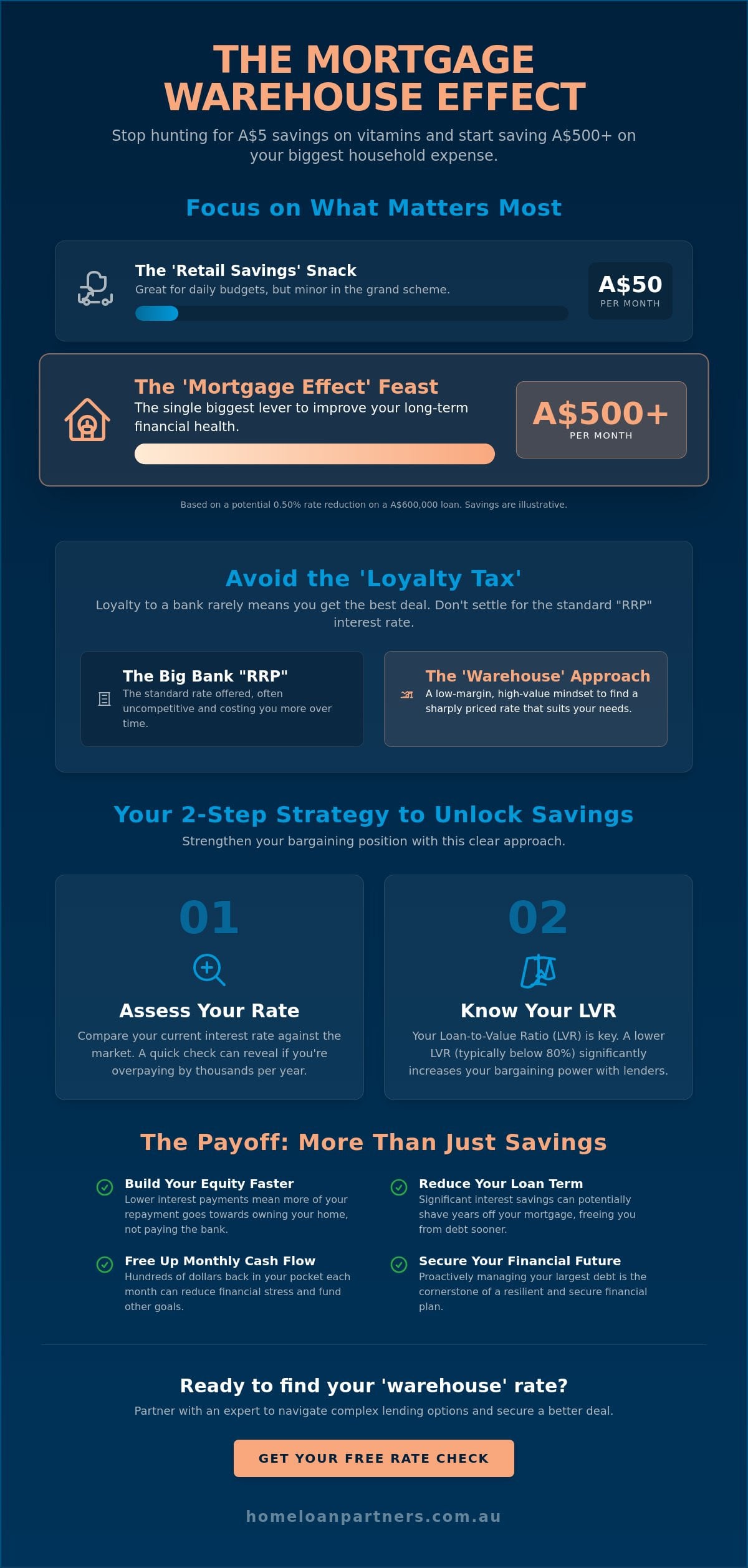
Many Australians take pride in finding the best deals on daily essentials. We often hear about the ‘Latte Effect’, the idea that skipping a daily A$5 coffee leads to wealth. While small habits help, the ‘Mortgage Effect’ is far more powerful for your long term security. A typical household might save A$50 a month by shopping at chemist warehouse for vitamins and prescriptions. This is a great start, but it pales in comparison to the A$500 a month you could potentially save by securing a 0.50% lower interest rate on a A$600,000 loan.
Preparing a household budget for 2026 requires looking past current prices. With the Reserve Bank of Australia (RBA) maintaining a focus on bringing inflation back to the 2% to 3% target range, your budget needs to be resilient. Hidden costs often lurk in recurring expenses like unused streaming services, high insurance premiums, or ‘lazy’ interest rates that have crept up over time. Auditing these monthly outgoings ensures your money works as hard as you do. By identifying these leaks, you create a buffer that protects your family from future economic shifts.
Essential vs. Discretionary Spending
Your monthly trip to chemist warehouse falls into essential spending because health is a non-negotiable priority. However, your mortgage is your largest essential expense. It deserves the highest level of scrutiny. Reviewing your bank statements helps identify ‘lazy’ spending, such as gym memberships you no longer use or automated subscriptions that offer little value. We recommend partnering with an expert to review your largest debts and ensure your essential costs remain manageable and competitive in the current market.
The Compound Effect of Small Savings
Small wins create momentum. Saving on prescriptions and skincare items contributes to a larger house deposit or provides a buffer for minor interest rate fluctuations. These habits build a discipline that translates well to larger financial goals. Consistently saving A$20 every week and placing it into a high-interest offset account can reduce your total loan term by over a year and save you thousands in interest charges. This steady approach turns modest retail savings into a significant financial advantage over the life of your loan, proving that consistency is the key to homeownership.
The ‘Mortgage Warehouse’ Concept: Comparing Lenders Like Products
Walking into a chemist warehouse feels different because you know you aren’t paying the Recommended Retail Price (RRP). You should treat your home loan with that same level of scrutiny. Most Australians treat their mortgage as a set-and-forget commitment; however, banks view it as a retail product with a profit margin. Paying the standard variable rate is essentially paying a retail price for money. By adopting a warehouse mindset, you look past the branding of the Big 4 banks to find the underlying value. A mortgage broker acts as your warehouse manager, sorting through the inventory of dozens of lenders to find the specific product that fits your financial profile.
We believe you shouldn’t have to pay a premium for a brand name on your bank statement. Our team scans the market to ensure you’re getting a wholesale-style deal rather than a marked-up retail offer. This proactive approach ensures your loan remains competitive long after the initial paperwork is signed.
Why Your Bank Isn’t Rewarding Your Loyalty
Your bank probably hasn’t called you lately to offer a lower interest rate. This lack of communication is due to “back-book” pricing. In the Australian market, lenders reserve their sharpest rates for new customers to grow their market share. This leaves loyal, existing customers on the “back-book” paying a Loyalty Tax. Statistics from the Reserve Bank of Australia consistently show that existing borrowers pay an average of 0.50% more than new borrowers for the exact same product.
If you’re currently on a honeymoon rate, your costs will likely jump significantly once that introductory period ends, often after the first two years of the loan. We help you avoid this trap by initiating pricing requests on your behalf. This process forces your current lender to match the market without you needing to handle a stressful or confrontational negotiation. It’s about making sure your bank works as hard for you as you do for your mortgage.
Wholesale Rates vs. Retail Rates
Think of a mortgage broker as your guide to a vast distribution center of finance. Instead of having one shelf of products like a local bank branch, we access a panel of over 36 lenders. This includes wholesale and non-bank lenders that don’t maintain expensive physical branches or massive advertising budgets. These lenders often provide “warehouse” style pricing because their overheads are significantly lower than the Big 4.
- Broad Selection: Access to 36+ lenders ensures you aren’t limited to one credit policy.
- Tailored Fit: Wholesale lenders often have more flexible criteria for self-employed borrowers or unique property types.
- Cost Transparency: We strip away the marketing fluff to show you the real cost of the credit.
While a standard Big 4 bank rate might sit at 6.75% for a long-term customer, a negotiated broker rate through a specialized wholesale lender could be as low as 6.09%. Our role as your partner is to find these hidden efficiencies and bring them to your front door. We handle the heavy lifting of the comparison process so you can focus on the security of your new home.
How to ‘Shop Around’ for Your Mortgage Safely
Securing a better deal on your mortgage requires the same tactical approach you use when hunting for value at chemist warehouse. You wouldn’t pay full price for vitamins if a discounted option sat on the next shelf; your home loan deserves that same level of scrutiny. Taking a proactive stance ensures you don’t stay loyal to a bank that no longer rewards your business.
- Step 1: Conduct a ‘Home Loan Health Check’. Look at your current statement to find your exact interest rate. Many homeowners are surprised to find they’re paying a “loyalty tax” of 0.5% or more above what the bank offers new customers.
- Step 2: Calculate your Loan-to-Value Ratio (LVR). This figure is your bargaining chip. If your home is worth A$850,000 and your mortgage is A$400,000, your LVR sits comfortably at 47%. Lenders reserve their sharpest discounts for borrowers with an LVR below 80%.
- Step 3: Compare against the ‘Warehouse’ market leaders. Scan the market for rates that beat your current one. In early 2026, even a 0.25% difference can save a typical Australian household over A$2,000 in annual interest.
- Step 4: Engage a partner for the heavy lifting. You don’t have to spend hours on hold with banks. A dedicated mortgage partner handles the paperwork and negotiations, acting as your guide through the entire transition.
- Step 5: Review your offset and redraw facilities. A low rate is excellent, but the right features help you pay off the principal faster. Ensure your new loan allows you to park every spare dollar where it reduces your interest daily.
Finding a better deal shouldn’t be a source of stress. Just as you trust the experts at chemist warehouse to provide the right products for your health, you can rely on professional guidance to protect your financial well-being.
The Role of Equity in Your Bargaining Power
Property values across Australia have seen steady shifts leading into 2026. This growth in value translates directly into equity, which is your most powerful tool for negotiation. High equity levels allow you to adopt a “bulk buy” strategy, where you use the value of your home to secure lower interest tiers or even fund strategic investments. Before you start shopping, obtain an accurate valuation. This document proves to potential lenders that you’re a low-risk borrower who deserves their premium rates.
Avoiding the Pitfalls of Switching
Refinancing isn’t free, so you must account for the entry and exit costs. Most Australian banks charge a discharge fee, which typically ranges from A$300 to A$600. If you’re currently in a fixed-rate term, break costs can be significant, so timing is everything. Remember that the “cheapest” headline rate isn’t always the best choice if it lacks essential features. An offset account can often save you more over the life of the loan than a slightly lower rate without one. Check our Refinancing Guide for a detailed cost breakdown.
Ready to see how your current deal stacks up? Book your free home loan health check today and let us help you find the savings you deserve.
The Home Loan Partners: Your Expert Guide to Better Rates
Just as you wouldn’t walk into a chemist warehouse and grab the first product you see without checking if it suits your specific health needs, your home loan requires a specialist’s eye. Generic online calculators provide a rough estimate, but they can’t account for the nuances of your financial history or your long-term goals. We position ourselves as your expert partner, translating complex bank jargon into a clear, actionable plan. We do the heavy lifting by analyzing your offset potential and equity, ensuring your loan structure works for you rather than the bank. Our relationship is a long-term journey; we continue to review your rate every 12 to 18 months after settlement to ensure you’re never paying more than necessary. This proactive approach helps our clients avoid the “loyalty tax” that often hits homeowners who stay with the same lender for too long.
Access to Over 36 Lenders Nationwide
Having access to a panel of over 36 lenders across Australia is the most effective tool for driving down your interest rate. This variety allows us to look beyond the standard offerings of the major banks to find products that offer genuine value and lower fees. Our commitment to unbiased guidance means we prioritize your financial health over any single lender’s sales targets. We manage the entire application process, often saving our clients 15 to 20 hours of personal research and administrative work. This stress-free approach means you don’t have to spend hours on hold with bank call centers or navigate confusing digital portals alone. We act as the steady hand that guides you through the paperwork, ensuring every detail is correct before submission to give you the best chance of a fast approval.
Start Your Savings Journey Today
You can begin your path toward a more efficient mortgage by booking a consultation today. We don’t charge any upfront broker fees for our standard residential service, which removes the financial barrier to getting professional advice. The first step involves a comprehensive review of your current financial position and a comparison against the latest market rates available in the Australian landscape. If you want to bring the same discount-driven mindset you use at chemist warehouse to your largest monthly expense, we’re here to guide you. Taking this step now can result in a more secure financial future for your family. Partner with us to find your best rate and take control of your home loan today.
Take Control of Your Mortgage Savings Today
Applying a savvy discounter mindset to your home loan is one of the most effective ways to manage the 2026 cost of living. Just as you look for value at chemist warehouse for your daily essentials, your mortgage requires the same regular comparison to ensure you aren’t overpaying. Most Australians can save thousands over the life of their loan by simply moving away from a “set and forget” mentality. We provide access to more than 36 Australian lenders, giving you a comprehensive view of the market without the stress of doing the research yourself.
Our role is to act as your expert partner, translating complex bank jargon into a clear plan for your future security. Whether you’re a first home buyer or looking to refinance, we’ll guide you through every step with professional, unbiased advice tailored to your specific needs. We offer a national service that never loses its personal touch, ensuring you feel supported from application to settlement and beyond. It’s time to stop wondering if there’s a better deal out there and start making your home loan work harder for you.
Book your free mortgage health check with The Home Loan Partners
Your journey toward a more affordable home loan starts with a single conversation, and we’re ready to help you every step of the way.
Frequently Asked Questions
Is it worth refinancing my home loan in 2026?
Yes, refinancing in 2026 is a smart move if you want to capture the lower rates predicted by major Australian economists for that period. If your current interest rate sits 0.75% above the lowest market offers, you’re likely overpaying. We’ll partner with you to calculate the exact break-even point so your move is financially sound.
How much can I actually save by switching lenders?
You can often save between A$3,000 and A$4,500 annually by switching to a lender with a rate that’s 0.50% lower on a A$500,000 balance. Much like the bulk savings you expect at chemist warehouse, these small margins create a massive impact over time. We focus on finding these high-value opportunities to keep more money in your bank account.
Does a mortgage broker charge a fee for their service?
In Australia, most mortgage brokers provide their services at no direct cost to you because they receive a commission from the lender you choose. This allows you to access expert advice and a wide range of loan products without paying an upfront fee. We pride ourselves on being a transparent partner throughout your entire home ownership journey.
What is the ‘Loyalty Tax’ and am I currently paying it?
The ‘Loyalty Tax’ refers to the extra interest banks charge long-term customers while offering cheaper rates to attract new ones. Statistics from the Reserve Bank of Australia indicate that new customers often pay 0.40% less than existing borrowers. If you haven’t negotiated your rate in the last 24 months, you’re almost certainly paying this hidden fee.
Can I get a ‘warehouse’ rate if I am a first home buyer?
First home buyers can access high-discount ‘warehouse’ rates by looking beyond the major four banks to smaller, more agile lenders. These providers operate with lower costs, similar to the chemist warehouse business model, and pass those savings directly to you. We’ll guide you through the eligibility criteria to ensure you secure a competitive deal safely.
How long does the process of switching home loans take?
The transition to a new home loan typically takes 28 to 42 days to complete. This timeframe covers the valuation of your property, the formal approval process, and the mandatory notice period required by your current lender. We manage the communication between all parties to keep the process moving steadily toward your settlement date.
What documents do I need to start a mortgage comparison?
To begin a detailed comparison, you’ll generally need your two most recent payslips and your most recent 90 days of home loan statements. We also require a valid form of identification like a passport or driver’s license. These documents help us provide a tailored assessment that reflects your true borrowing power across our panel of 30+ lenders.
Will shopping around for a loan hurt my credit score?
Looking at options won’t damage your credit, but making three or more formal applications in a 90 day period can negatively impact your score. We use a single, comprehensive review process to identify the best fit for your needs before any official enquiry is lodged. This careful method protects your financial reputation while we hunt for a better deal.