

What if the traditional 20% deposit requirement you’ve been told is essential was actually the biggest myth holding you back from the 2026 property market? Learning how to invest in real estate australia with little money is no longer a niche secret; it’s a strategic necessity as median house prices in cities like Perth surged by over 21% in 2024. You’re likely tired of watching your savings grow slowly while the rent trap feels like a permanent residence. It’s natural to feel anxious about your borrowing capacity or confused by the hidden costs of Lenders Mortgage Insurance.
We believe your path to property should be clear and stress-free. This guide reveals the proven financing strategies and creative ownership structures that allow you to enter the Australian market without a massive deposit. You’ll discover five specific low-money entry points and learn how a dedicated mortgage partner identifies flexible lenders to suit your goals. We’ve mapped out the exact steps you need to move from tenant to title deed holder with confidence.
Key Takeaways
- Understand why a 5% to 10% deposit is the new standard for savvy investors and how to redefine your investable capital for the 2026 market.
- Discover proven strategies for how to invest in real estate australia with little money, including the benefits of rentvesting and using LMI to enter the market sooner.
- Explore alternative paths to property ownership, such as leveraging existing home equity or forming strategic joint ventures to share costs and risks.
- Master a clear 5-step roadmap to assess your financial health and establish the true borrowing capacity needed for your first investment.
- Learn how a dedicated partner can guide you through tailored loan structures and niche lender policies to secure your long-term property goals.
What Does ‘Little Money’ Mean in the 2026 Australian Property Market?
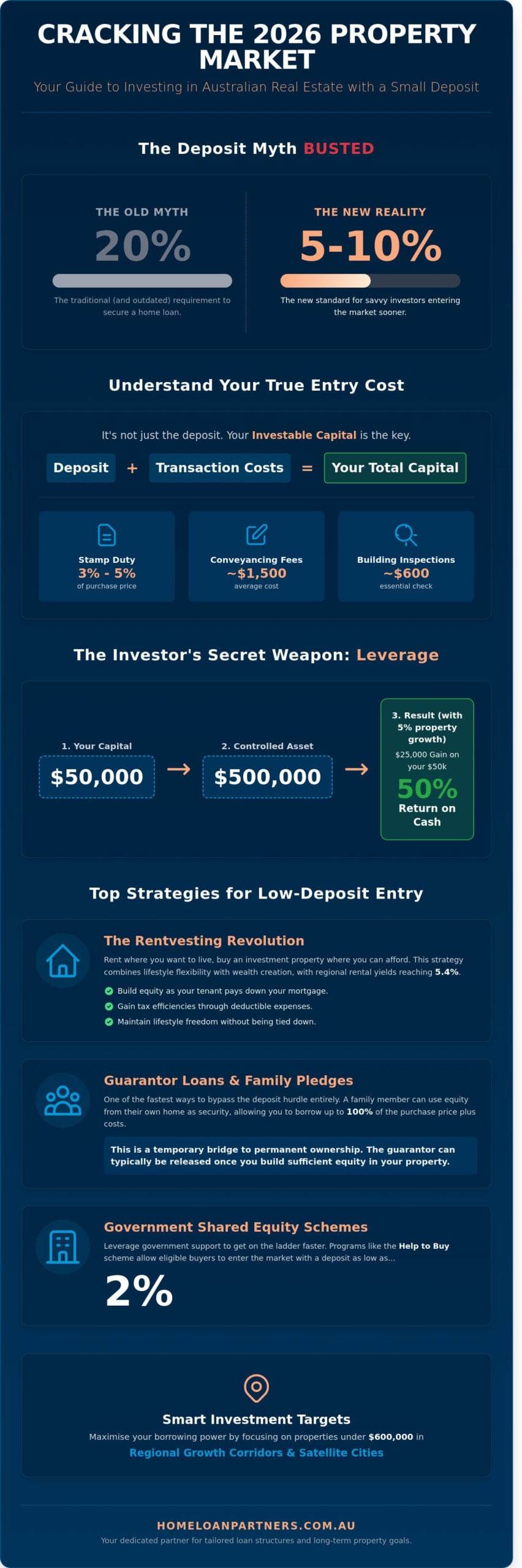
The old rule of thumb that you need a 20% deposit to start your portfolio is no longer the gold standard. In 2026, the landscape has shifted. Savvy investors now focus on entry points of 5% to 10% through various low-deposit schemes and lender’s mortgage insurance (LMI) strategies. Learning how to invest in real estate australia with little money starts with redefining your budget. It’s about your “Investable Capital,” which represents the total cash you have for a deposit plus transaction costs like stamp duty, rather than just a raw savings figure.
Property remains a powerhouse in the Australian economy. Even with interest rate fluctuations seen throughout 2024 and 2025, the underlying demand for housing keeps values resilient. Investors choose this asset class because it provides a tangible hedge against inflation. By understanding negative gearing and other tax benefits, you can manage your cash flow effectively while your asset grows in value over the next decade. Our team sees this as a long-term partnership between you and your portfolio.
The Reality of Entry Costs in Australia
You need to look beyond the sticker price. Hidden costs can consume a large portion of your initial capital. Stamp duty typically adds 3% to 5% to your purchase price, while conveyancing fees average $1,500 and building inspections cost roughly $600. Your borrowing power often matters more than your actual bank balance. Lenders prioritize your steady income and ability to service the debt. If you’re looking for your first investment, target regional growth corridors or satellite cities where entry prices remain below $600,000.
Leverage: The Investor’s Secret Weapon
Leverage is the use of borrowed capital to increase the potential return of an investment. This is the primary reason why how to invest in real estate australia with little money is a viable strategy. When you put down $50,000 to buy a $500,000 property, you control the entire asset. If that property grows by 5%, you’ve made a $25,000 gain on your $50,000 investment. That’s a 50% return on your cash. It’s vital to distinguish “good debt” used for income-producing assets from “bad debt” used for lifestyle purchases like cars or holidays.
Top Strategies to Invest in Property with a Small Deposit
Entering the property market doesn’t always require a massive windfall or a decade of strict saving. In 2026, savvy investors are using specific pathways to secure assets earlier. If you’re wondering how to invest in real estate australia with little money, the secret lies in choosing the right structure rather than waiting for the perfect bank balance. We see many clients successfully enter the market with deposits as low as 5% by utilizing professional guidance to navigate the lending landscape.
The Rentvesting Revolution
Rentvesting has become a cornerstone strategy for Australians who want to build wealth without sacrificing their lifestyle. This approach involves renting a home in an area where you want to live, such as a capital city hub, while buying an investment property in a more affordable high-growth suburb. In 2026, rental yields in regional hubs have reached 5.4%, often covering a significant portion of the mortgage repayments.
- Equity growth: You build wealth through capital gains while someone else pays down your debt.
- Tax efficiency: Expenses like interest, property management fees, and repairs are typically tax-deductible.
- Lifestyle flexibility: You aren’t tied to a mortgage in a location that doesn’t suit your current career or social needs.
Guarantor Loans and Family Pledges
A guarantor loan is one of the fastest ways to bypass the deposit hurdle. By having a family member offer a portion of their own home equity as security, you can often secure a loan for 100% of the purchase price plus costs. This removes the need for a cash deposit entirely. For those who don’t have access to family equity, the Australian Government’s Help to Buy program provides an alternative through shared equity, allowing eligible buyers to enter the market with just a 2% deposit.
We work closely with families to ensure these arrangements are safe for everyone involved. Usually, once your property value increases or you’ve paid down enough of the principal to reach an 80% loan-to-value ratio, you can apply to release the guarantor from the loan. It’s a temporary bridge that creates a permanent path to ownership.
Strategic Use of Lenders Mortgage Insurance (LMI)
Many investors view LMI as a wasted cost, but it’s actually a powerful tool to accelerate your timeline. If a $600,000 property grows by 7% in one year, that’s a $42,000 increase in equity. If the LMI fee to buy that property today with a 10% deposit is $12,000, paying the fee is far more profitable than waiting another year to save a 20% deposit. This “cost of delay” is a critical metric we help our clients calculate.
Certain professionals, including doctors, lawyers, and accountants, may even qualify for LMI waivers at 90% loan-to-value ratios. You can also capitalize the LMI into your loan, meaning it’s added to the total balance rather than paid upfront. If you’re ready to see what’s possible, you can explore your borrowing options with our team to find a tailored solution that fits your current budget.
Non-bank lenders and niche credit providers also offer low-deposit investment loans in 2026 that traditional big banks might overlook. These providers often have more flexible servicing criteria, making it easier to understand how to invest in real estate australia with little money while still maintaining a healthy cash flow for your future goals.
Alternative Paths: Fractional Investing and Equity
You don’t always need a massive pile of cash sitting in a savings account to enter the market. Learning how to invest in real estate australia with little money often involves looking at assets you already control or people you already trust. By shifting your focus from “how much do I have” to “how much can I access,” you open doors that remain closed to traditional buyers. These alternative paths require careful planning, but they offer a steady way to build a portfolio faster than saving a 20% deposit on a single income.
Unlocking the Power of Equity
If you already own a home, you might be sitting on a gold mine without realizing it. Usable equity is the difference between 80% of your home’s current market value and your outstanding loan balance. For example, if your property is valued at $850,000 and your mortgage is $400,000, your usable equity is $280,000. This “Equity Pull” strategy allows you to use that value as a deposit for an investment property. It’s a seamless way to grow your wealth without dipping into your daily cash flow. To get started, you can contact a partner to value your current home and determine your exact borrowing capacity.
Joint Ventures and Co-Buying
Pooling resources with friends or family is a practical solution to the high entry costs of Australian real estate. When two people earning the 2024 average full-time salary of $98,000 combine their incomes, their borrowing power often doubles. You can structure this through a “Tenants in Common” agreement, which allows you to own specific, unequal shares like 70/30 or 60/40. This differs from “Joint Tenants,” where everyone owns the whole property equally. A legal co-ownership agreement is essential. It should outline what happens if one person needs to sell their share or how to handle a $5,000 emergency repair. This clarity prevents future disputes and protects your personal relationship.
For those with even smaller amounts of capital, fractional investing through property funds provides a way to buy “slices” of a property for as little as $2,500. You receive a portion of the rental income and capital growth without the stress of being a landlord. Another sophisticated option is using a Self-Managed Super Fund (SMSF). While this allows you to buy property using your retirement savings, it’s a complex path that involves strict borrowing rules you should understand before proceeding — our guide on lending to SMSF and the 2026 borrowing rules covers the essential compliance requirements in detail. The setup costs can exceed $3,000; however, the tax rate on rental income is capped at a low 15%. This makes it a powerful long-term play for those looking to secure their future through property.
The 5-Step Roadmap to Your First Investment Property
Building a property portfolio is a marathon, not a sprint. When you’re learning how to invest in real estate australia with little money, following a disciplined sequence prevents expensive mistakes. Most successful investors don’t start with a luxury apartment in Sydney; they start with a logical plan. We’ve distilled the process into five actionable steps to move you from saving to settlement.
- Step 1: Financial Audit. Review your credit score and current savings. Lenders typically look for a score above 650 to offer the most competitive rates.
- Step 2: Expert Consultation. Partner with a mortgage broker to define your limit. This prevents you from falling in love with properties you can’t afford.
- Step 3: Strategic Selection. Identify regions where the entry price is low but the growth potential is high, such as emerging regional hubs in Queensland or Western Australia.
- Step 4: Rapid Pre-approval. Secure a formal pre-approval letter. These usually last 90 days and give you the confidence to sign a contract on the spot.
- Step 5: Settlement and Management. Finalize the loan and hire a professional property manager to protect your asset and maximize your 2026 tax deductions.
Establishing Your Borrowing Power
Your journey begins with a hard look at the numbers. Knowing your limit is the first real step because it dictates your entire search area. You can use our borrowing power calculator to get a preliminary estimate in under two minutes. Banks evaluate your capacity based on your debt-to-income ratio, usually capped at 6 times your annual earnings. They also scrutinize living expenses, so reducing your discretionary spending for three months before applying can significantly boost your loan amount.
Finding the Right Investment Grade Property
There’s a massive gap between a cheap property and an investment-grade one. A cheap property might stay vacant for weeks, while an investment-grade asset in a high-demand area attracts quality tenants immediately. Look for vacancy rates below 1.5% and areas with committed infrastructure projects, like the $1.8 billion Western Australian road upgrades scheduled for completion by 2026. Data should always drive your choice. Emotions lead to overpaying; logic leads to capital growth. We’ll help you focus on the yields that matter for your long-term security.
Ready to see what’s possible for your future? Speak with a dedicated lending partner today to calculate your true borrowing capacity.
How The Home Loan Partners Guide You to Market Entry
Entering the property market requires more than just a savings account; it demands a strategic gateway to the right credit products. At The Home Loan Partners, we provide access to a panel of over 36 lenders, ranging from the big four banks to specialized boutique firms. This diversity is essential for those learning how to invest in real estate australia with little money, as niche lenders often offer policies that accommodate 5% deposits or utilize specific government guarantee schemes that larger institutions might overlook. We find the specific policies that fit your unique financial profile, ensuring you aren’t limited by the rigid criteria of a single bank.
We don’t just find you a loan. We build a framework for your future wealth. Our team focuses on tailored loan structuring that prioritizes your 10 year investment strategy rather than just looking at a 12 month interest rate. Because we work for you rather than the banks, our advice remains completely unbiased. We negotiate directly with credit assessors to secure approvals that might otherwise be rejected by automated systems. Our commitment extends far beyond the day you get your keys. We conduct annual reviews to ensure your interest rate remains in the bottom 25% of the market, helping you recycle equity faster to buy your next property.
The Advantage of a Professional Mortgage Broker
We translate complex bank jargon into a clear investment path you can actually follow. Instead of getting lost in terms like LVR or DTI, you get a direct explanation of how these numbers impact your borrowing power. Our role is to act as your advocate during negotiations, pushing for higher valuations or waived fees. We view ourselves as your long-term partner. This means we help you grow from your first unit to a multi-property portfolio by managing your credit profile with precision and care. We’ve seen that clients who use a broker are 15% more likely to secure a loan that meets their specific investment goals compared to those who go direct to a bank.
Your Next Steps Toward Property Wealth
The 2026 property market offers unique opportunities for those who move early. You don’t need a million-dollar windfall to start your journey; you just need a solid plan and the right team behind you. By assessing your options today, you can position yourself to take advantage of projected capital growth cycles in emerging suburbs. Understanding how to invest in real estate australia with little money starts with a simple conversation about what’s possible. Take the first step toward securing your financial future and building a legacy. Book a consultation with The Home Loan Partners today to see exactly what your borrowing capacity looks like.
Take Your First Step Toward Property Ownership
The 2026 Australian property market demands a tactical approach. By utilizing 5% deposits or fractional ownership, you can build wealth even without a massive bank balance. Success depends on following a structured 5-step roadmap that prioritizes your financial readiness and targeted research. Mastering how to invest in real estate australia with little money is the essential first step toward your long-term financial security.
You don’t have to navigate these complex financial waters alone. Our team provides direct access to products from over 36 Australian lenders, ensuring your strategy is as unique as your personal goals. We provide expert guidance for first-time investors through a national service that puts your needs at the center of every decision. We’ll handle the heavy lifting so you can focus on finding the right property for your future.
Start your investment journey with a tailored loan strategy from The Home Loan Partners
Your dream of property ownership is closer than you think, and we’re ready to be your steady partner on this journey.
Frequently Asked Questions
Can I really buy an investment property with a 5% deposit in Australia?
Yes, you can secure an investment property with a 5% deposit by using Lenders Mortgage Insurance (LMI) or a family guarantor. While most big four banks like ANZ prefer a 20% cushion, they’ll often approve 95% loans for specific professionals. This is a key strategy for how to invest in real estate australia with little money because it lets you enter the market 3 years earlier. We’ll partner with you to calculate if the LMI cost outweighs potential gains.
Is it better to save for a 20% deposit or pay LMI now?
Paying Lenders Mortgage Insurance (LMI) now is often more financially sound than waiting to save 20% if property prices are rising by 6% or more annually. If a $600,000 house increases by $36,000 in one year, but your LMI premium is only $14,000, you’ve saved $22,000 by acting early. Our team provides a tailored analysis to ensure the numbers align with your long-term security and financial goals.
What is rentvesting and is it a good idea in 2026?
Rentvesting involves renting a home in a lifestyle area you love while buying an investment property in a high-growth suburb you can afford. This is a powerful way to learn how to invest in real estate australia with little money because it prioritizes cash flow over immediate homeownership. In 2026, 28% of first-time buyers are expected to use this model to balance professional mobility with long-term wealth creation.
How much equity do I need in my current home to buy an investment property?
You typically need 20% usable equity in your current home to fund a new investment without touching your savings. If your home is worth $800,000 and your mortgage is $500,000, your usable equity is $140,000 based on an 80% loan-to-value ratio. This amount can cover your 10% deposit and stamp duty costs. We act as your expert partner to unlock this value through a seamless refinancing process.
Can I use my superannuation to buy an investment property with little cash?
You can use your superannuation to buy property by establishing a Self-Managed Super Fund (SMSF). Most specialist lenders require a minimum SMSF balance of $200,000 to ensure the fund remains compliant with Australian Taxation Office rules. It’s a complex path, but it allows your retirement savings to work harder. Before proceeding, it’s worth reviewing the full rules around lending to SMSF in 2026 to understand the compliance requirements. We’ll guide you through the lending requirements to make the transition feel steady and stress-free for your family.
What are the biggest risks of investing in real estate with little money?
The primary risks include negative equity and the impact of interest rate rises on your monthly cash flow. If property values drop by 5% and you only have a 5% deposit, you owe the bank more than the asset is worth. Additionally, a 0.25% rate increase can add $120 to your monthly repayments on a $500,000 loan. We help you build a financial buffer to navigate these hurdles with confidence.
How does a mortgage broker help someone with a small deposit?
A mortgage broker acts as your steady hand by comparing products from over 35 different lenders to find the lowest LMI premiums. We do the heavy lifting by identifying banks that offer 90% loans without the strict genuine savings requirements that often stall small-deposit investors. Our goal is to make your path to settlement as simple and predictable as possible while protecting your credit score.
Are there any government grants for first-time property investors?
Most government grants like the First Home Guarantee are strictly for owner-occupiers, but you can pivot to investing after the initial residency period ends. For example, the 2026 First Home Super Saver Scheme allows you to withdraw up to $50,000 in voluntary contributions for your first home. If you live there for 12 months, you can later convert it into an investment property. This provides a strategic entry point for new investors.