

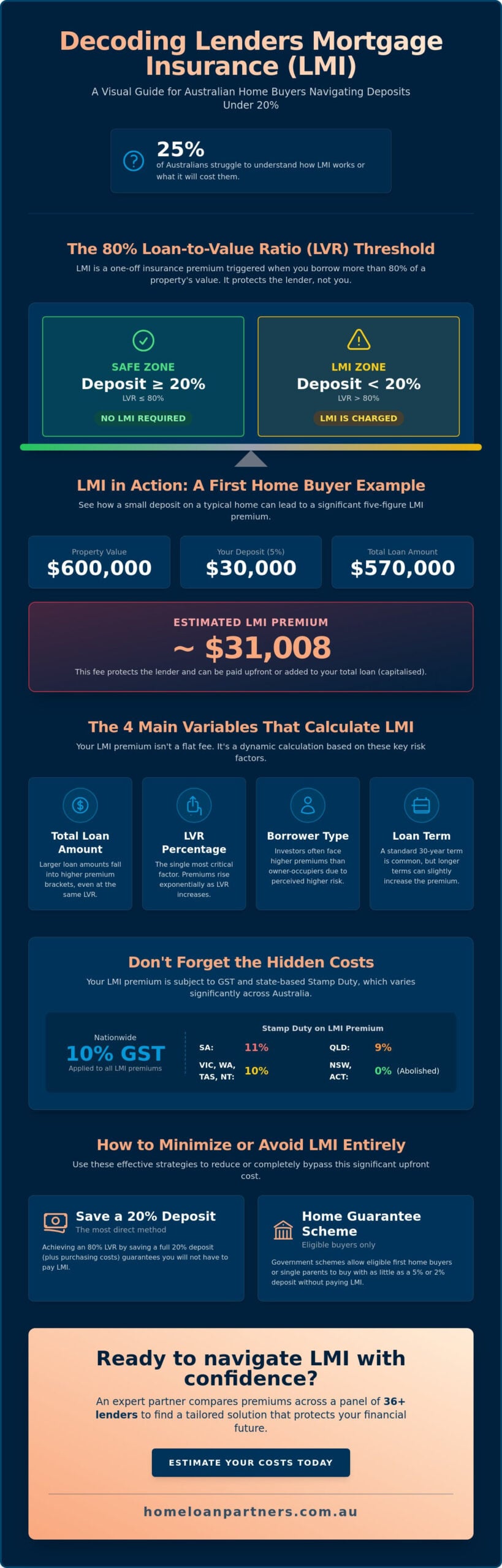
A recent survey by Money.com.au found that 25% of Australians struggle to understand how Lenders Mortgage Insurance works or what it will cost them. When you’re focused on the excitement of finding your perfect property, a hidden five-figure fee is the last thing you want to discover. Learning how to calculate LMI in australia is essential for any buyer with a deposit under 20%, as premiums can range from 1% to 5% of your total loan. For instance, a first-home buyer with a 5% deposit on a $600,000 home might face an LMI premium of approximately $31,008.
We understand that navigating LVR tiers and state-specific stamp duty can feel overwhelming. You deserve a clear path forward without the fear of overpaying for insurance that protects the lender rather than your own interests. This guide will help you master the variables that determine your costs so you can estimate your premium accurately. We’ll preview the latest 2026 property price caps and show you how to use the expanded Home Guarantee Scheme to potentially skip this cost entirely. Let’s work together to make your homeownership journey as seamless and predictable as possible.
Key Takeaways
- Identify the 80% Loan-to-Value Ratio (LVR) threshold and understand why this specific figure triggers mandatory insurance for most Australian banks.
- Master the core variables, including loan size and sliding risk tiers, to learn how to calculate LMI in australia and estimate your costs with precision.
- Evaluate the long-term financial impact of capitalising your premium versus paying upfront, while learning to avoid the common “LVR on LVR” trap.
- Explore effective ways to minimize or bypass these fees entirely using strategies like the 20% deposit rule or the updated 2026 Home Guarantee Scheme.
- See how an expert partner compares premiums across a panel of 36+ lenders to find a tailored solution that protects your financial future and homeownership goals.
What is LMI and Why Do Australian Lenders Charge It?
Buying your first home is a milestone that often comes with complex financial terms. One of the most significant is Lenders Mortgage Insurance (LMI). This is a one-off insurance premium that you pay to the lender when your deposit is less than 20% of the property’s value. While 25% of Australians find LMI difficult to understand, it’s a standard industry practice designed to bridge the gap between your savings and the bank’s risk requirements.
The 80% Loan-to-Value Ratio (LVR) is the magic threshold. Once you borrow more than 80% of a property’s value, banks view the loan as higher risk. It’s vital to understand that LMI protects the lender, not you. If you default on your loan and the property is sold for less than what you owe, the insurance covers the bank’s financial loss. It doesn’t offer you protection against job loss or illness; that’s what separate mortgage protection insurance is for.
Many of our clients view LMI as a strategic entry cost. You face a choice: spend years saving a full 20% deposit while property prices potentially climb, or pay the LMI premium to secure a home now with as little as a 5% deposit. In a rising market, the capital growth of your home can often outweigh the cost of the insurance premium within just a few years. It’s about finding the right balance for your personal goals.
Understanding Loan-to-Value Ratio (LVR)
Your LVR is the most critical factor when learning how to calculate LMI in australia. The math is simple: divide your loan amount by the property value and multiply by 100. For example, a $540,000 loan on a $600,000 property results in a 90% LVR. Even a 1% difference in this ratio can cost you thousands. Lenders use their own professional valuation rather than the purchase price to set this figure, so an unexpected valuation result can quickly shift your LMI costs.
The Role of LMI Providers (Helia and QBE)
Most Australian lenders don’t provide the insurance themselves. They partner with specialist providers like Helia or QBE LMI. While you don’t choose the insurer, the lender you select determines which provider’s rates you’ll pay. Each insurer has a different risk appetite for specific postcodes or loan sizes. By working with an expert partner, you can identify lenders whose chosen insurers offer more favorable premium calculations for your specific situation.
The 4 Main Variables Used to Calculate LMI
Understanding how to calculate LMI in australia requires looking at four specific levers that lenders pull to determine your risk profile. It isn’t a flat fee. Instead, it’s a dynamic calculation based on how much you borrow and the level of risk you represent to the bank. By identifying these variables early, you can make informed decisions that save you money over the life of your loan.
- Total Loan Amount: Lenders group loans into dollar brackets. A $600,000 loan usually carries a higher premium rate than a $400,000 loan, even if the LVR is the same.
- LVR Percentage: This is the ratio of your loan to the property’s value. As the Reserve Bank of Australia explains regarding the purpose of LMI, this insurance is a prerequisite for high-LVR lending to maintain financial stability.
- Borrower Type: Whether you are applying for first home buyer loans or investment property loans matters. Investors typically face higher premiums because lenders perceive a higher risk of default on non-primary residences.
- Loan Term: A 30-year loan is the standard, but longer terms increase the time the lender is exposed to high risk, which can nudge the premium upward.
The Risk Tier Multiplier
LMI premiums increase exponentially rather than linearly. Think of it as a series of risk cliffs. For example, the jump from an 89% LVR to a 91% LVR is often massive. On a $500,000 loan, that 2% difference in your deposit could result in an LMI premium that is thousands of dollars higher because you’ve crossed into a more expensive risk tier. This is why we often suggest our clients aim for specific “sweet spot” LVRs to keep costs manageable.
Hidden Costs: GST and Stamp Duty on LMI
Your final walk-away cost includes more than just the base premium. A 10% GST applies nationwide, but state-based stamp duty creates significant price variations. As of May 2026, South Australia charges the highest rate at 11% of the premium. Victoria, Western Australia, Tasmania, and the Northern Territory sit at 10%, while Queensland is 9%. Buyers in New South Wales and the ACT benefit from $0 stamp duty on LMI. These regional differences are why having an expert mortgage partner to guide you through the local regulations is so valuable.
When you know how to calculate LMI in australia with these taxes in mind, you avoid the shock of hidden costs at settlement. We help you factor these variables into your budget from day one, ensuring your path to homeownership stays clear and predictable.
Capitalising LMI vs. Paying Upfront: The Math
Choosing how to pay your premium is just as important as knowing how to calculate LMI in australia. You generally have two paths: paying the fee from your savings at settlement or “capitalising” it into your home loan. Our role as your expert partner is to show you the math behind both options so you can choose the path that aligns with your long-term security. While most buyers prefer to keep their cash for renovations or furniture, the long-term cost of each choice varies significantly.
Adding the premium to your loan balance can create a secondary hurdle known as the “LVR on LVR” trap. If your base loan is already at a 90% LVR and you add a 2% LMI premium, your total debt rises to 92% of the property’s value. This shift can sometimes push you into a higher risk tier, which ironically increases the very premium you are trying to finance. We help you navigate these tiers to ensure that capitalising the cost doesn’t inadvertently make your loan more expensive than it needs to be.
Upfront Payment Scenario
Paying your LMI premium upfront requires more cash at the start, but it protects your equity. By covering this cost with your savings, you keep your total loan balance lower and avoid paying interest on the insurance itself. This strategy is often best for buyers who have slightly more than a 20% deposit but choose to keep a higher LVR to maintain an emergency buffer. It ensures that every dollar you repay goes toward your home rather than an insurance premium.
Capitalisation Scenario
For many first-home buyers, capitalisation is a practical lifeline. It allows you to enter the market without needing an extra $15,000 to $30,000 in cash on settlement day. However, it’s vital to understand the “interest on insurance” impact. If you capitalise a $10,000 premium onto a 30-year loan at a 6% interest rate, that insurance will cost you approximately $21,600 by the time the loan is fully repaid.
Lenders also have strict limits on how much you can capitalise. Some banks allow a total LVR of 95% plus LMI, while others insist that the total loan, including the insurance, must stay under 95%. Understanding how to calculate LMI in australia within these specific lender constraints is where our steady hand makes the difference. We’ll help you model these scenarios so you can see exactly how your monthly repayments change depending on your choice.
How to Avoid or Minimize LMI in 2026
While mastering how to calculate LMI in australia is a vital skill for your property budget, the most rewarding strategy is often finding a way to eliminate the cost entirely. The most direct path remains the 20% deposit. By contributing a fifth of the property’s value upfront, you prove to the lender that you have enough equity to offset their risk, which brings your LMI premium to zero. However, we recognize that in a competitive market, saving a full 20% can feel like a moving target.
The landscape changed significantly in late 2025 and early 2026 with federal policy updates to the Home Guarantee Scheme. Managed by Housing Australia, this program now offers unlimited places and has removed previous income caps for applicants. If you are an eligible buyer with as little as a 5% deposit, the government acts as a guarantor for the remaining 15%. This allows you to bypass LMI completely, provided your purchase falls under the July 2026 price caps. For example, the cap currently sits at $1,500,000 for capital cities in New South Wales and $950,000 in Victoria.
LMI Waivers for High-Income Professionals
Specific lenders offer a “hidden” benefit for professionals in low-risk industries. If you work in the medical, legal, accounting, or engineering sectors, you may qualify for an LMI waiver. These specialized policies often allow you to borrow up to 90% of the property value with $0 insurance premiums. Banks view these careers as highly stable and are willing to waive the usual risk fees to secure your business. You’ll typically need to provide proof of membership with a relevant industry body and meet minimum income requirements to qualify for these tailored arrangements.
The Power of a Guarantor
A family guarantee loan is another powerful tool to bring your effective LVR below the 80% threshold. In this scenario, a close relative, usually a parent, uses the equity in their own home to provide additional security for your loan. This doesn’t require them to give you cash; it simply uses their property’s value to “top up” your deposit in the eyes of the bank. It’s a generous act that requires careful planning, but it can save you tens of thousands of dollars in insurance costs. Once you’ve paid down the loan or your property value has increased enough to reach 20% equity, you can often release the guarantor from the loan.
Our team specializes in identifying which of these strategies fits your unique financial profile. We can help you navigate the 2026 price caps and professional waiver criteria to ensure you keep your hard-earned savings in your own pocket. Talk to an expert partner today to see if you can buy your home without the burden of LMI.
Why Partnering with a Broker Simplifies LMI
Buying a home is one of the most significant financial decisions you’ll ever make. While you now understand the mechanics of how to calculate LMI in australia, applying that knowledge to the thousands of available loan products is a different challenge. This is where a dedicated partner makes the difference. We don’t just look at one bank’s criteria; we compare options across a panel of 36+ lenders to find the specific policy that fits your deposit and career profile.
A broker’s value lies in finding the “Policy Fit.” Some lenders have more generous LMI thresholds or unique agreements with insurers that can save you thousands of dollars. For example, if you’re sitting on a 19.9% deposit, we can often structure your application to avoid the LMI cliff entirely. Without this tailored guidance, you might accidentally submit an application that triggers a massive premium simply because of a minor calculation error or an unfavorable property valuation.
Our support doesn’t end at settlement. We stay with you for the long-term journey, tracking your property’s equity as the market evolves. This is particularly important for those considering refinancing. We ensure that if you decide to switch lenders in the future, you don’t pay LMI twice. By monitoring your LVR, we help you time your next move for when your equity has naturally crossed that 20% threshold, keeping your financial future secure.
Comparing LMI Multipliers Across Lenders
It’s a common misconception that LMI costs are identical across all banks. In reality, one bank might charge $8,000 while another charges $11,000 for the exact same loan amount and LVR. This happens because different lenders use different insurance providers, each with their own risk multipliers. We identify the “sweet spot” for your specific deposit size. By conducting a pre-assessment, we also help you avoid an automatic decline from an insurer, which protects your credit score and keeps your homeownership dreams on track.
Your Next Steps to Homeownership
At its core, learning how to calculate LMI in australia is about effective risk management. It’s about looking beyond a simple formula and understanding how lenders perceive your financial security. You don’t have to navigate these complex risk tiers alone. Whether you’re a first-time buyer or looking at investment property loans, we provide the steady hand and expert guidance you need to move forward with confidence.
Are you ready to see a clear, stress-free path to your new home? Book a personalised strategy session with The Home Loan Partners today. We’ll do the heavy lifting to ensure your premium is as low as possible, helping you achieve the Australian dream of homeownership sooner.
Secure Your Future with a Tailored Mortgage Strategy
Understanding how to calculate LMI in australia is the first step toward financial clarity in your home buying journey. We’ve explored how LVR tiers, loan amounts, and state-specific taxes create a shifting premium that doesn’t have to be a surprise at settlement. Whether you choose to capitalise the insurance or leverage the 2026 Home Guarantee Scheme, your path to homeownership is clearer when you have the right data at your fingertips. Knowledge is power, but the right partnership is what turns that information into a successful purchase.
You don’t need to master these complex risk calculations on your own. Our team provides the steady hand you need to navigate the current lending environment with confidence. With access to over 36 lenders, we offer expert guidance for first home buyers and create personalised loan structures that prioritise your long-term security. Let our expert partners calculate your LMI and find the best loan structure for you. We’re here to turn the Australian dream of homeownership into a seamless, stress-free reality for you and your family.
Frequently Asked Questions
Is LMI a one-off payment or an annual fee?
Lenders Mortgage Insurance is a one-off insurance premium paid at the time your loan settles. It isn’t an ongoing annual cost like your standard home or car insurance. You can choose to pay it upfront using your savings or add it to your total loan balance through capitalisation. If you capitalise it, you’ll pay interest on the premium over the life of your loan, but you won’t face a recurring yearly bill.
Can I get a refund on LMI if I pay my loan off early?
Most lenders don’t offer a refund on LMI if you pay your loan off early or refinance. While some insurers used to offer partial loyalty refunds if you closed the loan within the first two years, this practice has become increasingly rare in the current market. Because it’s a risk-offsetting fee paid to a third-party insurer, the money is generally considered fully earned once the loan is advanced at settlement.
How much is LMI on a $600,000 house with a 10% deposit?
For a $600,000 property with a 10% deposit ($60,000), your loan amount would be $540,000. At a 90% LVR, your LMI premium might typically range between $10,000 and $15,000 depending on the lender’s insurer. When you’re learning how to calculate LMI in australia for this scenario, remember that the premium increases significantly if your deposit drops to 5%, potentially doubling the cost as shown in recent 2026 data.
Does every lender use the same LMI calculator?
No, every lender uses their own specific risk tiers and chosen insurance provider. Australian banks typically partner with either Helia or QBE LMI, and each insurer has a unique matrix for determining premiums. This is why a quote from one bank might be thousands of dollars cheaper than another for the exact same property. We compare these variations across our panel to ensure you aren’t overpaying for your insurance.
What happens to LMI if I decide to refinance my home loan?
If you refinance and your new loan still represents more than 80% of your property’s value, you’ll likely need to pay LMI again. LMI is not transferable between lenders because the insurance policy only protects the specific financial institution that issued your original loan. We always help our clients track their equity growth to ensure they only refinance once they’ve reached the 20% equity safe zone to avoid this double cost.
Can I use the First Home Owners Grant (FHOG) to pay for my LMI?
Yes, you can use the First Home Owners Grant to help cover your LMI costs. While the grant is usually paid to your lender at settlement, it essentially acts as part of your total funds. You can use it to reduce your loan amount, which might lower your LVR tier, or apply it directly toward the upfront cost of the insurance premium to avoid capitalising it into your mortgage.
Is LMI tax-deductible for investment properties in Australia?
LMI is generally tax-deductible if you’re purchasing an investment property. The Australian Taxation Office (ATO) typically allows you to claim the cost of the premium as a borrowing expense. You usually spread this deduction over five years or the term of the loan, whichever is shorter. It’s a valuable way to offset the initial entry costs of your investment, but we always recommend confirming the specific timing with your accountant.
What is the maximum LVR a lender will allow with LMI?
Most Australian lenders set a maximum LVR of 95% for standard residential home loans including LMI. This means you’ll need at least a 5% deposit plus enough savings to cover costs like stamp duty. When determining how to calculate LMI in australia for high-LVR loans, keep in mind that some government-backed schemes allow you to buy with a 2% or 5% deposit without paying any LMI at all, effectively bypassing this limit.